How to solve sudoku comes down to one rule and a few ways of applying it: every row, every column and every box must contain each number exactly once, and you place a number only when logic shows it can go nowhere else. You never need to guess or do sums. This guide explains the rules, five strategies in the order beginners should learn them, and two fully worked puzzles, a 4×4 for children and a 9×9 with its solution.
Sudoku rules in one minute: how to play sudoku
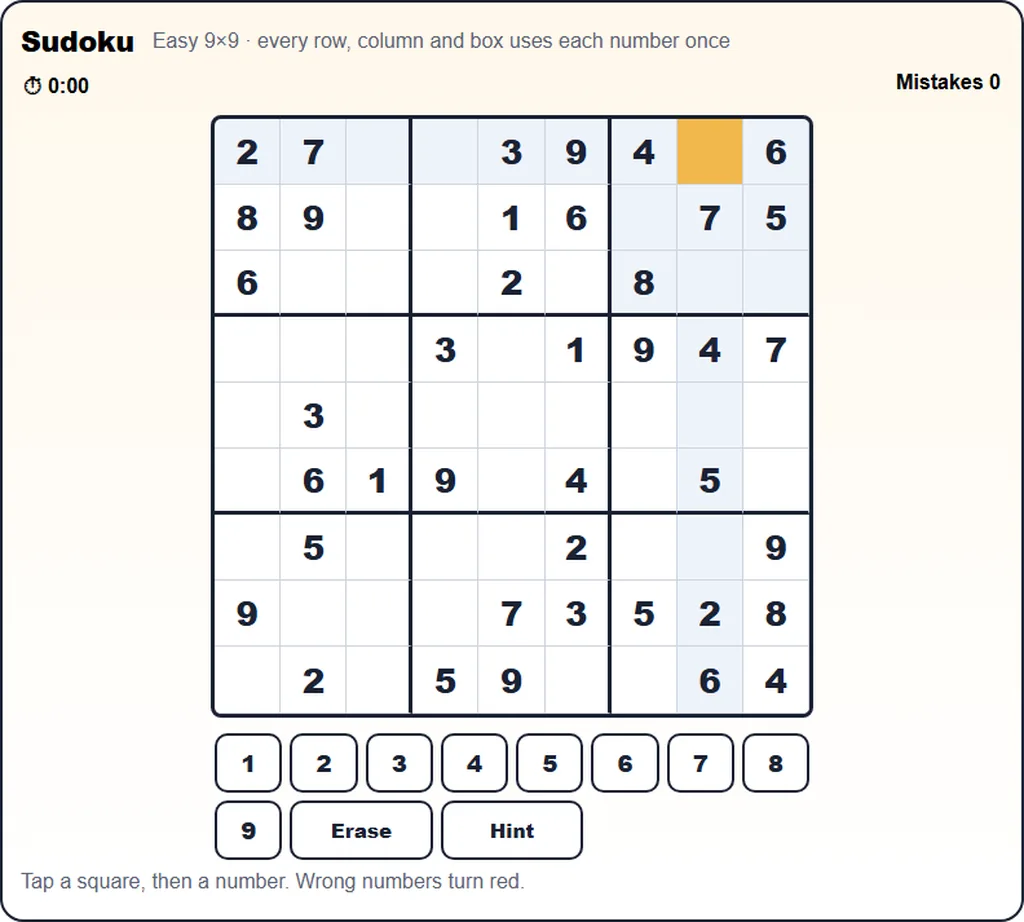
- A standard sudoku is a 9 by 9 grid, split into nine 3 by 3 boxes.
- Some squares are filled in at the start. These are the givens or clues.
- Fill every empty square so that each row, each column and each box contains 1 to 9 once each.
- A well-made puzzle has exactly one solution, which is why solving it never involves guessing. Every puzzle in our printable sudoku maker and online games is checked by a solver to make sure it does.
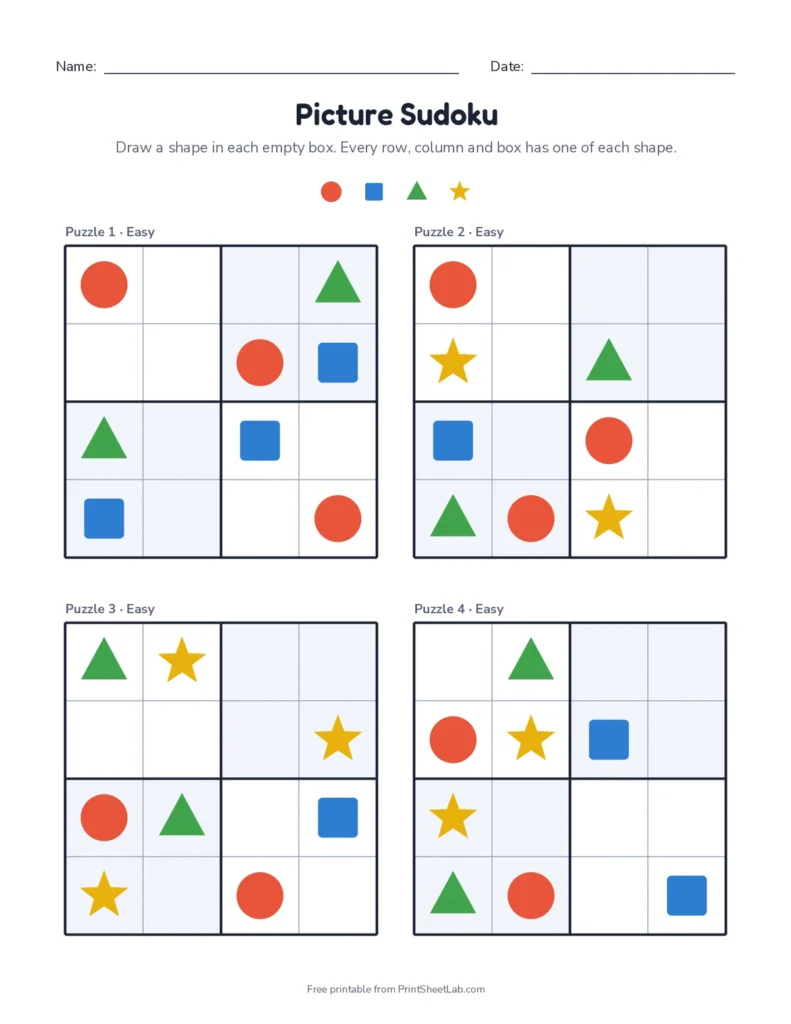
The numbers are only symbols, so how to play sudoku never depends on arithmetic. You could use letters, colors or shapes and the puzzle would work the same way, which is why picture sudoku suits children who are still learning their numbers.
How to solve sudoku: start small with 4×4 and 6×6
Children, and adults new to the puzzle, learn how to solve sudoku fastest on small grids. A 4×4 sudoku uses only 1 to 4 and four 2 by 2 boxes, so every rule is visible at once; most children can start at about 5 to 7. Next comes 6×6 sudoku with 2 by 3 boxes, then an easy 9×9 sudoku.
Worked example 1: a 4×4 sudoku
This small puzzle can be solved with nothing more than the rules. Each row, column and 2 by 2 box must contain 1, 2, 3 and 4. Empty squares are blank:
| 1 | 4 | ||
| 4 | 1 | ||
| 2 | 3 | ||
| 3 | 2 |
- Row 1 needs 2 and 3 in its middle squares. Column 2 already has a 3 (row 4), so the 3 goes in column 3. Row 1 is 1, 2, 3, 4.
- Row 2 needs 2 and 3 in columns 1 and 4. Column 1 already has a 2 (row 3), so column 1 gets the 3. Row 2 is 3, 4, 1, 2.
- Row 3 needs 1 and 4. Column 2 already has a 4 (row 2), so the 1 goes in column 2. Row 3 is 2, 1, 4, 3.
- Row 4 needs 1 and 4. Column 1 already has a 1 (row 1), so the 4 goes in column 1. Row 4 is 4, 3, 2, 1.
Check: every row, column and box now holds 1 to 4 exactly once. Every step used one idea: find a row with two gaps, then let a column rule out one of the two numbers. That idea is the heart of solving a sudoku at every size.
Sudoku strategies for beginners: five methods in learning order
Good sudoku strategies are simple habits, not tricks. The five below are in the order that sudoku for beginners should learn them: each one handles squares the previous one cannot reach. The first two or three solve every easy puzzle, and the last two open medium and hard grids.
Strategy 1: scanning (cross-hatching)
Pick a number, say 5, and a box that does not have a 5 yet. Every 5 elsewhere rules out its whole row and column. Cross those out in your head. If only one square in the box is left, the 5 goes there. Repeat for each number from 1 to 9, box by box.
This is the first thing to try when you are learning how to solve sudoku, and scanning alone solves most easy puzzles. It is also called finding a hidden single: the number has only one possible home in that box, row or column.
Strategy 2: nearly full rows, columns and boxes
Look for a row, column or box with only one or two empty squares. With one gap the missing number is obvious. With two gaps, check which of the two missing numbers already appears in each square’s row, column or box. The 4×4 example above is solved entirely this way.
Strategy 3: the only number that fits
Now turn the question round. Pick one empty square and ask which numbers could go there. Cross out every number already in its row, its column and its box. If only one number is left, that is the answer. This is called a naked single. It is slower than scanning, but it finds numbers that scanning misses. Solving well means switching between the two questions: “where can this number go?” and “what can go in this square?”
Strategy 4: pencil marks
For medium and hard puzzles, write the possible numbers small in the corner of each empty square. Each time you place a number, erase it from the pencil marks in the same row, column and box. Squares with a single mark left soon appear. Pencil marks are how you solve puzzles marked medium or hard without guessing: they turn guesswork into a checklist.
Strategy 5: pairs
If two squares in the same row, column or box can only hold the same two numbers, say 3 and 7, then one of them is the 3 and the other is the 7. Nobody else in that row can have a 3 or a 7, so remove those marks from every other square there. This naked pair is often the first strategy players need for hard puzzles.
A close cousin is the pointing pair: if every possible square for a 4 inside one box lies in the same row, the 4 in that row must be inside that box, so you can remove 4 from the rest of that row.
Worked example 2: a 9×9 puzzle and its solution
This puzzle has 36 givens and exactly one solution; we checked it with a solver that counts solutions. Rows are numbered from the top and columns from the left. Boxes are numbered 1 to 9 like reading a page: box 1 is top left, box 2 top middle and box 4 middle left.
| 5 | 6 | 3 | 4 | 7 | 1 | |||
| 4 | 7 | 5 | ||||||
| 8 | 5 | 3 | ||||||
| 3 | 5 | 4 | 1 | 2 | ||||
| 2 | 9 | 3 | 6 | |||||
| 4 | 5 | 7 | ||||||
| 6 | 5 | 7 | ||||||
| 7 | 5 | 1 | 3 | |||||
| 1 | 8 | 5 | 6 | 2 |

The chart shows how to solve sudoku from a standing start, using scanning only:
- Box 2 needs a 3. Row 1 and row 3 already contain a 3, which rules out four squares. Column 4 has a 3 in row 5, which rules out row 2, column 4. Only row 2, column 5 is left.
- Box 4 needs an 8. Column 2 has an 8 in row 3 and column 3 has one in row 9. The only square left is row 5, column 1.
- Box 4 needs a 7. Column 2 has a 7 in row 8, and row 6 has a 7 in column 8. That leaves row 4, column 3.
- Box 4 has two gaps. The missing numbers are 1 and 6. Column 2 already has a 6 at the top, so row 6, column 2 is 1 and row 6, column 3 is 6.
- Box 1 needs a 7. Row 2 has a 7 in column 6, and column 3 now has the 7 from step 3. Only row 3, column 1 is left.
Carry on the same way: pick a box, pick a missing number, rule out squares. Every remaining square in this puzzle can be found with scanning and “only number that fits” checks, so you will not need pencil marks. Try it before you look at the solution.
Solution
| 5 | 6 | 3 | 2 | 8 | 4 | 7 | 9 | 1 |
| 2 | 9 | 4 | 1 | 3 | 7 | 8 | 5 | 6 |
| 7 | 8 | 1 | 6 | 9 | 5 | 4 | 3 | 2 |
| 3 | 5 | 7 | 8 | 4 | 1 | 2 | 6 | 9 |
| 8 | 2 | 9 | 3 | 7 | 6 | 1 | 4 | 5 |
| 4 | 1 | 6 | 5 | 2 | 9 | 3 | 7 | 8 |
| 6 | 3 | 5 | 7 | 1 | 2 | 9 | 8 | 4 |
| 9 | 7 | 2 | 4 | 6 | 8 | 5 | 1 | 3 |
| 1 | 4 | 8 | 9 | 5 | 3 | 6 | 2 | 7 |
How many squares does each strategy solve? A solver’s count
Instead of trusting a rule of thumb, we ran a small program on worked example 2 that uses only the first two strategies: scanning for hidden singles, then checking each square for the only number that fits. After each pass it counts what it placed. This table shows the result:
| Pass | Placed by scanning (hidden singles) | Placed by “only number that fits” | Squares still empty |
|---|---|---|---|
| Start | – | – | 45 |
| Pass 1 | 23 | 11 | 11 |
| Pass 2 | 11 | 0 | 0 |
| Total | 34 | 11 | 0 |
Of the 45 empty squares, 34 fall to scanning and 11 to the only-number-fits check, and the whole grid is finished in two passes with no pencil marks, pairs or guessing. That is why we call this a puzzle for sudoku for beginners, and why the first lesson in how to solve sudoku is to scan before anything else. A medium or hard grid is simply one where these two checks stop early, and you need pencil marks or pairs to restart them.
The puzzle also has exactly one solution, which the program confirmed by counting every possible completion. The same program counted the complete 4×4 grids: there are exactly 288 of them, which is why a 4×4 puzzle with 5 to 8 clues is easy to solve. A 9×9 grid has about 6.67 sextillion complete solutions, according to the Wikipedia article on sudoku, so good puzzles come in endless variety.
How hard is it? Sudoku levels explained
Fewer givens usually mean a harder puzzle, because more squares must be worked out. These are the clue counts our puzzle maker uses:
| Puzzle | Good for | Clues given |
|---|---|---|
| 4×4 | Ages about 5 to 7 | 5 to 8 of 16 |
| 6×6 | Ages about 7 to 10 | 12 to 18 of 36 |
| Easy 9×9 | Older children and beginners | 40 of 81 |
| Medium 9×9 | Players who know scanning well | 32 of 81 |
| Hard 9×9 | Teens and adults; pencil marks and pairs | 27 of 81 |
The fewest clues a proper 9×9 sudoku can have is 17. Mathematicians proved in a large computer search that no 16-clue puzzle has a unique solution. Clue count is not everything, though: difficulty depends on which strategies the puzzle forces you to use. Once you know how to solve sudoku by scanning, try the medium sudoku and then the hard sudoku.
Sudoku for beginners: a 7-day practice plan
New players improve fastest with short, regular sessions on the right size of puzzle, not with one long struggle. This plan moves from a 4×4 grid to a medium 9×9 in a week. The times are our own guidelines for 20 to 30 minutes of practice a day, so do not worry if you are slower:
| Day | Puzzle | Skill to practice | Time to aim for (a guideline) |
|---|---|---|---|
| 1 | 4×4 picture or number sudoku | The three rules, one row at a time | 3 to 5 minutes |
| 2 | 4×4, fewer clues | Rows with two gaps | 3 minutes |
| 3 | 6×6 sudoku | Boxes of 2 by 3 | 8 to 12 minutes |
| 4 | Easy 9×9 | Scanning for one number at a time | 15 to 25 minutes |
| 5 | Easy 9×9 | The only number that fits a square | 15 to 20 minutes |
| 6 | Easy 9×9 again | Both together, no guessing | 12 to 18 minutes |
| 7 | Medium 9×9 | Pencil marks for the stuck squares | 25 to 40 minutes |
Mark each puzzle with the strategy that solved it. After a week you will know which of the sudoku strategies above you use without thinking, and which one to learn next. If a day feels too hard, repeat the previous puzzle rather than moving on: the aim of learning is confidence, not speed.
A step-by-step routine for any puzzle
- Scan 1 to 9 across all nine boxes and fill every hidden single.
- Fill nearly full rows, columns and boxes.
- Repeat steps 1 and 2 until nothing new appears; each new number opens up others.
- Add pencil marks to the remaining squares and look for single marks.
- Look for pairs and remove their numbers from neighboring squares, then go back to step 1.
This routine is how to solve sudoku at every level. Easy puzzles finish at step 3; hard ones need all five steps, sometimes several times.
What to do when you are stuck
Everyone gets stuck, even on easy puzzles. Before you reach for the answer key, work through this list:
- Scan again, number by number. Stuck players have usually missed a hidden single, most often for a number that already appears six or seven times.
- Look at the most crowded row, column or box. The fewer gaps there are, the fewer options you have to check.
- Check for a mistake. If a square has no possible number, an earlier placement is wrong. Look for two equal numbers in one row, column or box.
- Take a break. A fresh look often finds the move at once. Online, a Hint fills one square for you, but counts as a mistake.
Knowing what to do when you are stuck matters more than speed. Every placement should come with a reason you could say out loud.
Common mistakes and how to fix them
- Guessing. A guess that looks fine can wreck the puzzle 20 moves later. If you are stuck, scan each number again; you have probably missed one.
- Forgetting the box rule. Checking rows and columns is not enough. Most beginner errors are two equal numbers in one box.
- Writing in ink too early. Use pencil, or pencil marks, until you are sure.
- Not updating pencil marks. Every placed number removes that mark from its row, column and box. Stale marks hide easy moves.
- Starting in one corner. Begin where the grid is most crowded, not at the top left.
Sudoku for kids: teach the reasons, not just the answers
Sudoku for kids builds logical reasoning, patience and attention to detail without any arithmetic. When you teach children how to solve sudoku, say the reason for each move aloud (“the 3 can’t go here because this row has one”). Let them explain the next move back to you. Print puzzles with answer keys from our printable sudoku page, or play online, where clashing numbers turn red and a Hint button fills in one square.
Where sudoku comes from
The modern puzzle was designed by Howard Garns, a retired American architect, and first published by Dell Magazines in 1979 as “Number Place”. The Japanese puzzle company Nikoli introduced it in Japan in 1984, and the short name sudoku comes from a Japanese phrase meaning the digits must be single.
Sudoku variants to try next
- Killer sudoku: cages show the sum of their squares, so a little addition comes in.
- Diagonal sudoku: both main diagonals must also contain 1 to 9.
- Picture or letter sudoku: the same logic with shapes or letters, great for young children.
Sources
Our guide to how to solve sudoku draws on these sources. The history and the 17-clue minimum follow the Wikipedia article on sudoku. The proof that no 16-clue sudoku exists is the paper by McGuire, Tugemann and Civario, There is no 16-Clue Sudoku. Both worked puzzles were checked with our own solution-counting solver.
Frequently asked questions
9 quick answers
What is the fastest way to learn how to solve sudoku?
Start with 4×4 puzzles, then learn scanning: pick a number and find the only square in a box where it can go. Scanning alone solves most easy 9×9 puzzles.
Do you need math to solve sudoku?
No. Sudoku uses logic, not arithmetic. The numbers are just symbols, which is why picture sudoku works with shapes.
What age can children start sudoku?
Most children can start 4×4 sudoku at about 5 to 7, move to 6×6 at about 7 to 10, and try easy 9×9 puzzles after that.
Is it OK to guess in sudoku?
You never need to guess in a well-made puzzle, because it has exactly one solution that logic can reach. If you are stuck, scan each number again or add pencil marks.
How to solve sudoku faster?
Scan by number rather than by square, start with the most crowded boxes and fill every easy placement before you add pencil marks. Speed comes with practice on easy puzzles.
How many clues does a sudoku need?
At least 17 for a standard 9×9 puzzle with a unique solution. Easy puzzles usually give many more; ours give 40 for easy, 32 for medium and 27 for hard.
What are the best sudoku strategies for beginners?
Scanning (finding the only square for a number in a box), nearly full rows, columns and boxes, and the only number that fits a square. In our worked 9×9 puzzle, those methods solved all 45 empty squares in two passes.
How do I play sudoku for the first time?
Learn the three rules (1 to 9 once in every row, column and box), try a 4×4 puzzle, then a 6×6, and then an easy 9×9. Our 7-day plan above is a good route.
Is sudoku good for kids?
Yes. Sudoku for kids practices logic, attention and patience with no arithmetic. Start with 4×4 or picture puzzles at about 5 to 7, and explain each move aloud.