This tens and ones game helps first graders understand two-digit numbers by playing: race cars, pop balloons, flip memory cards or sprint through true and false sentences. Each question gives a number of tens and ones, such as 4 tens and 7 ones, and children find the number it makes, so they practice place value, the idea that each digit in a number has a worth based on its place. It is free, needs no sign-up, works on phones and tablets, and comes with a printable sheet with ten-rods and unit blocks.
Tens and ones game: see how it plays
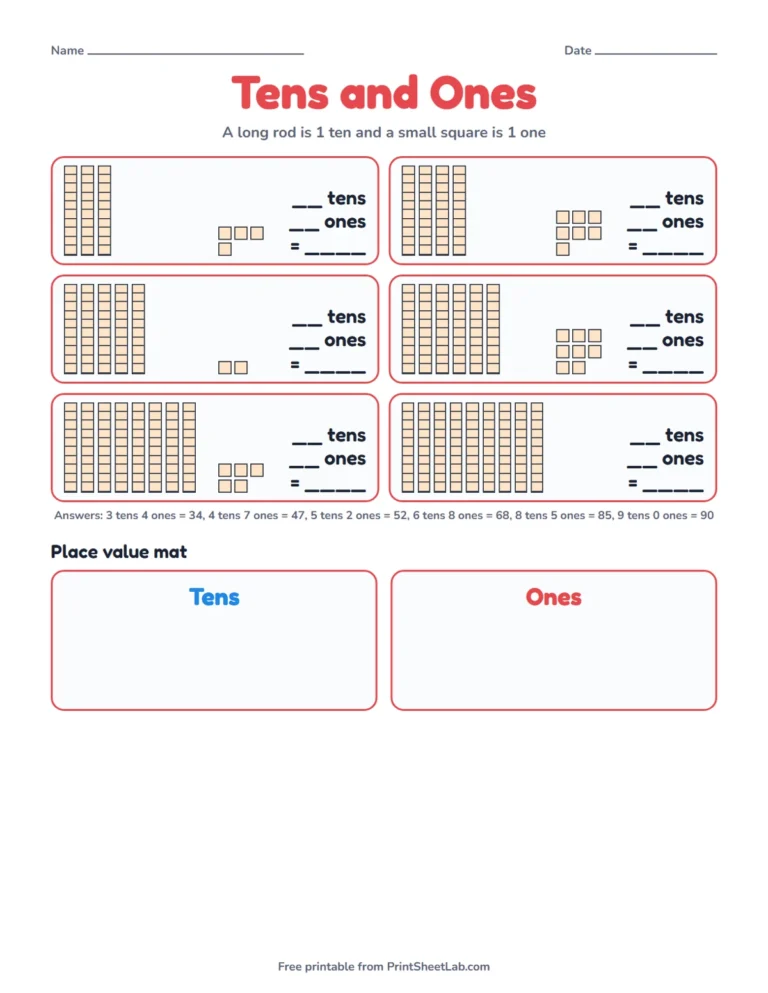
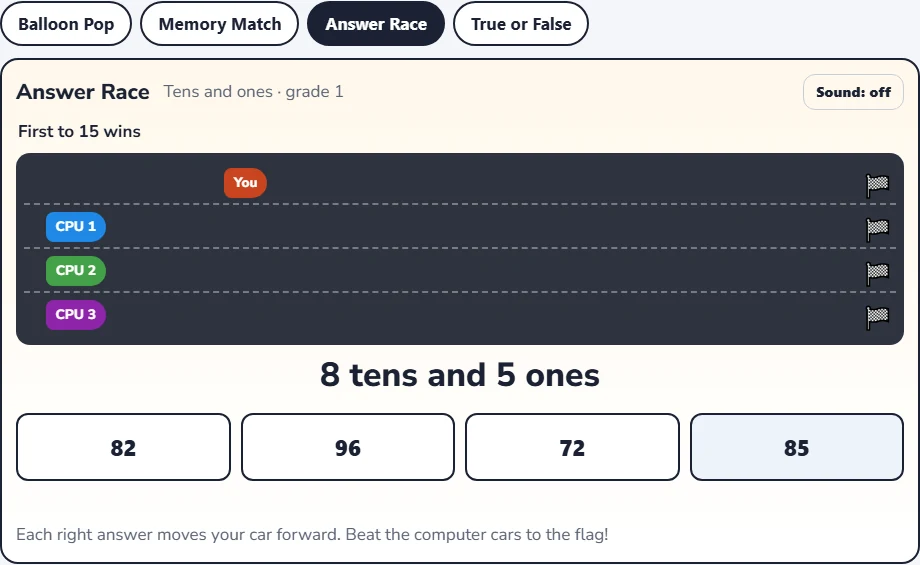
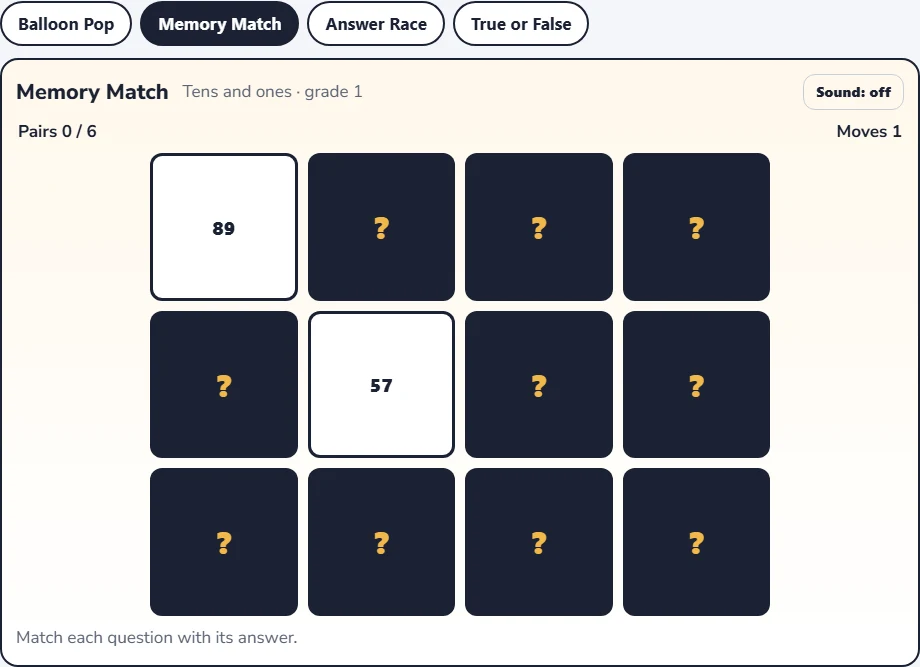
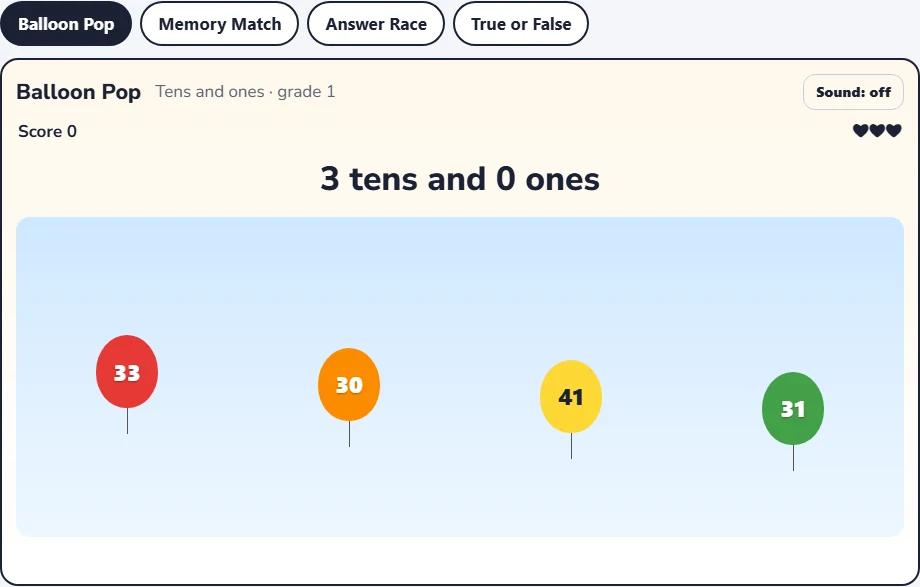
The game below has four modes, and every question asks for a two-digit number built from tens and ones. The printable sheet shows six numbers as base ten blocks to count, with a place value mat, and the pictures show Answer Race, Memory Match and Balloon Pop on this page.
How the tens and ones game works
- Answer Race: every right answer moves your car forward, and you race three computer cars to the finish flag. The first to 15 wins, and wrong taps cost time, not places.
- Memory Match: twelve face-down cards hide six “tens and ones” questions and their six answers. Flip two at a time and match each one to its answer in as few moves as you can.
- Balloon Pop: answers float up on balloons, and you pop the right one before it drifts off the top. The wrong balloons are within 15 of the right answer, so children must work out the number and cannot guess from the tens alone. The game speeds up as your score climbs, and three misses ends the round.
- True or False: sixty seconds on the clock. Decide whether each sentence, such as 3 tens and 6 ones = 36, is right or wrong. A streak of five or more scores double.
Place value game first grade: which numbers does it ask?
A question picks 1 to 9 tens and 0 to 9 ones, so the answers are the 90 numbers from 10 to 99. Nine of them end in zero (10, 20, 30 and so on), which have no ones. Nine are repeated digits, such as 11, 22, 33, 44, 55, 66, 77, 88 and 99. The wrong answers are numbers near the right one, and a common wrong answer is to swap the digits, so 34 can be mixed up with 43.
Place value tens and ones: twelve examples
| The question | The number | Expanded form | In words |
|---|---|---|---|
| 1 tens and 0 ones | 10 | 10 + 0 | ten |
| 1 tens and 5 ones | 15 | 10 + 5 | fifteen |
| 2 tens and 3 ones | 23 | 20 + 3 | twenty-three |
| 3 tens and 8 ones | 38 | 30 + 8 | thirty-eight |
| 4 tens and 0 ones | 40 | 40 + 0 | forty |
| 4 tens and 6 ones | 46 | 40 + 6 | forty-six |
| 5 tens and 7 ones | 57 | 50 + 7 | fifty-seven |
| 6 tens and 9 ones | 69 | 60 + 9 | sixty-nine |
| 7 tens and 2 ones | 72 | 70 + 2 | seventy-two |
| 8 tens and 4 ones | 84 | 80 + 4 | eighty-four |
| 9 tens and 0 ones | 90 | 90 + 0 | ninety |
| 9 tens and 9 ones | 99 | 90 + 9 | ninety-nine |
The expanded form is useful because it shows what the number means: 47 is 40 plus 7, which is four tens and seven ones. Children can use it to add and subtract in the next grade. Wikipedia’s positional notation article explains how place value lets ten digits write any number.
Base ten blocks: seeing tens and ones
A ten-rod is ten ones joined together, and a small cube is one. To show 34, draw three rods and four cubes. The picture helps children see that a ten is a bundle of ten ones, which is why the digit in the tens place is worth ten times as much. The printable sheet shows six numbers as blocks, and children write how many tens and ones they see, then the number. The place value anchor chart guide has more pictures, and you can print a place value chart or base ten blocks.
Tens and ones chart and base ten blocks printable
The tens and ones chart on the printable shows six numbers drawn with base ten blocks: a tall rod for each ten and a small square for each one, with a line to write the number. Print the base ten blocks printable, and children can write how many tens and ones they count before they play the tens and ones game. It also includes a place value mat for building numbers with real counters.
Common mistakes with tens and ones
- Reversing the digits: writing 43 for 3 tens and 4 ones. Have children say the tens first.
- Counting every block: counting a ten-rod as 1. Show that a rod is worth ten.
- The teens: eleven to nineteen sound as if they begin with the ones. Show 1 ten and 5 ones to explain fifteen.
- Zero ones: children forget the zero in 40. Say “four tens and no ones”.
Place value activities to try
- Bundle straws: make bundles of ten with rubber bands and use loose straws for the ones.
- Place value mat: use the printable mat with two boxes and toy counters to build numbers.
- Number cards: deal two digit cards and say which makes the bigger number.
- Money: use dimes for tens and pennies for ones to make 47¢ with 4 dimes and 7 pennies.
Where tens and ones fit at school
| Level | What children are expected to do |
|---|---|
| Grade 1 (US) | Understand that the two digits of a two-digit number represent amounts of tens and ones (1.NBT.B.2) |
| Grade 2 (US) | Understand that the three digits of a three-digit number represent hundreds, tens and ones (2.NBT.A.1) |
| Year 2 (England) | Recognize the place value of each digit in a two-digit number |
The Common Core grade 1 number and operations in base ten standards name this skill. Practice on paper with the printable worksheets, and move on to the two-digit addition game once place value is secure.
Tens and ones game: frequently asked questions
What are tens and ones?
They are the two places in a two-digit number. The tens digit says how many bundles of ten, and the ones digit says how many are left over.
What grade learns tens and ones?
First grade, usually ages 6 and 7, though kindergarten children start with the teens.
How do I explain 10 as a ten?
Show ten loose cubes and then a rod made of ten. Both are the same amount, and the rod is one ten.
Which numbers does the game use?
The numbers from 10 to 99, made from 1 to 9 tens and 0 to 9 ones.
Is the tens and ones game free, and do kids need an account?
Yes, it is free, and no account is needed. Best scores are saved only in the browser on this device.
Does it work on phones and tablets?
Yes. Every game is built for touch first and also works with a mouse on a computer.