Navratri bingo turns the nine nights of dance, color and lamps into a game that anyone on the ground can play without missing a step. The card on this page has 29 squares that almost every garba night produces somewhere, from the dandiya sticks and the dhol to a diya in the corner, a pile of footwear at the entrance and the tired feet that arrive around 10 p.m. Choose a card size, press print, and every guest gets a different card.
In short: open the Navratri bingo card maker above and press Edit and print this card, choose how many cards you need, and download one PDF. The card is titled Garba Bingo. There is no account and no cost, and nothing you type leaves your browser. Every square can be rewritten, so a housing society, a family at home and an office garba lunch can each get their own Navratri bingo list.
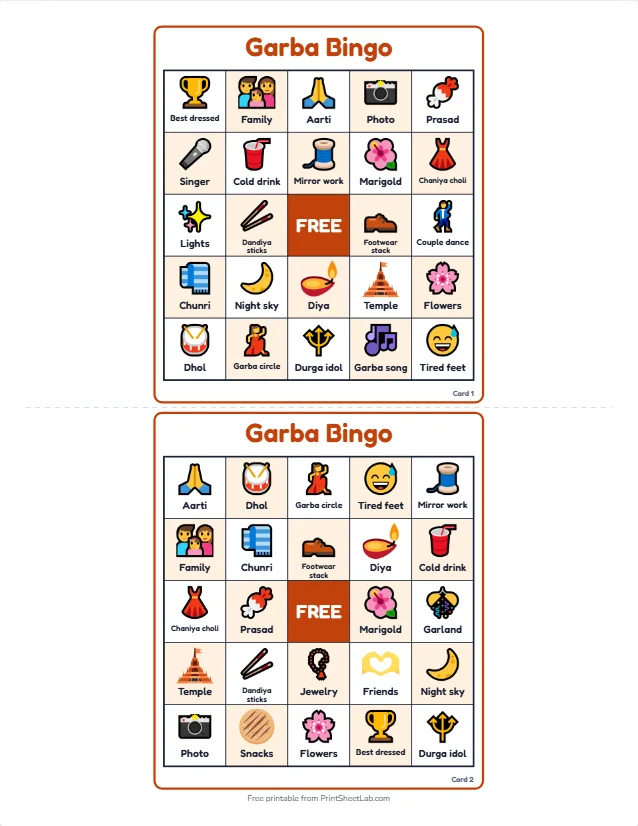
How to play Navratri bingo
The rules of Navratri bingo are the bingo rules everyone knows, with one difference: nobody has to call numbers. The evening supplies the calls. Each guest carries a card and a pencil, or a sticker sheet, and when a square happens in front of them, they mark it. Five in a row, across, down or diagonally, wins the first prize. A “seen it myself” honesty rule keeps it fair, and one friendly organizer settles any argument about whether a string of lights counts as lights.
- Hand out a card and something to mark with. A pencil, a sticker dot or a small bindi all work. Wet markers bleed through thin paper and stain a chaniya choli faster than you would think.
- Agree on the rules at the start. A square counts when you see it with your own eyes, and it counts once. Your own outfit counts for you and for the people looking at it.
- Mark between steps, never in the middle of the circle. The free center square is already marked, so a first line in Navratri bingo needs only four more.
- Announce the win to the organizer. In garba bingo the winner reads the line aloud, another guest checks each square, and the prize is handed over after the next song.
- Play another round. Switch the Navratri bingo game to four corners, an X or a full card once the first line is won.
Navratri bingo works because a garba night is so predictable in its details. Nobody knows who will win the best-dressed contest, but everyone knows the footwear will be stacked at the door before the first song and that someone will complain about tired feet before midnight. A Navratri bingo card that names those details gives a crowd a reason to look around at the lights, the circles and the outfits, rather than only at the dance floor in front of them.
Navratri bingo cards: all 29 squares
These Navratri bingo cards are made from a list of 29 squares. A standard 5×5 card with a free center needs 24 of them, so each card leaves out five and no two cards are identical. The table sorts the list into the families a host usually thinks in. Use it to decide which squares of your Navratri bingo cards to keep and which to swap for something that belongs to your own venue.
| Family | Squares on the list | Where you will see them |
|---|---|---|
| Dress and style | 👗 Chaniya choli, 🧣 Chunri, 📿 Jewelry, 🧵 Mirror work, 🏆 Best dressed | The entrance and the first hour. About as common as the dance floor itself. |
| Music and dance | 🥢 Dandiya sticks, 💃 Garba circle, 🥁 Dhol, 🎶 Garba song, 🕺 Couple dance, 🎤 Singer, 🌟 Spotlight, 😅 Tired feet | The heart of the night. Garba songs come early and dandiya sticks later. |
| Worship and place | 🪔 Diya, 🔱 Durga idol, 🙏 Aarti, 🍬 Prasad, 🛕 Temple | The shrine corner, the aarti break and, at some venues, a real temple next door. |
| Decoration and sky | 🌸 Flowers, 🎊 Garland, 🌺 Marigold, ✨ Lights, 🌙 Night sky | Overhead and at the gate. The cheapest squares to find. |
| People and moments | 👨👩👧 Family, 🫶 Friends, 📸 Photo, 👞 Footwear stack | Everywhere, and the footwear is always at the door. |
| Food and drink | 🫓 Snacks, 🥤 Cold drink | The break between rounds, around the midpoint of the evening. |
The Navratri bingo list is not random. Each family shows up at a different speed. The dress, light and gathering squares appear in the first half hour, so they act as the engine of the game, while the rarer squares (a temple on the way, the spotlight on a stage, a best-dressed announcement) turn a card into a small treasure hunt. If every square were as common as a string of lights, the first line would be over before the first song ended.
How many different cards can you print?
With 29 squares and 24 places on a 5×5 card, the number of different sets of squares is 29 choose 24, which is 118,755. Each set can be placed in a huge number of orders, so a society of 100 families can get 100 Navratri bingo cards that are all different. Smaller grids need fewer squares, and the list then has many more possible sets.
| Card size | Squares used | Different sets from the 29 | Best for |
|---|---|---|---|
| 3×3 with free center | 8 | 4,292,145 | Ages 3 to 6, and the very short game |
| 4×4 | 16 | 67,863,915 | A short round between two songs |
| 5×5 with free center | 24 | 118,755 | The classic garba night and the family group |
Three ways to play the Navratri bingo game
One printed set of Navratri bingo cards supports three quite different evenings. Pick the Navratri bingo game that fits the crowd, or run two in a row. The table compares them, and the sections below give the rules and prizes.
| Game | Who calls | Length | Best for |
|---|---|---|---|
| Garba bingo spotting | Nobody. The evening does. | The whole night, 3 to 5 hours | Community grounds and large societies |
| Drawn calling cards | An organizer draws cut-out squares | 10 to 20 minutes | Family gatherings, dandiya breaks and office events |
| Nine-night card | Nobody. You mark across the festival. | All nine nights | Friends who go every night and families at home |
Game one: garba bingo spotting on the night
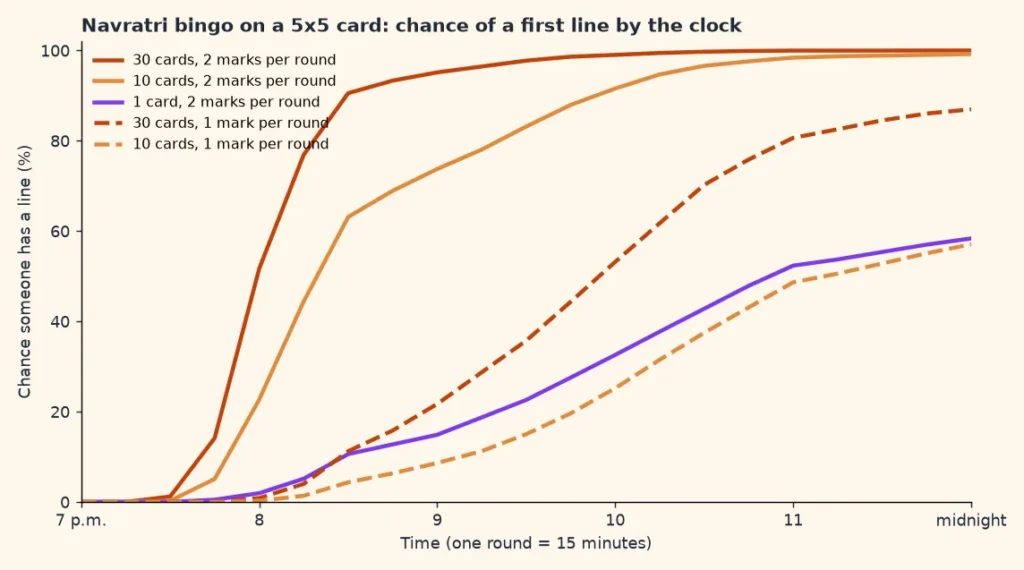
This is the version of Navratri bingo most guests want, and the one where the printed card pays off. Each guest carries a card and marks a square when it appears. The twist that makes it last: mark at most two squares per round, where a round is about one garba song or fifteen minutes. Without a limit a keen player can finish a line within the first hour, which leaves four hours of a night with nothing to chase. The simulation below gives the numbers.
- Prize for the first line: first in the prasad queue after aarti, or a small packet of mirror-work earrings.
- Prize for four corners: choose the song for the next round of dandiya.
- Prize for everyone: a sticker or a ribbon. Every guest who finishes a line gets one.
- Organizer job: keep a spare card for a guest who forgot hers and help older relatives read the squares.
Game two: drawn calling cards for a family gathering
This version of the Navratri bingo game suits a living room or a hall, and it is the one to pick when the weather is wet or the space is small. In the Print tab you can add calling cards to cut out, one per square, plus a caller sheet. Shuffle the cut-out squares in a thali, and an organizer draws one at a time and reads it aloud.
Everyone who has that square on their card marks it, so the Navratri bingo game becomes a shared one. Because all 29 squares come out in a random order and every square is called exactly once, the game has a predictable length. For a live round on a screen, with guests joining by link and cards marking themselves, the play bingo online page hosts the 75-ball game, and the play custom bingo online page explains how to play with your own list.
The organizer can make each call a small show: “Something is shining at the shrine. It is a… diya.” Ten seconds of theater per call turns the drawn game into a performance, and teenagers who think they are too cool for bingo often join in when they get to do the voices.
Game three: one card for the nine nights
Navratri lasts nine nights, and a single Navratri bingo card can too. Give each person a card on the first night and let them keep it. A square seen on any night counts, so the temple, the spotlight and the best-dressed announcement, which are rare in one evening, become likely over nine. The best rule is a cap on marks per night, so the card is not finished on night two. The nine-night section further down tells you which cap gives which game.
Garba bingo: what the squares mean
Garba bingo should leave players knowing a little more about the festival than before. Navratri is an annual Hindu festival in honor of the goddess Durga. The word means “nine nights” in Sanskrit, and the version most people celebrate is Sharada Navratri, which falls in the bright half of the lunar month of Ashvin, usually in September or October.
The nine nights are followed by Vijayadashami, also called Dussehra, on the tenth day. The Wikipedia article on Navaratri describes how the celebration differs from one region to another, which is why the template is a starting list and not a rulebook.
Garba, the circle dance behind garba bingo
Garba is a folk dance from Gujarat that is played across the Indian diaspora at festivals and other events. It is danced in a circle, often around an earthen pot with holes in its sides and a lamp inside, or around a picture or statue of the goddess. When many people take part they form concentric rings.
Everyone is invited to join, and people of all ages dance together. The traditional music uses the dhol and dholak drums, cymbals and the shehnai, and the usual dress is the chaniya choli for women and the kediyu for men. In 2023 UNESCO added the Garba of Gujarat to its Representative List of the Intangible Cultural Heritage of Humanity.
That is why the first group of squares on a garba bingo card is all about the circle: the dhol that sets the beat, the garba song, the garba circle itself and the dancers in chaniya choli. Mirror work, the small pieces of reflective glass stitched into the fabric, catches the light of the lamps and is easy to spot from across the ground. The chunri, a light scarf or dupatta, and the jewelry complete the picture.
Dandiya raas and dandiya bingo
At the end of each night of garba, Gujarati communities often play dandiya raas, a sibling dance in which each player holds a stick in each hand and taps out a rhythm with a partner. The sticks are sometimes described as representing the swords of the goddess, though the explanation varies from one family to another.
For dandiya bingo on a Navratri card the squares are quick to find once the sticks come out: the sticks themselves, a couple dance, the singer on the stage and the tired feet that follow. Dandiya bingo works especially well, and so does garba bingo, when the hall switches from garba to raas after the snack break, because the card gets a fresh group of squares to chase.
The shrine and the offerings
The worship squares need a gentle touch. The diya, the Durga idol, the aarti, the prasad and the temple are not decorations to the people who pray in front of them. A good rule for every organizer is to let the game run during the dance and the snack break, and to leave the aarti itself undisturbed: guests can mark the aarti square afterwards, from memory, with no cards or pencils in hand during the ritual. The same goes for prasad, which is received and eaten with respect, not raced for as a prize.
Navratri on a real night: a simulation
A host planning a Navratri bingo night always asks the same question: how long will Navratri bingo last? To answer it with numbers instead of a guess, we simulated a garba night from 7 p.m. to midnight at a large community ground. Each square has an assumed chance of being seen at all and an assumed time window. A string of lights is seen on 99 of every 100 nights, in the first half hour.
Dandiya sticks come out on 90 of 100 nights, usually after 8 p.m. A temple on the route appears on only 15 of 100 nights. These chances are our assumptions, chosen to feel like a busy ground in an Indian city or a hired hall in the diaspora. They are not survey data. We ran 8,000 evenings for the mark-everything game and 4,000 for the capped rounds.
In a typical evening the simulated guest sees about 24 of the 29 squares, so a 5×5 card with 24 squares ends the night with about 20 of its squares marked, plus the free center. The chart shows which squares come early, which come late and which are long shots.
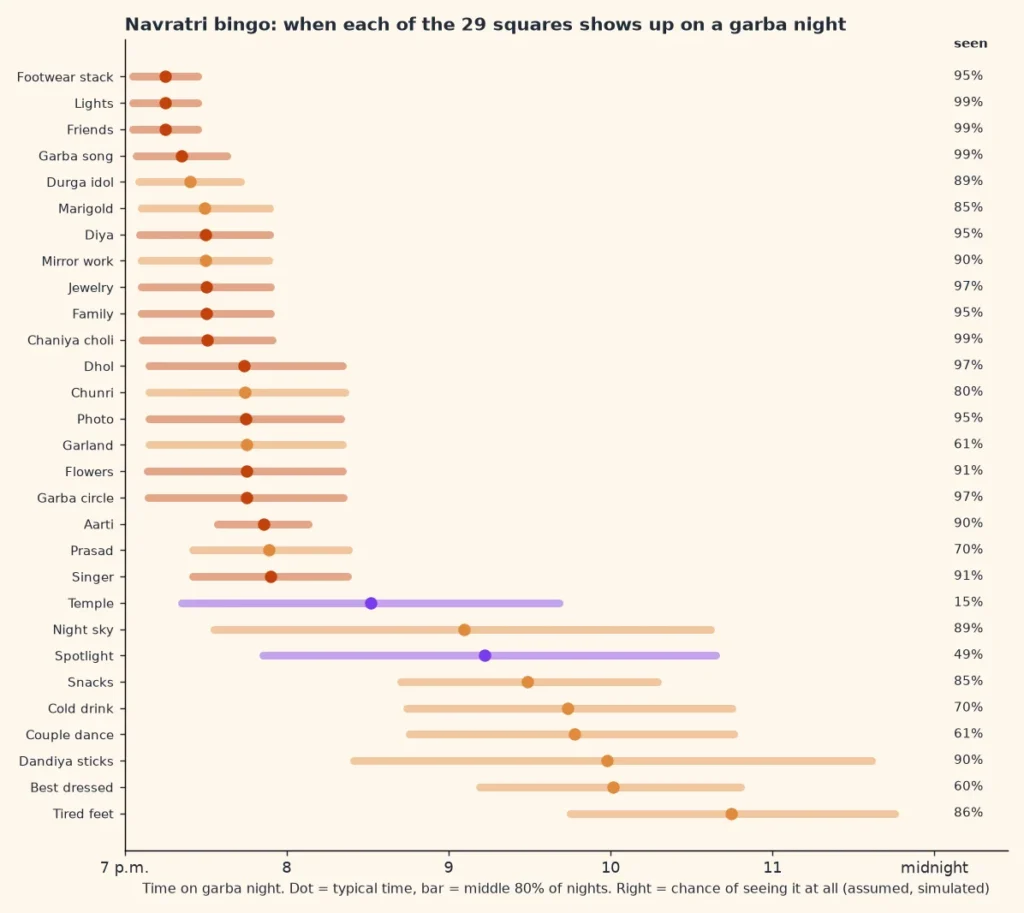
Ten squares have a chance of at least 95 percent, fourteen reach 90 percent, and only seven fall below 75 percent: the temple, the spotlight, the best-dressed announcement, the garland, a couple dance, a cold drink and the prasad. The shape of the chart is the shape of the night. Dress, lights and friends fill in before 8 p.m., the aarti and the singer around 8, snacks and the night sky in the middle, and dandiya sticks and tired feet last of all.
Mark everything you see: Navratri bingo ends within the first hour
| Cards in play (5×5) | Median time to a first line | Line by 8 p.m. | Line by 9 p.m. | Line by 10 p.m. |
|---|---|---|---|---|
| 1 card | 8:01 p.m. | 48% | 84% | 95% |
| 10 cards | 7:36 p.m. | 98% | 100% | 100% |
| 30 cards | 7:28 p.m. | 100% | 100% | 100% |
If guests mark every square they see, a single card has a first line after a median of about an hour, at 8:01 p.m., and 84% of cards have one by 9 p.m. With 30 cards on the ground a first line arrives at 7:28 p.m. That is too fast for an evening of Navratri bingo, and the full card is the only prize that lasts: with 30 cards in play it happens in only 6% of evenings by midnight. The fix is a limit on marking.
Two marks per round: Navratri bingo lasts the night
Under a limit of two marks per fifteen-minute round, guests pick which of the squares they have seen to mark, and the chosen square is random in our simulation. The tables show what that does.
| Cards in play | Marks per round | Median round of a first line | Median time | Cards with a line by midnight |
|---|---|---|---|---|
| 1 card | 2 | 16 | 11:00 p.m. | 58% |
| 10 cards | 2 | 6 | 8:30 p.m. | 99% |
| 30 cards | 2 | 4 | 8:00 p.m. | 100% |
| 10 cards | 1 | 17 | 11:15 p.m. | 57% |
| 30 cards | 1 | 12 | 10:00 p.m. | 87% |
With two marks per round a lone guest finishes a line in 58% of evenings, a group of ten gets a first line at 8:30 p.m., and thirty cards bring it to 8:00 p.m.
With one mark per round the game stretches further: ten cards need until 11:15 p.m., and a single card finishes in only 10% of nights, which is useful if you want the first line to be a surprise at the end of the evening. A thoughtful player does a little better than our random picker, because they can choose the square that completes a row. The numbers are a floor for careful players.
The drawn game: how many calls?
The drawn-card version is much more predictable. All 29 squares are called exactly once, in random order. We simulated 8,000 games to find out how many calls it takes before somebody has a line:
| Cards in play (5×5) | Calls to the first line (median) | Middle half of games | Calls to four corners (median) | Calls to a full card (median) |
|---|---|---|---|---|
| 1 card | 17 | 14 to 19 | 25 | 29 |
| 8 cards | 11 | 10 to 13 | 17 | 28 |
| 15 cards | 10 | 9 to 12 | 15 | 28 |
| 30 cards | 9 | 8 to 10 | 13 | 27 |
| 60 cards | 8 | 7 to 9 | 11 | 27 |
A family gathering of 15 players on 5×5 cards usually sees a first line after 10 calls, which is about a third of the way through the list. A full card needs nearly everything: a median of 28 calls with 15 players. For a quicker game, 4×4 cards with 10 players reach a first line at 10 calls and 3×3 cards with 10 players at 5. Assumptions: every call is equally likely at each step, cards are independent random draws, and nobody misses a call.
Navratri bingo across nine nights
The nine-night Navratri bingo card is the version no ordinary bingo game can offer, and the numbers behave differently from a single evening of Navratri bingo. In our simulation each of the 29 squares has the same chance each night as in the table above, and a square seen on any night stays marked.
After one night the guest has seen about 24 of the 29 squares, after three nights 28, and after nine about 29. The squares that stay missing at the end are the rare ones: the temple, the spotlight and the best-dressed announcement.
| Marks allowed per night | Median night of a first line | Line by night 4 | Full card by night 9 |
|---|---|---|---|
| 3 marks | 5 | 31% | 44% |
| 4 marks | 4 | 87% | 62% |
| 6 marks | 3 | 100% | 73% |
With three marks a night a first line arrives in the middle of the festival, around night 5, and only 44% of cards fill completely by night nine. With four marks the first line comes by night 4 and 62% of cards finish. With six marks a line is almost certain by night three, and 73% of cards end up full. If you want the full card to be a real prize, three or four marks per night is the right cap, because it makes the last squares matter.
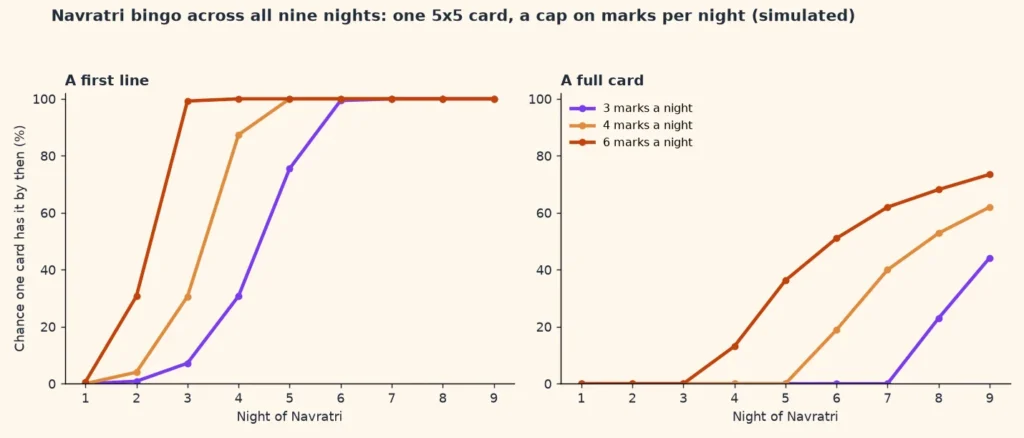
The nine-night Navratri bingo game suits a family that goes to the same venue every evening, a group of friends who meet at a different garba ground each night and an office team that holds a short garba break every day. Give out the card on the first night, collect it on the tenth day, and hold the prize-giving at the Dussehra gathering. A kept card also makes a nice memento when children write a short note or draw a sticker beside the squares they marked.
Navratri bingo for kids, teens and grandparents
Navratri bingo is one of the few games at a festival that works for a four-year-old and a seventy-year-old on the same card. The pictures let pre-readers play without help, and the squares let older relatives take part from a chair at the edge of the ground. The right setup depends on the player.
| Who | Card | How to play |
|---|---|---|
| Ages 3 to 5 | 3×3, one per page | A grown-up reads the pictures. Sticker dots, no pencils. A first line wins a ribbon for everyone. |
| Ages 6 to 9 | 3×3 or 4×4 | Words with emoji. Kids spot and shout. Play for a line, then for four corners. |
| Ages 10 to 15 | 5×5 | Two marks per round, plus two squares they invent themselves for the next night. |
| Young adults | 5×5, with a few funny squares | Add inside jokes. A square counts when a friend points it out. |
| Grandparents | 4×4, large print | A seat near the shrine corner and a card that asks for what they can see: lamps, flowers, family and the circle. |
Dandiya bingo is a good fit for teenagers, because the stick dance is the part of the night they enjoy most and the squares follow it. Garba bingo works for the youngest children, because the circle is simple to follow and the card gives them a job.
At a school event a round of Navratri bingo or dandiya bingo fits into the last half hour before the dance and needs no preparation beyond printing. Teachers can use it as a quiet way to teach the words: dhol, diya, chunri, aarti and prasad all appear on the card, and a child who has marked them has also met them.
For a mixed-age family, the simplest approach is one card per household instead of one per person. Everyone helps spot squares, and the oldest member holds the pencil. That keeps three generations looking at the same card and talking about what they see, which is the best result Navratri bingo can have.
Printable Navratri bingo: print, cut and hand out
For printable Navratri bingo, the Print tab has the controls you need and nothing you do not. You choose how many different cards to print, from 1 to 100, how many go on a page (1, 2, 4 or 6), Letter or A4 paper, and portrait or landscape. Cut guides are available for sheets that need trimming. For a society of 60 families, print 60 cards, four to a page, and keep ten spares for the cousin who arrives with a whole group.
- Use light cardstock. A card that will be carried through a crowd survives the evening better when it is thicker than copy paper, and a laminated card can be marked with a dry-erase pen and reused next year.
- Print names on the cards. The Design tab can put a name on each card, which saves confusion when two similar outfits swap cards at the snack counter.
- Use big squares for children and elders. One card per page in portrait gives the largest squares, which helps younger children and relatives who have forgotten their glasses.
- Print the caller sheet and calling cards if you plan the drawn game. They come out of the same Print tab.
- Bring a lanyard or a pocket. A card that hangs on a string is easier to keep out of the dance floor than one in a hand that also holds a pair of dandiya sticks.
Hosts who are away from a printer can save the printable Navratri bingo PDF to a phone or USB stick and print it anywhere. The shareable link in the card maker keeps only your word list, with no names or photos, so you can send it to the neighbors and let everyone print their own.
Navratri bingo free printable: what you get
Free, private and nothing to install
This Navratri bingo free printable does not ask for an email or an account, and nothing is added to your PDF but the card itself and a small footer. The editor runs in your browser, so your word list never goes to a server. You need only a printer or a PDF viewer.
What you can change
The card maker has five tabs: Setup, Items, Design, Templates and Print. On the Items tab you can rewrite any square, add an emoji or upload your own picture, and decide what the free space shows.
The Design tab holds color themes, fonts, text size, ALL CAPS, borders, rounded corners, tiles or plain grids, and a card background that can be a color, a pattern or your own picture. You can also add a title, a logo and a footer line. The Templates tab holds the other ready-made lists, and the Print tab holds the numbers: how many cards, which paper, which layout.
You do not have to start from this Navratri bingo page. The bingo card generator offers every card type in one place, and the blank bingo cards page gives you an empty grid to fill by hand.
Customize the cards for your own garba night
The best Navratri bingo card names your own ground. Open the Items tab and every square turns into a text box. Here is how a few common situations change the list.
- A housing society. Replace the temple with “The security guard dancing” and the spotlight with “The chairman joins the circle.”
- A family at home. Use a 4×4 card and squares such as “Grandmother’s shawl,” “A cousin who knows every step” and “Someone dances barefoot.”
- A school or college. Add “Teacher in chaniya choli,” “A group in matching outfits” and “Someone helps a friend with the steps.”
- An office garba lunch. Keep the dress squares, drop the late-night ones and add “Manager tries dandiya.”
- A diaspora hall. Add “Someone brings a friend who has never played,” “A parking-lot reunion” and “A garba song from a recent film.”
- Other ways of keeping the festival. In many homes in South India the nine nights are marked with an arrangement of dolls, and in the east it is Durga Puja. If your festival looks different from garba, rewrite the squares freely.
When your list has more than 24 words, the card maker gives every card a different mix, as described above. With exactly 24, every card has the same words in a different order. The free space can say “Free” or show its own emoji, text or picture, and the Design tab can print a title such as “Lakeview Society Garba 2026” and a footer with the date. Shuffle re-deals the squares across all cards, Undo takes back your last change, and the preview lets you zoom in before you download.
Garba night etiquette and safety
A Navratri bingo card in a guest’s hand is only a good idea if it does not get in the way of the dancing or the festival. A few common-sense notes help. They apply to any game you run at a festival, not just garba bingo.
- Eyes up on a crowded floor. Mark squares on the side of the circle, not inside it. A person who stops in the middle of a ring of dancers is a hazard for everyone behind.
- Keep sticks and cards apart. Dandiya sticks come out fast. Ask guests to keep the card in a pocket or on a lanyard during the stick rounds.
- Protect the ritual. No cards, no pencils and no phones during the aarti. Mark the square afterwards.
- Think about fasting guests. Many people fast during Navratri and may not eat the snacks on the card. A square counts when it is seen, not when it is eaten, so everyone can play.
- Be kind about outfits. The best-dressed square is a celebration, never a ranking of other guests. Photograph people only with their consent.
- Welcome newcomers. Garba is a social dance that invites everyone to join. A Navratri bingo card with a few “ask someone to teach you a step” squares makes it easier for first-timers to take part.
Navratri bingo is also a fine way to get children moving in a group instead of staring at phones. Pair them with an older cousin, give each pair a card, and the two of them become a team for the night. Winners could share the prize, and a card with a few clap-and-spin squares helps small children feel part of the circle.
More festival bingo and games
Navratri bingo is one of several festival lists in the card maker, and the Navratri bingo cards share the same editor as every other template. Once Dussehra is over, the next date on the calendar is the Diwali bingo list for the festival of lights, followed in spring by the Holi bingo list. The Diwali party games guide and the Bollywood party games guide give you other games for the same crowd.
If you prefer numbers to spotting, the difference is simple. Bingo means marking squares for things you see or find, and tambola means numbers called aloud on a 3×9 ticket. Both are welcome at a garba night, so Navratri bingo and tambola can share the evening, and the Navratri tambola page and the illustrated Dandiya Nights tickets cover the number-calling side. Every template is gathered on the printable bingo cards hub, and a number-based game runs on the bingo caller.
Frequently asked questions
10 quick answers
What is Navratri bingo?
Navratri bingo is a bingo variation in which every square names something you see or do on a garba night, such as dandiya sticks, a dhol, a diya or a pile of footwear at the door. Guests mark squares as they spot them or as an organizer calls them, and the first to complete a line wins.
Are these Navratri bingo cards really free?
Yes. You can make, edit and print the cards without an account or a payment. The editor runs in your browser, so the words and pictures you add never leave your device.
Is garba bingo the same as dandiya bingo?
They share one card. Garba bingo uses the squares of the circle dance, such as the dhol, the garba song and the chaniya choli. Dandiya bingo uses the stick-dance squares, such as the dandiya sticks, a couple dance and tired feet. The Navratri template includes both, and you can delete either half.
How many squares does the template have?
It has 29 squares. A 5×5 card with a free center uses 24 of them, a 4×4 card uses 16 and a 3×3 card with a free center uses 8. Because the list holds more words than a card has squares, cards differ from one another.
How many different cards can I print?
Up to 100 different cards in one PDF. There are 118,755 different sets of 24 squares to choose from, so even a big society can have a card each without repeats.
How long does a game last?
It depends on the rule. In our simulation, with two marks allowed per fifteen-minute round, ten cards get a first line at 8:30 p.m. With every square marked, a first line comes within the first hour or so. A drawn game with 15 players usually has a winner after about 10 calls.
Can I play for all nine nights?
Yes. Give out a card on the first night and let guests keep it. A square counts if it was seen on any night. With a cap of four marks per night, our simulation gives a median first line on night 4 and a full card for 62% of players by night nine.
Can I change the squares to match my venue?
Yes. On the Items tab every square can be rewritten, given an emoji or a picture. Swap the temple for the security guard dancing, add a society-specific moment, and use the free space for something personal.
What prizes work best?
Small ones. Good choices are first in the prasad queue, a pair of mirror-work earrings, a pair of decorated dandiya sticks, the song of your choice for the next round, or a ribbon for every guest who completes a line.
Does it replace tambola at a garba night?
No, it is a different game. Bingo marks squares for things you see, while tambola calls numbers on a 3×9 ticket. Many hosts play bingo during the dance and tambola at the snack break.