A budget planner printable is a one-page sheet where you plan where your money goes before the month starts: income at the top, then bills, everyday spending, and savings and debt payments. This free printable budget planner fills in 50/30/20 targets from your take-home pay, works for monthly, biweekly or weekly pay, and prints on US Letter or A4.
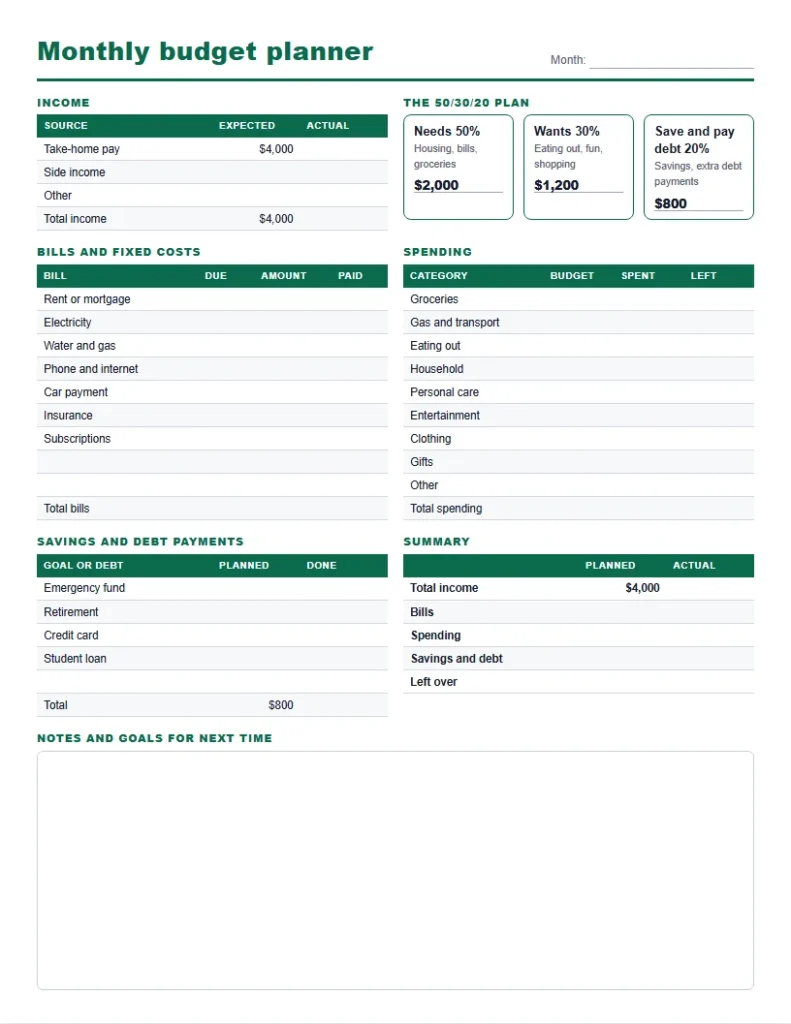
Quick answer: Type your take-home pay for the period, choose monthly, biweekly or weekly, and print. The budget planner printable splits your pay into 50% for needs, 30% for wants and 20% for savings and debt, so $4,000 a month becomes $2,000, $1,200 and $800. Leave the pay box empty to print a blank planner.
How to use the printable budget planner
- Choose how often you budget: a month, every two weeks, or a week. Match it to how often you are paid.
- Type your take-home pay for that period, after tax and other deductions.
- Pick the currency, paper size and color.
- Keep Print my income and 50/30/20 targets ticked to print your numbers, or untick it for a blank budget planner.
- Press Print or save as PDF. Then fill in your bills, due dates and spending budgets with a pen.
Your choices are remembered in this browser, so next month the budget planner printable opens with the same settings. Nothing you type is sent to a server.
What is on the budget planner
| Section | What you write | Why it helps |
|---|---|---|
| Income | Take-home pay, side income, other income, expected and actual | Shows exactly how much you have to plan with |
| 50/30/20 plan | Your needs, wants and savings targets | Gives each dollar a job before you spend it |
| Bills and fixed costs | Each bill, its due date, the amount and a paid box | Stops late fees and missed payments |
| Spending | A budget for groceries, transport, eating out and more, then what you spent | Shows where money leaks during the month |
| Savings and debt | Emergency fund, retirement, card and loan payments | Makes saving a planned line, not leftovers |
| Summary | Planned and actual totals, and what is left over | Tells you if the month worked |
| Notes | What to change next time | Turns each month into a better plan |
The 50/30/20 budget rule
The 50/30/20 rule splits take-home pay into three parts. About half goes to needs: housing, utilities, groceries, insurance, transport to work and minimum debt payments. About 30% goes to wants: eating out, entertainment, hobbies, travel and shopping you could skip. The last 20% goes to savings and extra debt payments.
| Monthly take-home pay | Needs (50%) | Wants (30%) | Savings and debt (20%) |
|---|---|---|---|
| $2,000.00 | $1,000.00 | $600.00 | $400.00 |
| $3,000.00 | $1,500.00 | $900.00 | $600.00 |
| $4,000.00 | $2,000.00 | $1,200.00 | $800.00 |
| $5,000.00 | $2,500.00 | $1,500.00 | $1,000.00 |
| $6,000.00 | $3,000.00 | $1,800.00 | $1,200.00 |
The split is a starting point, not a rule you must follow. In an expensive city, needs may take 60% or more; then trim wants first and keep savings as close to 20% as you can. If you are paying off high-interest debt, move more of the 30% to the 20%.
Monthly budget planner printable
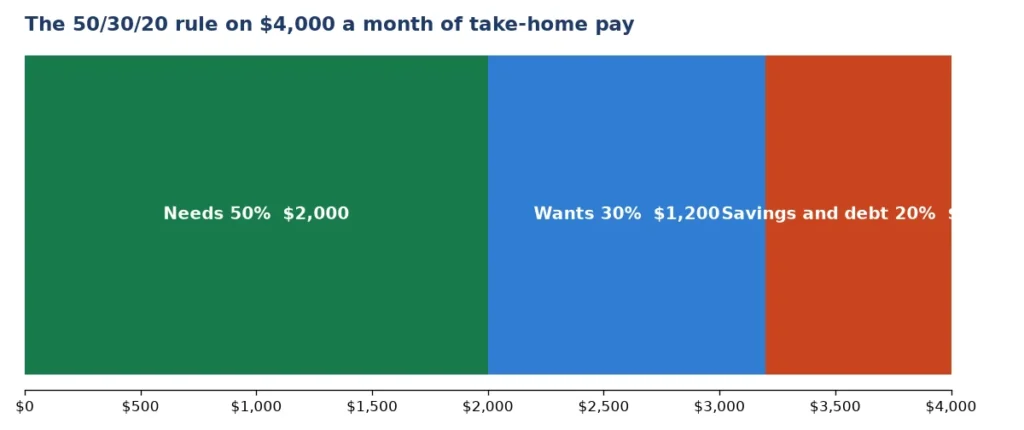
A monthly budget planner printable suits anyone paid once a month, and anyone whose bills are mostly monthly. Fill it in during the last few days of the month before: copy the bills from last month, check each due date, set a budget for each spending category, and decide what goes to savings.
During the month, write what you actually spent in the Spent column every few days. A minute at the kitchen table twice a week is enough to keep the sheet accurate.
Biweekly budget planner printable
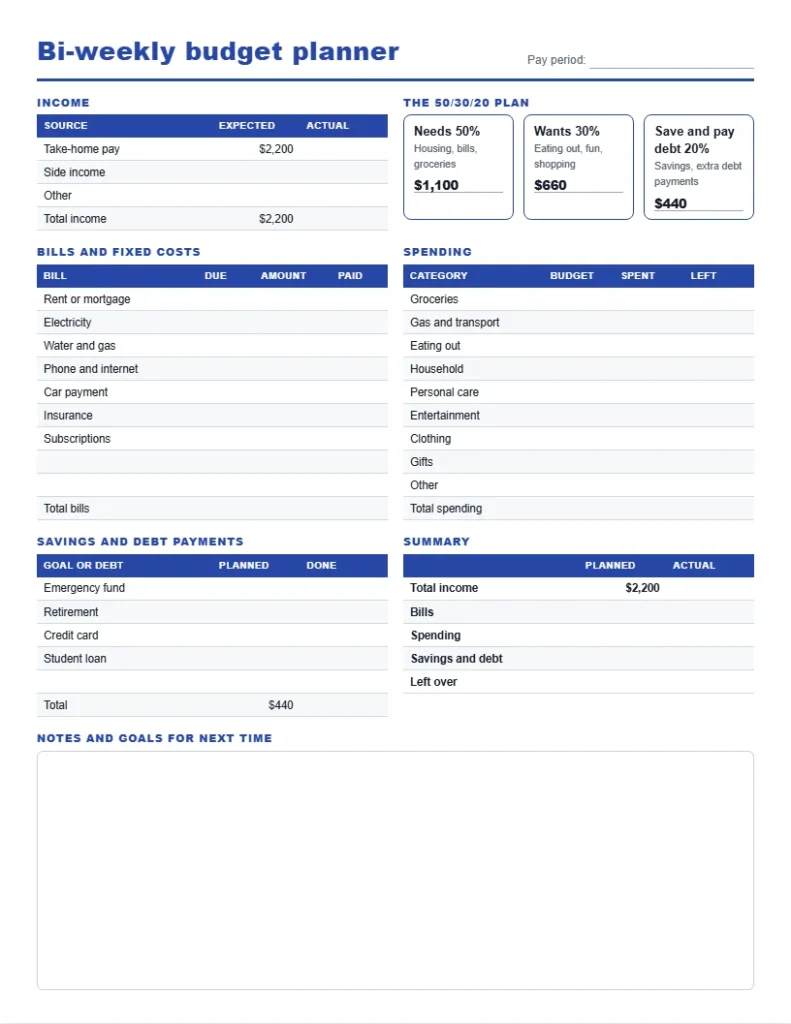
If you are paid every two weeks, a biweekly budget planner printable matches your paychecks. Choose Every two weeks, type one paycheck, and plan which bills that paycheck covers. Many people split the month: rent from the first paycheck, the other bills from the second.
Biweekly pay gives 26 paychecks a year, so two months each year have three paydays. Plan the third paycheck in advance, such as an extra debt payment or a boost to your emergency fund, instead of letting it disappear into everyday spending.
How to make a budget in six steps
- Add up your take-home pay for the month or pay period, using recent pay stubs.
- List every fixed bill with its due date and amount.
- Look at the last two or three months of bank and card statements to see what you really spend on groceries, gas and fun.
- Set a budget for each spending category, starting from what you actually spent.
- Give your savings and debt payments a fixed amount, and pay them first when your pay arrives.
- At the end of the month, compare planned and actual, then adjust the next planner.
That is how to make a budget that holds: base it on real numbers, plan savings first, and review it every month. The first month is always the hardest; by the third, the numbers settle.
Blank budget planner for writing by hand
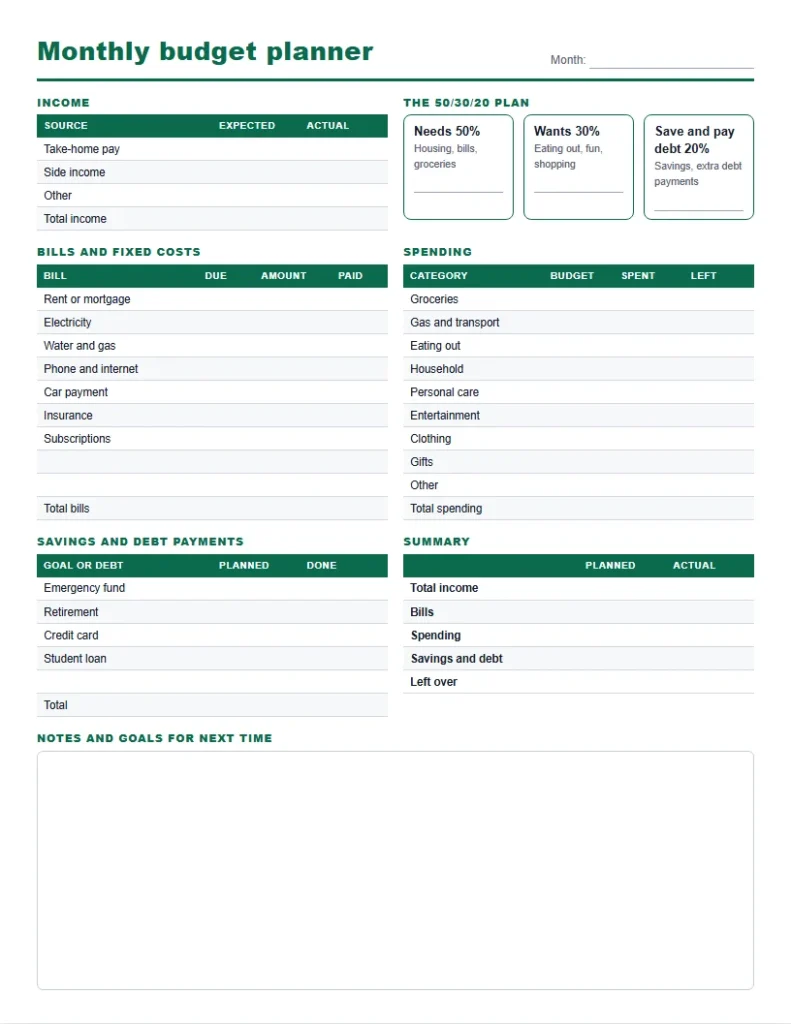
Untick the targets option and the budget planner printable comes out blank, with the categories in place and empty amount columns. A blank sheet works well on a clipboard, in a binder, or for a family budget meeting where everyone can see the numbers.
Monthly budget template: a worked example
Here is the monthly budget template filled in for take-home pay of $4,000. The numbers are an example, not a recommendation; your own costs will differ.
| Line | Planned | Group |
|---|---|---|
| Rent | $1,350 | Needs |
| Electricity, water and gas | $180 | Needs |
| Phone and internet | $110 | Needs |
| Groceries | $300 | Needs |
| Transport | $60 | Needs |
| Eating out | $300 | Wants |
| Subscriptions | $45 | Wants |
| Entertainment and hobbies | $255 | Wants |
| Clothing and personal | $300 | Wants |
| Gifts and other | $300 | Wants |
| Emergency fund | $400 | Savings and debt |
| Retirement | $200 | Savings and debt |
| Extra credit card payment | $200 | Savings and debt |
Needs come to $2,000, wants to $1,200 and savings and debt to $800, which matches the 50/30/20 split exactly. In a real month the lines rarely match so neatly, and that is fine: the point of a monthly budget template is that every dollar has a planned job before the month starts.
Free printable budget planner or a budgeting app?
A free printable budget planner keeps the whole month on one page you can see at a glance, with no account, no bank login and no subscription. Writing numbers by hand also makes people notice them more, which is why paper budgets still work well for many households.
Budgeting apps sort card transactions automatically and send reminders, but many charge a monthly fee and need access to your bank account. Some people use both: the app to track spending and the printable planner to set the plan for the month.
Budgeting with irregular income
If your income changes from month to month, as it does for freelancers, gig workers and anyone paid on commission, plan from your lowest normal month, not your average. Put anything above that into a buffer account, and pay yourself a steady amount from the buffer each month.
Self-employed people should also set aside tax from each payment, because nobody withholds it. The self-employment tax calculator shows the share to put aside, which you can add as its own line under Savings and debt.
A simple test for an irregular income plan: could you cover three months at your lowest income from the buffer and the emergency fund together? If not, keep building the buffer before you raise spending in good months. Write the buffer balance in the notes box each month so you can see it grow, and only increase your steady monthly pay once the buffer has stayed full for a few months in a row. This approach turns uneven paychecks into a regular salary you set yourself.
n
Budgeting as a couple or family
A shared budget works best when everyone sees the same page. Print the planner, sit down together once a month, and agree the bills, the savings amounts and a spending budget for each person. Give each adult a small amount of personal money that needs no explanation; it prevents most arguments about small purchases.
For children, a simple version of the same idea works: a weekly allowance split into spend, save and give. It teaches the habit long before they have bills of their own.
Weekly budget planner printable
A weekly budget planner printable suits anyone paid weekly, and anyone who finds a month too long to keep track of. Choose A week, type one week of take-home pay, and plan only the bills due that week plus a spending budget for groceries, fuel and small purchases. Short periods make overspending visible within days instead of at the end of the month.
Sinking funds for yearly costs
Some costs arrive once or twice a year: car registration, insurance premiums, back-to-school shopping, holiday gifts. A sinking fund spreads them over the year so they never wreck one month. Add up the yearly cost, divide by 12, and write that amount on the budget planner printable as its own line under Savings and debt.
| Yearly cost | Amount a year | Set aside each month |
|---|---|---|
| Car insurance | $1,440 | $120 |
| Holiday gifts | $900 | $75 |
| Car registration and service | $600 | $50 |
| Back to school | $480 | $40 |
| Total | $3,420 | $285 |
Keep sinking fund money in a separate savings account so it is not spent by accident, and move it on payday along with your other savings.
Paying off debt with the planner
List each debt under Savings and debt with its minimum payment. Pay the minimum on all of them, then put any extra on one debt at a time: the smallest balance first (the snowball method) or the highest interest rate first (the avalanche method). When one is paid off, roll its payment into the next.
Write the balance of each debt at the top of the notes box every month. Watching the numbers fall is one of the strongest reasons people keep using a budget planner printable after the first few months. The credit card payoff calculator shows how much faster an extra payment clears a card.
Budget categories to use
| Needs | Wants | Savings and debt |
|---|---|---|
| Rent or mortgage | Eating out and takeout | Emergency fund |
| Electricity, water and gas | Streaming and subscriptions | Retirement contributions |
| Groceries | Entertainment and hobbies | Extra credit card payments |
| Insurance | Clothing beyond the basics | Student or car loan extra |
| Phone and internet | Travel and gifts | Saving for a goal |
| Transport to work | Personal care extras | Investing |
Use the empty rows on the planner for anything that is particular to your household, such as childcare, pet care or tuition.
Budget planner printable PDF: tips
- Save one copy as a PDF named with the month, such as Budget planner November 2026, and fill it in on a tablet if you prefer.
- Print twelve blank copies at once and keep them in a folder for the year.
- In the print window, turn off headers and footers and keep the scale at 100%.
- Use a different color each month so the sheets are easy to tell apart.
Budgeting habits that stick
- Pick a budget day. The same day each month, such as the 28th, to fill in next month’s planner.
- Pay yourself first. Move savings on payday, before any spending starts.
- Round up. Budget $310 for groceries, not $297, so small price changes do not break the plan.
- Keep a small buffer. A $50 to $100 line for surprises stops one unexpected cost from ending the budget.
- Review, do not judge. An overspent category is information for next month, not a failure.
Most people need two or three months before their budget matches real life. Keep each month’s printed planner in a folder; looking back at the last three sheets is the quickest way to see which categories always run over and need a bigger number.
If you share the household with others, put the current budget planner printable somewhere everyone sees it, such as on the fridge, so planned spending is never a surprise.
Common budgeting mistakes
- Budgeting from gross pay instead of take-home pay.
- Forgetting yearly costs such as car registration, gifts and insurance; set aside a twelfth each month.
- Setting spending budgets far below what you really spend, which makes the plan fail in week two.
- Saving only what is left at the end of the month, which is usually nothing.
- Not writing down actual spending, so the plan never gets better.
Building an emergency fund with the planner
The first line under Savings and debt is the emergency fund. A common goal is three to six months of essential costs, kept in a separate savings account. Start smaller: even $500 to $1,000 covers many surprise bills without a credit card.
Write a fixed amount on the planner each month and move it on payday. Once the fund is full, move that amount to retirement or extra debt payments. The compound interest calculator shows how steady saving grows over time.
Frequently asked questions
10 quick answers
Is this budget planner printable free?
Yes. It is free to print and use, with no sign-up and no watermark.
How do I save the budget planner as a PDF?
Press Print or save as PDF, then choose Save as PDF as the printer in the print window.
What is the 50/30/20 rule?
It splits take-home pay into 50% for needs, 30% for wants and 20% for savings and debt. On $4,000 a month that is $2,000, $1,200 and $800.
Can I make a biweekly budget?
Yes. Choose Every two weeks and type one paycheck. The planner title and targets change to match.
Should I use gross or net pay?
Use take-home pay, the amount that reaches your bank account after tax and deductions.
Can I print a blank budget planner?
Yes. Leave the pay box empty or untick Print my income and 50/30/20 targets.
What paper sizes are there?
US Letter and A4. Keep the print scale at 100% so the page fits.
How often should I review my budget?
Write actual spending in once or twice a week, and compare planned and actual at the end of each month.
What if my needs are more than 50%?
That is common in high-cost areas. Cut wants first, keep saving something every month, and look for one large cost to lower over time.
Can I change the categories?
The planner lists common categories and leaves blank rows. Cross out any you do not use and write your own.
Related printables and calculators
- Move-in move-out checklist printable for a room-by-room condition list
- Printable planner generator
- Weekly planner printable
- Budget calculator to check your numbers before you print
- Bill tracker printable to keep track of due dates and payments
- Expense tracker printable to track what you actually spend
- Savings challenge printable to turn the savings line into a plan
- Habit tracker printable for a no-spend challenge
- Compound interest calculator
- Credit card payoff calculator
Sources and further reading
This budget planner printable is for personal planning, not financial advice.
Last updated: October 2026.