This mixed times tables game helps third and fourth graders practice every multiplication fact from 2 × 2 to 12 × 12 in one random mix, so the answers have to come from memory and not from counting up one table. Pop balloons, match cards, race cars or sprint through true and false sentences. It is free, needs no sign-up, works on phones and tablets, and comes with a printable times tables grid that shades the tricky middle facts.
Mixed times tables game: see how it plays
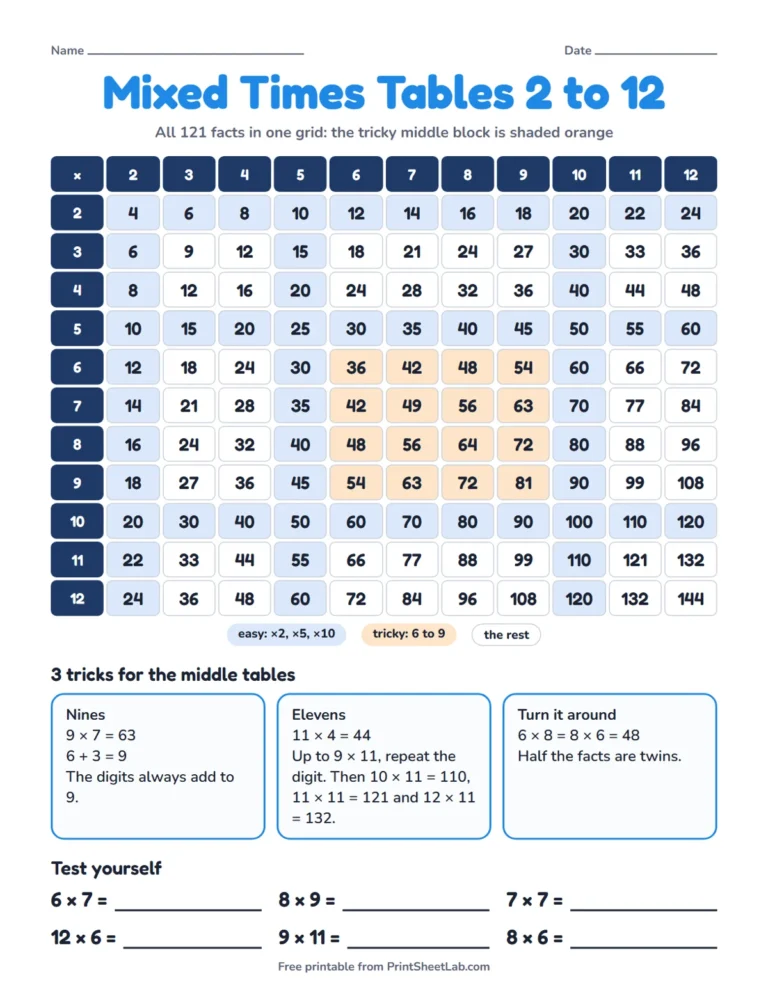
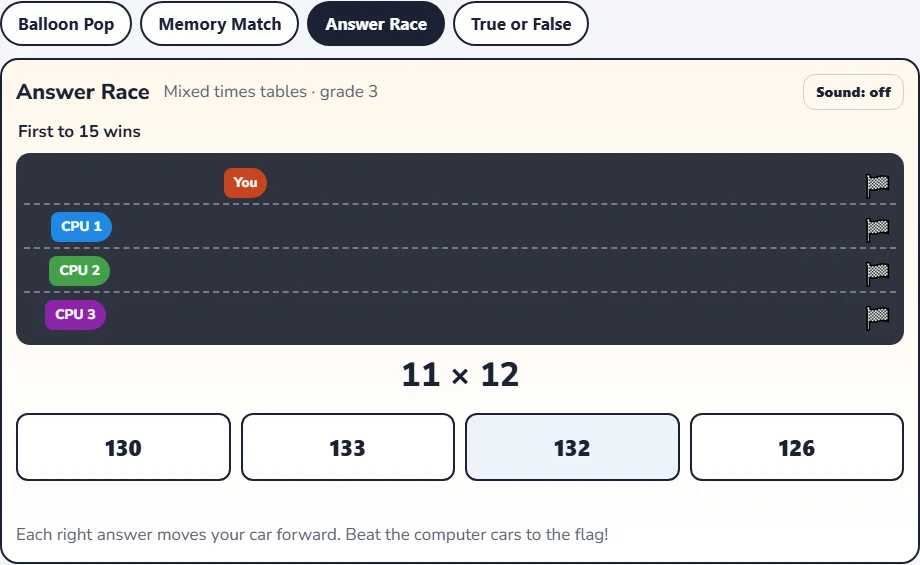
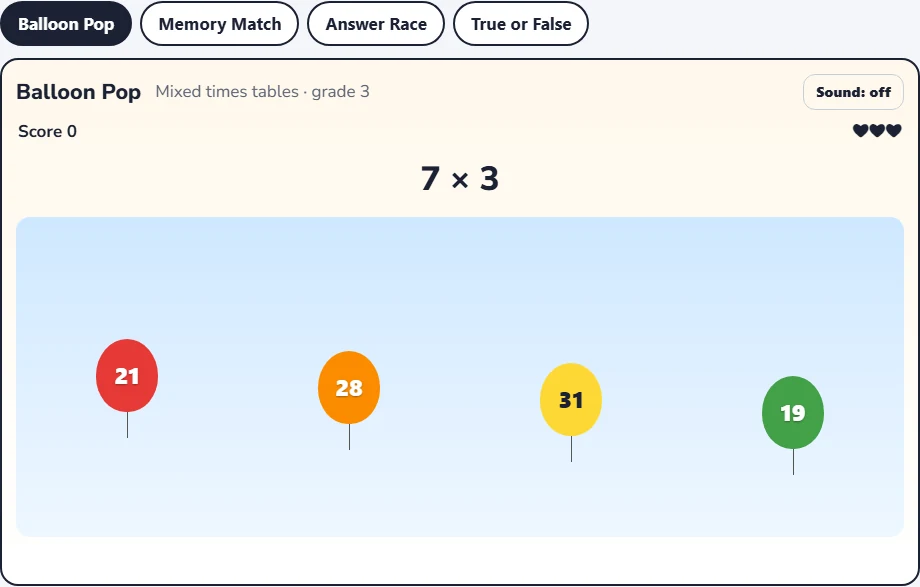
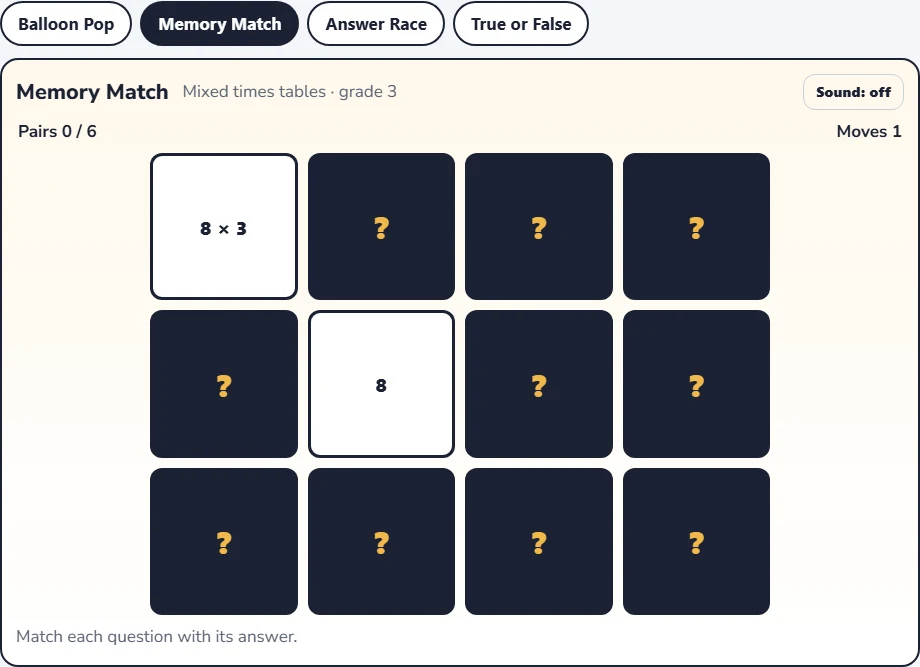
The game below has four modes, and every question multiplies two numbers chosen from 2 to 12. The printable grid shows all 121 products, with the easy tables in blue and the tricky 6 to 9 block in orange, and the pictures show Answer Race, Balloon Pop and Memory Match on this page.
How the mixed times tables game works
- Answer Race: every right answer moves your car forward, and you race three computer cars to the finish flag. The first to 15 wins, and wrong taps cost time, not places.
- Balloon Pop: answers float up on balloons, and you pop the right one before it drifts off the top. The wrong balloons are within 10 of the right answer, so a quick guess at the size of the product will not be enough. The game speeds up as your score climbs, and three misses ends the round.
- Memory Match: twelve face-down cards hide six multiplication facts such as 7 × 8 and their six answers. Flip two at a time and match each one to its answer in as few moves as you can.
- True or False: sixty seconds on the clock. Decide whether each sentence, such as 6 × 9 = 56, is right or wrong. A streak of five or more scores double.
Multiplication facts game: how many facts are there?
Both numbers in a question come from 2 to 12, so there are 11 × 11 = 121 questions. Because 7 × 8 and 8 × 7 are the same fact turned around, only 66 of them are really different, and they make 53 different products. The facts for each table are shown below, counted only when they have not already appeared in an earlier table:
| Table | New facts | How many | Total learned so far |
|---|---|---|---|
| 2 times table | 2 × 2 to 2 × 12 | 11 | 11 |
| 3 times table | 3 × 3 to 3 × 12 | 10 | 21 |
| 4 times table | 4 × 4 to 4 × 12 | 9 | 30 |
| 5 times table | 5 × 5 to 5 × 12 | 8 | 38 |
| 6 times table | 6 × 6 to 6 × 12 | 7 | 45 |
| 7 times table | 7 × 7 to 7 × 12 | 6 | 51 |
| 8 times table | 8 × 8 to 8 × 12 | 5 | 56 |
| 9 times table | 9 × 9 to 9 × 12 | 4 | 60 |
| 10 times table | 10 × 10 to 10 × 12 | 3 | 63 |
| 11 times table | 11 × 11 to 11 × 12 | 2 | 65 |
| 12 times table | 12 × 12 to 12 × 12 | 1 | 66 |
That is why mixed practice feels fair: by the time a child has learned the 6 times table, only 7 of its 11 facts are new, and the rest are old friends turned around. The last table, 12 × 12, adds just one new fact. The mixed times tables game then asks them all together. If your child is still on the lower tables, the 7 times table game and 8 times table game practice one table at a time.
Times table practice 2 to 12: the 10 tricky facts
When children miss facts in a mixed game, the misses nearly always fall in the middle block where both numbers are between 6 and 9. There are ten unique facts in this block, which is only 15 percent of the 66. Teach each with a memory hook and the block stops being a problem:
| Fact | Product | Memory hook |
|---|---|---|
| 6 × 6 | 36 | Six sixes: 5 × 6 + 6, which is 30 + 6 |
| 6 × 7 | 42 | 6 × 6 + 6, which is 36 + 6 |
| 6 × 8 | 48 | 5 × 8 + 8, which is 40 + 8 |
| 6 × 9 | 54 | 6 × 10 − 6, which is 60 − 6; the digits add to 9 |
| 7 × 7 | 49 | 50 − 1, or 7 × 7 is “seven sevens, forty-nine” |
| 7 × 8 | 56 | The digits count up: 5, 6, 7, 8 is 56 = 7 × 8 |
| 7 × 9 | 63 | 7 × 10 − 7, which is 70 − 7; the digits add to 9 |
| 8 × 8 | 64 | A chessboard has 8 × 8 = 64 squares |
| 8 × 9 | 72 | 8 × 10 − 8, which is 80 − 8; the digits add to 9 |
| 9 × 9 | 81 | 9 × 10 − 9, which is 90 − 9; the digits add to 9 |
Times tables 2 to 12: products you can make more than one way
Some products turn up in several tables, which is useful for spotting patterns and for division later. These are the products from 2 to 12 that have three different factor pairs:
| Product | Factor pairs |
|---|---|
| 24 | 2 × 12, 3 × 8, 4 × 6 |
| 36 | 3 × 12, 4 × 9, 6 × 6 |
Multiplication grid printable for the mixed times tables game
Print the multiplication grid printable above and keep it beside the screen while children play the mixed times tables game. Each time a fact is missed, they find it on the grid, say the product aloud and color the square. After a week the colored squares show which tables still need work, and the plain ones show what is already known. The grid also shows that every row counts up by the same step, and that the second half is a mirror of the first: a good picture for a child who thinks there are far too many facts to learn.
Mixed multiplication practice plan
| Week | Goal | What to do |
|---|---|---|
| 1 | Be sure of 2, 5 and 10 | Play for five minutes a day and print the grid to colour the facts you know. |
| 2 | Add 3, 4 and 11 | Use Answer Race and check the facts that need a second try. |
| 3 | Add the 6 to 9 block | Learn one hook a day from the table above, then play Memory Match. |
| 4 | Add 12 and mix everything | Beat your best Balloon Pop score and finish an Answer Race without a miss. |
Playing the mixed times tables game for a few minutes beats a long, rare session: five minutes a day is better than an hour on Sunday. Our guide to times tables tricks explains more routines, and the multiplication chart prints a clean grid.
Where mixed times tables fit at school
| Level | What children are expected to do |
|---|---|
| Grade 3 (US) | Fluently multiply within 100 and know from memory all products of two one-digit numbers (3.OA.C.7) |
| Grade 4 (US) | Use these facts to multiply multi-digit numbers (4.NBT.B.5) |
| Year 4 (England) | Recall multiplication and division facts up to 12 × 12, which is also what the Multiplication Tables Check tests |
The Common Core grade 3 operations and algebraic thinking standards set the memory goal, and England’s Department for Education publishes the multiplication tables check framework, which allows six seconds a question. Our multiplication worksheets give written practice with answer keys, and the mixed times tables game gives the spoken, fast kind.
Mixed times tables game: frequently asked questions
What is a mixed times tables game?
It asks questions from all the tables from 2 to 12 in random order, so children cannot count on from the question before. This is how the facts are used in real maths.
How many multiplication facts are there from 2 to 12?
There are 121 questions, but only 66 different facts once you notice that 6 × 7 and 7 × 6 are the same.
Which times tables should children learn first?
Start with 2, 5 and 10, then 3, 4 and 11, then 12, and finish with the 6 to 9 block, where only ten facts remain.
How fast should a child answer?
Recall means an answer in a few seconds without counting. The English tables check allows six seconds, which is a useful target for older children who play the mixed times tables game every day.
Is the mixed times tables game free, and do kids need an account?
Yes, it is free, and no account is needed. Best scores are saved only in the browser on this device.
Does it work on phones and tablets?
Yes. Every game is built for touch first and also works with a mouse on a computer.