Easter bingo gives the busiest morning of the spring something to do besides wait for brunch. The template on this page holds 29 squares that most Easter Sundays produce sooner or later, from a painted egg in the grass and a basket on every arm to jelly beans, a chocolate egg and the honey ham on the table. Choose a card size, press print, and each player gets a different card to mark as the day unfolds.
In short: open the card maker above and press Edit and print this card, choose how many cards you need, and download one PDF. It is free, it needs no account, and nothing you type leaves your browser. Any square can be rewritten, so your own family traditions can go straight onto the card.
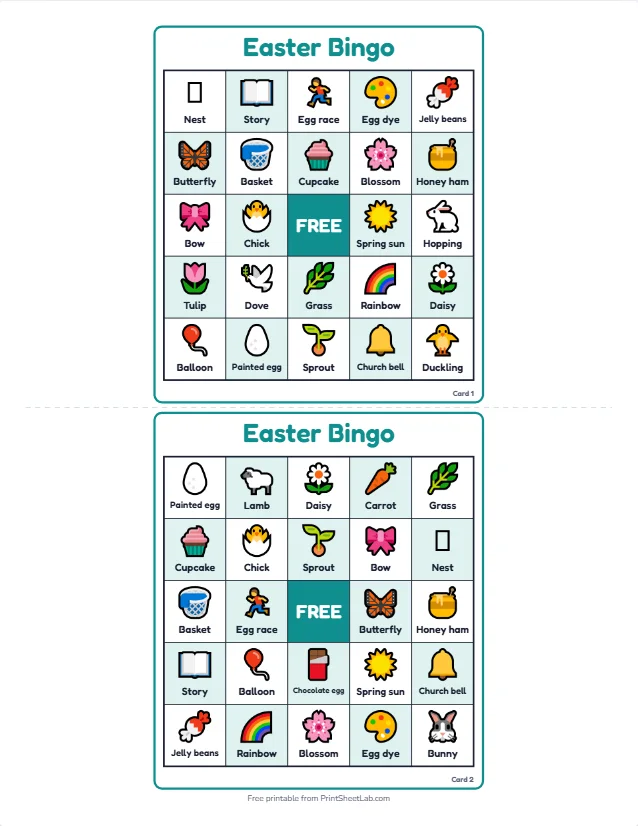
What Easter bingo is, and who plays it
Nobody calls numbers in Easter bingo. Players carry a card and mark a square when that thing happens in front of them: the first chick on a card, the first bunny ear on a headband, the moment a child finds the nest.
The first player with five in a row shouts, a neighbor checks the squares, and the prize basket comes out. Easter bingo is a spotting game, so it works for the one-year-old on the lap and for the grandparent who just wants a reason to sit by the window and watch the egg hunt.
The reason it fits the holiday is that Easter Sunday has a rhythm everyone half knows: morning bells, baskets, the hunt, brunch, cake, and a slow afternoon in the garden. An Easter bingo card that names those moments makes every stage of the day a little more fun, and gives a crowd of mixed ages one game to share.
Easter bingo cards: all 29 squares, by theme
These Easter bingo cards are built from a list of 29 squares. A standard 5×5 card with a free center needs 24 of them, so each card leaves out five. The table sorts the list by theme, which helps when you want to keep a card to one kind of Easter, such as an egg-hunt card or a brunch card.
| Theme | Squares on the list | When you will see them |
|---|---|---|
| Eggs and the hunt | 🥚 Painted egg, 🧺 Basket, 🪺 Nest, 🌿 Grass, 🍫 Chocolate egg, 🎨 Egg dye, 🏃 Egg race, 🐇 Hopping | Mid-morning. The hunt packs most of them into about an hour. |
| Baby animals and birds | 🐣 Chick, 🐰 Bunny, 🐑 Lamb, 🐥 Duckling, 🦋 Butterfly, 🕊️ Dove | Headbands and decorations at home; the real ones are rare and make great squares. |
| Spring garden and sky | 🌷 Tulip, 🌼 Daisy, 🌱 Sprout, 🌸 Blossom, 🥕 Carrot, 🌈 Rainbow, ☀️ Spring sun | Wherever you look outside, and on the table as flowers. The rainbow depends on the weather. |
| The table | 🍬 Jelly beans, 🍰 Cake, 🧁 Cupcake, 🍯 Honey ham | Brunch and dessert, around midday and early afternoon. |
| The day itself | 🔔 Church bell, 📖 Story, 🎀 Bow, 🎈 Balloon | Morning for the bell and the bow, any time for a story or a balloon on the mailbox. |
The mix is deliberate. If every square on an Easter bingo card were an egg, the card would be finished by the time the hunt ended, and anyone who missed the hunt would miss the game. By including garden squares, table squares and a few rare ones, the list gives players something to mark at every stage of Easter Sunday, and keeps a long afternoon from going flat.
How many different cards can you make?
With 29 squares and 24 places on a 5×5 card, there are 118,755 different sets of squares, and every set can be arranged in an enormous number of orders. A class of 30 or a family of 12 will never get two cards the same. Smaller grids use fewer squares, so there are even more combinations.
| Card size | Squares used | Different sets from the 29 | Best for |
|---|---|---|---|
| 3×3 with free center | 8 | 4,292,145 | Toddlers and the egg hunt itself |
| 4×4 | 16 | 67,863,915 | A short brunch game |
| 5×5 with free center | 24 | 118,755 | The all-day game |
Three ways to run an Easter bingo game
An Easter bingo game can be a quiet spotting contest, a talking game at the brunch table or a surprise-egg draw. The same printed Easter bingo cards work for all three. Many families run two. The table compares them.
| Game | Who calls | Length | Best for |
|---|---|---|---|
| Easter bingo egg-hunt card | The hunt itself | 30 to 45 minutes | Children in a yard or park, with small cards |
| Easter bingo brunch game | Everyone at the table | One meal, about an hour | Mixed ages around a table |
| Surprise-egg draw | A host cracks open plastic eggs | 10 to 20 minutes | Parties, classrooms and churches |
Game one: the Easter bingo egg-hunt card
For this kind of Easter bingo, give each child a 3×3 or 4×4 card on a clipboard, and mark a square when you find or see the thing. Painted egg, basket, nest and grass are almost guaranteed during a hunt, and the rest of the squares come from what is in the yard. A rule that prevents a fight: each child marks only what they found or saw, never what a sibling found. The first player with a line wins a bonus egg, and play goes on for four corners.
- Prize for the first line: the golden egg from the hunt, or first choice of the prize basket.
- Prize for four corners: a sticker sheet or a small bag of jelly beans.
- Prize for every child: a pencil topper or a bunny sticker for finishing a card, so nobody walks away empty-handed.
- Grown-up job: carry a spare card and a few extra pencils, and help the smallest children find the squares on the high branches.
Game two: Easter bingo at the brunch table
At a table, an Easter bingo card is a conversation starter. A square is marked when it appears on the table or when someone says the word: “Who baked the cake?” “Did anyone hear the bell?” “That is the third bunny headband.” Use a 4×4 Easter bingo card so the game ends before the plates are cleared, and let the youngest guest read out the winner’s squares. This game fits a family where some people see each other rarely, because it gives them something to say.
Game three: the surprise-egg draw
In the Print tab you can add calling cards to cut out, one per square, and a caller sheet for the Easter bingo game. Fold each calling card into a plastic egg. A host picks an egg from the basket, cracks it open and reads the square aloud.
This is the classic Easter egg bingo draw: the host gets to be a showman, the eggs add a bit of suspense, and every square is called exactly once. For a version on a screen with guests joining by link, see the play bingo online page; the play custom bingo online page explains how to play with your own list.
Easter egg bingo: the hunt and the brunch, simulated
Any host of Easter bingo wants to know when the first winner will appear. To answer with numbers instead of a hunch, we simulated 8,000 Easter Sundays. Each of the 29 squares has a window of the day and a chance of happening, for a household that does a morning egg hunt, eats brunch around noon and has cake after lunch.
These windows are our assumptions, not survey data: a painted egg in the hunt at 97 percent, a church bell at 45 percent, a rainbow at only 12. The heat map shows how the Easter bingo squares fill in through the day. The darker the cell, the more likely the square has been seen by the end of that hour.
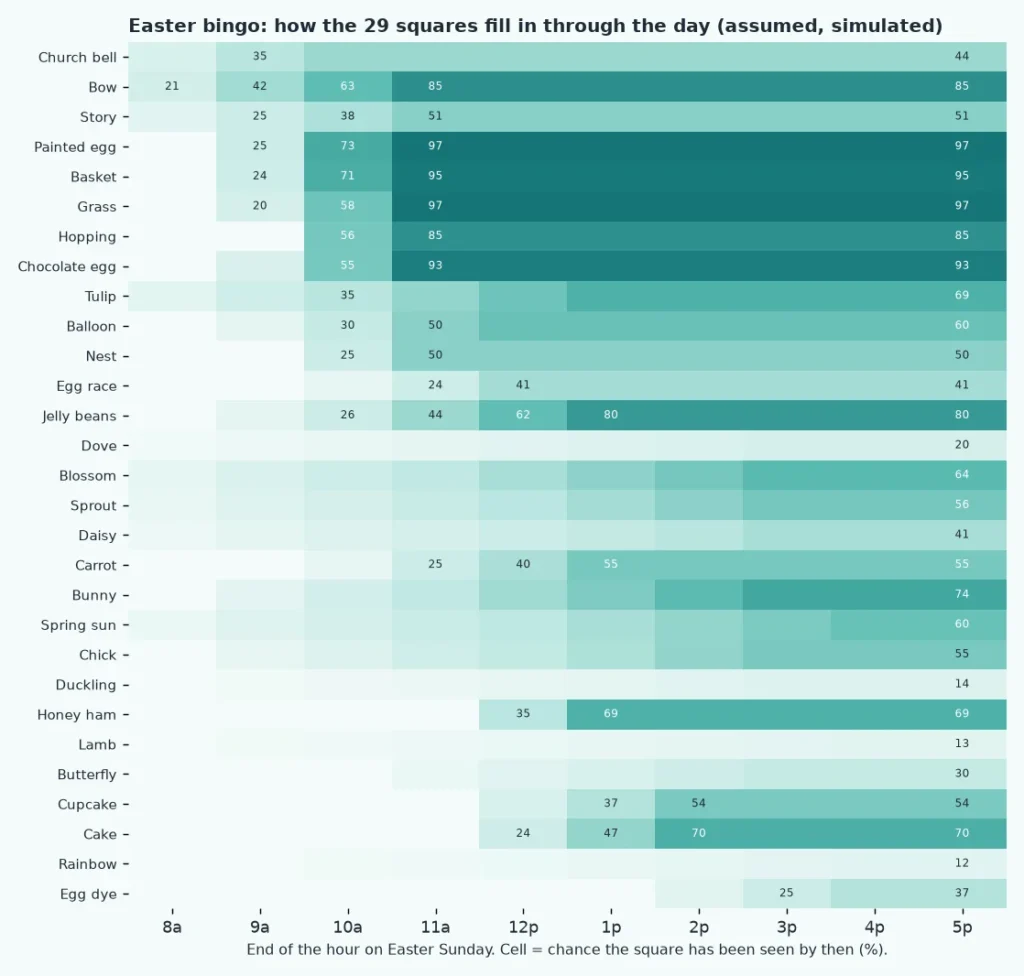
Four squares are 90 percent likely or better, and they all belong to the hunt: the painted egg, the grass, the basket and the chocolate egg. Another 10 are marked less than half the time, including the lamb, the duckling, the rainbow and the dove. On an average Easter Sunday a household sees about 17 of the 29 squares, which is why even the most active card rarely fills in completely.
Easter Sunday at home: the first line, by clock time
| Card | Median time of the first line | Line by noon | Line by 2 p.m. | Ever gets a line |
|---|---|---|---|---|
| 5×5, 1 card (a solo player) | 3:19 p.m. | 10% | 37% | 57% |
| 5×5, 6 guests with a card each | 12:17 p.m. | 42% | 84% | 95% |
| 5×5, 12 guests | 11:45 a.m. | 59% | 94% | 99% |
| 4×4, 6 guests | 11:54 a.m. | 53% | 90% | 97% |
| 3×3 with free center, 6 guests | 10:31 a.m. | 96% | 100% | 100% |
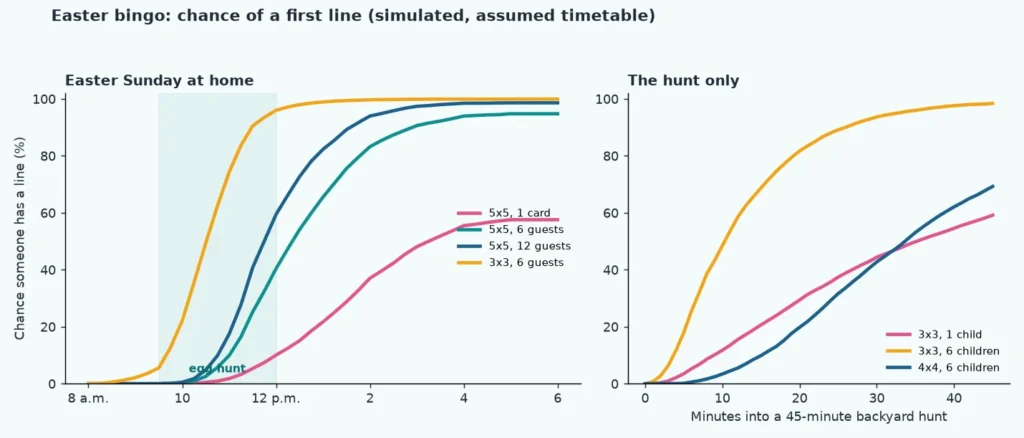
The results hold a surprise. A single Easter bingo player with a 5×5 card gets a line on only 57% of Easter Sundays, because too many squares simply never happen. Add players and the picture changes: with six guests, there is a line on 95% of days, and the median arrives at 12:17 p.m.. A 3×3 card with six players has a first line at about 10:31 a.m., just as the hunt ends, and 96% of games have a line by noon.
The hunt alone: 45 minutes in the yard
When the game is only the hunt, with squares as they might appear in a backyard, the cards have to be small. We simulated a 45-minute hunt where baskets, grass, painted eggs and chocolate eggs are almost certain and table squares such as cake and honey ham are not.
| Hunt card | Median minutes to a first line | Line by 15 minutes | Line by 30 minutes | Line by 45 minutes |
|---|---|---|---|---|
| 3×3, 1 child | 35 | 20% | 43% | 59% |
| 3×3, 6 children | 10 | 69% | 94% | 98% |
| 4×4, 6 children | 34 | 10% | 42% | 69% |
| 5×5, 6 children | no median (58% ever) | 5% | 32% | 58% |
For a hunt, print 3×3 cards. Six children on 3×3 cards have a line after a median of about 10 minutes, and 94% of hunts end with a winner by minute 30. A 5×5 card is too ambitious for a yard: even with six children, only 58% of hunts produce a line in 45 minutes. A tidy rule for Easter bingo at a hunt is this: use 3×3 for the hunt and 5×5 for the whole day.
The surprise-egg draw: how many calls?
The draw version of Easter bingo is steadier because every square is called once, in a random order. We simulated 8,000 draws with 29 calling cards:
| Cards in play | Calls to the first line (median) | Middle half of games | Calls to a full card (median) |
|---|---|---|---|
| 1 card | 17 | 14 to 19 | 29 |
| 4 cards | 13 | 11 to 15 | 28 |
| 8 cards | 11 | 10 to 13 | 28 |
| 15 cards | 10 | 9 to 12 | 28 |
| 25 cards | 9 | 8 to 11 | 28 |
| 30 cards | 9 | 8 to 10 | 27 |
An Easter bingo party of eight on 5×5 cards usually has a winner after about 11 calls, which is under half of the 29. With 3×3 cards and six players the median falls to 6 calls, and with 4×4 cards to 11. The assumptions are plain: random order, every square called once, independent random cards, and everyone playing every call.
Printable Easter bingo: print, cut and fill the basket
Printable Easter bingo is easy to prepare, because the Print tab does the arithmetic. Choose how many different cards to print, from 1 to 100, how many go on a page (1, 2, 4 or 6), Letter or A4 paper and portrait or landscape. For ten children, print two per page and five sheets. Add cut guides if you plan to trim the cards.
- Print on pastel paper or cardstock. Cards that will be carried across a yard last longer on a heavier sheet. Slip them into a plastic sleeve if the grass is wet.
- Put names on the cards. The Design tab can print a name on every card, which avoids mix-ups when children set their clipboards down.
- Use big squares for toddlers. One card per page, in portrait, gives the largest pictures.
- Print the caller sheet and calling cards for the surprise-egg draw, then fold each slip into a plastic egg.
- Bring spares and pencils. Crayons melt on a sunny porch, so pencils or stickers are safer markers.
You can save the Easter bingo PDF to a phone or USB stick and print at another house if you are celebrating away from home. The shareable link stores only the list of words, so you can message it to another host and let them print the same Easter bingo cards.
Easter bingo for kids
Easter bingo for kids is a gentle way to share one hunt among children of different ages. A child who is too young to run fast can still win Easter bingo, because the card rewards looking and not speed. The card also gives parents an easy way to slow the hunt down: “Find a square, then find an egg.” The setup depends on age.
| Age | Card | How to play |
|---|---|---|
| 2 to 4 | 3×3, one per page | A grown-up marks with the child. Sticker dots work better than pencils. Every child wins something. |
| 5 to 7 | 3×3 or 4×4 | Words with emoji. The child marks what they find. Play for a line, then four corners. |
| 8 to 11 | 4×4 or 5×5 | Add two or three squares they write themselves and a rule that a sighting must be named, such as “a tulip, red.” |
| 12 and up | Brunch table game | Teens often prefer a card they can mark with a joke. Let them write squares for next year. |
For mixed-age hunts of Easter bingo, group children by age and give each group its own colored eggs. The same thinking works for the cards: toddlers get the 3×3 card, older children the 4×4. A tidy trick for a class is to print the same list in two sizes, which lets one set of calling cards run both games. The party games for kids guide has more games that fit between the hunt and the cake.
Easter bingo free printable: what you get
Free and private
This Easter bingo free printable asks for no account and no email, and adds nothing to your PDF except the cards and a small footer. The editor runs in your browser, so the words and pictures you add stay on your device. When you close the tab, nothing is left on our side.
The five tabs
The card maker has five tabs. Setup sets the card type and size. Items holds the squares, where you can edit any word, add an emoji or upload a picture, and decide what the free space says. Design covers the color theme, fonts, text size, ALL CAPS, borders, rounded corners, tile or plain style, backgrounds, a logo, a title and a footer. Templates holds the other 29 ready-made lists. Print sets the number of cards, paper, layout, cut guides and the caller sheet, then downloads the PDF.
If you want to start from a blank page, use the blank bingo cards page; for numbers, words and every other card type in one place, open the bingo card generator.
Customize the cards in the card maker
The best Easter bingo card names your own traditions. Open the Items tab and every square turns into a text box. A few swaps families make:
- Your family’s food. Replace honey ham with lamb cake, hot cross buns, paska, simnel cake or a dish from your own table.
- A classroom party. Swap food squares for school ones: a book, a pencil, a sticker, a classmate in bunny ears.
- A church or community hunt. Keep the bell and the story, and add a verse, a hymn or the name of the church.
- A secular spring party. Delete the church bell and the story and add spring squares: a kite, rain boots, a robin.
- A grandparents’ video call. Use squares that can be spotted on a screen: “Someone waves,” “A bunny headband,” “The dog in a bow.”
When your list has more than 24 words, each card gets a different mix. With exactly 24, every card has the same words in a different order. The free space can say “Free”, or carry its own emoji, text or picture, such as the year or the family name. The Design tab can print a title and a footer, Shuffle re-deals the squares, Undo takes back a change, and the preview lets you zoom in before you download.
Hosting notes: allergies, food safety and fairness
A few details make the day smoother for everyone. They apply to any Easter game with a hunt, and they matter just as much when you play Easter bingo alongside it.
- Allergies. Several squares are food (chocolate egg, jelly beans, cake, cupcake, honey ham). If a child has an allergy to nuts, eggs or dairy, replace the squares that point at it, and fill plastic eggs with stickers or small toys.
- Egg safety. Hard-boiled eggs that are hidden outdoors should not sit out for more than about two hours in warm weather. Plastic eggs avoid the problem and give you more squares to draw from.
- Fairness. Give younger children a head start or their own zone, and agree how many eggs each child may keep. A square counts only for the child who found the thing.
- Sun and shade. A card in the sun fades and curls. Set a table in the shade with sunscreen and water next to the pencils.
- Inclusion. Easter is a Christian holiday, and families keep it in many ways: with church, with a hunt or with both. Keep the card gentle and delete any square that does not fit your group.
The tradition of decorated eggs is old and varied. The Wikipedia article on Easter eggs describes how dyed and painted eggs became a symbol of the spring holiday in many countries. Egg customs differ from one household and region to the next, which is one more reason to treat the template as a starting list.
More bingo cards for family days
The card maker holds a whole set of occasion lists beyond Easter bingo. For the weeks that follow, the summer bingo list suits school holidays, and the Thanksgiving bingo list works for autumn family dinners. A shower in the family calls for baby shower bingo, and a school party can use the classroom bingo template.
For the drive to the relatives, road trip bingo keeps the back seat busy, and the car games for kids guide adds more games. Every template is on the printable bingo cards hub, and number games run on the bingo caller.
Frequently asked questions
10 quick answers
What is Easter bingo?
Easter bingo is a bingo variation in which every square names something from the holiday, such as a painted egg, a basket, a chick or a bunny. Players mark a square when they see it or when a host calls it, and the first to complete a line wins.
Are these Easter bingo cards really free?
Yes. You can make, edit and print the Easter bingo cards without an account or a payment, and nothing you type is uploaded. The editor runs in your browser.
How many squares does the template have?
It has 29 squares. A 5×5 card with a free center uses 24 of them, a 4×4 card uses 16 and a 3×3 card with a free center uses 8. Because the list holds more words than a card has squares, cards differ from each other.
How many different cards can I print?
Up to 100 different cards in one PDF. There are 118,755 different sets of 24 squares on a 5×5 card, so even a large class can have one card each without repeats.
Can I use these cards for an egg hunt?
Yes. Use 3×3 Easter bingo cards for the hunt itself. In our simulation, six children on 3×3 cards have a first line after a median of about 10 minutes of a 45-minute hunt, while 5×5 cards rarely finish in a yard.
How does the surprise-egg draw work?
Print the calling cards from the Print tab, cut them out, and fold one into each plastic egg. A host draws an egg, opens it and reads the square. With eight players on 5×5 cards, a winner appears after about 11 calls.
What prizes work for an Easter bingo game?
Prizes for an Easter bingo game should be small and sweet or small and silly: first pick from the prize basket, a golden egg, stickers, a pencil with a bunny on top, or a chocolate. Give everyone who completes a card something, so the game stays friendly.
Can I change the squares to match my family?
Yes. On the Items tab every square can be edited, replaced with an emoji or given a picture. Swap honey ham for your own dish, add the dog in a bow, and use the free space for the family name.
What size should I print for toddlers?
For Easter bingo with toddlers, print a 3×3 card, one per page, with large pictures for ages two to four. It has only eight squares plus a free center, so a line comes quickly and a grown-up can mark with the child.
Can I play Easter bingo on a video call?
Yes. Send the shareable link or the PDF of the Easter bingo cards, let everyone print or draw a card, and call squares from a screen. For a live round with your own list, the play custom bingo online page explains how.