Knitting graph paper has cells that are wider than they are tall, the same shape as real stitches, so a chart looks like the finished knitting. This free printable knitting graph paper sizes each cell to your gauge, from 16 to 32 stitches and 20 to 40 rows over 4 inches (10 cm), with a darker line every tenth line for easy counting.
Knitting graph paper to print (PDF)
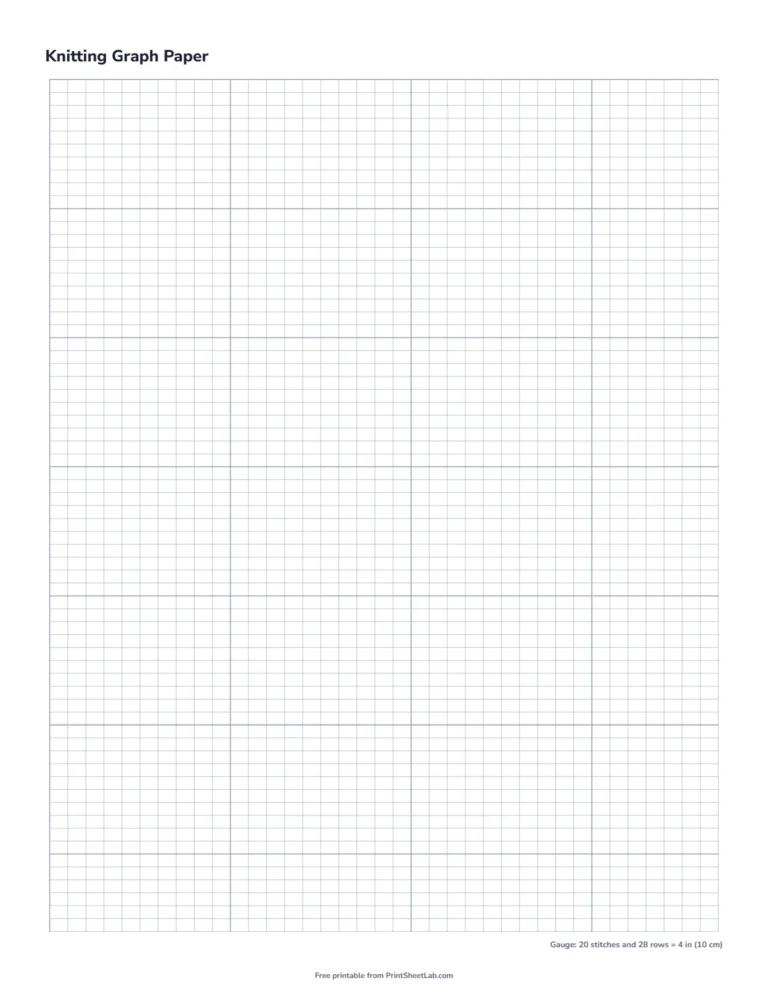
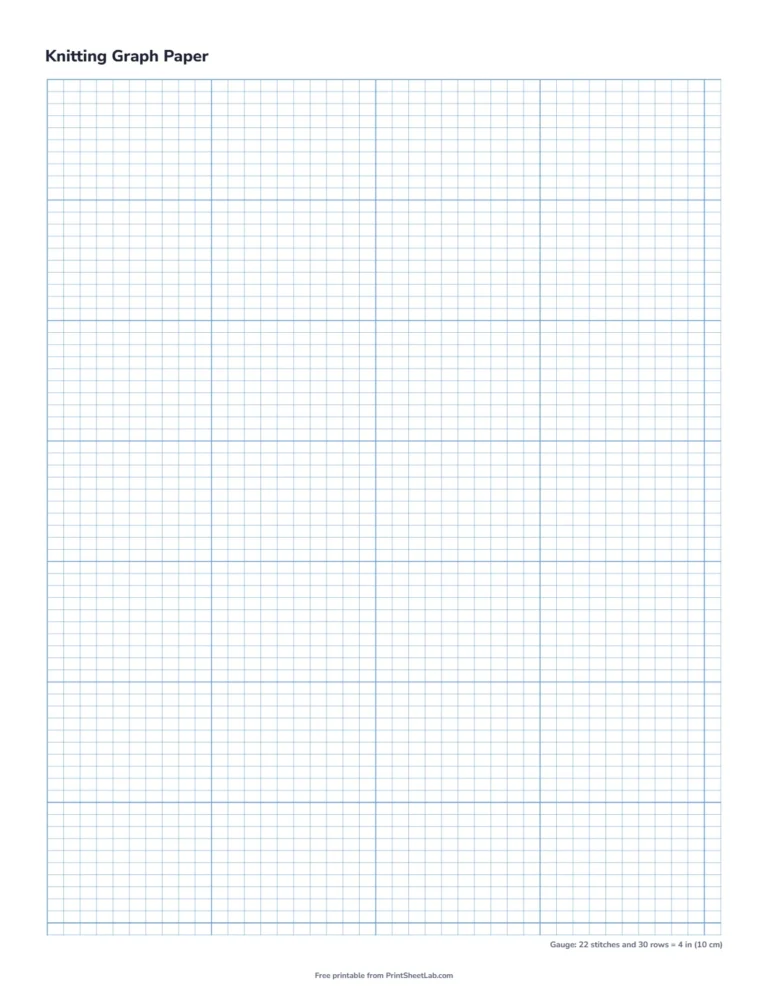
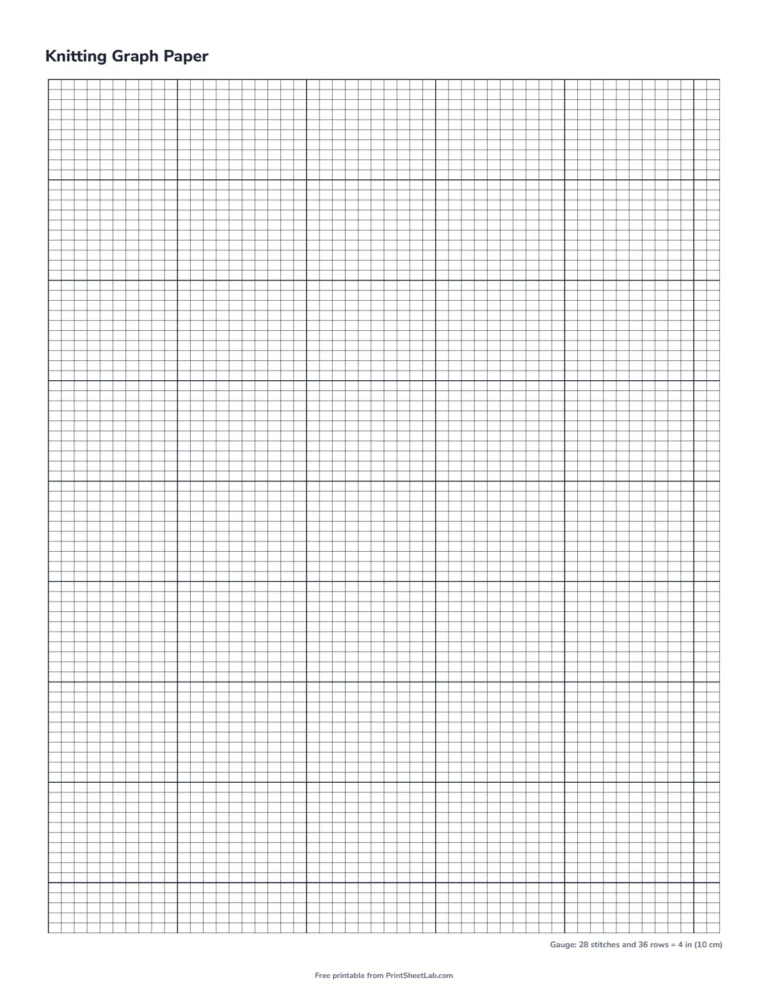
These four pages show the choices: a worsted-weight gauge of 20 stitches and 28 rows, a gauge of 22 and 30 in blue, a fine gauge of 28 and 36 in black, and a filled heart chart. Click a picture for the PDF, or use the generator above to enter your own gauge.
Why knitting chart paper is not square
A knitted stitch is wider than it is tall. For example, a typical worsted-weight swatch has about 20 stitches and 28 rows over 4 inches. Each stitch is 0.20 inch wide and 0.14 inch tall, so the stitch is 40% wider than it is high. If you chart a design on ordinary square graph paper, the knitted result comes out shorter and wider than your drawing. Knitting chart paper fixes this by making the cells the same shape as your stitches, so that what you draw is what you knit.
How to set your gauge on knitters graph paper
- Knit a swatch at least 6 inches wide, in the stitch pattern and the yarn you plan to use.
- Wash and dry the swatch the same way you will wash the finished piece, then let it rest flat.
- Count the stitches across 4 inches (10 cm), and the rows up 4 inches.
- Choose the nearest values in the generator. If your gauge falls between two settings, choose the closer one, then check the size of your chart against your swatch.
The paper uses 4 inches as its unit, so a gauge of 20 stitches and 28 rows means cells that are 0.20 inch by 0.143 inch. The generator offers 7 stitch counts (16, 18, 20, 22, 24, 28 and 32) and 8 row counts (20, 24, 26, 28, 30, 32, 36 and 40), which gives 56 gauges.
Gauge graph paper: cell sizes and chart sizes
This table lists the size of a cell and how many cells fit on a page for six common gauges. It is measured from the generator’s PDFs on US Letter paper:
| Gauge per 4 inches (10 cm) | One cell (wide x tall) | Row-to-stitch ratio | Cells across x down | Size of the chart on the page |
|---|---|---|---|---|
| 16 stitches, 20 rows | 6.3 x 5.1 mm | 1.25 | 30 x 47 | 7.5 x 9.4 in |
| 20 stitches, 28 rows | 5.1 x 3.6 mm | 1.40 | 37 x 66 | 7.4 x 9.4 in |
| 22 stitches, 30 rows | 4.6 x 3.4 mm | 1.36 | 41 x 71 | 7.5 x 9.5 in |
| 24 stitches, 32 rows | 4.2 x 3.2 mm | 1.33 | 45 x 75 | 7.5 x 9.4 in |
| 28 stitches, 36 rows | 3.6 x 2.8 mm | 1.29 | 52 x 85 | 7.4 x 9.4 in |
| 32 stitches, 40 rows | 3.2 x 2.5 mm | 1.25 | 60 x 94 | 7.5 x 9.4 in |
On every sheet, every tenth line is darker. You can count 10 stitches at a glance, which is useful for long rows.
Which gauge for which yarn?
Yarn labels give a typical stockinette gauge. These are the usual ranges for the standard yarn weights, which you can use as a starting point if you have not yet made a swatch:
| Yarn weight | Typical stockinette gauge, stitches per 4 inches | Charts: try |
|---|---|---|
| Bulky or chunky | 12 to 15 | Below the range of the generator; use 16 stitches |
| Worsted or aran | 16 to 20 | 16 or 20 stitches |
| DK or light worsted | 21 to 24 | 22 or 24 stitches |
| Sport or fine | 23 to 26 | 24 stitches |
| Fingering or sock | 27 to 32 | 28 or 32 stitches |
Your own gauge matters more than the label, because it depends on your needles and your tension.
How to read a knitting chart
A knitting chart is read from the bottom up, like the knitting itself. When you knit flat, the first row is a right-side row, which you read from right to left. The next row is a wrong-side row, which you read from left to right, and you purl the stitches that the chart shows as knit. When you knit in the round, every row is read from right to left. Mark the row you are on with a ruler or a sticky note. For background on charts and techniques, see Wikipedia’s knitting article.
Knitting chart example: a heart motif
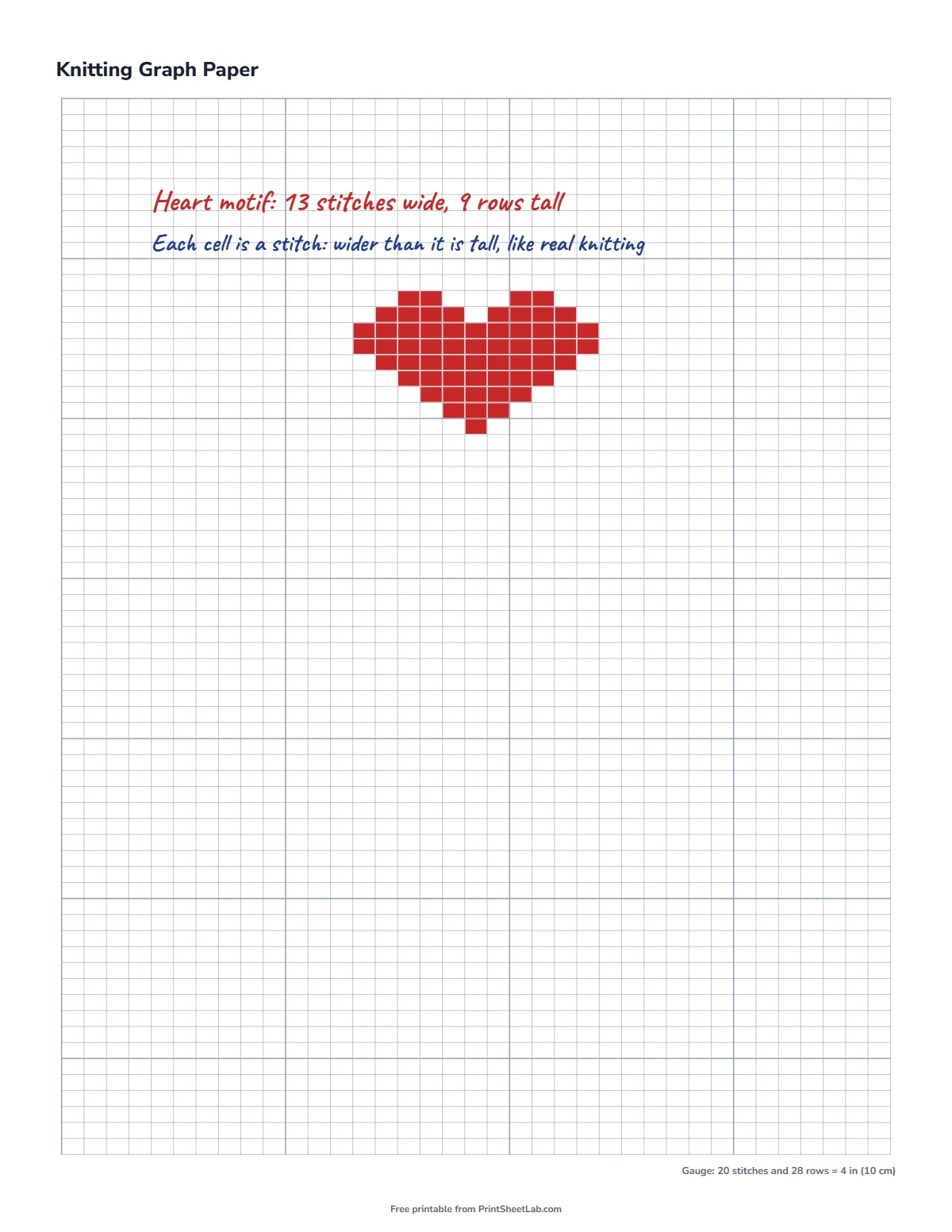
The filled example above is a heart that is 13 stitches wide and 9 rows tall. It has 59 red stitches and 58 background stitches. The knitted size depends on the gauge, and because stitches are wider than they are tall, the heart is much wider than a square-grid drawing would suggest:
| Gauge | Heart motif, 13 x 9 stitches, knitted size | Shape (width to height) |
|---|---|---|
| Square graph paper | Not to scale | 1.44 to 1 |
| 16 stitches, 20 rows | 3.25 x 1.80 in | 1.81 to 1 |
| 20 stitches, 28 rows | 2.60 x 1.29 in | 2.02 to 1 |
| 22 stitches, 30 rows | 2.36 x 1.20 in | 1.97 to 1 |
| 24 stitches, 32 rows | 2.17 x 1.12 in | 1.93 to 1 |
| 28 stitches, 36 rows | 1.86 x 1.00 in | 1.86 to 1 |
| 32 stitches, 40 rows | 1.62 x 0.90 in | 1.81 to 1 |
At 20 stitches and 28 rows, the heart measures 2.6 inches across and 1.3 inches high, which is twice as wide as it is tall. On square paper the same heart would look as if it were 1.4 times as wide as tall. This is why a chart on gauge paper matters for any design that has to keep its shape.
Colorwork chart template: planning floats
In stranded colorwork (often called Fair Isle) the color you are not using is carried across the back of the work as a float. Long floats snag and make the fabric pucker, and many knitters catch the yarn after about five stitches. A chart makes the runs easy to see. In the heart, the longest run of one color is 6 stitches, in the bottom row, so on that row the red yarn floats across six stitches at a time, and you should catch the float once to keep it from snagging. Use a colorwork chart template to check every row before you start.
Other ways to use knitting graph paper
- Cables and lace. Draw each stitch as a symbol and use the grid as a key.
- Intarsia. Plan blocks of color, such as a name or a picture in the middle of a sweater.
- Increase and decrease shaping. Draw the outline of a sleeve or a neckline, and count the stitches on each row.
- Designing from a photo. Trace a simple shape, then color the cells that it covers.
Cross-stitch uses square cells, so for that use graph paper.
Printing tip
Print at 100% or “Actual size” and turn off “Fit to page”, so every measurement on the sheet is exact. Choose Letter or A4 paper in the generator before you download the PDF.
Knitting graph paper: frequently asked questions
How do I find my gauge for knitting graph paper?
Knit a swatch, then count the stitches and rows over 4 inches (10 cm). Enter those numbers and the cells match your fabric.
Does it work for cross-stitch?
Cross-stitch uses square cells. Choose the same number of stitches and rows (for example 20 and 20) for square cells.
Why are the cells not square?
Knitted stitches are wider than they are tall, so the cells are drawn in the same shape. This keeps your chart in proportion to the finished work.
How many cells fit on a page?
It depends on the gauge. At 20 stitches and 28 rows, a Letter page holds 37 cells across and 66 down.
Is this knitting graph paper free?
Yes. It is free to print for home and classroom use, with no sign-up.
More printable paper
- Specialty paper generator with every layout on this site
- Paper generator for lined, graph, dot grid, isometric and handwriting paper
- Graph paper, lined paper and dot grid paper