A concrete calculator turns the size of your pour into the amount to buy: cubic yards or cubic meters for a ready-mix truck, or the number of 40, 60 or 80 lb bags for a DIY job. Pick a shape, type the sizes, add 5 to 10% waste, and the concrete calculator updates the answer as you type.
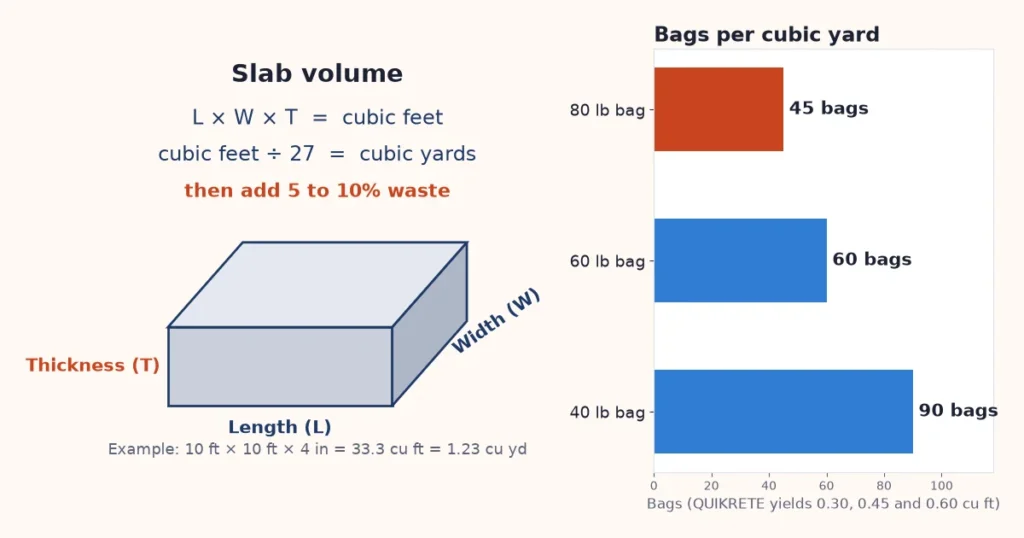
Quick answer: Volume = length × width × thickness. For a 10 ft × 10 ft slab that is 4 in thick, 10 × 10 × (4 ÷ 12) = 33.3 cubic feet, which is 1.23 cubic yards (divide cubic feet by 27). Add 10% waste for 1.36 cubic yards, or about 62 bags of 80 lb mix at 0.60 cubic feet per bag.
How to use the concrete calculator
The concrete calculator works for six shapes in imperial (feet, inches, cubic yards) or metric (meters, centimeters, cubic meters). Switch units at the top of the concrete calculator, then follow these steps.
- Choose what you are pouring: a slab, footing, wall, column, round column or post hole, or hollow tube.
- Type the sizes. Long dimensions are in feet or meters; thickness, depth and small widths are in inches or centimeters.
- Set the number of identical pieces if you are pouring several post holes, piers or footings.
- Keep the 10% waste allowance, or lower it to 5% for a flat, well-prepared base.
- Pick your bag size and read what the concrete calculator gives: the cubic yards, the bags to buy, the ready-mix amount rounded up, and the working underneath.
Concrete volume formula for every shape
Every concrete calculator finds the volume of the shape, adds waste, then converts to what you can buy. Here is the concrete volume formula for each shape, with small sizes divided by 12 (inches to feet) or 100 (centimeters to meters).
| Shape | Formula | Example |
|---|---|---|
| Slab or patio | length × width × thickness | 12 ft × 20 ft × 6 in = 120 cu ft |
| Footing or trench | length × width × depth | 100 ft × 20 in × 10 in = 138.9 cu ft |
| Wall | length × height × thickness | 30 ft × 6 ft × 8 in = 120 cu ft |
| Square or rectangular column | width × depth × height | 16 in × 24 in × 9 ft = 24 cu ft |
| Round column or post hole | π × (diameter ÷ 2)² × height | 12 in × 4 ft = 3.14 cu ft |
| Hollow tube | π ÷ 4 × (outside² − inside²) × length | 24 in outside, 3 in wall, 10 ft = 13.7 cu ft |
The volume calculator handles other solids, and the unit converter switches between units.
Concrete calculator worked examples with the working shown
Example 1: a 12 ft × 20 ft slab, 6 in thick
The slab holds 12 × 20 × (6 ÷ 12) = 120 cubic feet. With 5% waste that is 126 cubic feet, or 126 ÷ 27 = 4.67 cubic yards, so you would order 4.75 cubic yards of ready-mix (suppliers sell by the quarter yard). In 80 lb bags that is 126 ÷ 0.60 = 210 bags.
Example 2: six post holes, 12 in wide and 4 ft deep
One hole holds π × (0.5 ft)² × 4 ft = 3.14 cubic feet, so six holes hold 18.85. With 10% waste that is 20.73 cubic feet, or 0.77 cubic yards, which is 20.73 ÷ 0.60 = 34.6, so buy 35 bags of 80 lb mix. This is a job for bags, not a truck.
Example 3: a 3 m × 3 m patio, 10 cm thick (metric)
The slab holds 3 × 3 × 0.10 = 0.90 cubic meters, or 0.99 with 10% waste. In 25 kg bags of about 11.75 liters each, that is 990 ÷ 11.75 = 84.3, so buy 85 bags, or order 1.0 cubic meter of ready-mix.
How many bags of concrete do I need?
The concrete calculator finds the number of bags by dividing the volume you need by the yield of one bag, then rounding up. The QUIKRETE Concrete Mix data sheet lists 0.30 cubic feet for a 40 lb bag, 0.45 for a 60 lb bag and 0.60 for an 80 lb bag. Always check the yield printed on your own bag, because brands differ.
| Bag size | Yield per bag | Bags per cubic yard | Bags per cubic meter | Bags for 10 cu ft |
|---|---|---|---|---|
| 40 lb | 0.30 cu ft | 90 | 118 | 34 |
| 60 lb | 0.45 cu ft | 60 | 79 | 23 |
| 80 lb | 0.60 cu ft | 45 | 59 | 17 |
For metric bags the concrete calculator scales the QUIKRETE figures by weight, at about 0.47 liters per kilogram: about 9.4 liters for 20 kg, 11.75 for 25 kg and 14.1 for 30 kg. Type your own yield in the optional box if your bag says otherwise.
How many 80 lb bags make a yard?
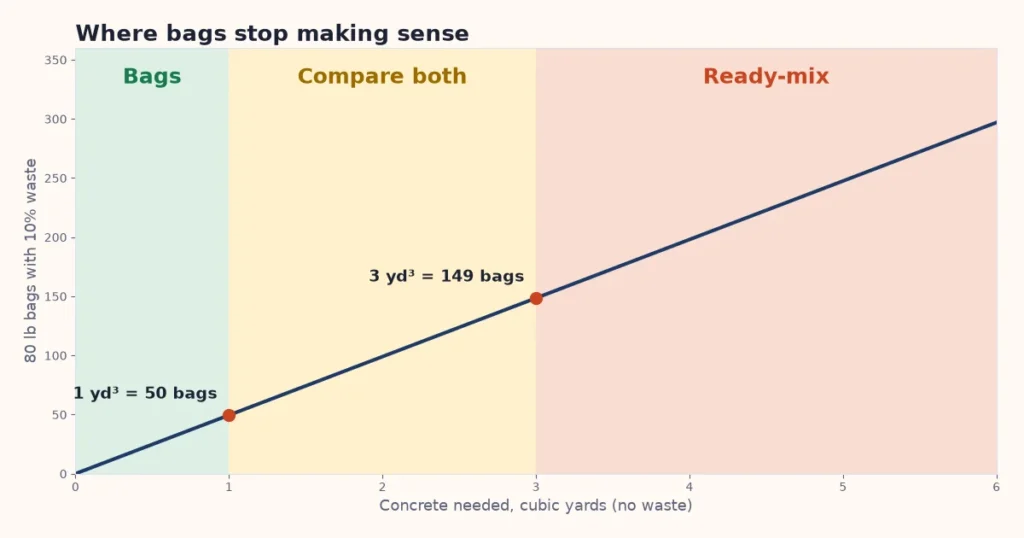
It takes 45 bags of 80 lb mix to make one cubic yard, because 27 cubic feet divided by 0.60 is 45. With 10% waste, plan on 50 bags. A 60 lb bag needs 60 bags per yard, and a 40 lb bag needs 90.
Concrete calculator for slab, patio and driveway
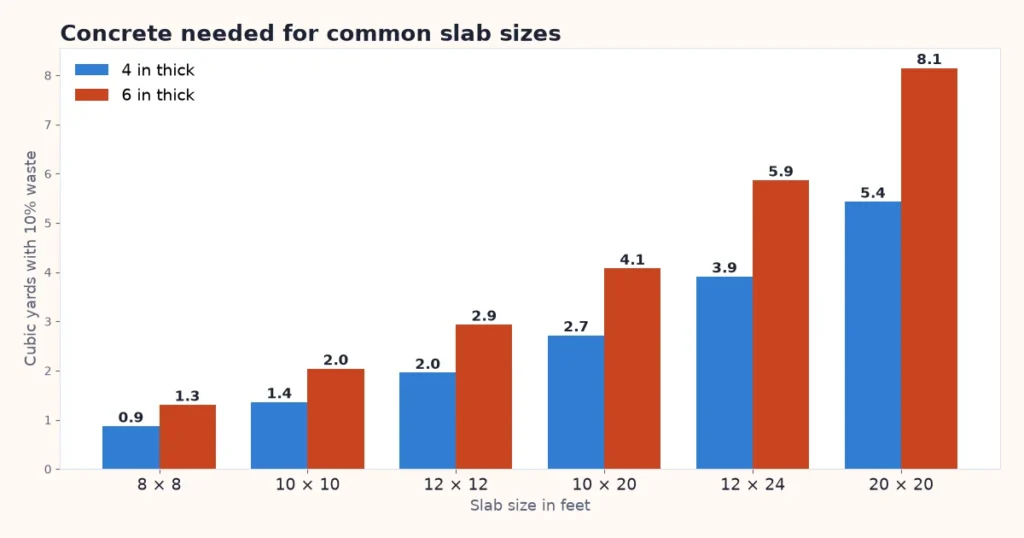
A slab is the most common job for a concrete calculator. The table gives the net volume, the volume with 10% waste, and the 80 lb bags to buy for a 4 in slab (paths and patios) and a 6 in slab (driveways and garage floors).
| Slab size | 4 in: cu yd | 4 in: +10% | 4 in: bags | 6 in: cu yd | 6 in: +10% | 6 in: bags |
|---|---|---|---|---|---|---|
| 8 × 8 ft | 0.79 | 0.87 | 40 | 1.19 | 1.30 | 59 |
| 10 × 10 ft | 1.23 | 1.36 | 62 | 1.85 | 2.04 | 92 |
| 12 × 12 ft | 1.78 | 1.96 | 88 | 2.67 | 2.93 | 132 |
| 12 × 24 ft | 3.56 | 3.91 | 176 | 5.33 | 5.87 | 264 |
| 20 × 20 ft | 4.94 | 5.43 | 245 | 7.41 | 8.15 | 367 |
The base matters as much as the volume. Use a compacted gravel sub-base and level, braced forms. A walkway is often 4 in thick, while a driveway or garage floor is commonly 5 to 6 in; check local rules and any supplier or engineer advice.
Concrete calculator for footings and walls
A footing is a long, narrow trench of concrete. The concrete calculator for footings multiplies the trench length by the width and depth. The table shows what each 10 ft run holds.
| Footing width × depth | Cu ft per 10 ft | Cu yd per 10 ft | 80 lb bags per 10 ft (+10%) |
|---|---|---|---|
| 12 in × 6 in | 5.00 | 0.185 | 10 |
| 16 in × 8 in | 8.89 | 0.329 | 17 |
| 20 in × 10 in | 13.89 | 0.514 | 26 |
| 24 in × 12 in | 20.00 | 0.741 | 37 |
Foundation footings carry the weight of a building, so their size and depth come from the local building code and the soil, not from a calculator. Use these numbers to estimate material and have an engineer confirm the design.
Concrete calculator for post holes and tube forms
Deck posts, fence posts and piers use round holes or cardboard tube forms, so the concrete calculator for post holes uses the cylinder formula. The table shows what one hole holds and how many 80 lb bags it takes with 10% waste.
| Hole diameter | 3 ft deep: cu ft | 3 ft deep: bags | 4 ft deep: cu ft | 4 ft deep: bags |
|---|---|---|---|---|
| 8 in | 1.05 | 2 | 1.40 | 3 |
| 10 in | 1.64 | 3 | 2.18 | 4 |
| 12 in | 2.36 | 5 | 3.14 | 6 |
| 16 in | 4.19 | 8 | 5.59 | 11 |
| 24 in | 9.42 | 18 | 12.57 | 24 |
Concrete calculator cubic yards and cubic meters
US suppliers quote cubic yards and the rest of the world quotes cubic meters, so the concrete calculator cubic yards result is also shown in cubic meters. One cubic yard is 27 cubic feet or 0.7646 cubic meters, and one cubic meter is 35.31 cubic feet or 1.308 cubic yards. For example, 1.36 cubic yards is 1.04 cubic meters.
Ready-mix truck or bags? How to choose
Bags suit small pours and ready-mix suits large ones, and the concrete calculator shows both amounts side by side. Once you need more than about one cubic yard (45 bags of 80 lb mix, or 0.75 cubic meters), compare the two. Beyond three yards, hand-mixing is slow, and a stalled pour leaves a weak cold joint.
A standard mixer truck usually carries 8 to 10 cubic yards in the United States. In the UK, a full-size truckmixer carries 6 or 8 cubic meters, and suppliers such as Hanson also run mini-mix trucks for small loads. Many suppliers add a short-load fee or set a minimum order for small deliveries, so ask before you book.
| Pour | Volume with 10% waste | 80 lb bags | Typical choice |
|---|---|---|---|
| 6 post holes (12 in × 4 ft) | 0.77 cu yd | 35 | Bags |
| 10 ft × 10 ft patio, 4 in | 1.36 cu yd | 62 | Bags or mini-mix |
| 12 ft × 20 ft slab, 6 in | 4.89 cu yd | 220 | Ready-mix |
| 24 ft × 24 ft garage floor, 6 in | 11.73 cu yd | 528 | Ready-mix, 2 loads |
For a cost example with illustrative prices, if an 80 lb bag is $7.00, the 62 bags for the patio cost $434. If ready-mix is $190 per cubic yard, the 1.5 yards you would order cost $285 before delivery and short-load fees. Type your own prices into the concrete calculator to compare.
How much extra concrete to order
Order 5 to 10% more than the exact volume. Ground is rarely level, forms bulge, and some mix is lost in the wheelbarrow and chute. Use 5% for a flat, compacted base with rigid forms, and 10% or more for rough excavations, post holes and small jobs. Running short is worse than having extra, because a second delivery arrives after the first batch has started to set.
Concrete calculator by region: US, Canada, UK and Australia
Units, bag sizes and buying habits differ by country, so check the local details before you order.
Concrete calculator for the United States and Canada
US ready-mix is sold in cubic yards, usually rounded up to the nearest quarter or half yard, and DIY mix comes in 40, 50, 60 and 80 lb bags. QUIKRETE Concrete Mix reaches 4,000 psi after 28 days, according to its data sheet. Canadian ready-mix is ordered in cubic meters and bag weights are printed in kilograms, so type the yield from the bag. Local codes set footing depth for frost and permit rules.
Concrete calculator for the UK and Europe
Ready-mix is sold in cubic meters. Some suppliers set a 1 m³ minimum order for small loads, as Brett does for domestic customers, and mini-mix trucks serve small loads. Bagged mixes are usually 20 or 25 kg, and bulk bags of ballast need cement added.
Concrete calculator for Australia and New Zealand
Ready-mix is ordered by the cubic meter in strength grades such as N20 or N25 MPa, and small-load services cover small jobs. Premix bags are typically 20 kg and yield roughly 0.009 to 0.011 cubic meters each, so check your bag. A 0.5 m³ garden slab is roughly 45 to 56 bags.
Reinforcement, safety and when to ask an engineer
This concrete calculator estimates the volume of concrete only. Reinforcement such as rebar, welded wire mesh or fiber, control joints and a gravel base are separate decisions that depend on the load, the soil and the local code.
- Structural work: foundations, retaining walls, suspended slabs, stairs and load-bearing columns need an engineer, a permit and an inspection.
- Wet concrete is caustic: the QUIKRETE data sheet warns of severe skin burns and serious eye damage. Wear impervious gloves, a mask and eye protection.
- Curing: keep the surface moist for at least 5 days in warm weather or 7 days in colder weather, as the data sheet advises.
- Call before you dig: locate buried utilities before digging footings or post holes.
Common mistakes with a concrete calculator
- Mixing units in a concrete calculator. Thickness is in inches or centimeters while length is in feet or meters. Forgetting to divide by 12 is the classic error.
- Skipping waste. The exact volume leaves no room for a low spot or a spill.
- Trusting a random bag yield. Use the number on your bag.
- Forgetting the sub-base. Digging an inch too deep adds an inch of concrete across the whole slab.
Frequently asked questions
9 quick answers
How do I calculate how much concrete I need for a slab?
Multiply length by width by thickness, all in feet, then divide by 27 for cubic yards. A 10 ft × 12 ft × 4 in slab is 10 × 12 × 0.333 = 40 cubic feet, or 1.48 cubic yards, so order about 1.6 with 10% waste. The concrete calculator does this in one step.
How many bags of concrete do I need for a 10 x 10 slab?
A 10 ft × 10 ft slab that is 4 in thick needs 33.3 cubic feet, or 56 bags of 80 lb mix (62 with 10% waste). At 6 in thick it needs 50 cubic feet, which is 84 bags (92 with waste).
How many 80 lb bags of concrete are in a yard?
One cubic yard needs 45 bags of 80 lb mix, because each bag yields about 0.60 cubic feet and 27 ÷ 0.60 = 45. Add 10% for waste and buy about 50 bags.
How many bags of concrete for a post hole?
A 12 in wide hole that is 3 ft deep holds 2.36 cubic feet, which is 5 bags of 80 lb mix with 10% waste. A 10 in hole 3 ft deep takes 3 bags.
Is it cheaper to mix concrete myself or order ready-mix?
For under about one cubic yard, bags are usually cheaper and simpler. For several yards, ready-mix is often cheaper once you count labor, mixer hire and time, though short-load fees apply to small deliveries.
How much extra concrete should I order?
Order 5 to 10% more than the calculated volume. Use 5% for a flat base with rigid forms and 10% or more for uneven ground, post holes and small jobs.
How thick should a concrete slab be?
A patio or walkway slab is commonly 4 inches thick, and driveways and garage floors are often 5 to 6 inches. Local codes, soil, loads and climate may require more.
Do I need rebar or mesh?
Many slabs use reinforcement to control cracking, but the right type depends on the load, soil and code. Ask a local supplier or engineer. Structural concrete always needs a professional design.
Can I use this concrete calculator for metric sizes?
Yes. Choose Metric at the top of the concrete calculator, enter meters and centimeters, and read cubic meters and bags in kilograms. It also shows cubic yards.
Related calculators and worksheets
- Volume calculator for boxes, cylinders and other solids
- Perimeter and area calculator for the surface of a slab
- Square footage calculator for room and lot areas
- Mulch calculator for garden beds
- Paint calculator and flooring calculator for the rest of the project
- Geometry worksheets to practice volume and area
Sources and further reading
- QUIKRETE Concrete Mix 1101 data sheet for bag yields, strength, curing and safety
- Concrete on Wikipedia for materials and curing
- Hanson truck information for UK truckmixer sizes and mini-mix loads
- Brett small-load concrete for UK minimum-order practice
Bag yields and ready-mix practice vary by brand, supplier and region. This calculator gives planning estimates, not an engineering design.
Last updated: October 2026.