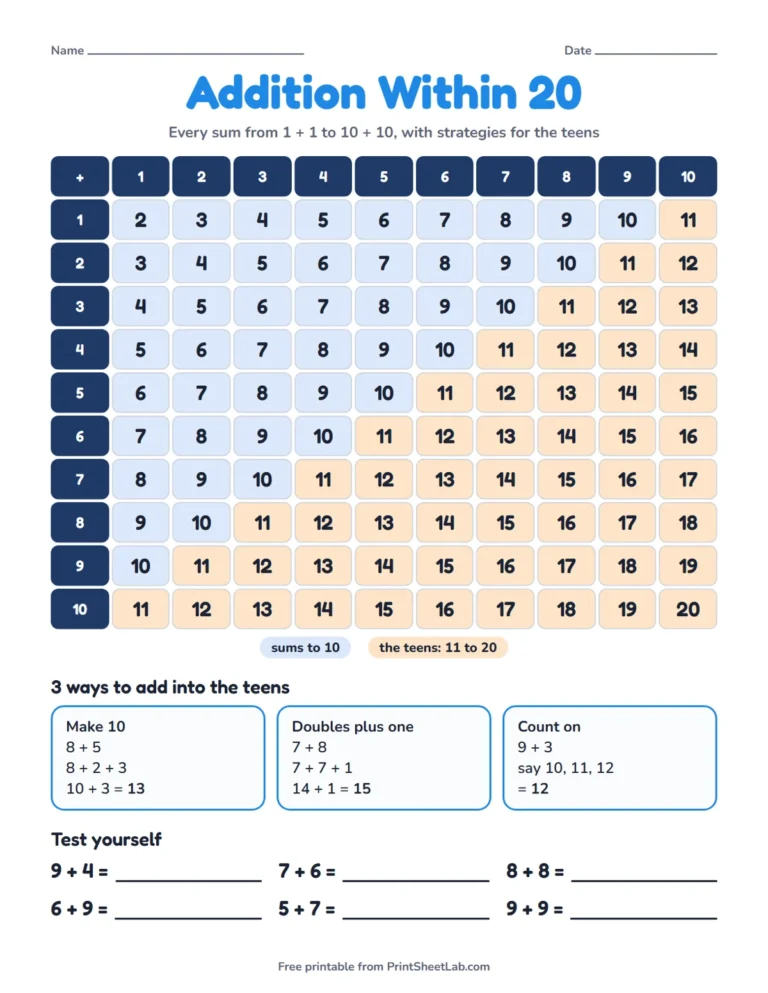
This addition within 20 game helps first graders learn their sums to 20 by playing: race cars, pop balloons, flip memory cards or sprint through true and false sentences. Every question adds two numbers with a total of 20 or less, such as 7 + 8, 9 + 6 or 12 + 8, in random order, so children get daily addition within 20 practice and learn the facts to 20 as facts they can recall. It is free, needs no sign-up, works on phones and tablets, and comes with a printable addition within 20 chart.
Addition within 20 game: see how it plays
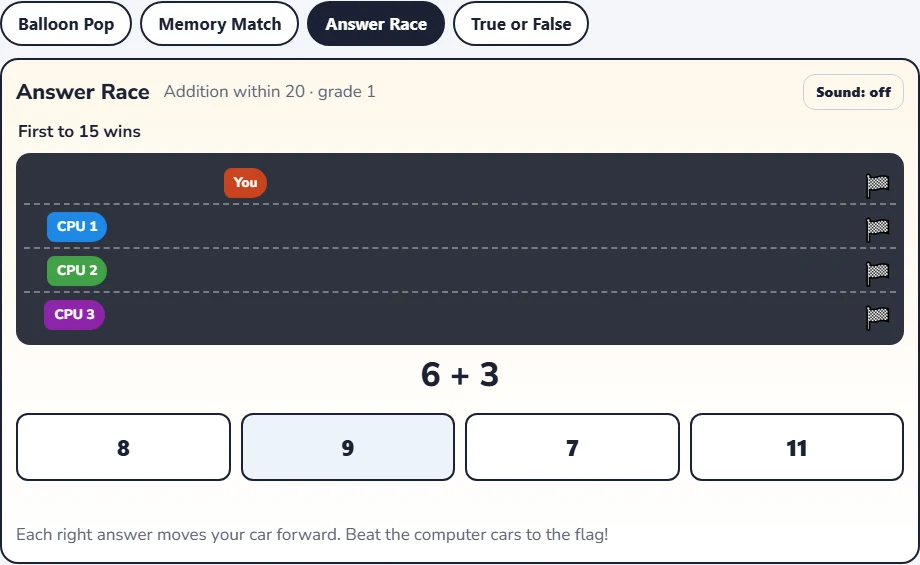
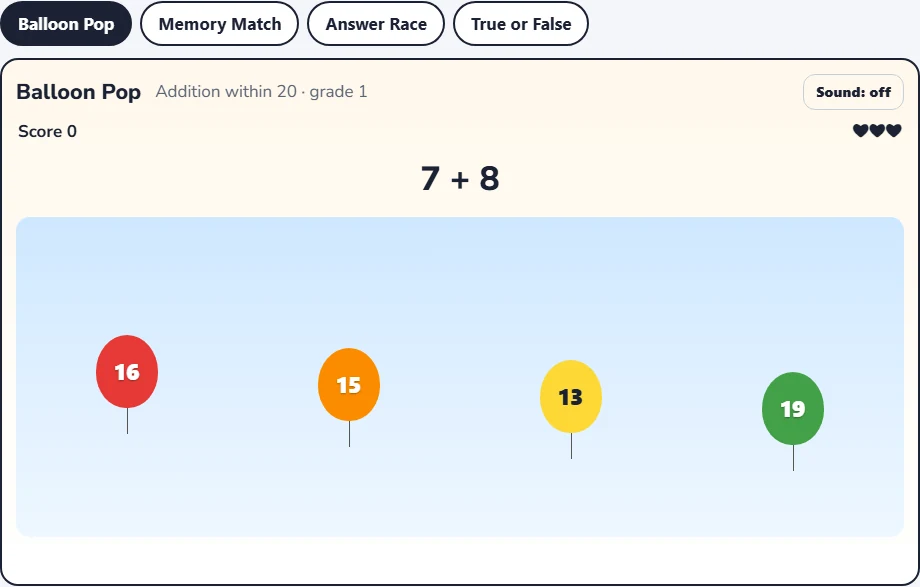
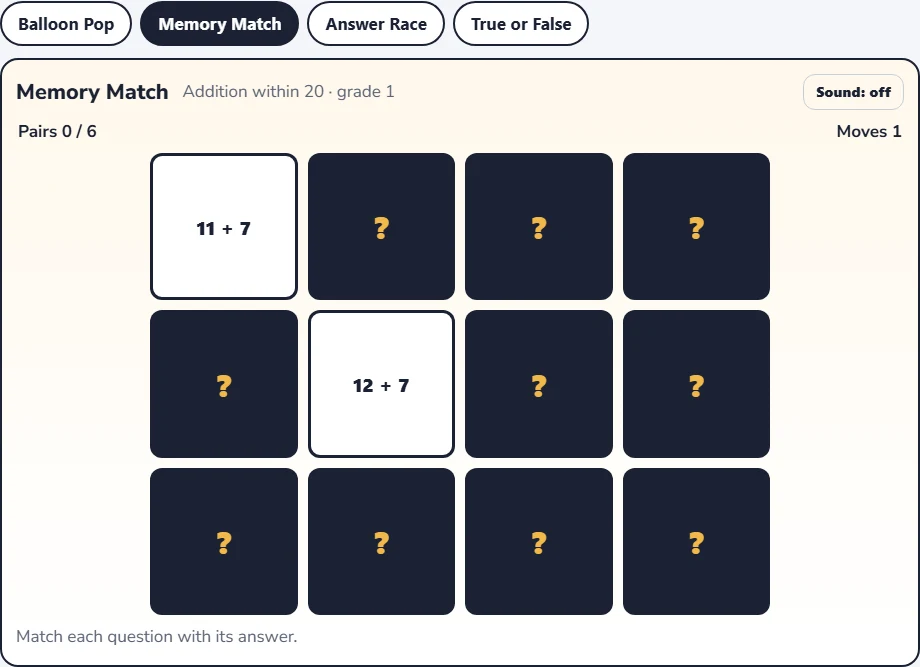
The game below has four modes, and each one asks only adding to 20 questions. The printable chart shows every sum from 1 + 1 to 10 + 10 with the teens in orange, and the pictures show Answer Race, Balloon Pop and Memory Match on this page.
How the addition within 20 game works
- Answer Race: every right answer moves your car forward, and you race three computer cars to the finish flag. The first to 15 wins, and wrong taps cost time, not places.
- Balloon Pop: answers float up on balloons, and you pop the right one before it drifts off the top. The wrong balloons sit within 4 of the right answer, so children have to work out the sum and not just spot the odd one out. The game speeds up as your score climbs, and three misses ends the round.
- Memory Match: twelve face-down cards hide six sums such as 6 + 7 and their six answers. Flip two at a time and match each one to its answer in as few moves as you can.
- True or False: sixty seconds on the clock. Decide whether each sentence, such as 9 + 8 = 16, is right or wrong. A streak of five or more scores double.
Addition facts to 20: five strategies for the teens
Once children know their sums to 10, the teen sums are built from facts they already have. Teach one strategy at a time, and let children choose the one that feels quickest for each fact:
| Strategy | Example facts | How it works |
|---|---|---|
| Doubles | 6 + 6 = 12 and 9 + 9 = 18 | Double the number: 9 + 9 is 18 |
| Near doubles | 6 + 7 = 13 and 8 + 9 = 17 | Double the smaller number, then add 1 |
| Make 10 | 9 + 5 = 14 and 8 + 7 = 15 | Break one number to fill the ten first |
| Ten and ones | 10 + 7 = 17 and 12 + 4 = 16 | Say the tens and ones: ten and seven |
| Count on | 14 + 3 = 17 and 15 + 2 = 17 | Start at the bigger number and count up |
The make-10 strategy, also called bridging through ten, is the most useful. To add 8 + 6, take 2 from the 6 to turn the 8 into 10, which leaves 4 more: 10 + 4 = 14. It works because ten is the easiest number to add to, and it prepares children for regrouping in two-digit addition. The addition within 20 game asks every kind of teen fact, so it is a quick way to see which strategy a child needs. Our guide to addition strategies for kids shows each method with pictures.
Grade 1 addition game: a teaching order that works
- Be sure of sums to 10 first. Play the addition within 10 game until facts such as 4 + 6 and 7 + 3 are instant.
- Learn the doubles to 10 + 10: 2, 4, 6, 8, 10, 12, 14, 16, 18 and 20. Doubles are anchors for the near doubles.
- Add near doubles: 6 + 7 is one more than 6 + 6, so it is 13.
- Practice make 10: know the pairs that make 10, then use them to bridge, as in 9 + 4 = 10 + 3. The number bonds to 10 game helps.
- Add speed with Answer Race and Balloon Pop in the addition within 20 game once accuracy is high.
Math facts game ideas: adding to 20 game activities at home and school
- Dozen eggs: a carton holds 12 eggs. If 8 more are bought, 12 + 8 = 20 eggs.
- Dice and cards: roll two dice and add them, then add a third die, or use playing cards with the face cards removed.
- Number line: hop from 9 to 10 and then on to 14 to see why 9 + 5 = 14. Our number line maker prints jumps ready to draw on.
- Ten frames: fill one ten frame and start on a second to see the teens as “ten and some more”.
Addition within 20 practice: word problems
- Mia has 9 stickers and Leo gives her 7 more. How many stickers does she have? Answer: 16.
- There are 8 red apples and 8 green apples in a basket. How many apples are there? Answer: 16.
- A bus has 12 children on it, and 6 more climb on. How many children are on the bus? Answer: 18.
- Sam read 7 pages before lunch and 9 after. How many pages did he read? Answer: 16.
Where addition within 20 fits at school
| Level | What children are expected to do |
|---|---|
| Grade 1 (US) | Add and subtract within 20, and show fluency within 10 (1.OA.C.6) |
| Grade 2 (US) | Fluently add and subtract within 20 using mental strategies, and know all sums of two one-digit numbers from memory (2.OA.B.2) |
| Year 1 (England) | Number bonds and related facts within 20 |
| Year 2 (England) | Recall and use addition and subtraction facts to 20 fluently |
The addition within 20 game supports these goals, which come from the Common Core grade 1 operations and algebraic thinking standards and the English national curriculum. Print the addition within 20 worksheets for matching practice on paper, or the making 10 worksheets for the bridging strategy.
Addition within 20 game: frequently asked questions
What grade is the addition within 20 game for?
First grade is the main year for adding to 20, and grade 2 children use the same facts to add two-digit numbers.
What is the best way to learn addition facts to 20?
Learn the doubles and near doubles, then the make-10 bridge. Children who rely on counting on their fingers should keep practicing the facts to 10 first.
How many addition facts are there within 20?
There are 100 sums if you add every pair from 1 + 1 to 10 + 10, and 55 of them are different once you notice that 6 + 8 is the same as 8 + 6.
Does the addition within 20 game include numbers bigger than 10?
Yes. A question may start from 12, as in 12 + 5 or 12 + 8, so children practice adding on to teen numbers too.
Is the addition within 20 game free, and do kids need an account?
Yes, it is free, and no account is needed. Best scores are saved only in the browser on this device.
Does the addition within 20 game work on phones and tablets?
Yes. Every game is built for touch first and also works with a mouse on a computer.