A debt snowball calculator is a debt payoff calculator for several debts at once: you pay the minimums on all of them and put every spare dollar on one target. This page runs the snowball method (smallest balance first) and the avalanche method (highest interest rate first) side by side on your own numbers, so it works as a debt avalanche calculator too, and you can see the payoff date and the interest each method costs before you choose.
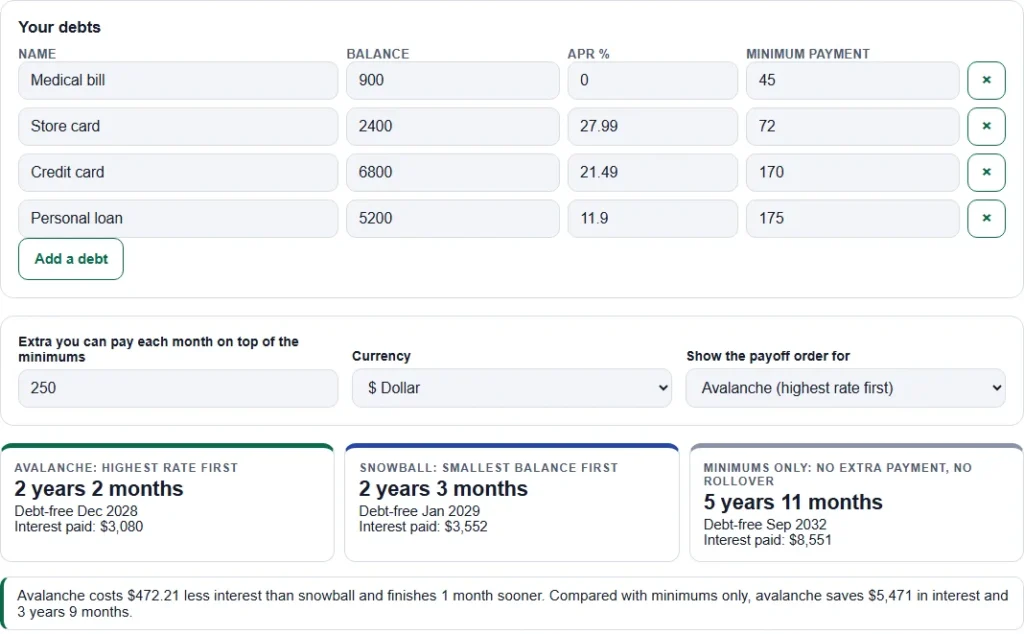
Quick answer: List your debts with the balance, interest rate (APR) and minimum payment, add the extra amount you can pay each month, and read the three result cards. In the example below, $250 extra clears $15,300 of debt in 2 years 2 months with avalanche and 2 years 3 months with snowball, and avalanche pays $472.21 less interest.
How to use the debt snowball calculator
- In the debt snowball calculator, enter each debt: a name, the current balance, the APR (the yearly interest rate) and the minimum payment from your statement.
- Type the extra amount you can pay every month above the minimums. Leave it at 0 to see what the debt payoff plan looks like on minimums alone.
- Read the three cards of the debt snowball calculator: avalanche, snowball and minimums only. Each shows the time to debt-free, the month you finish and the interest you pay.
- Choose which method to show in the payoff order table, then press Print the payoff plan if you want a paper copy.
The tool simulates each month. It adds a month of interest to every balance (balance times APR divided by 12), pays the minimum on every debt, and sends whatever is left of your budget to the target debt. When a debt is cleared, its minimum stays in the budget and rolls onto the next target. That rollover is what makes the snowball and avalanche methods faster than paying each debt on its own.
Debt snowball vs avalanche calculator: how the methods differ
| Debt snowball | Debt avalanche | |
|---|---|---|
| Target order | Smallest balance first | Highest interest rate (APR) first |
| What you get early | The first debt disappears quickly | The most expensive debt shrinks first |
| Total interest | Equal to or higher than avalanche | The lowest possible for the same monthly budget |
| Best when | You need early wins to keep going | Rates differ a lot, or one rate is very high |
With the same monthly budget, the avalanche order never costs more interest than the snowball order, because every extra dollar goes to the highest rate available. The snowball order gives up some of that saving for earlier finish lines. How much it gives up depends on your debts, and the calculator shows the exact amount.
Debt avalanche calculator example with four debts
Enter these four debts into the debt snowball calculator to follow along. They total $15,300 and have minimums of $462 a month. The medical bill is the smallest balance but carries no interest, which is where the two methods part ways:
| Debt | Balance | APR | Minimum payment |
|---|---|---|---|
| Medical bill | $900 | 0% | $45 |
| Store card | $2,400 | 27.99% | $72 |
| Credit card | $6,800 | 21.49% | $170 |
| Personal loan | $5,200 | 11.9% | $175 |
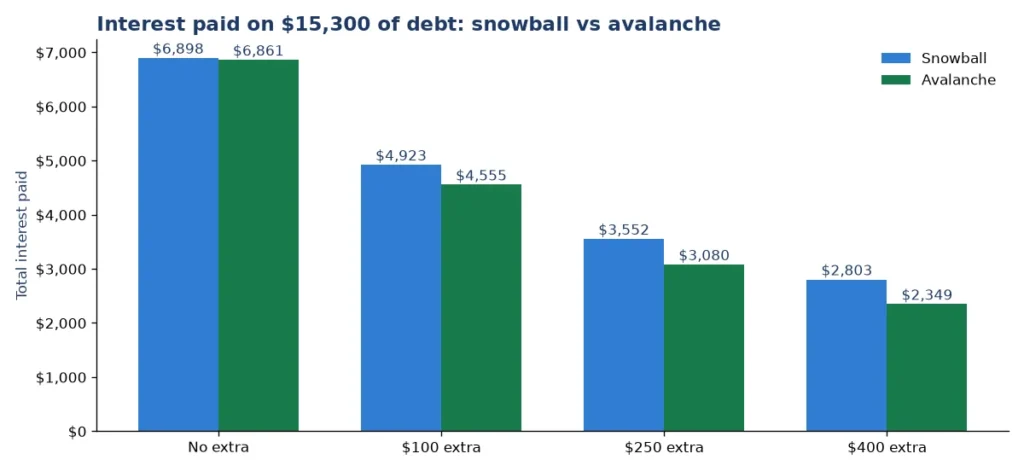
| Extra a month | Avalanche: time | Avalanche: interest | Snowball: time | Snowball: interest | Snowball costs more by |
|---|---|---|---|---|---|
| $0 | 4 years | $6,861 | 4 years 1 month | $6,898 | $36.33 |
| $100 | 3 years | $4,555 | 3 years | $4,923 | $368.44 |
| $250 | 2 years 2 months | $3,080 | 2 years 3 months | $3,552 | $472.21 |
| $400 | 1 year 9 months | $2,349 | 1 year 10 months | $2,803 | $453.88 |
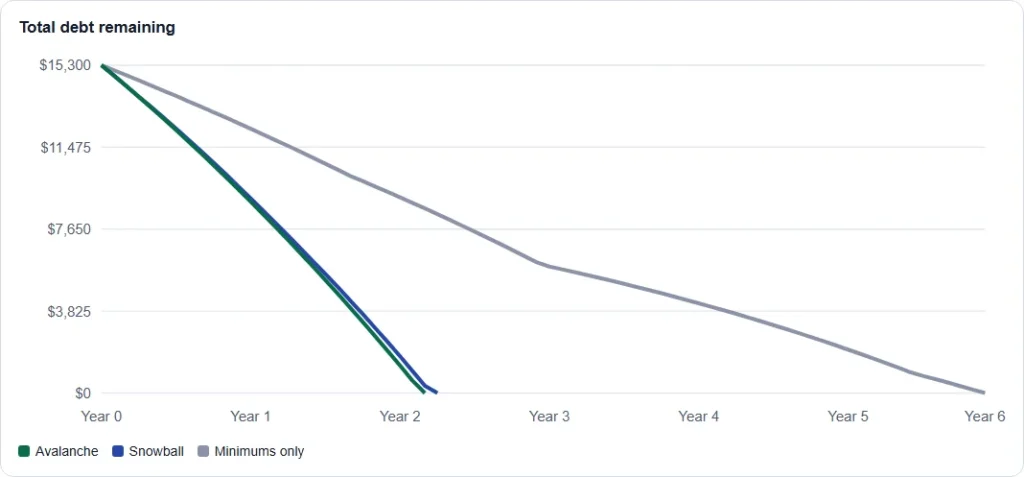
Paying only the minimums on each debt separately takes 5 years 11 months and costs $8,551 in interest, so even a small extra payment changes the picture a lot.
The order each method clears the debts
With $250 extra each month, the two methods clear the debts in these months:
| Debt | Balance | APR | Snowball clears it | Avalanche clears it |
|---|---|---|---|---|
| Medical bill | $900 | 0% | Month 4 | Month 20 |
| Store card | $2,400 | 27.99% | Month 11 | Month 9 |
| Credit card | $6,800 | 21.49% | Month 27 | Month 23 |
| Personal loan | $5,200 | 11.9% | Month 18 | Month 26 |
Snowball clears the 0% medical bill in month 4, which saves no interest because it had none. Avalanche leaves it until month 20 and spends that money on the 27.99% store card and the 21.49% credit card first. That ordering is where the $472.21 difference in interest comes from.
When the two methods give the same answer
If the smallest balance also has the highest rate, snowball and avalanche choose the same target every month and the results are identical. For example, a $1,500 card at 24.99% and a $4,000 card at 19.99% with $100 extra both take 2 years 5 months and cost $1,507.77 in interest either way. The methods only separate when a small balance has a lower rate than a larger one.
What an extra payment is worth in a debt payoff plan
| Extra a month | Debt-free in (avalanche) | Interest paid | Interest saved vs no extra | Sooner than minimums only |
|---|---|---|---|---|
| $0 | 4 years | $6,861 | – | 23 months sooner |
| $50 | 3 years 5 months | $5,464 | $1,397 | 30 months sooner |
| $100 | 3 years | $4,555 | $2,306 | 35 months sooner |
| $150 | 2 years 8 months | $3,916 | $2,945 | 39 months sooner |
| $250 | 2 years 2 months | $3,080 | $3,781 | 45 months sooner |
| $400 | 1 year 9 months | $2,349 | $4,513 | 50 months sooner |
In the debt snowball calculator, the first $100 does the most work in this example: it removes about $2,300 of interest. After that each extra payment still helps, but with smaller steps, because less balance is left to charge interest.
Why a payment barely above the interest takes decades
Interest on a $6,800 balance at 21.49% is about $121.78 in the first month (6,800 times 21.49% divided by 12). Only the part of a payment above that amount reduces the balance. The same card with three different monthly payments:
| Monthly payment | Time to pay off | Total interest |
|---|---|---|
| $122 | 29 years 8 months | $36,529 |
| $170 | 5 years 11 months | $5,267 |
| $250 | 3 years 2 months | $2,605 |
If a minimum payment is lower than a month of interest, the balance grows and the debt snowball calculator warns you. Check that every minimum covers at least the interest, and then build the plan on top of it.
What to enter and what to leave out
- Include credit cards, store cards, personal loans, car loans, student loans and medical or other payment plans.
- 0% promotional rates: enter 0, and rerun the plan with the new rate when the offer ends.
- Variable rates: enter today’s rate. The plan assumes the rate stays the same, so update it when the rate changes.
- Mortgage: usually left out, because it has a fixed payment over a long term and a much lower rate than most cards. Add it if you want to see the whole picture.
- New charges: the plan assumes you stop adding to the balances. New purchases lengthen every result.
What the SEC says about high-rate debt
The SEC Office of Investor Education and Advocacy advises paying down the card that charges the highest rate first while paying the minimum on the other cards, and says the same applies to other high-interest debt of about 8% or above. That is the avalanche order. The snowball order is a personal choice, and the debt snowball calculator shows the cost of choosing it.
Frequently asked questions
7 quick answers
Is the debt snowball or the debt avalanche better?
For the same monthly budget, avalanche never pays more interest than snowball, so it is cheaper. Snowball clears small debts sooner, which some people find easier to stick with. In the worked example above the difference is $472.
How do I use the debt snowball calculator with extra payments?
Enter the extra amount you can pay above all the minimums. The plan keeps the total payment the same each month, so when one debt is paid off its minimum rolls onto the next target.
What if my income changes?
Run the plan with the extra amount you are sure of, and rerun it when your budget changes. Printing a new plan takes a minute.
Should I save an emergency fund before paying off debt?
A small cash buffer stops a surprise bill from going back on a card. How much to keep is a personal choice, and the budget planner printable can show how much room you have.
Does this include late fees or new charges?
No. It assumes a fixed rate, payments on time each month and no new charges.
Is this debt snowball calculator free, and are my numbers stored?
Yes, it is free. The numbers stay in your browser and nothing is sent to a server.
What is a debt payoff plan?
It is a written order and a monthly amount for clearing your debts. The plan this debt payoff calculator builds names the target debt each month and shows the month every debt is cleared.
Related calculators and printables
- Credit card payoff calculator for one card at a time
- Loan calculator for a fixed-payment loan
- Budget planner printable to find the extra payment
- Savings challenge printable for a buffer
- Compound interest calculator
This page gives general information and tools, not financial advice. Rates, fees and terms vary by lender.
Last updated: October 2026.