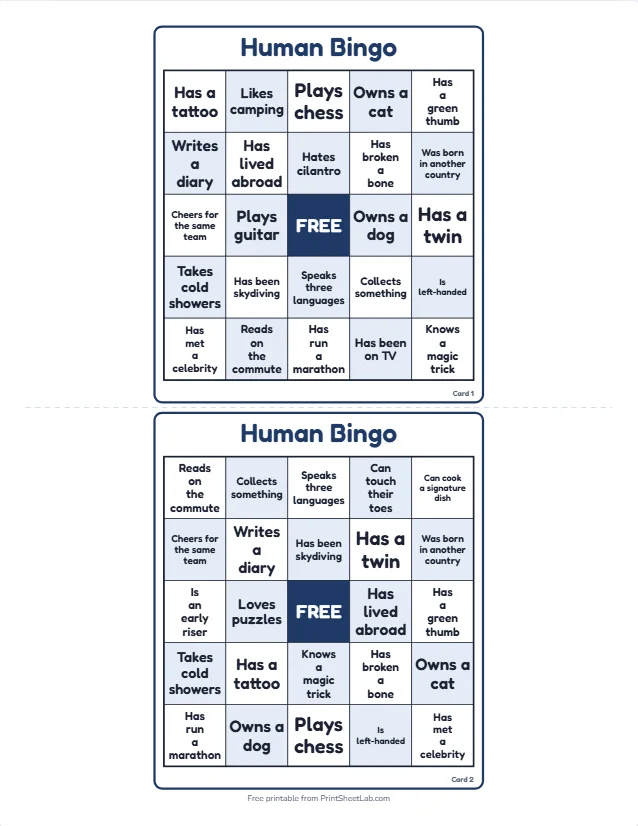
Human bingo is the icebreaker where nobody calls numbers and everybody walks around. Each guest gets a card full of statements such as “owns a dog” or “has run a marathon”, and the goal is to find a different person who fits each square and get a name or initials in it. This page has a free set of 29 squares, the rules that keep a crowd of 50 under control, a table that matches group size to card size and time, and a simulation of how long a first line really takes.
In short: press Edit and print this card in the card maker above to open the full-screen editor with the 29 squares loaded. Change any square on the Items tab, choose how many different cards to print (1 to 100), and download one PDF. It is free, needs no sign-up, and nothing you type leaves your browser.
Human bingo icebreaker: why it gets strangers talking
Most introductions at a new job, a training day or a family reunion die after the first sentence. People say their name and where they work, nod, and look for the coffee. A human bingo icebreaker fixes that by giving every conversation a reason. You are not asking a stranger about their life out of nowhere; you are checking a square. “Do you speak three languages?” is an easy question to ask, and the answer usually leads to a second one without any help from the host.
Human bingo is also fair to shy people. A guest who finds small talk painful can stand in the middle of a room with a card in hand and a clear task, and the task lets them end each chat politely: thank you, signed, next. Outgoing guests meet more people, quiet guests meet at least the four or five they need for a line, and the host does almost nothing once the round has started. For a short overview of why facilitators open sessions this way, see the Wikipedia article on icebreakers in facilitation.
The 29 squares on the human bingo cards
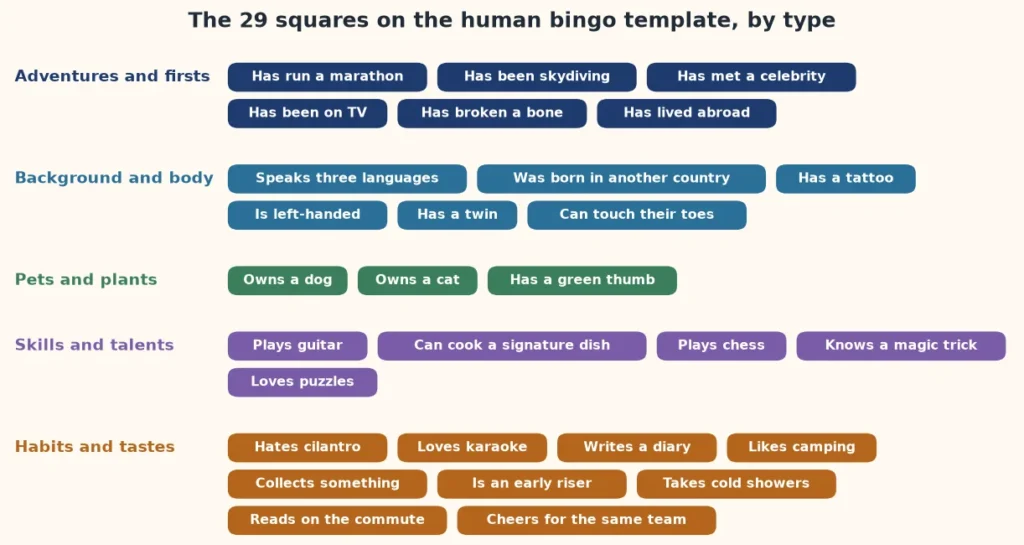
The human bingo template above uses 29 statements written for a mixed adult group. They avoid anything personal enough to embarrass someone (no income, no age, no relationship status) and lean on things people are usually glad to talk about: pets, travel, hobbies, small oddities. A 5×5 card with a free center needs 24 squares, so with 29 statements on the list, five are left out of each card and the left-out five change from card to card. That is why two guests rarely have the same squares, never mind the same positions.
| Type | Squares on the list | Planning tier |
|---|---|---|
| Adventures and firsts | Has run a marathon, Has been skydiving, Has met a celebrity, Has been on TV, Has broken a bone, Has lived abroad | Mostly rare, except Has broken a bone and Has lived abroad (medium) |
| Background and body | Speaks three languages, Was born in another country, Has a tattoo, Is left-handed, Has a twin, Can touch their toes | Medium, with Has a twin rare and Has a tattoo and Can touch their toes common |
| Pets and plants | Owns a dog, Owns a cat, Has a green thumb | Dog common, cat and green thumb medium |
| Skills and talents | Plays guitar, Can cook a signature dish, Plays chess, Knows a magic trick, Loves puzzles | Medium, with Can cook a signature dish common |
| Habits and tastes | Hates cilantro, Loves karaoke, Writes a diary, Likes camping, Collects something, Is an early riser, Takes cold showers, Reads on the commute, Cheers for the same team | Medium, with Likes camping, Is an early riser and Reads on the commute common and Takes cold showers rare |
The tiers matter because they decide how long a round of human bingo lasts. We sorted the 29 squares into three bands as a planning aid. These are our own judgment for a typical adult room, not data from a survey, and a room of marathon runners will break the table. A square is common if roughly one guest in three fits it (we use 40% in the math below), medium if roughly one in six fits (17%), and rare if fewer than one in ten fit (4%).
| Tier | Squares | How many | Assumed chance a guest fits |
|---|---|---|---|
| Common | Owns a dog, Likes camping, Is an early riser, Reads on the commute, Has broken a bone, Can touch their toes, Can cook a signature dish, Has a tattoo | 8 | 40% |
| Medium | Owns a cat, Loves karaoke, Loves puzzles, Plays chess, Writes a diary, Has a green thumb, Collects something, Speaks three languages, Was born in another country, Hates cilantro, Is left-handed, Cheers for the same team, Has lived abroad, Plays guitar, Knows a magic trick | 15 | 17% |
| Rare | Has run a marathon, Has been skydiving, Has met a celebrity, Has a twin, Takes cold showers, Has been on TV | 6 | 4% |
Weighted by those assumptions, the average square on the list is matched by about 21% of guests (8 x 40% + 15 x 17% + 6 x 4% = 5.99, divided by 29). That is the figure we use as “typical” in the simulation further down. Because each card holds 24 of the 29 squares, a card usually contains four or five rare ones, and those are the squares that decide whether a guest finishes a line or has to keep hunting.
How to play the human bingo game
The human bingo game has one rule that makes it different from number bingo: a square is only filled by another person, and every person can fill only one square on your card. Everything else in human bingo is ordinary bingo. Here is the round in the order a host should run it.
- Hand out one card and one pen to each guest. Pencils work too, but a pen makes a signature harder to dispute. Tell guests not to fill in their own squares.
- Explain the goal in one sentence. “Find someone who fits a square, ask them to sign or write their initials in it, and complete a row, a column or a diagonal.” Point at the free center and say it counts as already signed.
- State the one-name rule. Each person may sign your card once. If your neighbor owns a dog and plays chess, they sign one of the two and you must find someone else for the other.
- Set a visible timer. A human bingo round of 10 to 20 minutes is plenty for a line in most rooms (the numbers are in the simulation below). Write the end time on a whiteboard.
- Start the mingle. Guests walk, ask, sign and move on. A good host circulates, introduces people who are standing alone, and keeps the volume friendly.
- When someone shouts “Bingo!”, check the card. Read each signed square aloud and ask the signer to confirm. Then either end the round or play on for a second prize.
- Finish with a debrief. Ask which square was the hardest to find and who had the best story. This is where the human bingo icebreaker pays for itself, because people repeat what they learned.
Rules for large groups
With 15 guests, almost any human bingo rule works. With 60 or 100, the host needs a few more decisions made in advance, otherwise the room turns into a queue. These are the rules that matter most at scale.
- Name or initials. In a crowd, ask for initials and a first name. A full signature takes ten seconds longer, and ten seconds multiplied by five chats multiplied by 60 guests is a lot of standing around.
- One name per card. Without this rule, the first guest who fits three squares gets mobbed. With it, a person who is rare on the card still has to be shared out, and you get more conversations.
- Win condition. For your human bingo game, choose one: first line, four corners, X or blackout. A single line is the right default for a round of 15 minutes or less. Blackout needs at least 25 guests and 30 or more is safer (see the blackout notes below).
- Time limit instead of “first to finish”. A fixed round means the shy guest who never reaches a line still gets a full mingle. At the whistle, count signed squares and give the prize to the longest line or the most squares.
- Prizes. Human bingo prizes should be small and fun: a coffee voucher, a front-row seat, first choice at lunch. Offer a second prize for the most unusual signature, for example the only person who has met a celebrity, so the winner is not always the most outgoing guest.
- Walk, do not sit. Tell people that the game ends if they stay in one chair; a table of eight can finish a whole card without meeting anyone new.
Human bingo free: set up your printable cards in five minutes
This human bingo free set is made in the browser, so there is nothing to download and edit first. The card maker above opens your human bingo set as a full-screen editor with five tabs: Setup, Items, Design, Templates and Print. The numbers below are the real ones for this template.
- Setup. The grid is 5×5 with a free center. A 5×5 card with a free space needs 24 squares. Switch to 4×4 (16 squares, no free space) for a smaller group or 3×3 (8 squares plus a free center) for a group of ten.
- Items. The 29 statements are listed here. Edit any of them, delete the ones you do not want, add new ones, or paste a whole list. The free space can hold its own text, an emoji or a picture, so “FREE” can become your company name.
- Design. Pick a color theme (the human bingo template uses a midnight blue), a font, text size and ALL CAPS. Add a logo, change the title, add footer text and print each guest’s name on their card if you like.
- Print. Choose how many different cards (1 to 100), 1, 2, 4 or 6 per page, Letter or A4, portrait or landscape, and optional cut guides. Download the PDF or print directly. A shareable link stores the words only.
Every card is a different random arrangement of your list. With 29 statements and 24 squares per card, there are 118,755 different sets of 24, and each set can be arranged in about 6.2 x 10²³ orders, so a printed stack of 100 cards will not contain a repeat in any realistic sense. Human bingo does not need the caller sheet or the calling cards that number bingo uses, so leave those off and save paper.
Human bingo printable: print settings that work
A human bingo printable lives or dies on legibility, because guests read it at arm’s length while walking. The template uses large bold type and a free center; keep both. These settings are the ones that work in a real room.
| Setting | Recommended | Why |
|---|---|---|
| Cards per page | 1 or 2 | Squares need room for a signature. At 4 or 6 per page the boxes are too small to sign. |
| Orientation | Portrait for 5×5 | Landscape suits a 3×3 or a card with a long title. |
| Number of cards | Guests plus 10% | Spares cover latecomers and spoiled cards. |
| Text size | Medium to large | Long statements such as “Can cook a signature dish” wrap onto three lines and need space. |
| Cut guides | On, if printing 2 per page | You can slice the sheet in half and have one clean card per guest. |
Print one human bingo test page first and fold it in half. If a statement is cut off or hard to read, reduce the number of words in the square, not the size of the type. “Has met a celebrity” is a good length; “Has met a celebrity at an airport or a restaurant” is not.
Human bingo for adults: where it fits and how long to allow
Human bingo for adults works anywhere strangers share a room and a few minutes. The human bingo cards are the same; what changes is the tone of the squares and the time you allow. The table below lists the settings where human bingo works most often.
| Setting | Typical group | Card and rule | Time to allow | Square tone |
|---|---|---|---|---|
| New class or training course | 12 to 30 | 5×5, one name per card, first line | 10 to 15 min | Skills, hobbies, hometown; keep it light |
| Staff meeting or all-hands | 15 to 40 | 5×5, first line, then four corners | 10 min | Pets, commutes, favorite lunch; avoid job titles |
| Family reunion | 20 to 60 | 5×5 with generational squares | 15 to 20 min | Family trivia: “Has met a cousin once removed” |
| Conference or networking event | 40 to 150 | 5×5, time-boxed round | 15 to 20 min | Industry-neutral hobbies and travel; add a sponsor logo |
| Onboarding day for new hires | 6 to 15 | 3×3 or 4×4, whole team included | 8 to 10 min | Team-specific squares, such as “Has worked in another country” |
| Retirement or farewell party | 25 to 80 | 5×5 with memory squares | 15 min | Stories about the guest of honor |
For a conference round of human bingo, consider asking guests to find people they have not met yet, and give a small prize to the card with the most different companies on it. For onboarding, pair human bingo with a short list of icebreaker questions; our icebreaker questions page has 84 you can print or show on screen.
The card size should follow the group size. Fewer than about 12 guests cannot supply enough different partners for a 5×5 card, because a line through the center needs four signatures from four different people and a full card needs 24. In a team of eight, use a 3×3 card, where a line needs only two or three names, or let a person sign twice.
| Group size | Best card | Squares needed | Signatures for a line | Mingle time |
|---|---|---|---|---|
| 6 to 12 | 3×3 with free center | 8 | 2 to 3 | 6 to 10 min |
| 13 to 20 | 4×4 or 5×5 | 16 or 24 | 4 to 5 | 10 to 15 min |
| 21 to 40 | 5×5 with free center | 24 | 4 to 5 | 12 to 20 min |
| 41 to 100 | 5×5, time-boxed | 24 | 4 to 5 | 15 to 25 min |
| 100+ | 5×5 plus zones or table rules | 24 | 4 to 5 | 20 to 25 min |
If your group meets on video, human bingo cards work on screen too: guests type names into a document or use the chat. Our Zoom bingo cards and meeting bingo cards pages are written for that setting, and play custom bingo online explains how to run a custom card game with a link. Human bingo itself is a walking game and works best in person.
How long until a first line? A mingle simulation
Hosts always ask how long to book a human bingo round. We simulated it. Each simulated guest holds a 5×5 card with a free center and 24 squares, and meets the other guests one at a time in random order.
In each conversation, every unsigned square independently matches the partner with the same chance p. The partner signs one matching square, chosen so as to build the line that is closest to finished. We counted conversations until the guest completes a row, column or diagonal, then converted at 45 seconds per conversation, which includes walking over, asking and signing.
The human bingo model is simpler than a party. It assumes the partner reads the whole card, that squares are independent (in life a marathon runner is more likely to have run abroad), and that nobody is stuck in a long chat. Use it to compare settings rather than to predict a stopwatch reading. We ran 2,500 simulated guests per cell.
| Average chance a guest fits a square | Group of 10: median minutes, share with a line in 10 min | Group of 20 | Group of 40 |
|---|---|---|---|
| 10% | 6 min, 20% | 9 min, 58% | 9.75 min, 58% |
| 15% | 6 min, 47% | 7.5 min, 87% | 7.5 min, 88% |
| 20% | 5.25 min, 67% | 6 min, 96% | 6 min, 97% |
| 30% | 4.5 min, 91% | 5.25 min, 100% | 5.25 min, 100% |
| 40% | 4.5 min, 98% | 4.5 min, 100% | 4.5 min, 100% |
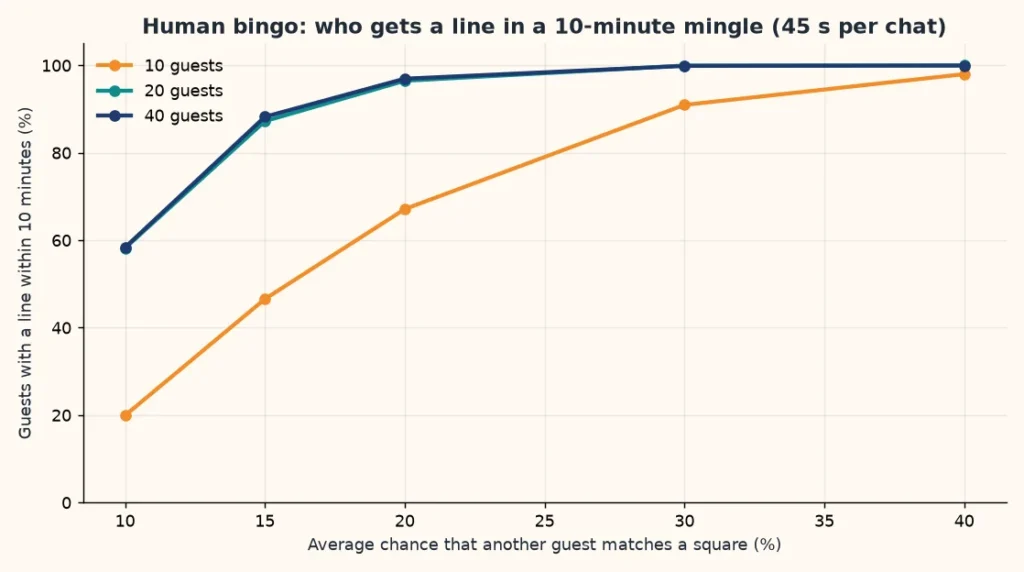
Three things stand out about human bingo timing. First, the group size stops mattering from about 20 guests: with a 20% average chance, the median guest finishes a line in 6 minutes whether the room holds 20, 40 or 80 people, because a guest only needs about eight good conversations and there are always enough partners.
Second, the squares matter much more than the crowd: dropping the average chance from 30% to 10% moves the median from 5.25 minutes to 9 minutes in a group of 20. Third, a small group is the dangerous case: with 10 guests and a 20% average chance, only 67% of guests find a line before they run out of partners, and at 10% only 20% do.
Assumptions in one place
- 5×5 card, free center, 24 squares, one signature per person per card.
- Every other guest is met at most once, in random order, so a guest in a group of 10 has only 9 conversations available.
- 45 seconds per conversation, including the walk. A guest who reads the card out loud instead of showing it takes longer (see below).
- The chance p is the same for every square in a run. Real cards mix common and rare squares, so treat p as the average from the tier table above, about 21%.
- A line means any row, column or diagonal. Four corners or an X needs a different count.
Showing the card versus asking out loud
Everything above assumes the human bingo guest hands over the whole card and the partner picks a square. Many people prefer to ask questions out loud. We reran a group of 30 with a 20% average chance where the guest asks about only 8 squares per chat, and then only 4.
A median guest needs 8 conversations to finish a line when the card is shown, 13 conversations when asking about 8 squares, and 20 when asking about 4, and with 4 questions per chat 92% of guests finish before they run out of partners. In minutes at 45 seconds each, that is 6, 9.75 and 15. The practical rule is to tell guests to show the card: it halves the round.
The first bingo in the room
The host of a human bingo round cares about the first shout, not the median guest. In the same model with a 20% average chance, the first completed line among 10 guests arrives after a median of 5 conversations (about 3.75 minutes), among 20 guests after 4 conversations (3 minutes), and from 40 guests up after 4, which is the floor: a line through the free center needs four signatures.
So the room’s first “Bingo!” comes around the 3 to 4 minute mark in almost any group of 20 or more, which is why we recommend letting the round run for the full time instead of ending at the first shout.
Dead squares: when a statement has nobody to match
In a small room a rare square can stall human bingo completely. The chance that at least one of the other guests fits a statement is 1 minus (1 minus q) raised to the number of other guests, where q is the share of people who fit it. In a group of 20, a statement that 3% of people fit, such as having a twin, has a match only 44% of the time, so in more than half of such rooms nobody can sign it at all.
| Share of people who fit the square | Group of 10 | Group of 20 | Group of 30 | Group of 50 | Group of 100 |
|---|---|---|---|---|---|
| 3% | 24% | 44% | 59% | 78% | 95% |
| 10% | 61% | 86% | 95% | 99% | 100% |
| 20% | 87% | 99% | 100% | 100% | 100% |
| 40% | 99% | 100% | 100% | 100% | 100% |
| 60% | 100% | 100% | 100% | 100% | 100% |
For small human bingo groups, delete the rare squares and keep the common and medium ones, which you can do on the Items tab in seconds. The 29 statements on this list include six rare ones; with fewer than 30 guests it is worth swapping two or three for something everyone can answer, such as “Has a favorite coffee order”.
Playing for a blackout
A blackout in human bingo means all 24 squares, each signed by a different person. That needs at least 25 people in the room, and a person-by-person simulation shows how fragile it is.
With a 20% average chance, a guest in a group of 25 completes a blackout 0% of the time, in a group of 30 25%, in a group of 40 88% and in a group of 60 100%. At a 30% average chance the group of 30 improves to 66%. Our advice is to use blackout only above 40 guests and to give it a long time slot, since the median blackout takes about 28 to 33 conversations, or 21 to 25 minutes.
Customizing the squares for your group
The 29 squares are a starting point for your own human bingo list. The best human bingo cards are written for one room, because a guest who sees “Has been to our Austin office” knows the card was made for them. The Items tab takes any text, emoji or picture, so you can rewrite half the list in ten minutes.
Rules for a good square
- Make it answerable with yes or no. “Plays guitar” is a quick question. “Has a favorite band” sounds easy, but everyone has one, so it is no longer a game.
- Aim for between 10% and 40% of the room. That is where finding a person feels like a small win rather than a chore or a given.
- Keep it short. Five words or fewer prints in a large size. Long squares get tiny text.
- Add one story square. “Has met a celebrity” produces a better conversation than any other square on the list, because the signer has a story to tell.
- Include something everyone can sign. A square such as “Had coffee today” gives the shyest guest a guaranteed quick win.
- Mix the types. The chart above has five types; a human bingo card with all five gives every guest a way in.
Squares for five common groups
| Group | Replace some of the 29 with squares like |
|---|---|
| New employees | Has worked in another country, Commutes more than 30 minutes, Has a side project, Speaks a language besides English, Has been here more than five years |
| University class | Is studying a second subject, Has a part-time job, Lives within walking distance, Has taken a gap year, Plays in an intramural team |
| Family reunion | Has met all four grandparents, Was at the last reunion, Can name every cousin, Lives in another state, Brought a dish |
| Conference | Has spoken at an event, Works remotely, Has changed careers, Has a podcast, Flew in from another country |
| Neighborhood or club | Has lived here more than ten years, Has a garden, Walks to the shops, Knows a neighbor’s name, Has a bike |
Names, logos and the free square
The Design tab lets you add a logo, change the title, and print each guest’s name on their card, which saves handing out name tags separately. The free center can carry your company name, an emoji, or a short instruction such as “Say hello!”. If the group is large, an event title and a date in the footer turns a throwaway sheet into a keepsake. For a clean slate with your own human bingo list, start from the blank bingo cards page or the bingo card generator.
What to leave out
Keep squares about choices and experiences, and leave out things guests cannot choose or may not want to share: health, income, relationship status, religion, politics, weight, age, or anything about family loss. A square like “Has broken a bone” is on the list because it usually brings a story, but swap it if your group includes people recovering from an injury. When in doubt, ask a colleague to read the list as if they were new to the group.
Accessibility and inclusion
Human bingo is a walking game, and mingling is physically demanding in ways a host does not always see. Plan for guests who use a wheelchair, a cane or a walker, guests with low vision, guests who are deaf or hard of hearing, and guests who find crowds overwhelming. These adjustments cost almost nothing.
- Print the human bingo cards in a larger size for guests with low vision: choose a larger text size on the Design tab and print one card per page.
- Let guests sit. Tell everyone that people who prefer to stay seated can have partners come to them, and ask a few guests to be “visitors” who circulate.
- Keep the room clear. Leave aisles wide enough for a wheelchair or walker between tables and chairs.
- Offer an alternative to a signature. Initials, a check mark or a spoken name that a buddy writes down all count, so no one is blocked by a writing difficulty.
- Give a quiet option. A shy guest or a guest who finds crowds hard can play human bingo in a pair, or complete the card by chatting at a table instead of walking.
More find-someone-who bingo for specific parties
This page is the general-purpose human bingo set. If your event has a theme, these find-someone-who pages are written for it, each with its own squares and its own audience.
- Kitty party icebreaker games is a 30-square set for new members of a ladies’ group, with tea-and-chat squares and links to play on phones.
- Travel bingo has 120 squares about places and journeys, from hill stations to scuba diving, for reunions and travel-themed kitty parties.
- Couples bingo has 28 “find a couple who” squares, designed for anniversaries and parties where guests arrive in pairs.
- Wedding guest bingo mixes both families with 28 squares such as “went to school with the bride”.
For other occasions, start from the printable bingo cards hub, which lists every template. The getting to know you bingo page is the school-friendly cousin of this human bingo set, and classroom bingo is for review games where the teacher calls the clues.
Frequently asked questions
10 quick answers
What is human bingo?
Human bingo is a mingling game where each square on a bingo card holds a statement about a person, such as “owns a dog”. Guests walk around, find someone who fits a square, get that person’s name or initials, and try to complete a line. Nothing is called out, so there is no caller.
How many people do I need to play human bingo?
Human bingo needs at least 8 or 9 for a 3×3 card and about 12 for a 5×5 card. A line through the free center needs four different people, but the card works better with 20 or more so that guests can find a match for rare squares. For a blackout you need at least 25.
Can the same person sign more than once?
Not by default. The standard rule is one signature per person on each card, which forces guests to talk to different people. For very small groups you can allow two. In our classroom simulation on the getting to know you bingo page, allowing two names per person cut the median time to a line by more than a third.
How long does a human bingo game take?
A human bingo round takes 10 to 15 minutes for the mingle and 5 minutes to explain and debrief. In the simulation, a typical guest finishes a line in 6 to 10 minutes. A blackout needs 20 to 25 minutes in a group of 40 or more.
Is human bingo suitable for adults at work?
Yes. It is one of the most common icebreakers at training days and team meetings. Keep squares neutral (pets, hobbies, travel), avoid personal topics, and make joining optional for guests who would rather watch.
Can I use these human bingo cards for free?
Yes. The cards are free to print for any non-commercial use, you do not need an account, and nothing is uploaded. Replace the squares, add your logo, and print as many as you need.
How many different cards can I print?
Up to 100 different human bingo cards in one print job. Every card uses a different random arrangement of your list; with 29 squares and 24 per card, there are more possible cards than you will ever print.
Do I need a caller or a number generator?
No. Human bingo has no numbers to call. The caller tools on this site are for number bingo and the 90-ball game; human bingo is played by walking around with your card.
How do I make the game harder or easier?
Make human bingo easier with a smaller grid, common squares and a free center. Make it harder by choosing rarer squares, using a blackout, banning repeat partners from earlier rounds, or requiring a short story with each signature.
Can we play human bingo online?
You can, in chat or in a shared document, but it works best in person because the point is moving around the room. Our Zoom bingo page covers the video call version, and the online bingo pages show how to run a card game from a link.