Quick answer: Geometry worksheets teach shapes, their sides and angles, symmetry and measuring. This page has 160 free printable geometry worksheets with answer keys for kindergarten to grade 4: 2D and 3D shapes, angles, symmetry and area. Updated October 2026.
Geometry worksheets to print (PDF)
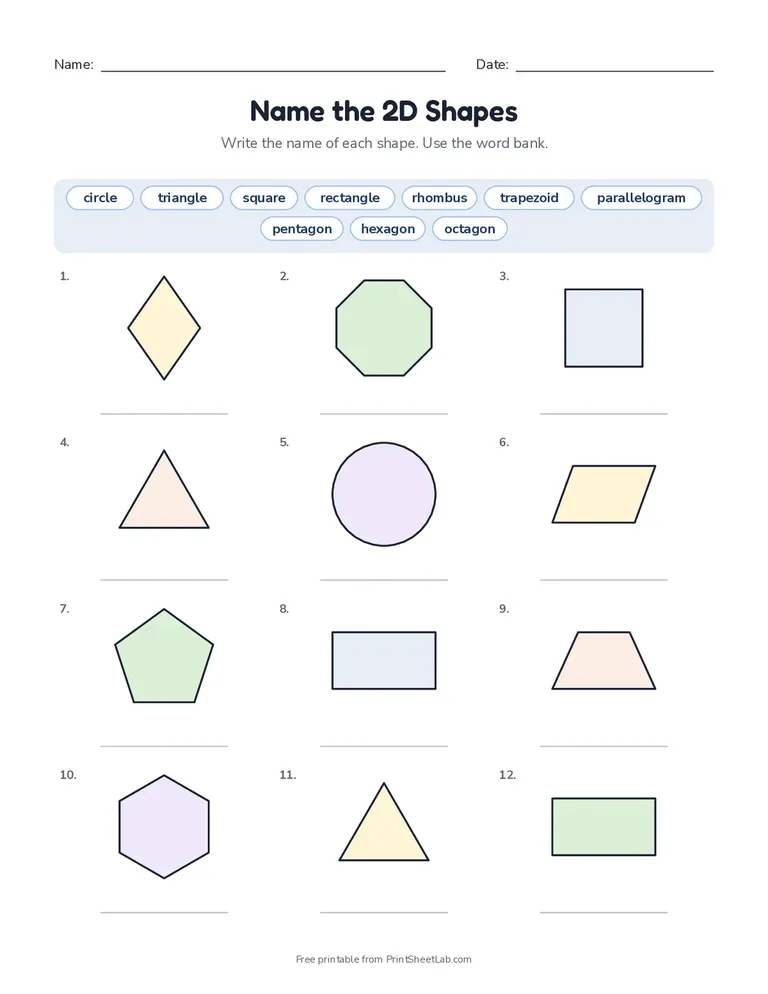
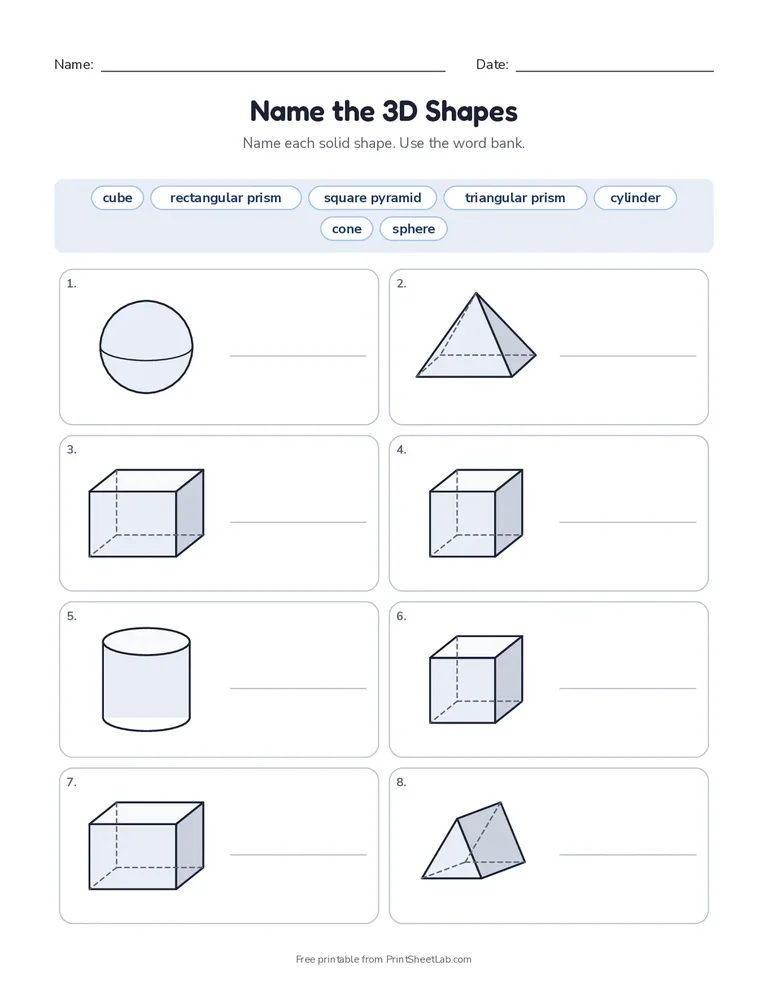
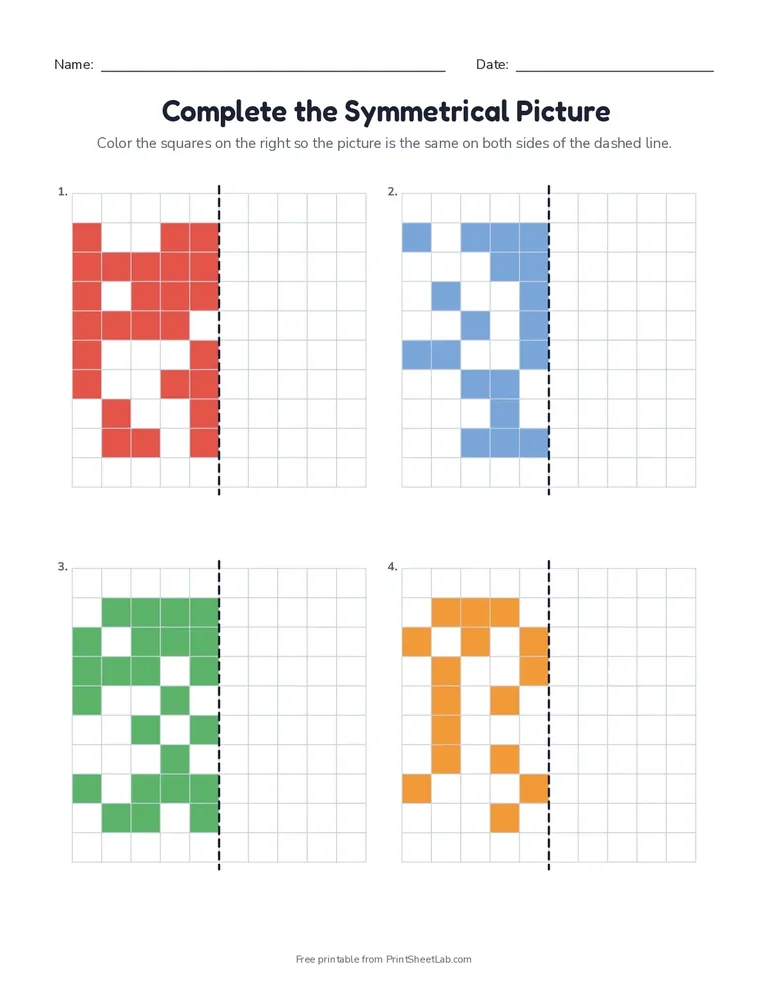
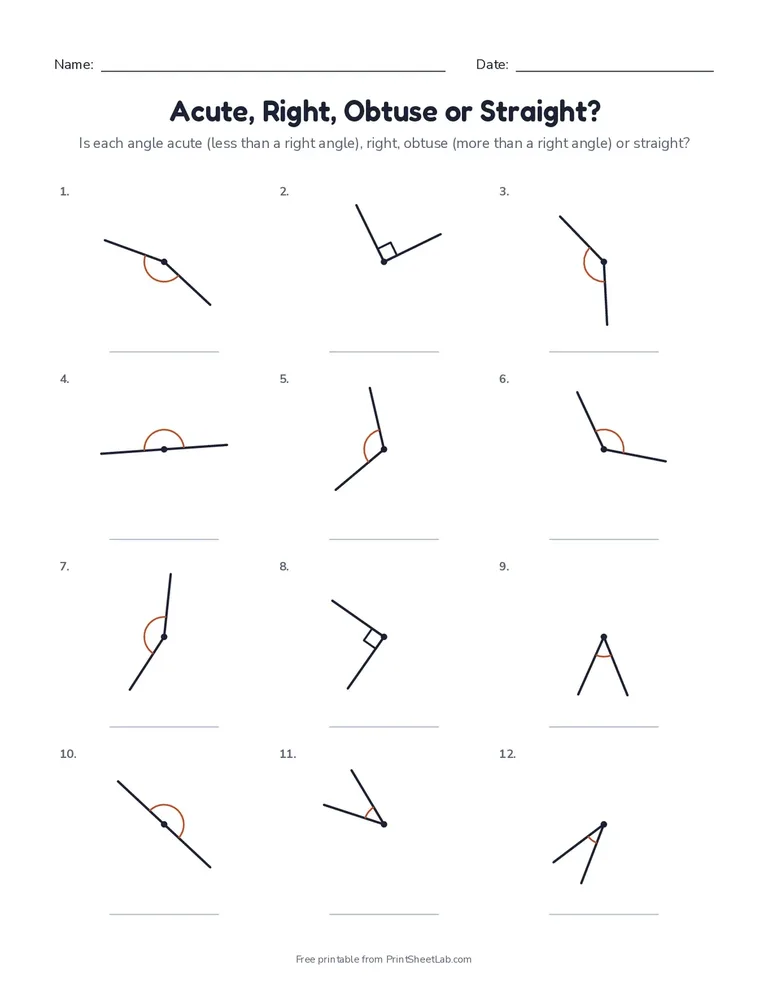
These geometry worksheets are a sample of the 16 printable PDFs in this section, from 2D shapes to angles. Click a picture for the PDF, or open one of the sets below.
Seeing shapes everywhere
Geometry starts with names (triangle, hexagon, cube) and grows into properties: how many sides and corners, which shapes have faces, which pictures are symmetrical, which angles are bigger than a right angle. These worksheets follow that path. Every shape is drawn clearly with thick lines, and the 3D solids show hidden edges as dashed lines, just like in a textbook.
Geometry by grade
| Grade | What children learn |
|---|---|
| Kindergarten and grade 1 | Naming 2D and 3D shapes (K.G.A.2, 1.G.A.1) |
| Grade 2 | Sides, angles and faces; triangles to hexagons (2.G.A.1) |
| Grade 4 | Angles, lines and lines of symmetry (4.G.A.1, 4.G.A.3) |
Shape facts at a glance
| Shape | Sides / faces | Corners (vertices) | Remember |
|---|---|---|---|
| Triangle | 3 sides | 3 | The angles always add up to 180° |
| Square | 4 equal sides | 4 | 4 right angles |
| Rectangle | 4 sides (opposite sides equal) | 4 | 4 right angles |
| Pentagon | 5 sides | 5 | Penta = 5 |
| Hexagon | 6 sides | 6 | Honeycomb cells are hexagons |
| Octagon | 8 sides | 8 | A stop sign |
| Cube | 6 square faces, 12 edges | 8 | A dice |
| Cylinder | 2 flat faces, 1 curved surface | 0 | A tin can |
| Cone | 1 flat face, 1 curved surface | 1 (the apex) | An ice-cream cone |
| Sphere | 1 curved surface | 0 | A ball |
Hands-on geometry ideas
- Shape hunt: find five circles, rectangles and triangles at home or in class and tick them on a chart.
- Build it: make 2D shapes from straws or craft sticks and count the sides; make 3D shapes from modeling clay and count the faces.
- Feely bag: hide a 3D shape in a bag; children describe it by touch (“it has a point and one flat face”) before naming it.
- Fold and cut: fold paper in half and cut a shape to make a symmetrical picture.
Common mistakes
- Thinking a square turned on its corner (a “diamond”) is a different shape. Turning a shape does not change it.
- Calling a 3D cube a “square” or a sphere a “circle”. Squares and circles are flat (2D).
- Counting the same edge of a 3D shape twice.
What is in the geometry worksheets
There are 16 geometry worksheets in four sets, each with an answer key. All of these geometry worksheets are free to print:
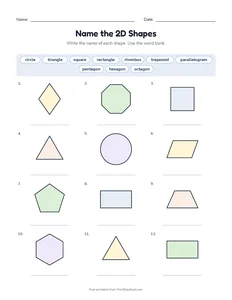
- 2D shapes: names, sides and vertices (Kindergarten to grade 2, 5 worksheets)
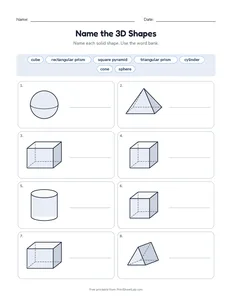
- 3D shapes: faces, edges and vertices (Grades 1 to 3, 4 worksheets)
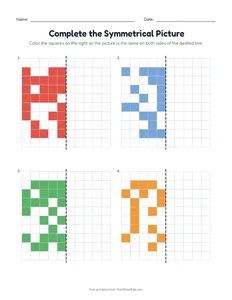
- Lines of symmetry (Grades 2 to 4, 4 worksheets)
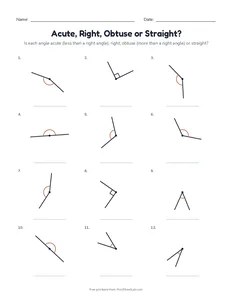
- Acute, right, obtuse and straight angles (Grade 4, 3 worksheets)
2D shapes worksheets: polygons and their angles
A polygon is a flat shape with straight sides, and it has as many corners as sides. The names come from Greek numbers: penta for five, hexa for six, octo for eight. A useful fact for older children is that the angles inside a polygon always add up to (number of sides − 2) × 180°, which means that every triangle adds up to 180° and every quadrilateral to 360°. In a regular polygon all the angles are equal, so you can divide the total:
| Polygon | Sides and corners | Angle sum | Each angle of a regular one |
|---|---|---|---|
| Triangle | 3 | 180° | 60° |
| Quadrilateral | 4 | 360° | 90° |
| Pentagon | 5 | 540° | 108° |
| Hexagon | 6 | 720° | 120° |
| Heptagon | 7 | 900° | 128.6° |
| Octagon | 8 | 1080° | 135° |
| Nonagon | 9 | 1260° | 140° |
| Decagon | 10 | 1440° | 144° |
| Dodecagon | 12 | 1800° | 150° |
The 2D shapes worksheets for the early grades ask for names, sides and vertices only, but the angle sums are a good extension of these geometry worksheets for grade 4 and above. See Wikipedia’s polygon article for more.
3D shapes worksheets: faces, edges and vertices
A face is a flat surface, an edge is where two faces meet, and a vertex is a corner where edges meet. For the shapes with flat faces, the numbers always obey a formula discovered by Leonhard Euler: vertices − edges + faces = 2. Children can check it with 3D shapes worksheets that ask them to count the parts of a solid:
| 3D shape | Faces (F) | Edges (E) | Vertices (V) | V − E + F |
|---|---|---|---|---|
| Cube | 6 | 12 | 8 | 2 |
| Rectangular prism | 6 | 12 | 8 | 2 |
| Triangular prism | 5 | 9 | 6 | 2 |
| Square pyramid | 5 | 8 | 5 | 2 |
| Triangular pyramid (tetrahedron) | 4 | 6 | 4 | 2 |
| Pentagonal prism | 7 | 15 | 10 | 2 |
| Hexagonal prism | 8 | 18 | 12 | 2 |
The last column is 2 for every solid. The curved solids are different: a cylinder has 2 flat faces and 1 curved surface, a cone has 1 flat face and 1 curved surface, and a sphere has only 1 curved surface and no edges or vertices. Wikipedia’s Euler characteristic article explains the formula.
Symmetry worksheets: lines of symmetry
A line of symmetry divides a shape into two halves that are mirror images. If you fold along the line, the halves match exactly. Symmetry worksheets ask children to draw the lines on shapes and letters, and the answer is not always what they expect:
| Shape | Lines of symmetry |
|---|---|
| Equilateral triangle | 3 |
| Isosceles triangle | 1 |
| Scalene triangle | 0 |
| Square | 4 |
| Rectangle (not a square) | 2 |
| Rhombus (not a square) | 2 |
| Parallelogram (no right angles) | 0 |
| Kite | 1 |
| Regular pentagon | 5 |
| Regular hexagon | 6 |
| Circle | infinite |
Geometry worksheets on symmetry often surprise children: a rectangle has two lines of symmetry, not four, because its diagonals are not lines of symmetry unless it is a square. A circle has an infinite number of lines, because any line through the center works. Lines of symmetry are part of grade 4 (4.G.A.3).
Angles worksheets grade 4: acute, right, obtuse and straight
Angles worksheets for grade 4 teach children to classify angles by size, using the right angle of a page corner as a reference (4.G.A.1). They then measure with a protractor (4.MD.C.6):
| Angle | Size | Example |
|---|---|---|
| Acute | less than 90° | The tip of a pencil |
| Right | exactly 90° | The corner of a page |
| Obtuse | between 90° and 180° | A reclining chair back |
| Straight | exactly 180° | A straight line |
| Reflex | between 180° and 360° | The outside of a corner |
A good trick is to hold a sheet of paper in the corner of the angle: if the angle is smaller than the paper’s corner, it is acute; if it is bigger, it is obtuse.
Free geometry worksheets: basic, easy and printable
This page is also searched as free geometry worksheets, basic geometry worksheets, easy geometry worksheets, free printable geometry worksheets, geometry printable worksheets free, geometry practice sheets, geometry practice worksheets, geometry worksheets pdf, geometry worksheets pdf with answers and geometry review worksheet. All of them are the free PDFs above, each with an answer key. Basic geometry worksheets for the early grades are the shapes sheets, and geometry homework for older children can use the angles and area sheets. This collection covers kindergarten to grade 4.
Frequently asked questions
5 quick answers
What is a vertex?
A vertex is a corner where two sides (or edges) meet. The plural is vertices.
Is a square a rectangle?
Yes. A square has four right angles, so it is a special rectangle with all sides equal.
How many faces does a cube have?
6 faces, 12 edges and 8 vertices.
What is the difference between 2D and 3D shapes?
2D shapes are flat and have length and width only (square, circle). 3D shapes are solid and also have depth (cube, sphere).
Where can I download free geometry worksheets?
Open any worksheet on this page or on a topic page, choose US Letter or A4, then print or save the PDF. All are free, with answer keys.