This subtraction within 10 game helps kindergarten and first grade children learn their take-away facts by playing: race cars, pop balloons, flip memory cards or sprint through true and false sentences. Each question takes away a number from 10 or less, such as 9 − 4, 6 − 2 or 10 − 7, so children practice subtraction facts until the answers come without counting. It is free, needs no sign-up, works on phones and tablets, and comes with a printable subtraction chart with ten frames.
Subtraction within 10 game: see how it plays
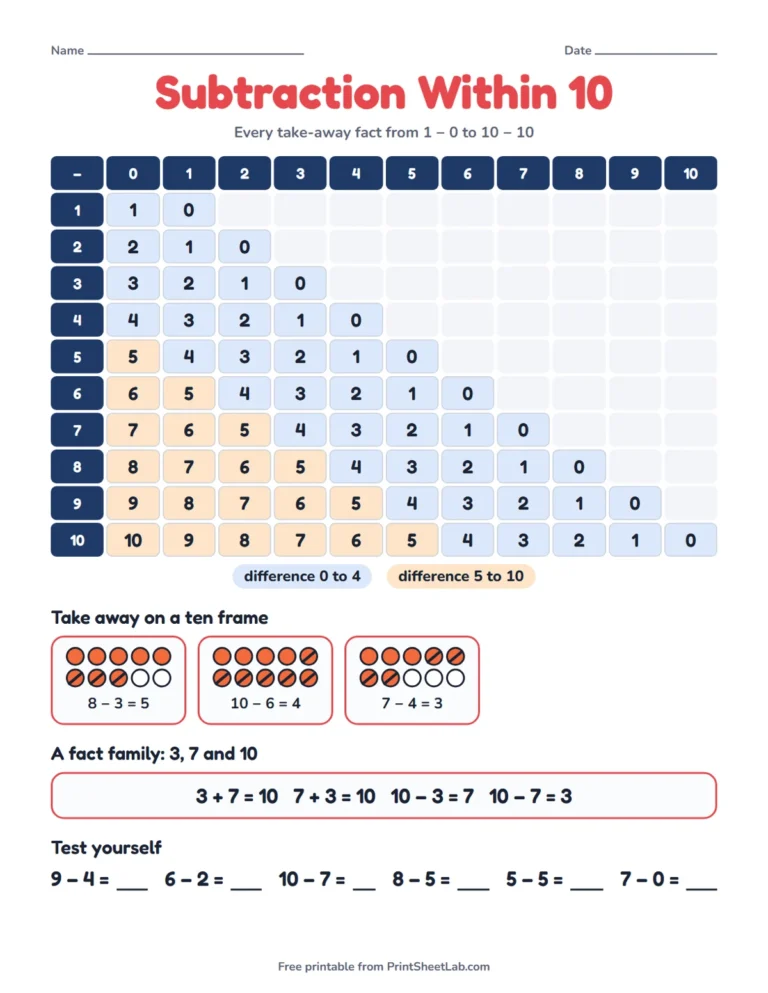
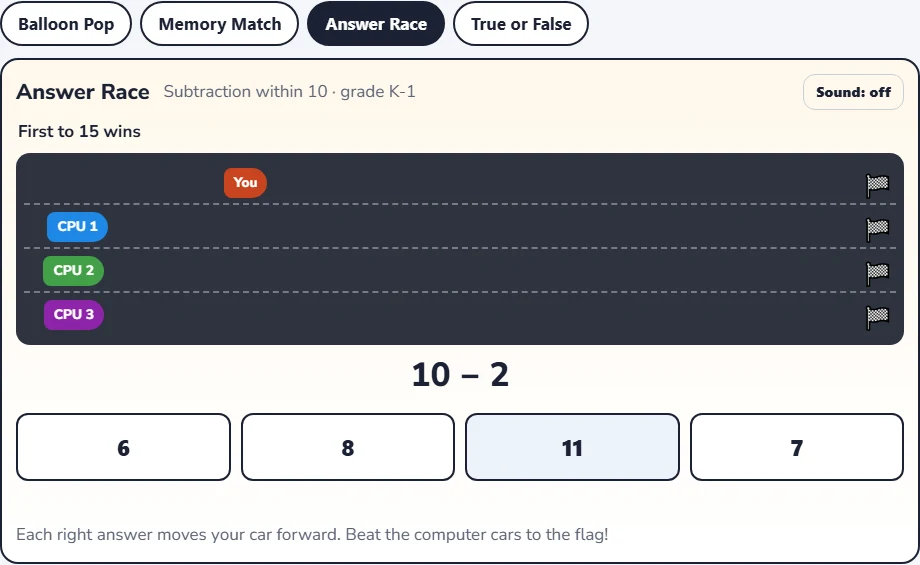
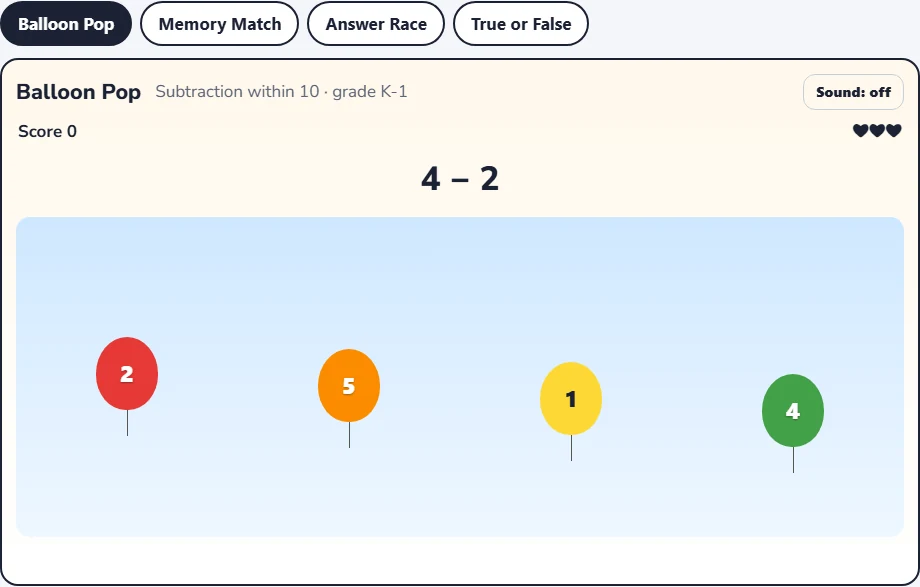
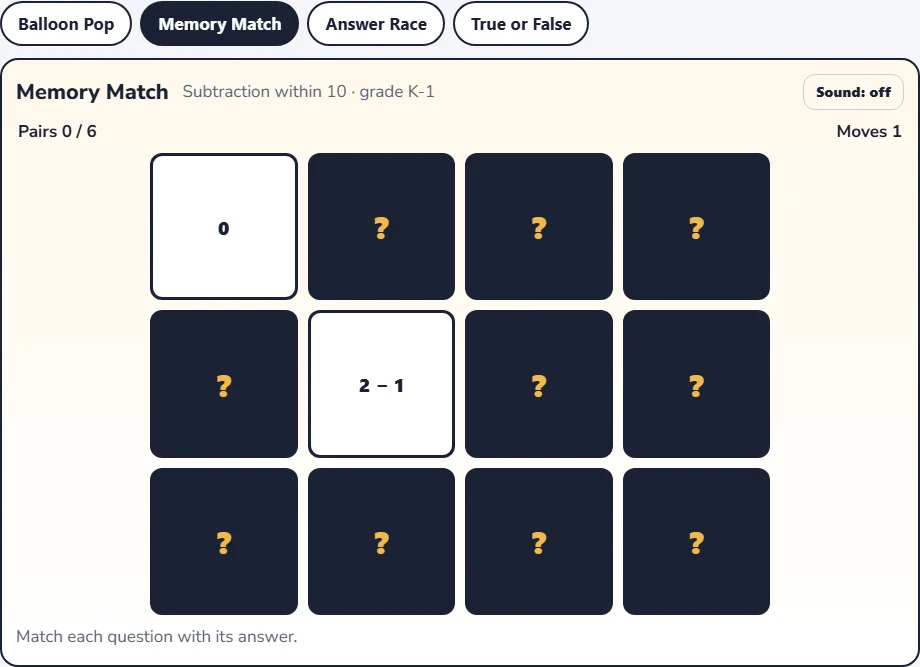
The subtraction within 10 game below has four modes, and every question subtracts within 10. The printable chart shows all the facts in a grid, with take-away on ten frames and a fact family, and the pictures show Answer Race, Balloon Pop and Memory Match on this page.
How the subtraction within 10 game works
- Answer Race: every right answer moves your car forward, and you race three computer cars to the finish flag. The first to 15 wins, and wrong taps cost time, not places.
- Balloon Pop: answers float up on balloons, and you pop the right one before it drifts off the top. The wrong balloons are within 3 of the right answer, so children have to work out the difference and not only spot the odd number out. The game speeds up as your score climbs, and three misses ends the round.
- Memory Match: twelve face-down cards hide six subtraction facts such as 9 − 4 and their six answers. Flip two at a time and match each one to its answer in as few moves as you can.
- True or False: sixty seconds on the clock. Decide whether each sentence, such as 8 − 3 = 5, is right or wrong. A streak of five or more scores double.
Subtraction facts to 10: how many are there in the subtraction within 10 game?
Each question starts from a number from 1 to 10 and takes away a number from 0 up to that number, so the answer is never negative. That gives 65 different facts. The number of facts grows with the starting number, as the table shows:
| Start at | Facts | Answers |
|---|---|---|
| 1 | 2 | 0 to 1 |
| 2 | 3 | 0 to 2 |
| 3 | 4 | 0 to 3 |
| 4 | 5 | 0 to 4 |
| 5 | 6 | 0 to 5 |
| 6 | 7 | 0 to 6 |
| 7 | 8 | 0 to 7 |
| 8 | 9 | 0 to 8 |
| 9 | 10 | 0 to 9 |
| 10 | 11 | 0 to 10 |
Twenty of the facts are the easiest of all: 10 facts take away zero (the number stays the same) and 10 take away the whole number (the answer is zero). That leaves 45 facts that need real thinking, which is where practice time should go.
Take away game strategies for kindergarten and grade 1
| Strategy | Example | How it works |
|---|---|---|
| Count back | 9 − 3 | Start at 9 and count back: 8, 7, 6. Good when taking away 1, 2 or 3. |
| Think addition | 10 − 7 | Ask 7 + ? = 10. The missing 3 is the answer. |
| Ten frame | 8 − 5 | Draw 8 dots, cross out 5, and count the 3 left. |
| Number line | 7 − 4 | Hop back 4 from 7 and land on 3. |
| Fact family | 3, 4, 7 | Know that 3 + 4 = 7, so 7 − 4 = 3 and 7 − 3 = 4. |
In a take away game the “think addition” idea is the most powerful, because it turns every subtraction into a fact children already know. Our number bonds to 10 game practices the pairs behind 10 − 7 and the rest, and a printed ten frame lets children cross out circles.
Fact families for subtraction within 10
Three numbers that belong together make a fact family: two numbers added give the third, and the third take away either of them gives the other. A child who knows one fact of the family knows all four. These are six families that cover many of the facts in the game:
| Family | Addition facts | Subtraction facts |
|---|---|---|
| 2, 3, 5 | 2 + 3 = 5 and 3 + 2 = 5 | 5 − 2 = 3 and 5 − 3 = 2 |
| 3, 4, 7 | 3 + 4 = 7 and 4 + 3 = 7 | 7 − 3 = 4 and 7 − 4 = 3 |
| 4, 5, 9 | 4 + 5 = 9 and 5 + 4 = 9 | 9 − 4 = 5 and 9 − 5 = 4 |
| 3, 7, 10 | 3 + 7 = 10 and 7 + 3 = 10 | 10 − 3 = 7 and 10 − 7 = 3 |
| 2, 6, 8 | 2 + 6 = 8 and 6 + 2 = 8 | 8 − 2 = 6 and 8 − 6 = 2 |
| 1, 8, 9 | 1 + 8 = 9 and 8 + 1 = 9 | 9 − 1 = 8 and 9 − 8 = 1 |
Subtraction games for kindergarten and first grade subtraction game ideas
The best subtraction games for kindergarten are short and physical: line up ten toys and take some away, or hop back along a floor number line. A first grade subtraction game can add a little speed, so use the subtraction within 10 game for two or three minutes at the end of a lesson. If a fact is still slow, go back to the ten frame and the fact family, and then play again.
Subtraction within 10 chart and ten frame subtraction
The subtraction within 10 chart on the printable lists every fact in a grid, with the answers in blue for small differences and orange for larger ones. Below the grid, ten frame subtraction shows 8 − 3, 10 − 6 and 7 − 4 by crossing out circles, which is the picture behind the facts. Children can use the subtraction within 10 chart to check their answers after a round of the subtraction within 10 game.
Subtraction word problems within 10
- There are 9 birds on a fence and 4 fly away. How many are left? Answer: 5.
- Mia has 7 stickers and gives 3 to Leo. How many does she have now? Answer: 4.
- A box holds 10 crayons, and 6 are red. How many are not red? Answer: 4.
- Sam had 8 grapes and ate all of them. How many are left? Answer: 0.
Where subtraction within 10 fits at school
| Level | What children are expected to do |
|---|---|
| Kindergarten (US) | Solve subtraction word problems and subtract within 10 (K.OA.A.2) |
| Kindergarten (US) | Fluently add and subtract within 5 (K.OA.A.5) |
| Grade 1 (US) | Add and subtract within 20, showing fluency within 10 (1.OA.C.6) |
| Year 1 (England) | Read, write and use subtraction facts within 20, and subtract one-digit numbers |
The Common Core kindergarten operations and algebraic thinking standards set these goals. When facts to 10 are quick, move on to the subtraction within 20 game, and print the subtraction worksheets for written practice.
Subtraction within 10 game: frequently asked questions
What grade is the subtraction within 10 game for?
Kindergarten and first grade, usually ages 5 to 7. First graders should be quick with all of these facts.
How do I help a child who counts on fingers?
Fingers are a fine start. Move on to ten frames and number bonds, and use the game to practice the facts a little each day until they are known.
How many subtraction facts are there within 10?
There are 65 facts in the subtraction within 10 game, from 1 − 0 to 10 − 10.
Does the game ever have a negative answer?
No. Each question starts from a number and takes away the same or a smaller number, so the answer is 0 or more.
Is the subtraction within 10 game free, and do kids need an account?
Yes, it is free, and no account is needed. Best scores are saved only in the browser on this device.
Does it work on phones and tablets?
Yes. Every game is built for touch first and also works with a mouse on a computer.