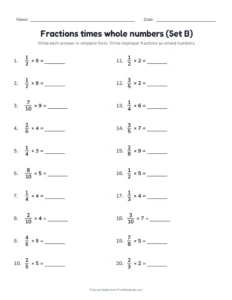
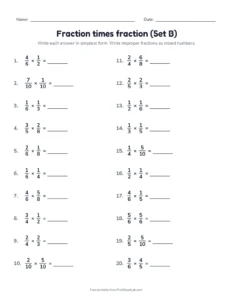
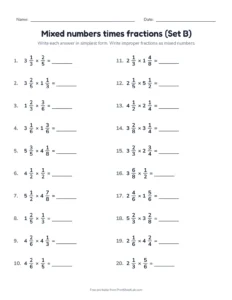
Multiplying fractions worksheets teach one of the most useful rules in elementary math: multiply the numerators, multiply the denominators, and simplify. These free printable multiplying fractions worksheets start with a fraction times a whole number, move to a fraction times a fraction, and finish with mixed numbers and word problems. Every PDF has an answer key, and the maker below creates new problems in seconds.
Quick answer: To multiply fractions, multiply the numerators (top numbers), multiply the denominators (bottom numbers), then simplify: 2/3 × 3/4 = 6/12 = 1/2. To multiply a fraction by a whole number, write the whole number over 1. This page has 7 free multiplying fractions worksheets (PDF) with answer keys, from fractions times whole numbers to mixed numbers, plus a maker for new problems. Updated October 2026.
Ready-to-print samples
A few of the ready PDFs on this page. The full list is under Ready-to-print worksheets, and the maker above makes new problems on demand.
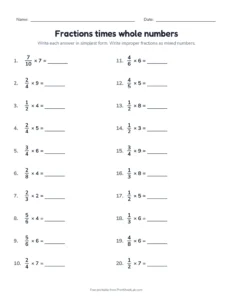
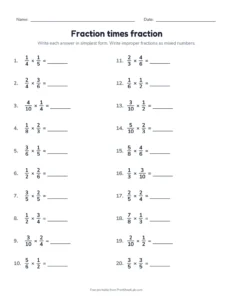
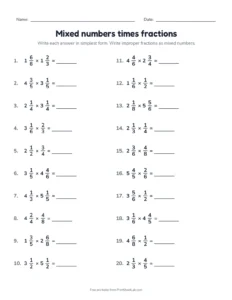
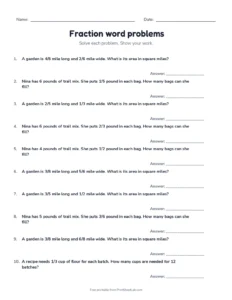
Fractions times whole numbersLevel 1 with a full answer key.PDFFraction times fractionLevel 2 with a full answer key.PDFMixed numbers times fractionsLevel 3 with a full answer key.PDFFraction word problemsReal-world fraction problems.PDF
How to multiply fractions in three steps
Multiply the numerators: the top numbers give the new numerator.
Multiply the denominators: the bottom numbers give the new denominator.
Simplify: divide the top and bottom by their greatest common factor. You can also cancel before you multiply, which keeps the numbers small.
You do not need a common denominator to multiply, which is the biggest difference from adding fractions. The rule works because a fraction of a fraction is a smaller piece of a piece: half of a third is a sixth.
Multiplying fractions: six worked examples
Each row shows the multiplication across and the simplified answer. Cover the last column and try each problem first:
Problem
Multiply across
Before simplifying
Answer in simplest form
2/3 × 3/4
2 × 3 = 6 and 3 × 4 = 12
6/12 = 1/2
1/2
1/2 × 5/6
1 × 5 = 5 and 2 × 6 = 12
5/12
5/12
3/5 × 2/9
3 × 2 = 6 and 5 × 9 = 45
6/45 = 2/15
2/15
4/7 × 7/8
4 × 7 = 28 and 7 × 8 = 56
28/56 = 1/2
1/2
5/6 × 3/10
5 × 3 = 15 and 6 × 10 = 60
15/60 = 1/4
1/4
1/4 × 1/4
1 × 1 = 1 and 4 × 4 = 16
1/16
1/16
Multiplying fractions by whole numbers worksheet
A multiplying fractions by whole numbers worksheet uses the same rule. Write the whole number as a fraction over 1, then multiply across. A fraction times a whole number is also the same as repeated addition, so 3/4 × 6 means six lots of three quarters:
Problem
Write the whole number as a fraction
Product
As a mixed number
3/4 × 6
3/4 × 6/1 = 18/4
9/2
4 1/2
2/5 × 10
2/5 × 10/1 = 20/5
4
4
5/6 × 4
5/6 × 4/1 = 20/6
10/3
3 1/3
7/8 × 3
7/8 × 3/1 = 21/8
21/8
2 5/8
2/3 × 9
2/3 × 9/1 = 18/3
6
6
Multiplying mixed numbers worksheets
For mixed numbers, first change each one to an improper fraction: multiply the whole number by the denominator and add the numerator. Then multiply across and change the answer back to a mixed number:
Problem
Change to improper fractions
Multiply
Answer
2 1/3 × 1 1/4
7/3 × 5/4
35/12
2 11/12
2 1/2 × 3/5
5/2 × 3/5
3/2
1 1/2
2 3/4 × 1 1/3
11/4 × 4/3
11/3
3 2/3
4 1/2 × 2/3
9/2 × 2/3
3
3
Why is the product smaller?
When you multiply by a proper fraction, you take part of a number, so the answer is smaller than the number you started with. This idea, called scaling, is a standard in fifth grade. It works the other way too: multiplying by a fraction greater than 1 makes a number larger:
Factors
Product
Is the product smaller than both factors?
1/2 × 1/2
1/4
Yes: 1/4 is smaller than 1/2
3/4 × 2/3
1/2
Yes: 1/2 is smaller than 3/4 and 2/3
4/5 × 5/6
2/3
Yes: 2/3 is smaller than 4/5 and 5/6
3/2 × 4/3
2
No: one factor is greater than 1, so the product can be larger
Multiplying fractions worksheet, practice and PDFs
This page is also searched as multiply fractions worksheet, fraction multiplication worksheet, multiplying fractions practice, multiplying fractions sheet, multiplication of fractions worksheets and fractions multiplication worksheets. All of them are the free PDFs above, with an answer key on the last page, for US Letter or A4, with no sign-up. Press Customize on any card to load the same level into the maker and print a new set of problems.
Multiply a fraction or whole number by a fraction, with an area model
Grade 5
5.NF.B.5
Understand multiplication as scaling: what happens to the size of the product
Grade 5
5.NF.B.6
Solve real-world problems that multiply fractions and mixed numbers
Grade 6
6.NS.A.1
Divide fractions by fractions (the next step)
Common mistakes when multiplying fractions
Mistake
Example
Fix
Adding the denominators
1/2 × 1/3 = 1/5
Multiply the denominators: 2 × 3 = 6, so 1/6
Finding a common denominator first
2/3 × 3/4: changing to twelfths
You do not need one for multiplying: multiply across
Forgetting to simplify
4/6 left as the answer
Divide top and bottom by the GCF: 2/3
Not changing mixed numbers
2 1/2 × 3 = 6 1/2
Write 5/2 × 3/1 = 15/2 = 7 1/2
Cross-multiplying
2/3 × 3/4 as 2 × 4 over 3 × 3
Multiply top by top and bottom by bottom
A weekly plan for multiplying fractions
Day
Focus
Suggested block
Monday
Fractions times whole numbers
15 min
Tuesday
Fraction times fraction
15 min
Wednesday
Mixed numbers times fractions
15 min
Thursday
Word problems and mixed review
15 min
Weekly total
Four short sessions
60 min
Try ten multiplying fractions problems
Here is a short set you can use as a warm-up or a quick check. Look for numbers you can cancel before multiplying, such as the 5 in the first problem. Answers are in simplest form.
#
Problem
Answer
1
2/5 × 5/6
1/3
2
3/8 × 4/9
1/6
3
7/10 × 5/14
1/4
4
3/4 × 8/15
2/5
5
5/9 × 3/10
1/6
6
6/7 × 7/12
1/2
7
1/3 × 9/4
3/4
8
4/5 × 15/16
3/4
9
2/3 × 2/3
4/9
10
5/8 × 16/25
2/5
Cancel before you multiply
Cross-cancelling saves time and keeps the numbers small. Look for a common factor between any numerator and any denominator. In 3/4 × 8/15, the 3 and the 15 share a factor of 3, and the 4 and the 8 share a factor of 4. After cancelling you have 1/1 × 2/5, which is 2/5, with no simplifying left to do.
Cancelling is optional, and students who find it confusing can multiply across and simplify at the end. Both paths give the same answer. Encourage cancelling once multiplying across feels easy, because it matters most with larger numbers, and it is a habit that carries over to algebra.
Multiplying fractions vocabulary
Students answer questions faster when they know the words. These are the terms used on the worksheets and answer keys:
Word
Meaning
Example
Numerator
The top number of a fraction, which counts the parts you have
3 in 3/4
Denominator
The bottom number, which tells how many equal parts make a whole
4 in 3/4
Product
The answer to a multiplication
2/3 × 3/4 = 1/2
Simplest form
A fraction where the top and bottom share no factor except 1
6/12 becomes 1/2
Improper fraction
A fraction with a numerator larger than or equal to the denominator
7/3
Mixed number
A whole number and a fraction together
2 1/3
Reciprocal
A fraction turned upside down
3/4 and 4/3
Real-life uses of multiplying fractions
Fraction multiplication appears whenever someone takes part of a part. Here are everyday examples to use when children ask why they need it:
Situation
Multiplication
Answer
Half of 3/4 of a pizza is left over
1/2 × 3/4
3/8 of the pizza
A recipe calls for 2/3 cup, and you make half the recipe
1/2 × 2/3
1/3 cup
A path is 3/5 of a mile and you walk 2/3 of it
2/3 × 3/5
2/5 of a mile
A board is 4 1/2 feet long and you cut 2/3 of it
2/3 × 9/2
3 feet
Three quarters of the class is wearing red, and a third of those wear hats
1/3 × 3/4
1/4 of the class
Tips for teachers and parents
Start with a picture before the rule. Draw a rectangle, shade 2/3 of it in one direction and 3/4 in the other, and count the overlap: six of twelve squares, which is 1/2. This area model, named in standard 5.NF.B.4, shows why the numerators multiply and the denominators multiply.
Next, use the rule on small fractions, then move to larger ones and mixed numbers. Ask children to estimate first. If one factor is less than 1, the product will be smaller than the other factor. Finally, mix this skill with the dividing fractions worksheets so students decide which operation each problem needs.
Which multiplying fractions worksheet should you start with?
Pick the first level students cannot yet finish without help, and move up when they score above 90 percent. Each level has a Set B for a retest a week later.
Level
Skill
Best for
Level 1
Fraction times whole number
Grade 4 and early grade 5
Level 2
Fraction times fraction
Grade 5
Level 3
Mixed numbers times fractions
Grades 5 and 6
Level 8
Word problems with fractions
Grades 5 and 6, once the basics are secure
Frequently asked questions
6 quick answers
Where can I download free multiplying fractions worksheets?
Open any worksheet in the Ready-to-print list on this page, choose US Letter or A4, then print or save the PDF. They are free, with answer keys, and no account is needed.
How do you multiply fractions?
Multiply the numerators, multiply the denominators and simplify. For example, 2/3 × 3/4 = 6/12, which simplifies to 1/2.
How do you multiply a fraction by a whole number?
Write the whole number as a fraction over 1 and multiply across. For example, 3/4 × 6 = 3/4 × 6/1 = 18/4, which is 4 1/2.
Do you need a common denominator to multiply fractions?
No. A common denominator is needed to add or subtract fractions, but not to multiply them.
How do you multiply mixed numbers?
Change each mixed number to an improper fraction, multiply across, then change the answer back to a mixed number if you like.
What grade multiplies fractions?
Grade 4 multiplies a fraction by a whole number, and grade 5 multiplies a fraction by a fraction and by mixed numbers.