Halloween bingo turns the loudest night of the fall into a game you can win with your eyes open. The template on this page has 30 squares that almost every October 31 produces somewhere, from the pumpkin on the porch and the cardboard ghost in the window to a vampire in the doorway and the one house that gives out full-size chocolate bars. Choose a card size, press print, and every player gets a different card.
In short: open the card maker above and press Edit and print this card, pick how many cards you need, and download a single PDF. No account, no cost, and nothing you type leaves your browser. Every square can be rewritten, so a school party, a street walk and a grown-up costume night can each get their own list.
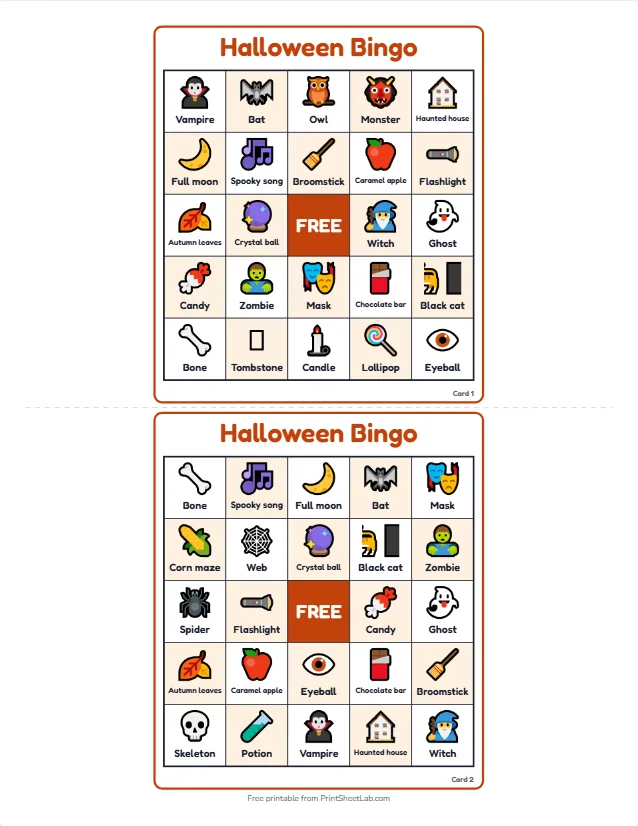
How to play Halloween bingo
The rules of Halloween bingo are the bingo rules everyone already knows, with one twist: nobody has to shout numbers. The night supplies the calls. Players carry a card and a crayon, and when a square happens in front of them, they mark it. Five in a row, across, down or diagonally, wins the first prize. A “seen it myself” honesty rule keeps it fair, and a friendly adult referee settles any argument about whether a plastic spider counts as a spider.
- Give every player a card and something to mark with. Crayons, stickers, or a couple of candy corn pieces to cover squares all work. Wet markers bleed through thin paper.
- Agree on the rules before you set off. A square counts when you see it with your own eyes, and it counts once. Costumes count for the person wearing them and for people looking at them.
- Mark as you go. The free center square is already marked, so a first line needs only four more.
- Announce the win to the group. The winner reads the line aloud, another player checks each square, and the prize is handed over.
- Play another round. Switch Halloween bingo to four corners, an X or a full card once the first line is won.
Halloween bingo works because the night is so predictable in its details. Nobody knows which houses will give out full-size candy bars, but everyone knows a spider web will appear before the third porch. A Halloween bingo card that names those details gives a crowd of excited kids a reason to look closely at the decorations, rather than just at the candy bowl.
Halloween bingo cards: all 30 squares
These Halloween bingo cards are made from a list of 30 squares. A standard 5×5 card with a free center needs 24 of them, so each card leaves out six and no two cards are identical. The table sorts the full list into the families a host usually thinks in. Use it to decide which squares to keep, and which to swap for something that belongs to your own street.
| Family | Squares on the list | Where you will see them |
|---|---|---|
| Creatures | 👻 Ghost, 🦇 Bat, 🕷️ Spider, 🧙 Witch, 🧛 Vampire, 💀 Skeleton, 🧟 Zombie, 🐈⬛ Black cat, 🦉 Owl, 👹 Monster | Porches, windows, and the costume parade. About half are decorations and half are people. |
| Decorations | 🎃 Pumpkin, 🕸️ Web, 🏚️ Haunted house, 🪦 Tombstone, 🕯️ Candle, 🔮 Crystal ball, 🌙 Full moon, 🍂 Autumn leaves, 👁️ Eyeball, 🦴 Bone, 🧹 Broomstick | Front yards, doorways and party tables. The cheapest squares to find. |
| Treats | 🍬 Candy, 🍎 Caramel apple, 🍭 Lollipop, 🍫 Chocolate bar | The bowl at the door, and the best reason to carry a bag. |
| Costume and gear | 🎭 Mask, 🔦 Flashlight, 🎶 Spooky song, 🧪 Potion | Kids’ hands, a speaker on a porch and the punch bowl at a party. |
| Places | 🌽 Corn maze | Only on a farm trip, a pumpkin patch or a fall festival. |
The Halloween bingo list is not random. Each family shows up at a different speed. Decorations and treats fill in at nearly every house, so they act as the engine of the game, while the rarer squares (the crystal ball, a potion, a corn maze) are what make a card feel like a treasure hunt. If every square on a Halloween bingo card were as common as a pumpkin, the first line would be over before the first porch light clicked on.
How many different cards can you print?
With 30 squares and 24 places on a 5×5 card, the number of different sets of squares is 30 choose 24, which is 593,775. Each set can be placed in a huge number of orders, so a class of 30 children gets 30 cards that are all different, and a street of 100 kids can still get 100 different cards. Smaller grids need fewer squares, so a Halloween bingo card of 4×4 or 3×3 has even more possible sets.
| Card size | Squares used | Different sets from the 30 | Best for |
|---|---|---|---|
| 3×3 with free center | 8 | 5,852,925 | Ages 3 to 5, and the very short game |
| 4×4 | 16 | 145,422,675 | A short classroom round |
| 5×5 with free center | 24 | 593,775 | The classic party and walk |
Three ways to play a Halloween bingo game
One printed card supports three quite different evenings. Pick the one that fits the crowd, or run two in a row. The table compares them, and the sections underneath give the rules and prizes.
| Game | Who calls | Length | Best for |
|---|---|---|---|
| Halloween bingo spotting walk | Nobody. The neighborhood does. | 45 to 90 minutes | Families and friend groups walking the street |
| Party game with calling cards | A host draws cut-out squares | 10 to 20 minutes | Costume parties, school and library events |
| Halloween bingo costume parade | The parade itself | 15 to 30 minutes | Classrooms and offices where costumes walk past one by one |
Game one: the Halloween bingo spotting walk
This is the version of Halloween bingo most families want, and the one where the printed card pays off. Each child carries a card, and every time they see a square, they mark it.
The twist that makes the walk last: mark only one square per house. Without that rule a keen player can fill half a line on the first porch, and the game is over in four houses. With it, the child has to choose which sighting to keep, and the contest stretches to a satisfying 15 houses or so. The simulation further down gives the numbers.
- Prize for the first line: first pick from the group candy swap at the end of the night, or the glow stick from the bag.
- Prize for four corners: choose the movie for the post-walk snack.
- Prize for everyone: a small sticker sheet. Every child who completes a line gets one.
- Grown-up job: a parent carries a spare card and helps younger children spot squares on the dark side of the street.
Game two: the party game with calling cards
This version of the Halloween bingo game suits a party table, and it is the one to pick when the weather is bad. In the Print tab you can add calling cards to cut out, one per square, plus a caller sheet. Shuffle the cut-out squares in a bowl or a cauldron, and a host draws one at a time and reads it in a spooky voice.
Everyone who has that square on their card marks it. Because the 30 squares come out in a random order and every square is called exactly once, the game has a predictable length. For a live round on a screen, with guests joining by link and cards marking themselves, the play bingo online page hosts the 75-ball game, and the play custom bingo online page explains how to play with your own list.
The host can make each call a little show: “Something is moving in the corner. It is a… spider.” A call that takes ten seconds of theater makes the drawn-card game feel like a performance, and teenagers who are too cool for bingo often join in the performance.
Game three: a Halloween bingo costume parade
When a class or an office parades its costumes, the parade is the caller of Halloween bingo. Each guest walks past, and observers mark squares: a witch, a vampire, a mask, a skeleton, a monster. Squares that need an item (a broomstick, a flashlight, a bone) can be marked when someone is carrying one.
The rule is a simple one: one costume can fill only one square, which prevents a single clever outfit from completing a line. The first to a line wins a small prize and gets to join the judging panel for the costume contest.
Halloween bingo on trick-or-treat night: a real simulation
A host planning a Halloween bingo night always asks the same question: how long will the game last? To answer it with numbers instead of a guess, we simulated walking a street. At each house, every square has its own chance of being seen, and we ran 8,000 walks of up to 40 houses for each setup (4,000 for the one-square-per-house rule).
The chances are our assumptions, chosen to feel like a typical American suburb. They are not survey data. A pumpkin is seen at 85 of every 100 houses, a ghost at 35, a vampire at 10, and a crystal ball at only 2. The full moon is seen on 35 percent of nights, and a corn maze on only 6 percent of walks.
For a 25-house walk, the simulated child sees about 26 of the 30 squares, so a typical 5×5 card with 24 squares ends the night with about 21 of its squares marked, plus the free center. The chart shows which Halloween bingo squares are safe and which are long shots.
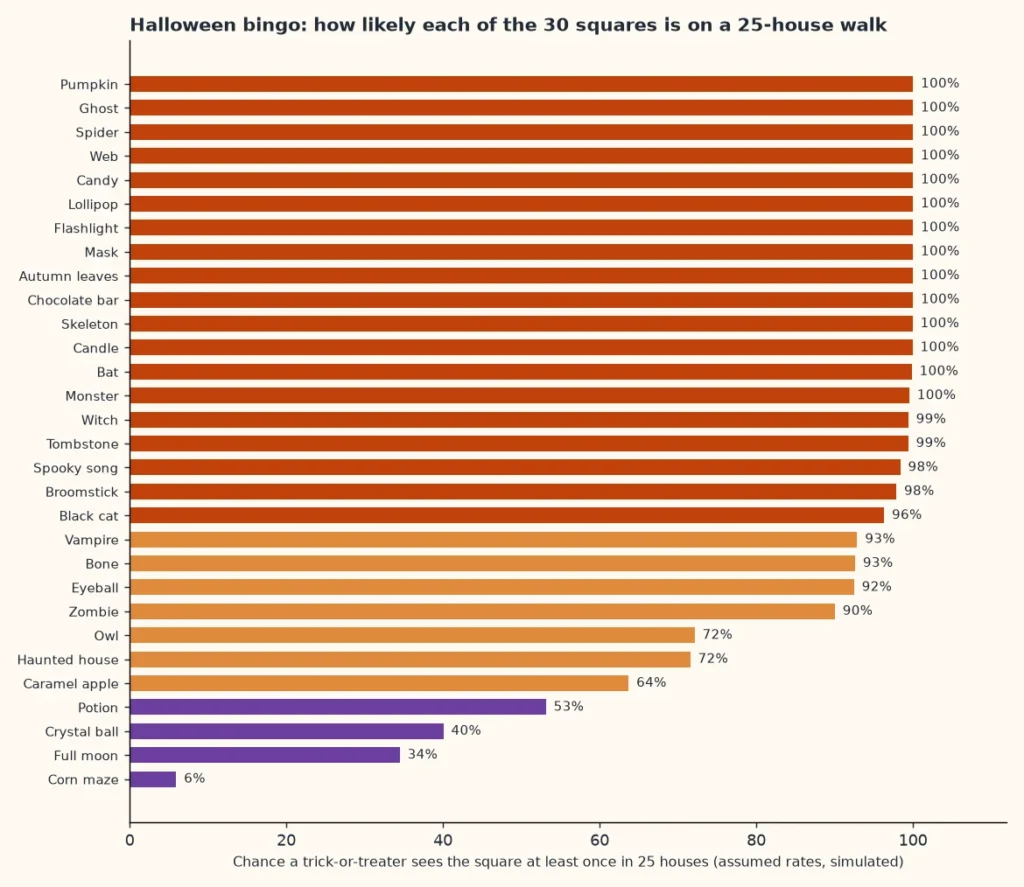
Sixteen squares are all but certain, at 99 percent or more, and only seven fall below 75 percent: the crystal ball, the potion, the caramel apple, the owl, the haunted house and the full moon, with the corn maze at the very bottom. That gives a Halloween bingo card a useful shape. A first line is easy, and a full card is a long shot: even if a lone child marks every square seen, a 5×5 blackout happens in only about 4% of 40-house walks.
Mark everything you see: the game is over by house five
| Pattern (5×5 card) | 1 card | 10 cards |
|---|---|---|
| Any line, median houses | 5 | 2 |
| Four corners, median houses | 21 (only 67% ever get there) | 4 |
| X pattern, median houses | only 42% ever finish | 11 |
| Full card, chance by house 40 | 4% | 19% |
If players mark every square they see in Halloween bingo, a lone child has a line after a median of 4 houses, and 65% of children have one by house five. With ten cards on the walk, the first line arrives at house 2. That is too fast for an evening of trick-or-treating, which is why the one-square-per-house rule exists. For a game that keeps going, use four corners or the X, or go for the full card with a stack of squares you have to hunt for.
One square per house: a first line takes about 15 houses
| Cards on the walk | Median houses to a first line | Middle half of walks | Line by house 10 | Line by house 20 |
|---|---|---|---|---|
| 1 card (a solo child) | 15 | 12 to 17 | 10% | 90% |
| 4 cards (a group of friends) | 11 | 10 to 13 | 37% | 100% |
| 10 cards (a class walk) | 10 | 8 to 11 | 71% | 100% |
With the one-square-per-house rule, a solo child needs a median of 15 houses, and 90% of children have a line by house 20. A group of four playing Halloween bingo needs 11, and a class of ten needs 10. More cards only shave a few houses, because every child is limited by the same thing: one mark per door. Seen from the other side, the rule makes the game fair for slow children, since nobody can fill a row by shouting out three sightings on one porch.
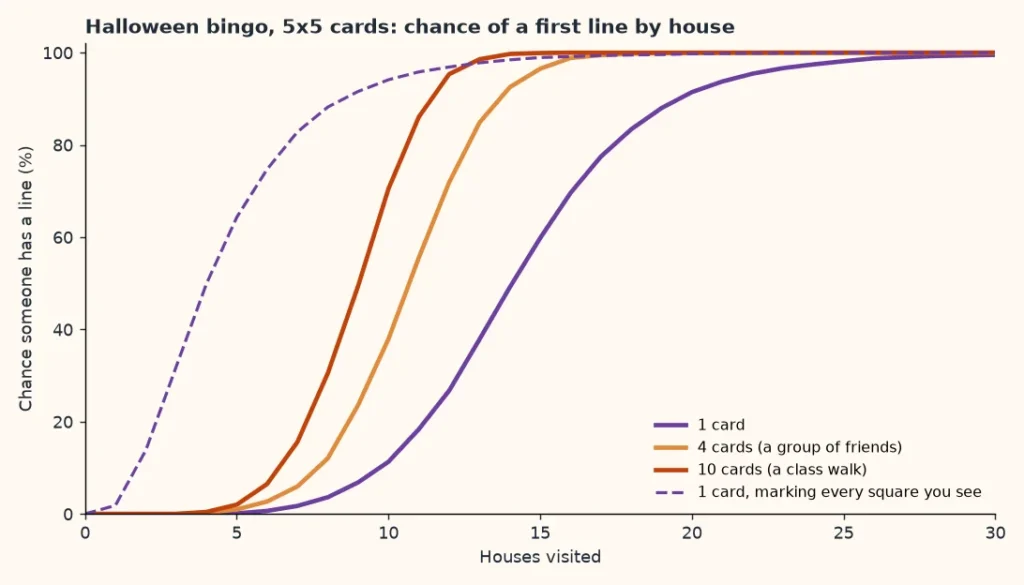
In the simulation, each child chooses at random among the squares seen at that house that are still open on the card. A thoughtful player does a little better, because they can choose the square that finishes a row. The numbers are a floor for a child who spots carefully and a ceiling for one who forgets to mark.
The party game: how many calls?
The drawn-card Halloween bingo game is much more predictable. All 30 squares are called exactly once, in random order. We simulated 8,000 games to find out how many calls it usually takes before somebody has a line:
| Cards in play (5×5) | Calls to the first line (median) | Middle half of games | Calls to a full card (median) |
|---|---|---|---|
| 1 card | 17 | 15 to 19 | 30 |
| 4 cards | 13 | 11 to 15 | 29 |
| 8 cards | 12 | 10 to 13 | 29 |
| 15 cards | 11 | 9 to 12 | 29 |
| 25 cards | 10 | 8 to 11 | 28 |
| 30 cards | 9 | 8 to 10 | 28 |
A party with 15 players on 5×5 cards usually sees a first line after 11 calls, which is about a third of the way through the list. A full card needs nearly the whole list: a median of 29 calls with 15 players, and 30 with one. For a quicker game, 4×4 cards with 8 players reach a first line at 11 calls and 3×3 cards with 8 players at 5. Assumptions: every call is equally likely at each step, cards are independent random draws, and nobody misses a call.
Printable Halloween bingo: print, cut and hand out
For printable Halloween bingo, the Print tab has the controls you need and nothing you do not. You choose how many different cards to print, from 1 to 100, how many go on a page (1, 2, 4 or 6), Letter or A4 paper, and portrait or landscape. Cut guides are available for sheets that need trimming. For a class of 28, print 30 cards, two per page, and keep two spares for the child who spills the juice.
- Use light cardstock or laminate. A card that will be carried on a walk survives the evening better when it is thicker than copy paper. Laminated cards can be marked with dry-erase crayons and reused.
- Print names on the cards. The Design tab can put a name on each card, which saves tears when two identical costumes swap cards.
- Use big squares for little hands. One card per page in portrait gives the biggest squares; use it for ages 3 to 5.
- Print the caller sheet and calling cards if you plan the party game. They come out of the same Print tab.
- Bring a clipboard. A clipboard and a pencil on a string make a card easy to mark in the dark under a flashlight.
Hosts who are away from a printer can save the Halloween bingo PDF to a phone or USB stick and print it anywhere. The shareable link in the card maker keeps only your word list, with no names or photos, so you can send it to the other parents and let everyone print their own.
Halloween bingo for kids
Halloween bingo for kids is a quiet way to make a loud night safer and funnier. Kids who are busy looking for a bat in a window are kids who are not running ahead of the group. The pictures on every square let pre-readers play without help, and Halloween bingo rewards sharp eyes is a good use of a flashlight. The right setup depends on the child.
| Age | Card | How to play |
|---|---|---|
| 3 to 4 | 3×3, one per page | A grown-up reads the pictures. Sticker dots, no pens. Everybody wins at the first line. |
| 5 to 7 | 3×3 or 4×4 | Words with emoji. Kids spot and shout. Play for a line, then for four corners. |
| 8 to 10 | 5×5 | The one-square-per-house rule, plus two squares they invent themselves. |
| 11 and up | 5×5 or the costume parade round | Add a rule that a sighting counts only if they can name it. Let them write a few squares for the next round. |
Classrooms get a lot from this. A round of Halloween bingo fits into the last half hour before a party, needs no preparation beyond printing, and gives the children something to do with the costumes. Pair it with the games in the Halloween games for kids guide for a full afternoon. If the school bans candy, change the four treat squares to a book, a sticker, a pencil and a glow stick, and the card still works.
Halloween bingo for adults
Halloween bingo for adults is a different animal from the version with sticker dots, and Halloween bingo for adults needs a lighter touch. Grown-ups at a costume party already have conversation to make and drinks to hold, so the card needs to ask for very little.
The best rule is that a square counts when someone else points it out to you. That makes Halloween bingo a way for guests to talk to strangers: “I think I see a vampire over there. Is that one yours?” The card becomes an excuse to ask a question, not a puzzle to solve alone.
Three tweaks make it grown-up. First, change the list. Replace the lollipop with “Someone is wearing a pun costume,” the corn maze with “Someone says they hate horror films,” and the spooky song with “The playlist plays the Monster Mash.” Second, use a 4×4 card with no free space, so the game ends in about 40 minutes. Third, give prizes that suit the party: first pick of the leftover candy, a bottle of something good for the full card, or the judge’s chair for the costume contest.
For more party ideas aimed at grown-ups, read the Halloween games for adults guide and pair the best two with bingo. If drinks are part of the evening, a friendly reminder helps: the game is about spotting, not about drinking at every call, and a non-alcoholic option for every guest belongs on the table.
Halloween bingo free printable: what you get
Free, private and nothing to install
This Halloween bingo free printable does not ask for an email or an account, and nothing is added to your PDF but the card itself and a small footer. The editor runs in your browser, so your word list never goes to a server. You need only a printer or a PDF viewer.
What you can change
The card maker has five tabs: Setup, Items, Design, Templates and Print. On the Items tab you can rewrite any square, add an emoji or upload your own picture, and decide what the free space shows.
The Design tab holds color themes, fonts, text size, ALL CAPS, borders, rounded corners, tiles or plain grids, and a card background that can be a color, a pattern or your own picture. You can also add a title, a logo and a footer line. The Templates tab holds the other ready-made lists, and the Print tab holds the numbers: how many cards, which paper, which layout.
You do not have to start from this page. The bingo card generator offers every card type in one place, and the blank bingo cards page gives you an empty grid to fill by hand.
Customize the cards in the card maker
The best Halloween bingo card names your own street. Open the Items tab and every square turns into a text box. Here is how a few common situations change the list.
- Your neighborhood. “The house with the fog machine,” “A porch skeleton wearing sunglasses,” “Full-size candy bar.”
- A school or library party. Swap candy for books, stickers and pencils, add “Teacher in costume” and “Someone dressed as a book character.”
- A very young group. Delete the scary squares (zombie, monster, skeleton) and add friendly ones (a smiling pumpkin, a cartoon ghost, a bunny costume).
- A trunk-or-treat. Use car squares: “A hay bale,” “A fog machine,” “A trunk with a theme.”
- A fall-festival version. Keep the corn maze, the caramel apple and the autumn leaves, and drop the spooky ones.
When your list has more than 24 words, the card maker gives every card a different mix, as described above. With exactly 24, every card has the same words in a different order. The free space can say “Free” or show its own emoji, text or picture, and the Design tab can print a title such as “Maple Street Halloween 2026” and a footer with the date. Shuffle re-deals the squares across all cards, Undo takes back your last change, and the preview lets you zoom in before you download.
Safety and etiquette on Halloween night
A Halloween bingo card in a child’s hand is only a good idea if it does not add to the risks of a dark street. A few common-sense notes help. They apply to any game you play while trick-or-treating, not just Halloween bingo.
- Eyes up when crossing. Cards are marked on the sidewalk or the porch, never in the road. Agree that nobody marks while crossing a street.
- Keep a flashlight pointed at the ground and wear reflective tape or a glow stick. The flashlight is also a square on the card, so there is a reason to carry one.
- Stay with an adult if children are under 12, and let the adult take the card for a young child who is busy carrying a bag.
- Respect the houses. Do not point at a decoration and say it is scary for the sake of a square. Pick houses with lit porches and say thank you at every door.
- Think about allergies. Four squares mention food. Houses that are known for nut-free treats, and homes that display a teal pumpkin, are worth a mention to children who live with allergies.
- Keep it kind. Costumes are not squares to be mocked. A “Witch” square is for a witch, and not for a child’s real-life grandmother.
Trick-or-treating itself has a long history, and the Wikipedia article on trick-or-treating traces how door-to-door requests for treats grew into the modern night. The practice varies from one country and one street to the next, which is another reason to treat the template as a starting list. A street in Mexico celebrating Day of the Dead and a block in Ohio will want different squares.
More bingo cards for the season
Halloween bingo is one of a whole set of occasion lists in the card maker. Once the candy is sorted, the next date on the calendar is the Christmas bingo list, with a family-gathering version in the baby shower bingo template for a shower in the weeks around it.
For the car ride to the fall festival, the road trip bingo list keeps the back seat busy, and the classroom bingo template is useful for the week after the party. Every template is gathered on the printable bingo cards hub, and number-based games run on the bingo caller.
Frequently asked questions
10 quick answers
What is Halloween bingo?
Halloween bingo is a bingo variation in which every square names something you see or do on Halloween, such as a pumpkin, a ghost, a bat or a bag of candy. Players mark squares as they spot them or as a host calls them, and the first to complete a line wins.
Are these Halloween bingo cards really free?
Yes. You can make, edit and print the Halloween bingo cards without an account or a payment. The editor runs in your browser, so the words and pictures you add never leave your device.
How many squares does the template have?
It has 30 squares. A 5×5 card with a free center uses 24 of them, a 4×4 card uses 16 and a 3×3 card with a free center uses 8. Because the list holds more words than a card has squares, cards differ from one another.
How many different cards can I print?
Up to 100 different cards in one PDF. There are 593,775 different sets of 24 squares to choose from, so even a big class can have a card each without repeats.
Can I play Halloween bingo while trick-or-treating?
Yes. Use the one-square-per-house rule so Halloween bingo lasts the whole walk. In our simulation a solo child with a 5×5 card needs a median of 15 houses to get a first line, and a group of four needs 11.
How do I run the party version?
In the Print tab, add the calling cards and the caller sheet. Cut the cards out, shuffle them, and draw one at a time. Players mark the square on their card, and the first complete line wins. A Halloween bingo party with 15 players usually has a winner after about 11 calls.
Is there a version for adults?
Yes. For Halloween bingo with grown-ups, use a 4×4 card, change a few squares to costume-party jokes, and let a square count when someone else points it out. The Halloween games for adults guide has other games to pair with it.
What prizes work best?
Prizes for Halloween bingo should be small and silly. Kids like first pick from the candy swap, a glow stick or a sticker sheet. Adults like the judge’s chair at the costume contest, first pick of the leftover candy, or a good bottle for a full card.
Can I change the squares to match my street or school?
Yes. On the Items tab every square can be rewritten, given an emoji or a picture. Swap candy for stickers in a school party, add the house with the fog machine, and use the free space for something personal.
What size should I print for young children?
Print a 3×3 card, one per page, with large pictures for ages 3 to 5. It has only eight squares plus a free center, so a first line comes within a few houses and the child stays interested.