Print free isometric paper as isometric dot paper or isometric graph paper, with 1 cm, 5 mm, 1/4 inch, 1/2 inch or custom spacing. Pick the dot or line color, portrait or landscape, and download a PDF for US Letter, A4 or A5. The preview above updates as you change each setting, and you can put up to 10 pages in one PDF.

What is isometric paper?
Isometric paper is printed with a grid of equilateral triangles instead of squares. Every point is the same distance from its six neighbors, and the lines run in three directions: straight up and down, and at 30 degrees above and below the horizontal. Those three directions match the three edges you see at the corner of a cube, which is why isometric paper makes it easy to draw 3D shapes that look right without any measuring. The method is called isometric projection.
- Isometric dot paper (also called an isometric dot sheet) shows only the points of the grid. You join the dots you need, so the finished drawing looks clean.
- Isometric graph paper (isometric grid paper) prints every line of the triangle grid. It is easier for beginners and for shading faces of a shape.
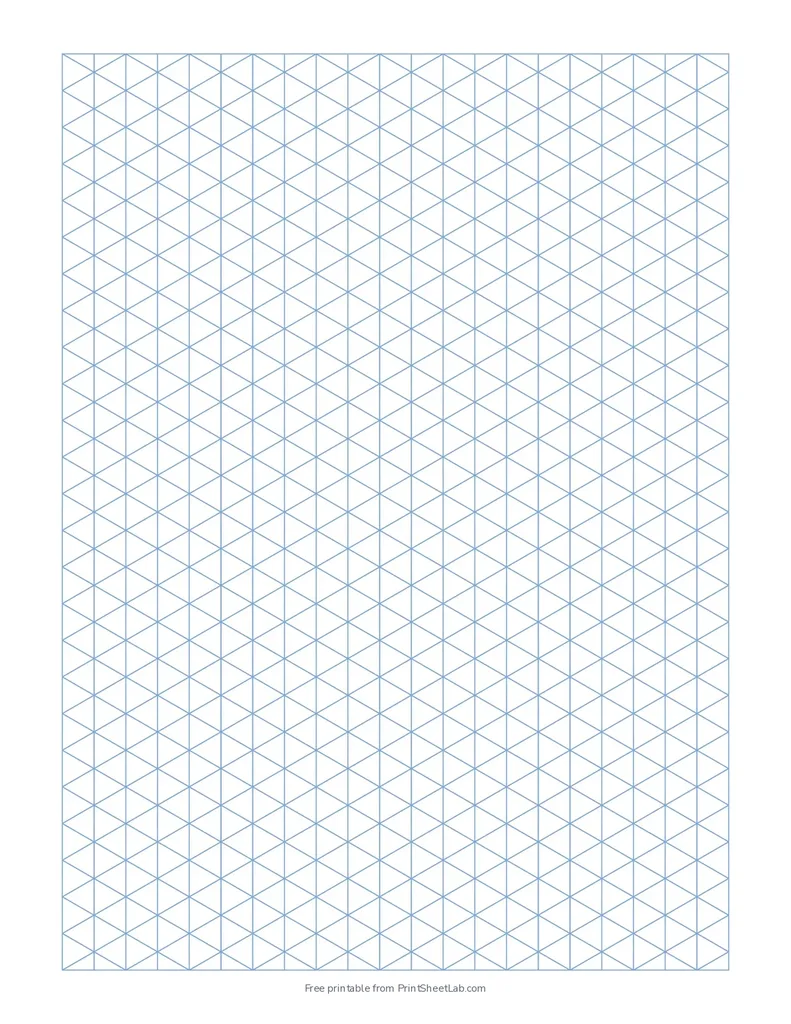
Isometric dot paper printable: PDF downloads
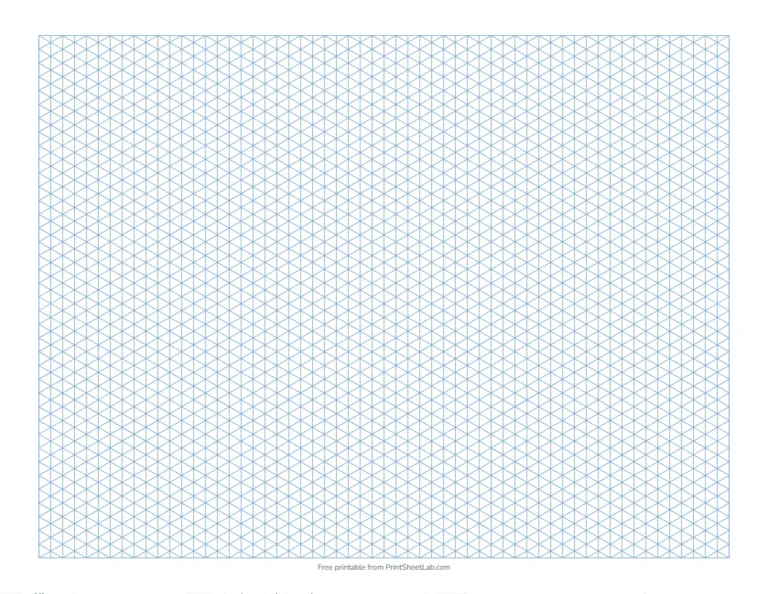
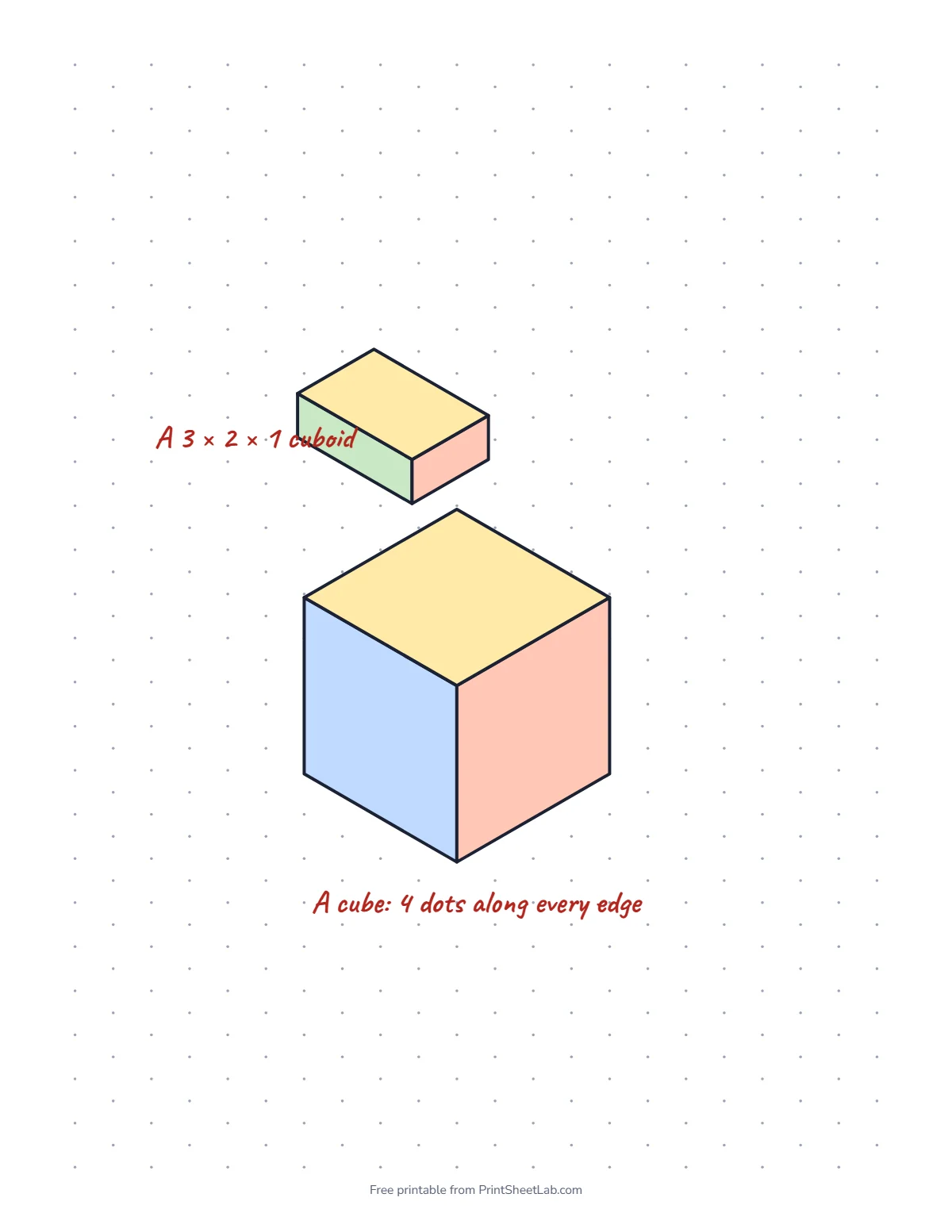
These four pages show what the generator prints: isometric dot paper with 1 cm dots, isometric graph paper with 5 mm lines in landscape, 1/4 inch grid paper, and a drawing of a cube and a cuboid on the dots. Click a picture for the PDF, or use the generator above to choose the spacing and the style.


What is isometric paper used for?
- Math: drawing cubes, cuboids, prisms and shapes made of unit cubes, counting cubes to find volume, and matching 3D drawings to their front, side and top views. Many class 7 math courses, including NCERT in India, use isometric dot sheets for these lessons.
- Technical drawing and design: quick 3D sketches of parts, furniture, rooms and product ideas.
- Game art and pixel art: isometric maps, buildings and characters in the classic isometric game style.
- Art and lettering: 3D block letters, optical illusions and geometric patterns.
- Crafts: triangle and hexagon quilt layouts, tessellations and bullet journal headers.
Isometric paper sizes: how many dots fit on a page?
| Spacing (between neighboring dots) | Dots on US Letter* | Dots on A4* | Good for |
|---|---|---|---|
| 1 cm | 561 | 605 | School math, cube drawings, beginners |
| 5 mm (0.5 cm) | 2,222 | 2,344 | Detailed sketches, game maps, small drawings |
| 1/4 inch | 1,418 | 1,445 | US imperial drawings and design sketches |
| 1/2 inch | 369 | 366 | Young learners, large print, big 3D letters |
*Counted from the PDFs this maker produces, in portrait with half-inch margins and no name line. You can also choose 2 cm or type any spacing from 1 to 100 mm.
How to draw a cube on isometric dot paper
- Choose a dot for the top corner of the cube.
- From that dot, draw one line to the next dot down and to the left, and another to the next dot down and to the right. These lines slope at 30 degrees.
- From each of those two dots, draw a line in toward the middle to meet at the dot directly below the top corner. You now have the top face of the cube: a diamond (rhombus).
- From the left, middle and right corners of the diamond, draw a vertical line straight down to the next dot.
- Join the bottom ends: bottom left to bottom middle, and bottom middle to bottom right. The cube is finished.
For a cuboid, make the sloped edges longer: for example 3 dots down to the left, 2 dots down to the right and 1 dot down for the height gives a 3 by 2 by 1 cuboid. Shade the top, left and right faces in three different tones to make the shape look solid.
Counting cubes on isometric dot paper
The two shapes in the filled example are a cube with an edge of 4 dots and a cuboid that is 3 units long, 2 wide and 1 high. Drawing them is only the first step. Counting unit cubes gives volume, and counting outside squares gives surface area. For a cube with edge n, the volume is n³ and the surface area is 6n². In an isometric view you see three of the six faces, so you see 3n² unit squares:
| Edge length n | Unit cubes (n³) | All outside squares (6n²) | Squares you see in an isometric view (3n²) |
|---|---|---|---|
| 1 | 1 | 6 | 3 |
| 2 | 8 | 24 | 12 |
| 3 | 27 | 54 | 27 |
| 4 | 64 | 96 | 48 |
| 5 | 125 | 150 | 75 |
| 6 | 216 | 216 | 108 |
For a cuboid, the surface area is 2 times the sum of the three face areas. Here are some shapes to draw, with their volume and surface area:
| Cuboid (length x width x height) | Volume in unit cubes | Surface area in unit squares |
|---|---|---|
| 1 x 1 x 1 | 1 | 6 |
| 2 x 2 x 2 | 8 | 24 |
| 3 x 2 x 1 | 6 | 22 |
| 4 x 3 x 2 | 24 | 52 |
| 4 x 4 x 4 | 64 | 96 |
| 5 x 3 x 2 | 30 | 62 |
Ask students to draw each shape, shade the three visible faces and count the squares. Then they can check their count with the formulas.
Isometric paper vs graph paper
Square graph paper is best for flat work: charts, floor plans and 2D shapes, and for drawing the front, side and top views of an object. Isometric paper is best for showing the object in 3D, because its lines already run in the three directions of a cube’s edges. For bullet journals and general sketching, plain dot grid paper is usually easier to write on.
How to print isometric paper
- Choose Isometric, then Dots or Lines, and the spacing above.
- Pick US Letter, A4 or A5, and portrait or landscape. Landscape gives wider drawings, such as a row of buildings.
- Choose a light gray or blue color so the grid stays behind your drawing.
- Download the PDF and print at 100% or “Actual size”, so 1 cm really measures 1 cm.
Frequently asked questions
7 quick answers
What is isometric dot paper?
It is paper printed with dots arranged in a triangular pattern, so each dot has six neighbors at the same distance. Joining the dots gives lines at 30 degrees and vertical lines, which is what you need to draw 3D shapes.
How many directions are the lines on isometric graph paper?
Three: vertical lines, and two sets of lines at 30 degrees above and below the horizontal. The three sets meet at 60 degree angles and form equilateral triangles.
What is the difference between isometric dot paper and isometric graph paper?
They use the same grid. Dot paper shows only the points, so your drawing stands out. Graph paper prints every line, which helps beginners and makes shading easier. Switch between them with the Dots and Lines buttons.
What size isometric dot paper should I use for school?
1 cm spacing is a common choice for math lessons because each unit is easy to count. Use your teacher’s worksheet as a guide if it asks for a particular size.
Can I print isometric paper on A4?
Yes. Choose A4 before downloading and the grid is drawn for A4 without scaling, so the spacing stays exact.
How do I make isometric paper in Word or Excel?
It is very hard to line up triangle grids by hand in Word or Excel. Make the page here and download the PDF, or insert the PDF page into your document.
Is this isometric paper free?
Yes. It is free to print for school, work and hobby use, with no sign-up.
More printable paper
- Graph paper in quarter inch, 5 mm and 1 cm squares.
- Dot grid paper for bullet journals.
- Graph paper with x and y axis for coordinate planes.
- Printable paper maker for every paper type.