Perspective drawing paper gives you a horizon line and guide lines that run to a vanishing point, so boxes, rooms and streets shrink into the distance the way they do in real life. These free printable perspective grids have one or two vanishing points, a high, middle or low horizon, and 16, 24 or 36 guide lines. Print the PDF and draw on it.
Perspective drawing paper to print (PDF)
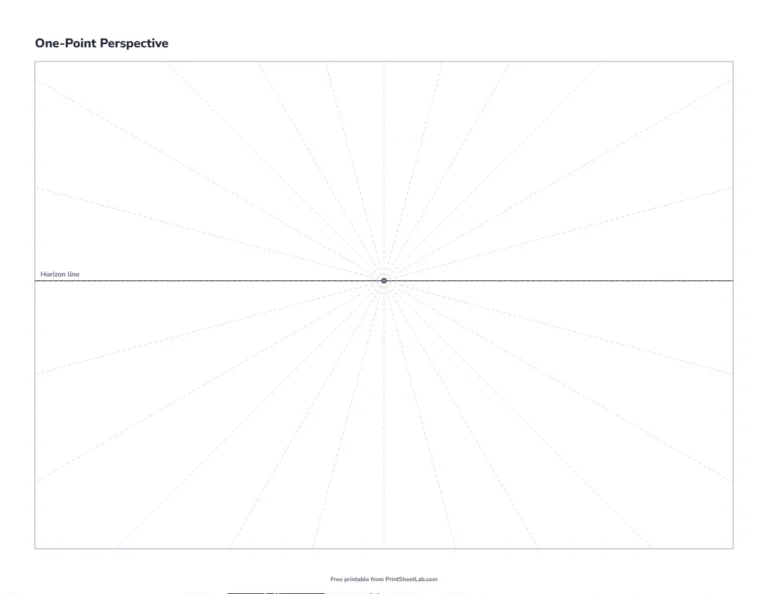
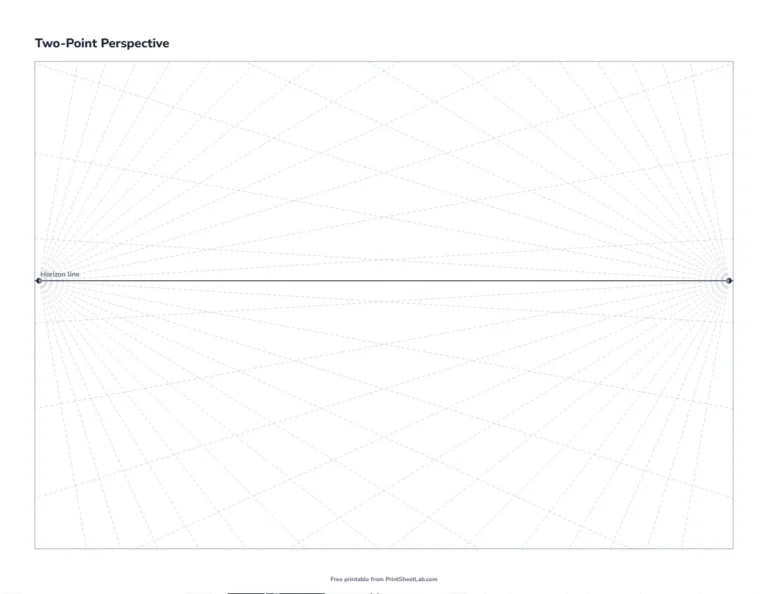
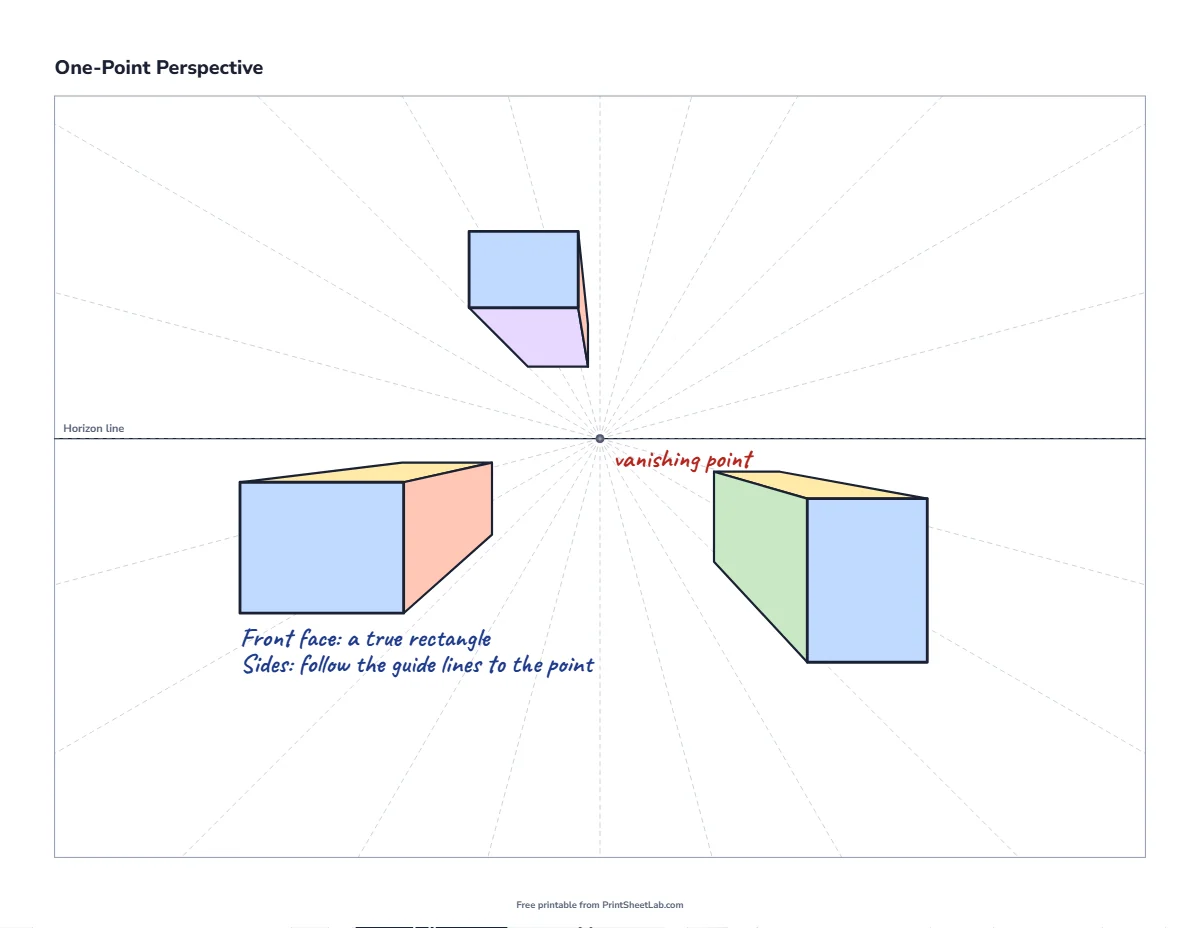
These four pages show the choices: a one-point grid, a two-point template, a high horizon with 36 guide lines, and a filled example with three boxes. Click a picture for the PDF, or use the generator above to choose the vanishing points, the horizon height and the number of guide lines.

How perspective drawing paper works
In linear perspective, lines that are parallel in real life, such as the edges of a road, appear to meet at a single point on the horizon. That point is the vanishing point. The horizon line is your eye level, so it stays at the same height no matter what you draw. The dashed guide lines on the sheet fan out from the vanishing point, and every edge that runs into the distance should follow one of them. Wikipedia’s perspective (graphical) article describes how artists such as Brunelleschi worked out the method in the early 1400s.
One point perspective grid or two point perspective template?
The one point perspective grid has a single vanishing point in the middle of the horizon. It is the right choice for a scene seen straight on, where one face of every object points at you: a road, a hallway, railway tracks, or the front of a building. The two point perspective template has a vanishing point near each side of the page, 9.9 inches apart. Use it for objects seen from a corner, such as a house, a box or a street corner. With two points, vertical lines stay vertical and the sides recede to the left and the right.
Where should the horizon go?
The horizon line on this perspective drawing paper is where the viewer’s eyes are, and the generator offers three heights. On a landscape Letter sheet, the picture area starts 0.88 inch from the top and is 6.98 inches tall, so the horizon lines are here:
| Horizon setting | Horizon line, from the top of the page | What the viewer sees | Try it for |
|---|---|---|---|
| High (30%) | 2.97 in | A bird’s-eye view: most of the picture is below the horizon | City streets from a roof, a table top, a map-like scene |
| Middle (45%) | 4.02 in | Standing height, looking straight ahead | Hallways, roads, rooms and railway tracks |
| Low (65%) | 5.42 in | A worm’s-eye view: tall objects tower over you | Tall buildings, trees, a dramatic hero shot |
Anything above the horizon is seen from below, and anything below it is seen from above. A box that sits on the horizon line shows you neither its top nor its bottom, which is the easiest case for a first drawing.
Perspective grid printable: how many guide lines?
You can print 16, 24 or 36 guide lines. More lines make it easier to follow an edge, but they also make the page busier. For a one point grid the lines are spread all the way around the vanishing point, and for the two point template they cover a 160 degree fan at each point. The spacing between the lines is:
| Guide lines | One point: angle between lines | Two points: angle between lines at each point | Good for |
|---|---|---|---|
| 16 | 22.5° | 10.7° | A clean grid for beginners |
| 24 | 15.0° | 7.0° | Most drawings |
| 36 | 10.0° | 4.6° | Detailed scenes with many objects |
The lines are light dashed gray, so they are easy to leave in or to erase.
How to draw a box in one point perspective
- Print the perspective drawing paper with one vanishing point, and use the dot printed on the horizon line.
- Draw the front face of the box as a straight rectangle. It is not distorted in one-point perspective.
- From each corner of the front face, draw a light line to the vanishing point. Use the printed guide lines, or a ruler.
- Decide how deep the box is, and draw the back edges. The back top edge is a horizontal line that joins the two receding lines. Draw the back side edge the same way.
- Erase the lines you cannot see, and darken the edges of the box.
The filled example shows three boxes using this method. The one below the horizon shows its top face, the one above shows its underside, and the sides always follow the guide lines to the vanishing point.
How to draw a box in two point perspective
- Draw a vertical line for the nearest corner of the box. It should cross the horizon if you want the box at eye level.
- From the top and the bottom of that line, draw guide lines to the left vanishing point and to the right vanishing point.
- Draw two more vertical lines, one on each side, to mark the far edges of the two faces. Keep them closer to the middle than the vanishing points.
- Join the far corners with lines to the opposite vanishing points to close the top and the box.
- Erase the hidden lines and darken the outline.
Things get smaller with distance: a quick size guide
The size of an object in the picture is in proportion to one divided by its distance from the viewer. When the distance doubles, the object looks half as tall. This is the reason the poles along a straight road appear to shrink toward the horizon:
| Distance (nearest pole = 1) | Apparent height | A pole drawn 40 mm tall at distance 1 is drawn |
|---|---|---|
| 1 | 100% | 40.0 mm tall |
| 2 | 50% | 20.0 mm tall |
| 3 | 33% | 13.3 mm tall |
| 4 | 25% | 10.0 mm tall |
| 5 | 20% | 8.0 mm tall |
| 10 | 10% | 4.0 mm tall |
Use this when you draw a row of identical things, such as fence posts or street lamps. A simple way is to draw a diagonal across the first panel and use it to find the next one.
Perspective drawing for beginners: practice ideas
- Start with one box. Draw ten boxes at different spots on the page, above, below and on the horizon.
- Draw a street. Use the one point grid for a road with buildings on each side, then add doors and windows that shrink toward the vanishing point.
- Build a room. Draw the back wall as a rectangle, then connect its corners to the vanishing point to make the floor and ceiling.
- Move the horizon. Draw the same box on the high and low horizon sheets and compare the two views.
- Trace first. Lay thin paper over the perspective drawing paper, so you can draw several versions without printing again.
- Add a third point. For very tall buildings, add a vanishing point high above the page by hand.
Drawing guide paper: tips for clean results
- Draw lightly first. The guide lines are pale, so pencil lines in a darker gray stand out.
- Use a ruler for the lines that run to the vanishing point, and draw freehand for curves.
- Keep the drawing guide paper flat and tape it down if the page slides.
A page of perspective drawing paper costs almost nothing, so print several and keep the good ones. For square grids and plain pages, see graph paper and dot grid paper.
Printing tip
Print at 100% or “Actual size” and turn off “Fit to page”, so every measurement on the sheet is exact. Choose Letter or A4 paper in the generator before you download the PDF.
Perspective drawing paper: frequently asked questions
What is the difference between one-point and two-point perspective?
One-point perspective has a single vanishing point and shows one face of an object head-on. Two-point perspective has two vanishing points and shows an object from a corner.
Where should the horizon line go?
The horizon is at eye level. Put it high for a bird’s-eye view, in the middle for a standing view and low for a view from the ground.
How many guide lines should I choose?
Twenty-four is a good start. Choose 16 for a cleaner page, or 36 for a detailed scene with many objects.
Does the perspective grid print in landscape?
Yes. The perspective guides print in landscape on Letter or A4, because a wide page gives the vanishing points more room.
Is this perspective drawing paper free?
Yes. It is free to print for home and classroom use, with no sign-up.
More printable paper
- Specialty paper generator with every layout on this site
- Paper generator for lined, graph, dot grid, isometric and handwriting paper
- Graph paper, lined paper and dot grid paper