A FIRE calculator turns your spending into a target number and tells you how many years of saving it takes to reach it. FIRE stands for financial independence, retire early: the point where your investments can pay for your spending without a job. This calculator gives you your FI number, the age you reach it, your Coast FIRE number, and a milestone tracker you can print.
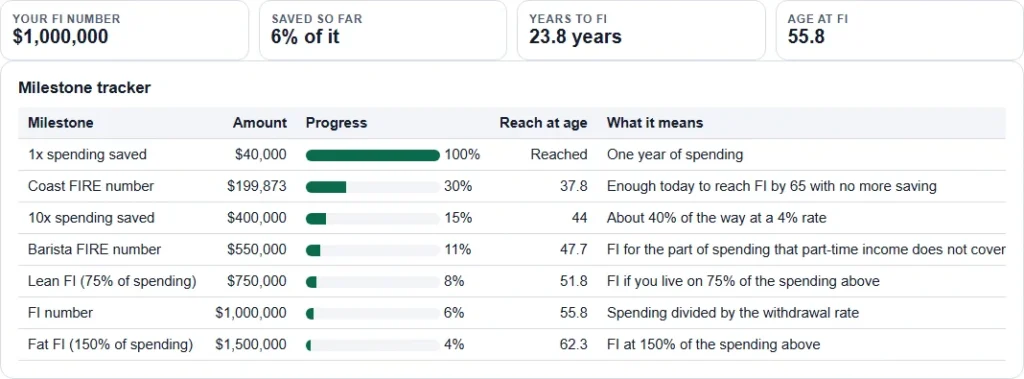
Quick answer: Enter your age, yearly spending, savings and monthly saving. The FI number is yearly spending divided by the withdrawal rate: at 4%, $40,000 of spending needs $1,000,000. With $60,000 saved, $1,500 a month and 5% growth after inflation, that takes 23.8 years, and the Coast FIRE number is $199,873.
How to use the FIRE calculator
- Enter your age, the traditional retirement age you would otherwise work to, and your yearly spending in retirement in today’s money.
- Enter what you have invested and what you save each month.
- Set the growth rate after inflation and the withdrawal rate. Leave them at 5% and 4% to follow the examples here.
- Read your FI number, the years to reach it and the age you reach each milestone, then print the milestone tracker and log your real balance each year.
All figures are in today’s dollars, which is why the growth rate is the rate after inflation. Spending in retirement should be what you expect to spend, not what you earn.
Financial independence calculator: your FI number is spending divided by the withdrawal rate
The FI number is the size of portfolio at which a chosen share of it, taken each year, covers your spending. A 4% withdrawal rate means a target of 25 times yearly spending, and a lower rate means a bigger target:
| Yearly spending | FI number at 3% | FI number at 3.5% | FI number at 4% |
|---|---|---|---|
| $24,000 | $800,000 | $685,714 | $600,000 |
| $36,000 | $1,200,000 | $1,028,571 | $900,000 |
| $48,000 | $1,600,000 | $1,371,429 | $1,200,000 |
| $60,000 | $2,000,000 | $1,714,286 | $1,500,000 |
| $80,000 | $2,666,667 | $2,285,714 | $2,000,000 |
Each $1,000 of yearly spending adds $25,000 to the target at 4%. Cutting spending shrinks the target and raises the amount you can save, which is why spending matters twice.
Years to financial independence by savings rate
The time to FI depends mostly on the share of income you save. This table starts from zero savings and assumes 5% growth after inflation, a 4% withdrawal rate, and that you spend what you do not save:
| Share of income saved | Years to FI from zero |
|---|---|
| 10% | 51.0 years |
| 20% | 36.4 years |
| 25% | 31.6 years |
| 30% | 27.7 years |
| 40% | 21.4 years |
| 50% | 16.4 years |
| 60% | 12.2 years |
| 70% | 8.7 years |
| 75% | 7.1 years |
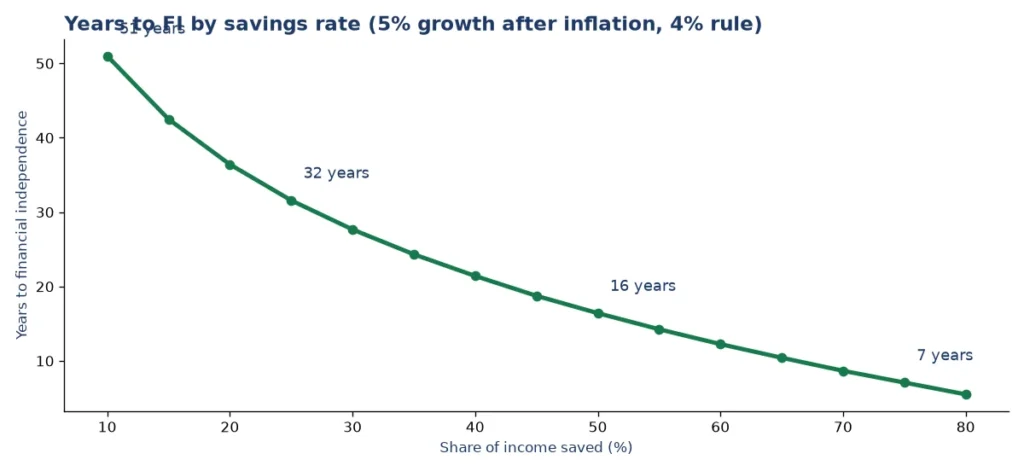
Moving from 10% to 20% saves about 15 years, while moving from 50% to 60% saves about 4. The first steps pay the most in time.
How the growth rate changes the answer
| Growth after inflation | Years to FI at a 50% savings rate |
|---|---|
| 3% | 18.8 years |
| 4% | 17.5 years |
| 5% | 16.4 years |
| 6% | 15.5 years |
| 7% | 14.7 years |
A one-point difference in the growth you assume changes the answer by about a year at this savings rate. Use a rate you would be comfortable missing, not the best year you can remember.
Coast FIRE calculator: the number that lets you stop saving
Your Coast FIRE number is the amount that grows to your FI number by the traditional retirement age with no more contributions. Its formula is FI number divided by (1 + growth rate) to the power of the years left. For a $1,000,000 FI number at 5% growth after inflation:
| Your age | Coast FIRE number if you retire at 60 | Coast FIRE number if you retire at 65 |
|---|---|---|
| 25 | $181,290 | $142,046 |
| 30 | $231,377 | $181,290 |
| 35 | $295,303 | $231,377 |
| 40 | $376,889 | $295,303 |
| 45 | $481,017 | $376,889 |
| 50 | $613,913 | $481,017 |
The number rises with age because there is less time left for growth to do the work. Once your savings pass it, your job only has to pay your current spending. That is what Coast FIRE means: you can coast on the growth.
FIRE milestone tracker: a worked example
Take a 32-year-old with $60,000 invested, $1,500 saved a month, and $40,000 of yearly spending in retirement. The calculator shows these milestones, with the age each one is reached at 5% growth after inflation:
| Milestone | Amount | Saved so far | Reached at age |
|---|---|---|---|
| 1x yearly spending | $40,000 | 100% | Reached |
| Coast FIRE number (retire at 65) | $199,873 | 30% | 37.8 |
| 10x yearly spending | $400,000 | 15% | 44.0 |
| Barista FIRE number ($18,000 part-time income) | $550,000 | 11% | 47.7 |
| Lean FI (75% of spending) | $750,000 | 8% | 51.8 |
| FI number | $1,000,000 | 6% | 55.8 |
| Fat FI (150% of spending) | $1,500,000 | 4% | 62.3 |
The ladder shows steps worth celebrating: the first year of spending saved comes first, passing the Coast FIRE number at age 37.8 means that, on these assumptions, you could stop adding to the portfolio and let growth carry it, and the full FI number lands at age 55.8.
Printing the FIRE milestone tracker and year log
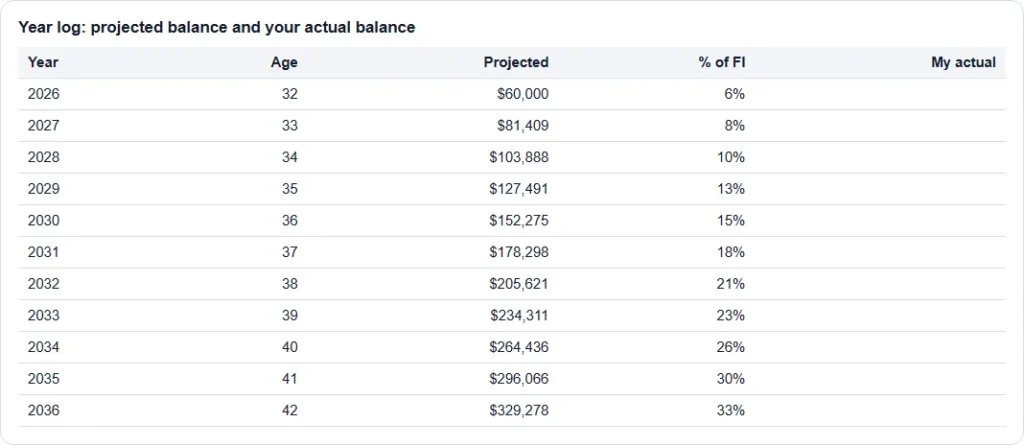
Press Print the milestone tracker to get the milestone ladder and a year log. The log shows your projected balance for the next ten years next to a blank column for your actual balance. Fill in the last column each January. If your real balance is above the projection, you are ahead; if it is below, change one of the three levers: spending, saving or the target age.
What this FIRE calculator leaves out
- A fixed rate. Real markets move up and down, and bad returns in the first years of retirement hurt more than the same returns later.
- A 30-year horizon in the original research. The study behind the 4% rule looked at payout periods of 15 to 30 years, and an early retirement can be longer. See the Trinity study summary for what it did and did not test.
- Taxes. Withdrawals from some accounts are taxed, and the calculator does not model them.
- Health insurance before Medicare age. It is a real cost in the US that varies by plan and income. Put it in your yearly spending.
- Changes in spending. Spending can rise or fall over time, so recheck the plan every year.
For the 4% rule in more depth, and how pension and Social Security income change the picture, see the retirement calculator.
Frequently asked questions
6 quick answers
What is a FIRE number?
It is the portfolio size at which your chosen withdrawal rate covers your yearly spending: spending divided by the withdrawal rate. At 4% it is 25 times your spending.
What is Coast FIRE?
Coast FIRE is the point at which your savings, with no more contributions, grow to your FI number by the age you would normally retire. After that you only need to earn enough to cover current spending.
What is Barista FIRE?
It is financial independence for part of your spending, with part-time income covering the rest. The calculator uses spending minus your part-time income, divided by the withdrawal rate.
Should I use 4% or a lower withdrawal rate?
A lower rate gives a larger target and more margin for a long retirement or poor early returns. Try 3.5% to see how much the target moves.
Does the calculator include inflation?
Yes, by working in today’s dollars. Enter the growth rate after inflation, so 7% growth and 2% inflation is about 5%.
Is this financial advice?
No. It is a projection tool built on assumptions you set. Speak to a qualified adviser about your own situation.
Related calculators
- Retirement calculator for the 4% rule and pension income
- Compound interest calculator to see growth year by year
- Budget calculator to find your yearly spending and savings rate
- Dividend calculator with DRIP for income investing
- Debt snowball calculator if debt comes first
This page gives general information and tools, not financial advice.
Last updated: October 2026.