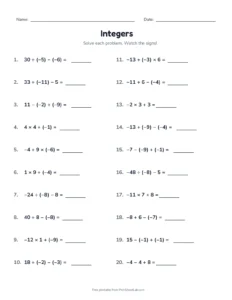
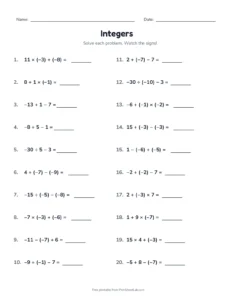
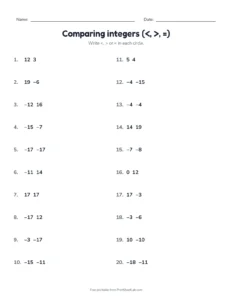
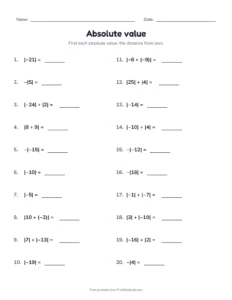
Free integer worksheets generator: add, subtract, multiply and divide integers, compare and order them, absolute value and word problems, with answer keys and online practice.
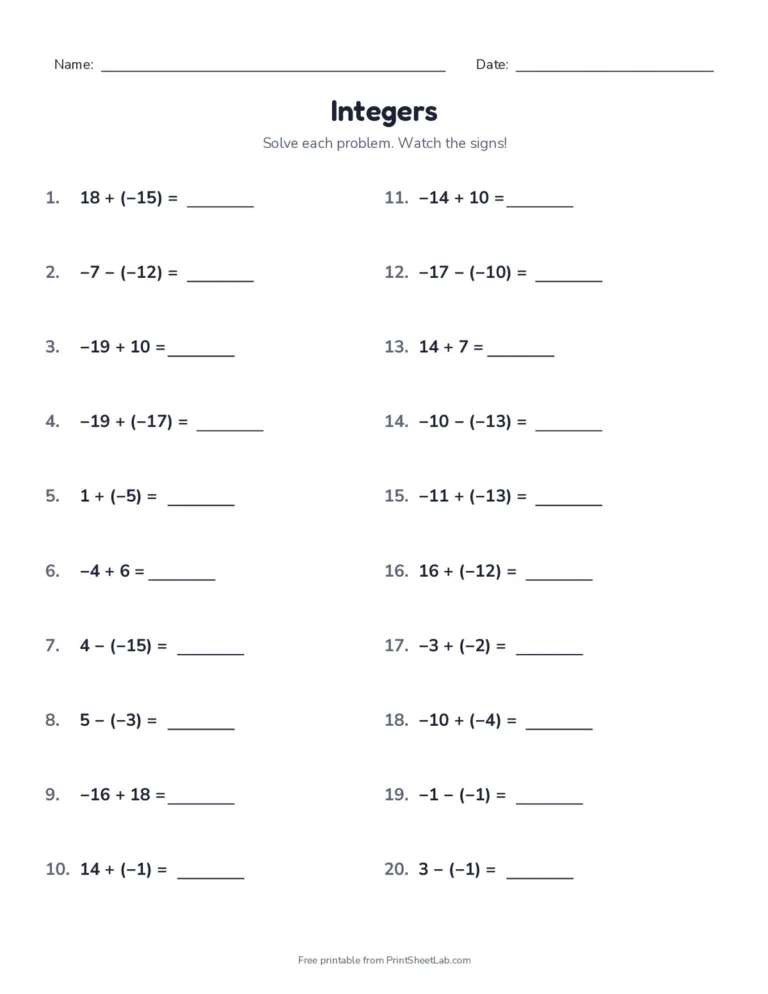
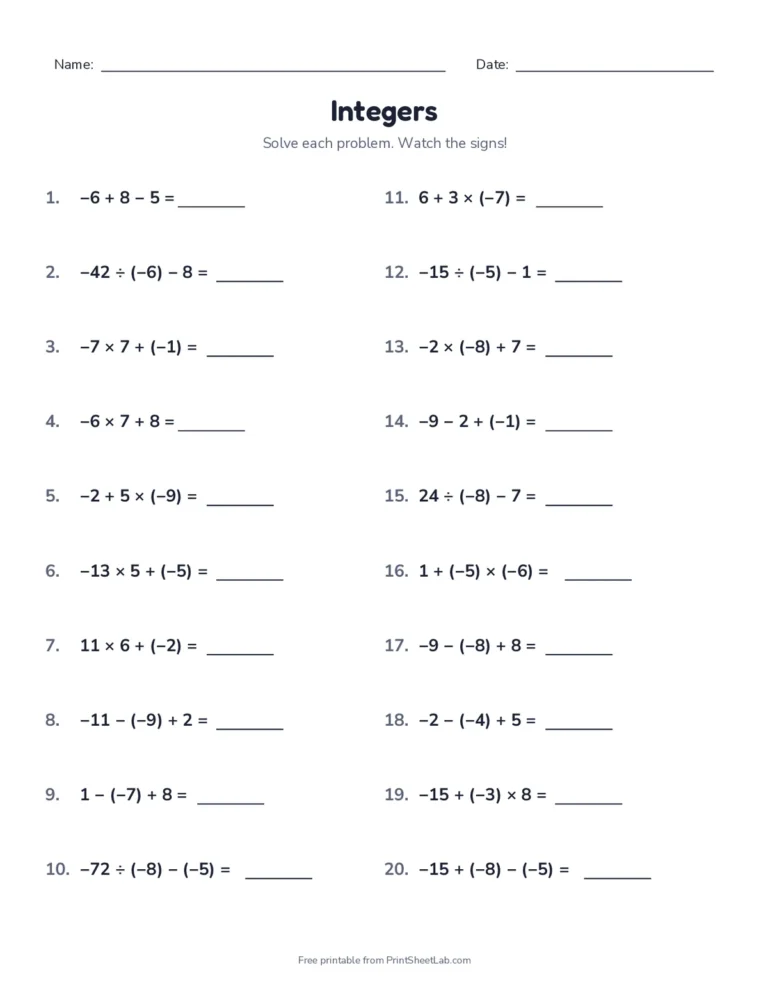
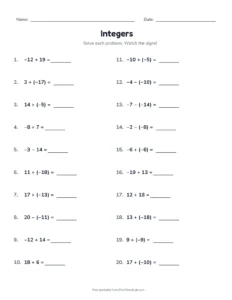
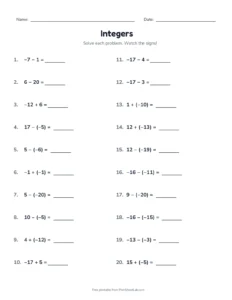
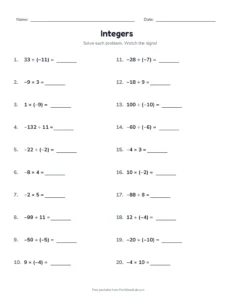
Free integer worksheets for 6th and 7th grade. Practice adding and subtracting integers, multiplying and dividing integers, or mixed problems with three numbers. Negative numbers are shown in parentheses the way textbooks write them, and every sheet has an answer key. Start with adding and subtracting integers, then try the integer word problems about temperature, sea level and money.
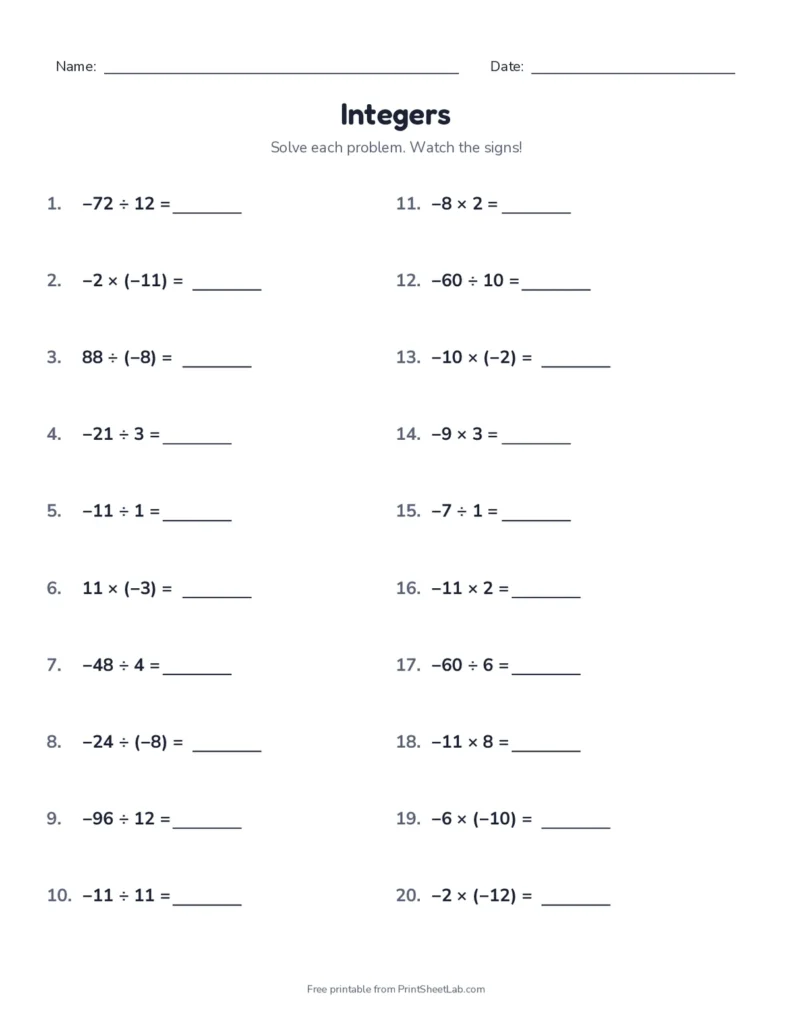
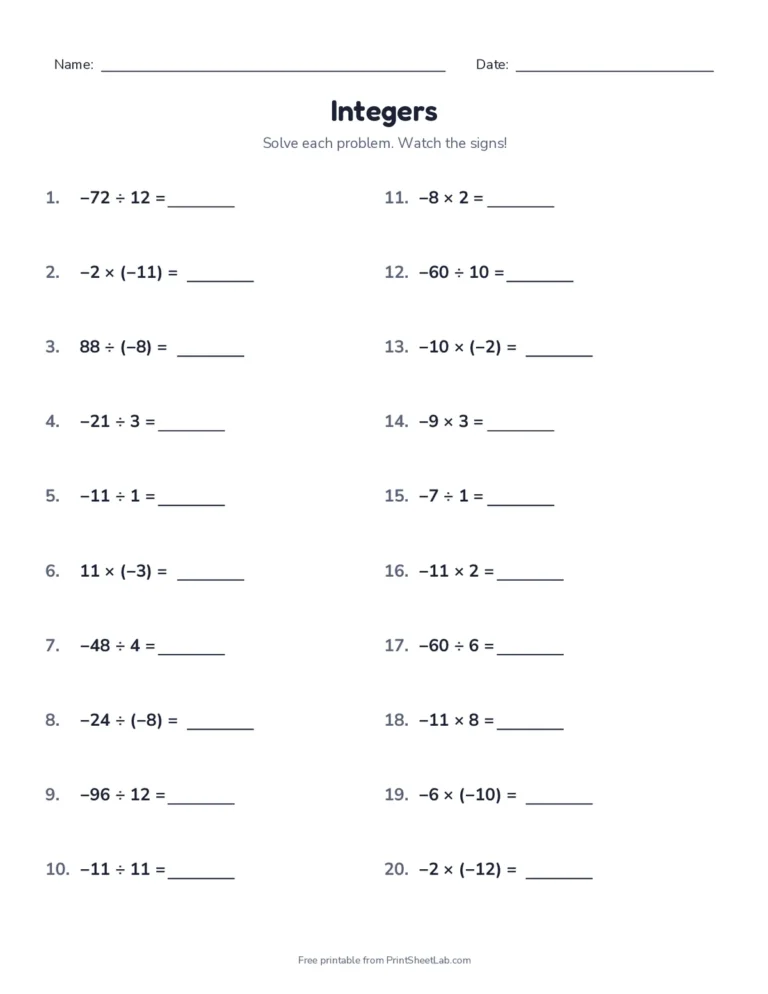
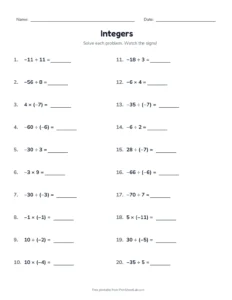
A multiplying and dividing integers sheet: sign rules in action, ready to print.
Quick answer: This page has free integer worksheets with answers for 6th and 7th grade: adding, subtracting, multiplying and dividing integers, absolute value and word problems. Updated October 2026.
Integer practice online with instant checking
Type your answer (use a minus sign for negatives) and press Check. How long a streak can you build?
Ready-to-print integer worksheets (PDF)
Every PDF has an answer key on the last page. Press Customize for new problems or a different level.
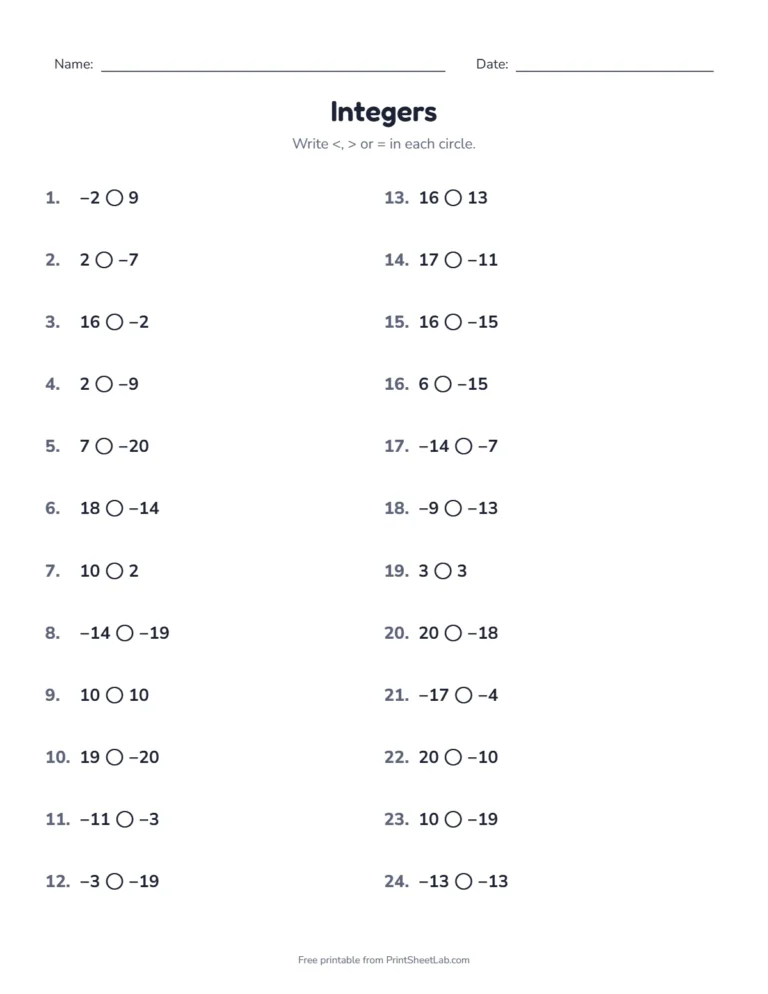
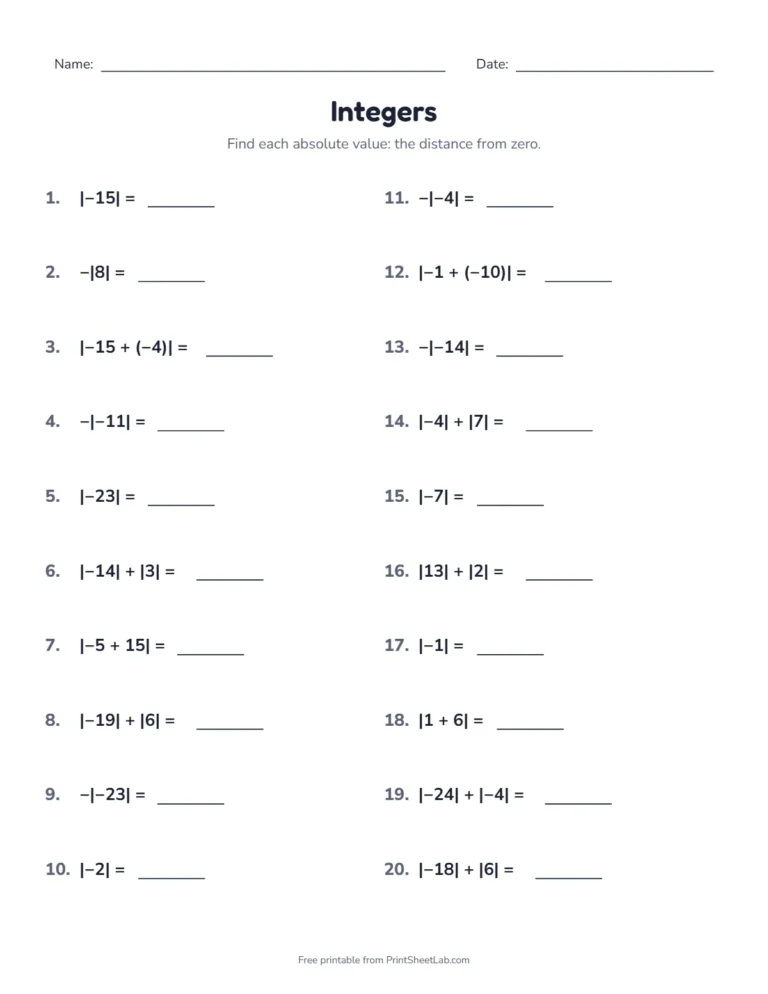
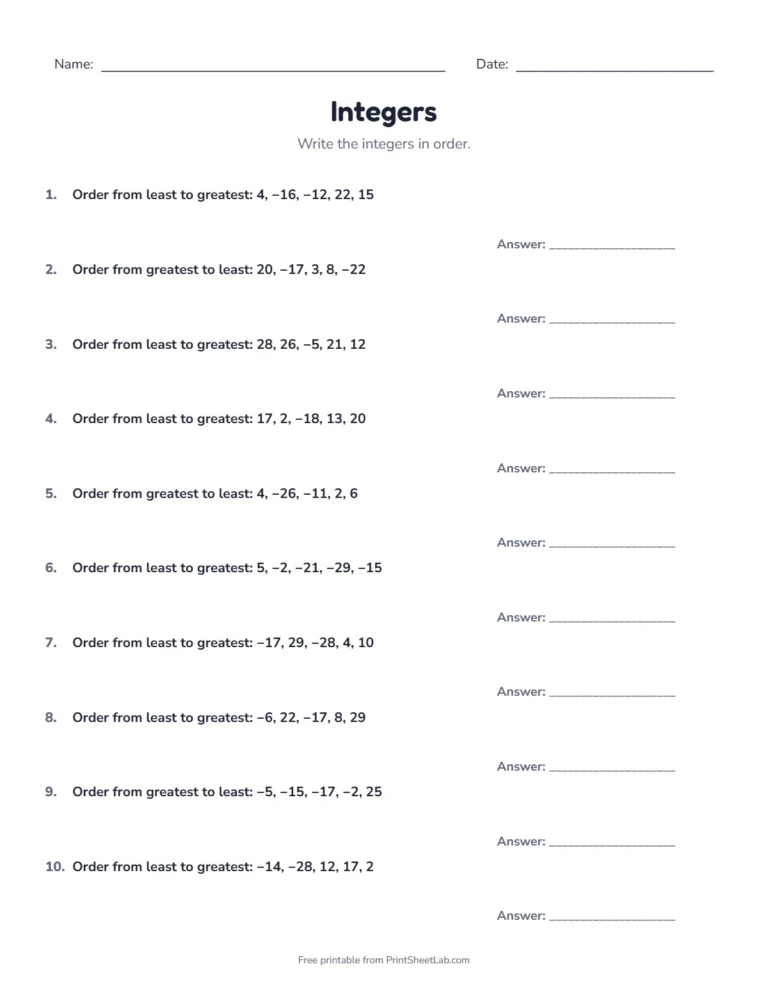
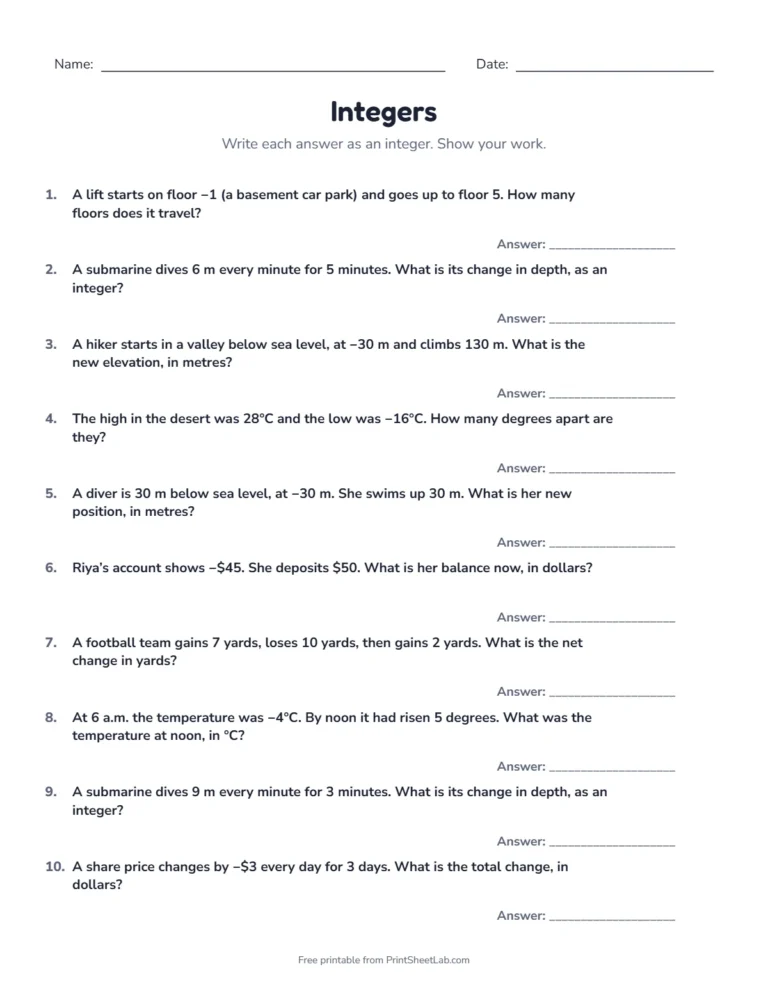
Adding and subtracting integersLevel 1 + answer key.PDFCustomizeMultiplying and dividing integersLevel 2 + answer key.PDFCustomizeMixed integer operationsLevel 3 + answer key.PDFCustomizeComparing integersLevel 4: write <, > or =, with key.PDFCustomizeAbsolute valueLevel 5 + answer key.PDFCustomizeOrdering integersLevel 6: least to greatest + key.PDFCustomizeInteger word problemsLevel 7: real-life problems + key.PDFCustomize
Integer rules at a glance
Operation
Rule
Example
Adding, same signs
Add, keep the sign.
−6 + (−3) = −9
Adding, different signs
Subtract the sizes, keep the sign of the bigger one.
−9 + 4 = −5
Subtracting
Add the opposite.
5 − (−2) = 5 + 2 = 7
Multiplying or dividing
Same signs give a positive, different signs give a negative.
−4 × (−3) = 12, −20 ÷ 5 = −4
A number line is the best picture for adding and subtracting integers: adding a positive moves right, adding a negative moves left.
How to add integers
Adding integers comes down to one question: do the two numbers have the same sign or different signs?
Same signs: add the sizes and keep the sign. 7 + 5 = 12, and −7 + (−5) = −12. Two debts of 7 and 5 dollars make a debt of 12.
Different signs: subtract the smaller size from the bigger one and keep the sign of the bigger one. For −9 + 4, nine is bigger than four, so the answer is −5. For 9 + (−4), the answer is 5.
Two-color counters make the different-signs rule easy to see. Lay out 9 red counters for −9 and 4 yellow counters for +4. Each red and yellow pair is a zero pair because −1 + 1 = 0. Remove four zero pairs and five red counters are left: −5.
How to subtract integers: keep, change, change
Subtracting a number is the same as adding its opposite. Many classrooms remember it as keep, change, change: keep the first number, change the minus to a plus, and change the sign of the second number. Then follow the adding rules.
5 − (−2) becomes 5 + 2 = 7.
−3 − 6 becomes −3 + (−6) = −9.
−8 − (−10) becomes −8 + 10 = 2.
Why does it work? On a number line, subtraction asks how far apart two numbers are and in which direction. Taking away a debt of 2 dollars leaves you 2 dollars better off, which is why subtracting a negative moves you to the right.
Multiplying and dividing integers
For multiplication and division, ignore the signs, work out the answer, then decide the sign:
Same signs give a positive answer: −6 × (−3) = 18 and −24 ÷ (−4) = 6.
Different signs give a negative answer: −6 × 3 = −18 and 24 ÷ (−4) = −6.
With more than two numbers, count the negative signs. An even number of negatives makes a positive product; an odd number makes a negative one. So −2 × (−3) × (−1) = −6.
The pattern 3 × (−2) = −6, 2 × (−2) = −4, 1 × (−2) = −2, 0 × (−2) = 0 grows by 2 each step. Keep going and −1 × (−2) has to be 2. That is the reason a negative times a negative is positive.
Comparing and ordering integers
On a number line, the number further to the right is always greater. That makes 3 greater than −8, and −2 greater than −9, even though 9 looks like the bigger digit. A quick check: the negative number closer to zero is the greater one, because it is “less in debt”.
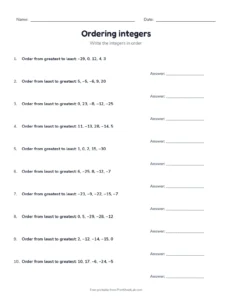
To order a list such as 4, −7, 0, −2 and 9 from least to greatest, place the negatives first, starting with the one furthest from zero: −7, −2, 0, 4, 9. The comparing worksheet uses the symbols <, > and =, and the ordering worksheet mixes least-to-greatest and greatest-to-least lists.
Absolute value
The absolute value of a number is its distance from zero, written between two straight bars. Distance is never negative, so |−8| = 8 and |8| = 8. Watch the sign outside the bars: −|−8| means “the opposite of 8”, which is −8. Work inside the bars first: |−9 + 4| = |−5| = 5. Absolute value shows up whenever only the size of a change matters, such as how far a diver is from the surface or how many degrees a temperature dropped.
Integers in real life
Negative numbers are not just a classroom idea. Children already meet them in:
Temperature: −5°C is five degrees below freezing, and a rise of 12 degrees takes it to 7°C.
Sea level: a diver at −30 m who swims up 12 m reaches −18 m.
Money: an overdrawn account of −$20 plus a $45 deposit leaves $25.
Buildings: a lift going from floor −2 to floor 7 travels 9 floors.
Sports: golf scores below par are negative, and a football team that loses yards has a negative gain.
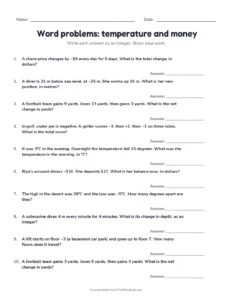
Word problems about temperature, sea level, money, lifts and sport.
Common mistakes to watch for
Thinking −9 is greater than −2 because 9 is bigger than 2.
Changing only one sign in keep, change, change: 5 − (−2) is 7, not 3.
Using the multiplication sign rule for addition: −4 + (−3) is −7, not 7.
Dropping the minus sign in the final answer. Writing negatives in parentheses, as our worksheets do, helps.
Treating −|−6| as 6 instead of −6.
Which grade learns integers?
In the Common Core math standards, 6th graders meet negative numbers: they place integers on a number line, compare and order them, find absolute value and use them in real situations (6.NS.C.5 to 6.NS.C.7). In 7th grade they add, subtract, multiply and divide integers and rational numbers (7.NS.A.1 to 7.NS.A.3). Our integer worksheets follow the same path, so a 6th grader can start at levels 4 to 6 and a 7th grader at levels 1 to 3 and 7. For the bigger picture, see the definition of an integer.
Integers worksheet and answers: eight examples
Here is a short integers worksheet with answers, with a mix of the four operations and absolute value. Cover the answer column, solve each problem, then check:
Problem
Answer
-8 + 5
-3
6 – 11
-5
-4 × 7
-28
-24 ÷ 6
-4
-3 – (-9)
6
12 + (-15)
-3
-2 × (-8)
16
|-13|
13
This page is also searched as integers worksheet, integer worksheet, integers worksheets, negative integers worksheet, integer practice worksheets, integers practice, worksheet of integers, integer practice sheets, integers exercise and integers exercises, integer examples and answers, integers worksheet answers and math integers worksheet. All are the free PDFs and the live practice above, with answers. Integers worksheet and answers sets for each operation make the best practice for negative integers.
Frequently asked questions
12 quick answers
What is the rule for adding and subtracting integers?
Same signs: add and keep the sign. Different signs: subtract and keep the sign of the bigger number. To subtract, add the opposite. Our integer worksheets practice each rule separately before mixing them.
What are good integer word problems for 7th grade?
Temperature changes, elevation above and below sea level, bank balances and golf scores. The word problem level of these integer worksheets uses twelve real-life types.
What are integers?
Integers are the whole numbers, their negatives and zero: …, −3, −2, −1, 0, 1, 2, 3, …. They do not include fractions or decimals.
How do you add integers with different signs?
Subtract the smaller size from the bigger size and keep the sign of the number with the bigger size. For −12 + 5, the answer is −7.
What does keep, change, change mean?
It is a way to subtract integers: keep the first number, change subtraction to addition, and change the sign of the second number. Then add as usual.
Why is a negative times a negative positive?
Multiplying by −1 flips a number to the other side of zero. Doing it twice flips it back, so −3 × −4 lands on the positive side: 12.
Is zero positive or negative?
Neither. Zero is an integer, but it is not positive or negative. It sits in the middle of the number line.
What is the absolute value of a negative number?
Its distance from zero, which is always positive. The absolute value of −15 is 15.
What grade learns integers?
Students meet negative numbers in 6th grade and learn all four operations with integers in 7th grade.
Do these integer worksheets have answer keys?
Yes. Solutions sit at the end of each integer PDF, and the generator above deals out a fresh set of problems whenever you press New problems.
Where can I download free integer worksheets?
Open any page in the gallery above, choose US Letter or A4, then print or save the PDF. They are free and have answer keys.
What is 6 – 11 as an integer?
It is -5. Subtracting 11 from 6 goes five below zero on the number line.