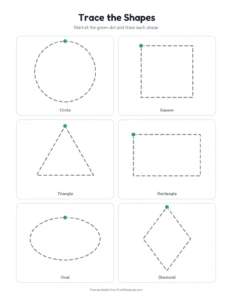
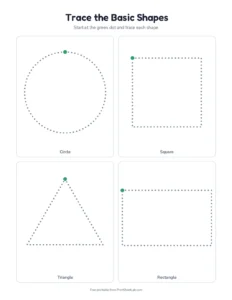
Tracing worksheets help young children build the hand control they need for writing. They trace dashed lines, shapes, letters, numbers and names, always starting at a green dot. These free printable tracing worksheets for preschool and kindergarten start with pre-writing lines and shapes, then lead to letters, numbers and names. Use the maker below for your own sheet, or print a ready PDF.
Quick answer: Tracing worksheets are printable pages where a child traces dashed or dotted lines, shapes, letters or numbers to practice pencil control. For preschool, start with straight lines and circles, then crosses, squares and slanting lines, before letters. This page has free tracing worksheets for lines and shapes (10 ready PDFs plus a maker), with links to letter, number, name and word tracing. Updated October 2026.
Ready-to-print samples
A few of the ready PDFs on this page. The full list is under Ready-to-print worksheets.
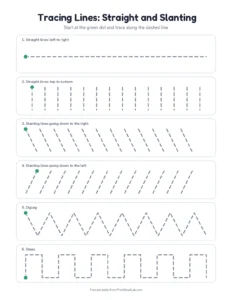
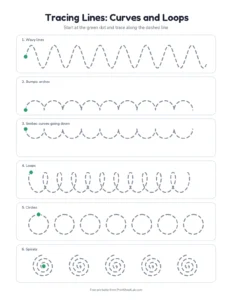
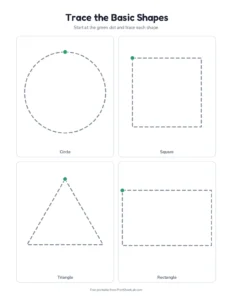
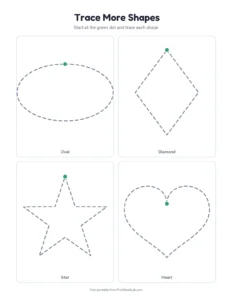
Tracing lines: straightSix pre-writing patterns.PDFTracing lines: curvesWaves, bumps, loops and spirals.PDFTracing shapes: basicCircle, square, triangle, rectangle.PDFTracing shapes: moreOval, diamond, star and heart.PDF
Tracing worksheets: the different kinds
Tracing comes in several forms, and each trains a slightly different skill. Lines and shapes train pencil control. Letters, numbers and names train the shapes of writing. Words and sentences train spacing and flow. Choose by age and by what your child is working on:
Tracing lines worksheets: the order children learn
Children master pre-writing strokes in a fairly regular order, and the CDC developmental milestones list drawing and copying among the skills of ages 3 to 5. which is why a tracing lines worksheet starts with straight lines and circles. The ages below are approximate, based on commonly cited developmental norms, and every child is different. If a stroke is hard, go back one step and practice it in sand, paint or chalk:
Pre-writing skill
Typical age (approximate)
Trace it on
Vertical and horizontal lines
2 to 3
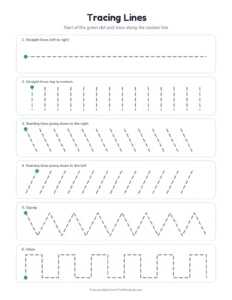
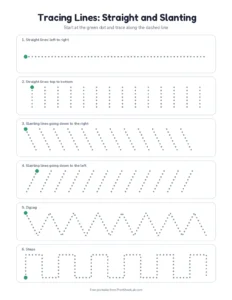
Straight lines: left to right and top to bottom
Circle
3
Circles and loops
Cross (+)
4
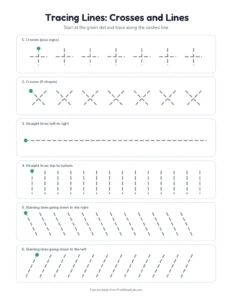
Crosses and lines
Square
4 to 5
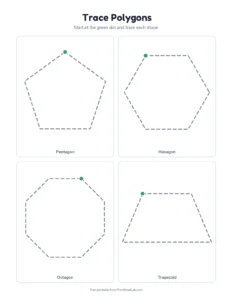
Basic shapes
Slanting (diagonal) lines
5
Slanting lines and zigzag
Triangle and X
5 to 6
Basic shapes and X crosses
How to use tracing worksheets with a young child
Start with a big finger trace. Let the child trace the dashed line with a finger first.
Find the green dot. It shows where to start, so strokes always begin in the same place.
Use a short, thick crayon. A tripod grip is easier with a short crayon or a golf pencil.
Trace slowly, left to right. Quality matters more than speed.
Finish with a smile. One page is enough, and praise the effort.
Tracing worksheets for preschool, nursery and toddlers
You will find this page searched as tracing worksheets for preschool, tracing worksheets for nursery, tracing worksheets for toddlers, free tracing worksheets, printable tracing worksheets and tracing worksheets pdf. They are all the same pages: free PDFs for US Letter or A4, with no sign-up. For toddlers and younger children, choose the large setting in the maker and the dotted style, and expect them to scribble on the line before they trace it. For older preschoolers, the medium size and dashed style are a good next step.
Tracing pages are best when they are short. A child of three or four may only want one page, and that is fine. Come back to the same page on another day, because repetition is how strokes become automatic.
Tracing activity worksheets and tracing pages at home
A tracing activity does not need to be on paper. Trace lines in sand or salt, draw big shapes with chalk on the pavement, or paint straight lines and loops on a window with a wet brush. Then move to a tracing activity worksheet to put the same strokes on paper. Tracing pages work well in a folder or a sheet protector, so a child can trace with a dry-erase marker again and again.
A weekly plan for tracing worksheets
Day
Focus
Suggested block
Monday
Tracing lines: straight lines and zigzag
10 min
Tuesday
Tracing lines: curves and loops
10 min
Wednesday
Tracing shapes: circle and square
10 min
Thursday
Letters, numbers or the child’s name
10 min
Weekly total
Four short sessions, with Friday free for play
40 min
What tracing worksheets help children learn
Tracing is simple, but it trains several skills at once. The table shows what each tracing page builds, which is why occupational therapists and teachers often recommend it before and during early writing:
Skill
How tracing builds it
Pencil control
Following a dashed line trains the small muscles of the hand
Hand-eye coordination
The eyes guide the hand along the path
Pencil grip
Repeated, short tracing sessions help a relaxed tripod grip develop
Letter formation
Lines and curves are the strokes that letters are built from
Attention and patience
Finishing a page from the green dot to the end builds focus
Common tracing problems and what to try
Problem
What to try
The child leaves the line
Use the large size and the light solid style, and trace with a finger first
Pressing too hard
Use a crayon or a soft pencil, and trace with a gentle touch
Tiring quickly
Stop after one row or one page and come back another day
Holding the pencil in a fist
Try a short, thick crayon, and play with tongs or tweezers to build finger strength
Starting in the wrong place
Point to the green dot before each row and say start here
Printing and reusing tracing worksheets
Print on US Letter or A4 at 100% scale. Black and white printing works well, because the dashed lines are gray and the green start dot is easy to see. To reuse a page, slide it into a clear sheet protector and trace with a dry-erase marker, then wipe it clean. A tracing page in a folder also makes a good quiet activity for car rides and waiting rooms.
Tracing worksheets by age: what to print and for how long
The best tracing worksheet is the one that matches what a child can already almost do. These ages are approximate, and a child who is a little behind or ahead is perfectly normal:
Age
What children usually do
Tracing to print
How long
2
Scribble with a fist grip, copy a vertical line
Large straight lines, dotted, one or two rows
3 to 5 min
3
Copy a circle and a horizontal line
Straight lines, circles and loops, large size
5 to 8 min
4
Copy a cross, begin to draw a square
Crosses, shapes, the first letter of the name
8 to 10 min
5
Copy a triangle, write some letters and numbers
Shapes, letters, numbers and the name
10 to 12 min
6
Write letters and words on lines
Letters, words and sentences
10 to 15 min
A four-week plan for tracing lines and shapes
If your child is new to tracing, a four-week plan gives a gentle start. Use one or two sheets a week, with a short session of five to ten minutes on three or four days:
Tracing, drawing and handwriting: what is the difference?
Tracing follows a printed guide, so the hand is led along the path. Drawing makes a shape or a picture from memory, and handwriting forms letters and numbers on lines. Children usually move in that order, with a lot of overlap, and each step feeds the next. Tracing is a bridge: it builds the control that drawing needs, and drawing builds the memory that handwriting needs. That is why we suggest tracing a line, then drawing the same line alone.
Tracing tips for left-handed children
Left-handed children can use the same worksheets, with a few changes. Tilt the paper slightly to the right, so the child can see the line while tracing. Place the paper so the left hand does not cover what has been written. A pencil held a little higher up, and a slanted board, can also help. Show the strokes in the same direction for everyone: left to right for lines and counterclockwise for circles.
Frequently asked questions
8 quick answers
Where can I download free tracing worksheets?
Open any worksheet in the Ready-to-print list on this page, choose US Letter or A4, then print or save the PDF. They are free, and no account is needed.
What should a preschooler trace first?
Start with straight lines, left to right and top to bottom, and circles. Then add crosses, squares, slanting lines and triangles, and only then letters.
At what age should children start tracing?
Many children begin tracing simple lines around age three. Younger children scribble first, and that is a normal and useful step.
Can I make my own tracing worksheet?
Yes. Use the maker on this page to choose line patterns or shapes, the size, the line style and the paper size, then download a PDF.
How many tracing worksheets should a preschooler do a day?
One or two short pages a day is plenty. A three or four year old may only manage one row, and that is fine. Stop when the child loses interest and return the next day.
Do tracing worksheets help with handwriting?
Yes. Tracing trains the hand to follow a path and the eyes to guide it, which are the skills handwriting needs. It works best with other play, such as drawing, painting and playdough.
Are tracing worksheets good for toddlers?
Toddlers usually scribble, and that is a normal first step. Offer large, dotted lines and thick crayons, expect scribbles, and keep it playful.
What is the difference between dashed and dotted lines?
Dashed lines are short strokes with gaps and are easier to follow; dotted lines are a row of dots and give the child more freedom. Start with dashed and move to dotted.