A Cornell notes template splits the page into three parts: a wide column for notes, a narrow cue column for questions and key words, and a summary box at the bottom. Print the template with wide, college or narrow ruled lines on Letter or A4 paper, then use the same sheet for every class. Each page is free, with no sign-up.
Cornell notes template to print (PDF)
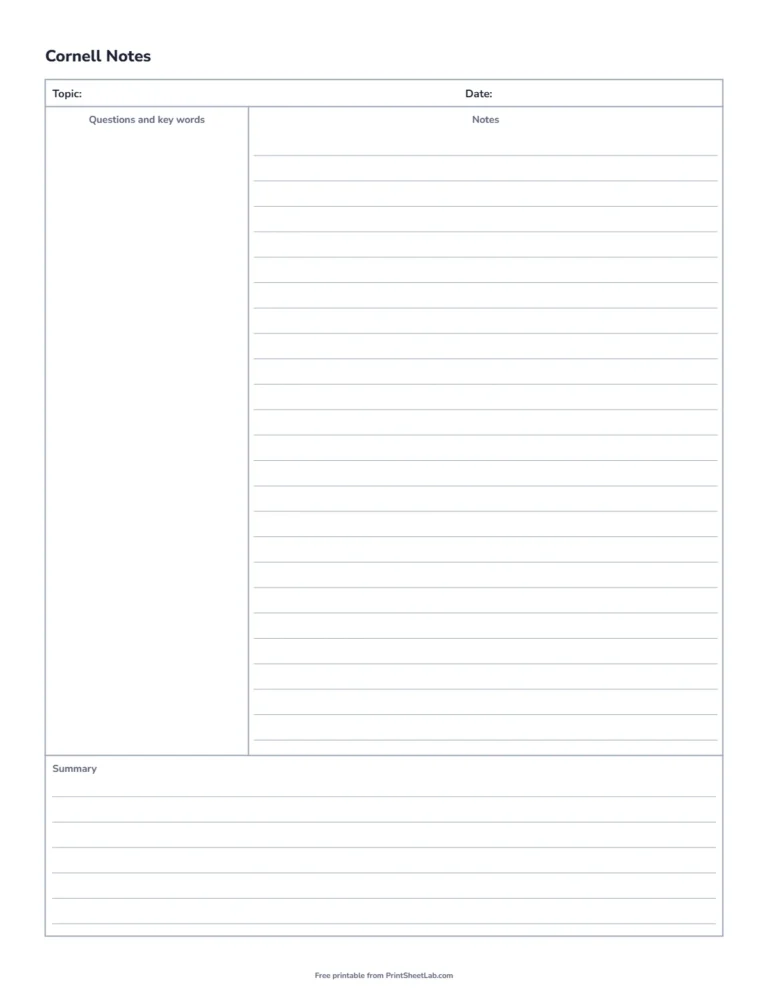
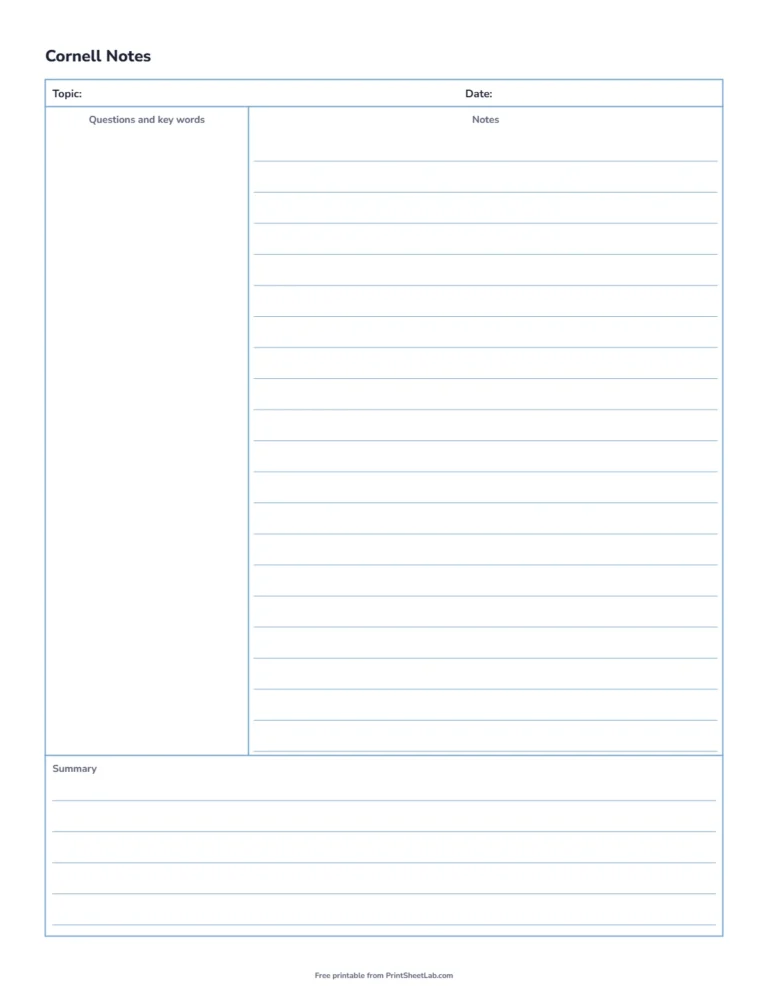
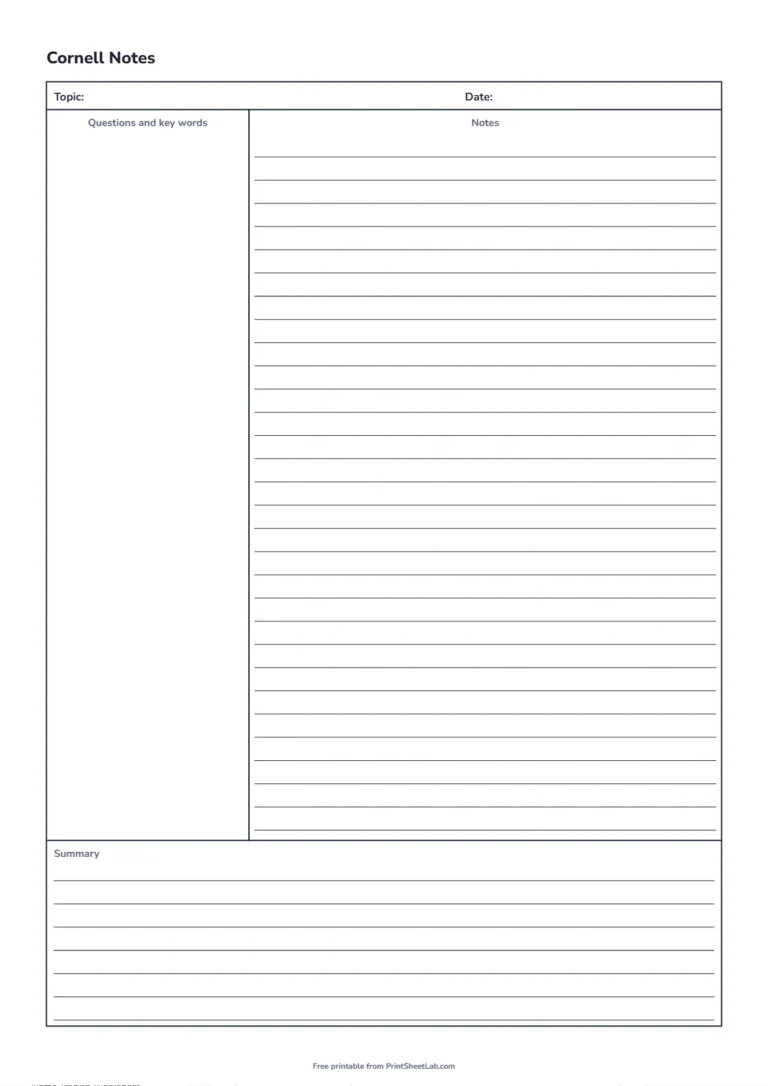
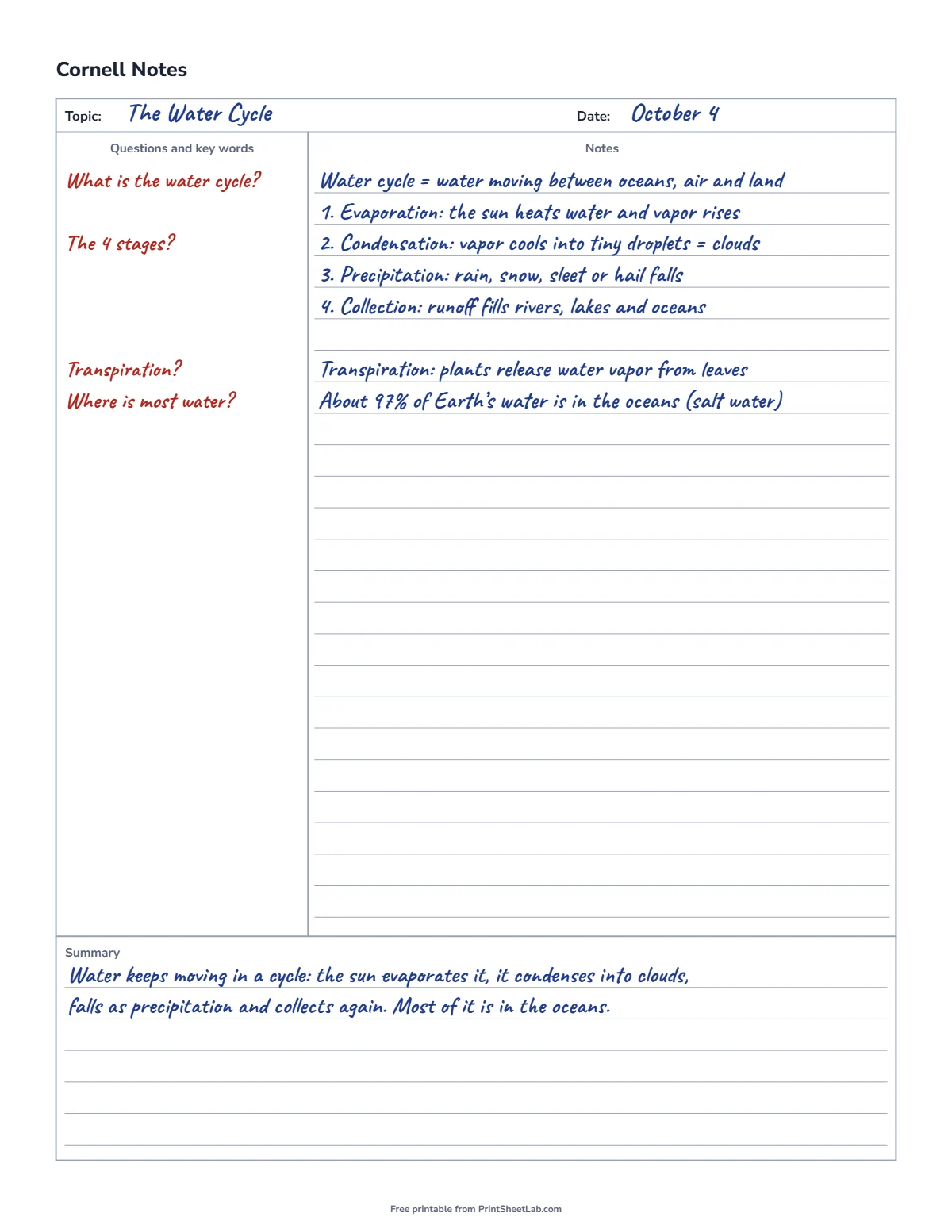
These four pages show what the generator prints: a college ruled sheet in gray, a wide ruled sheet in blue, a narrow ruled A4 sheet in black, and a filled example on the water cycle. Click any picture for the PDF, or use the generator above to pick the line spacing, the color and the paper size.
How the Cornell notes template is laid out
The layout is the same on every sheet, so a stack of pages looks like one set of notes. These sizes are measured from the generator’s PDF on US Letter paper with half-inch margins:
| Part of the page | Size on US Letter | What goes there |
|---|---|---|
| Header strip | 7.5 in wide, 0.3 in tall | The topic and the date |
| Cue column (left) | 2.25 in wide, 30% of the width | Questions, key words and clues, written after the lesson |
| Notes column (right) | 5.25 in wide, 20 to 27 lines | Notes written during the lesson |
| Summary box (bottom) | 7.5 in wide, 2 in tall | Two or three sentences in your own words |
The cue column is a little narrower than a third of the page, so the notes column still has room for a full sentence on each line. The summary box is always 2 inches tall, which is enough for three or four lines of writing.
Cornell note taking paper: wide, college or narrow ruled
The only setting that changes the number of lines is the line spacing. Wide ruled lines give younger students room to write, and narrow ruled lines fit more words on the page. Here is how many lines each ruling gives on one Letter sheet:
| Ruling | Line spacing | Lines for notes | Lines in summary | Lines in total | Best for |
|---|---|---|---|---|---|
| Wide ruled | 11/32 in (8.7 mm) | 20 | 5 | 25 | Grades 3 to 6 and large handwriting |
| College ruled | 9/32 in (7.1 mm) | 24 | 6 | 30 | Middle school, high school and college |
| Narrow ruled | 1/4 in (6.3 mm) | 27 | 7 | 34 | Small handwriting and long lectures |
At six to eight words a line, a college ruled sheet holds about 150 to 190 words of notes. That is why many students use one page for each topic, not one page for each lesson.
How to take Cornell notes: the five Rs of the Cornell method
The Cornell method was developed by Walter Pauk, an education professor at Cornell University. He described it as five steps, which make a simple routine for the whole page. Use this Cornell method template as a checklist:
| Step | What you do | When |
|---|---|---|
| Record | Write the main ideas in the notes column, in short phrases | During the lesson or reading |
| Reduce | Turn the notes into questions and key words in the cue column | Right after, ideally the same day |
| Recite | Cover the notes and answer each cue question out loud | Day 1, then again later in the week |
| Reflect | Write what the page means, and how it links to what you already know | In the summary box |
| Review | Read the page again for a few minutes | Every week before the test |
The cue column is the key. When you cover the notes and try to answer your own questions, you are practicing recall, which helps memory more than reading the page again. For background on the method and its history, see Wikipedia’s Cornell Notes article.
Cornell notes example: the water cycle
The filled example above shows a finished page. The topic and date go in the header. The notes are short phrases that follow the order of the lesson: evaporation, condensation, precipitation and collection. After the lesson, the student wrote four questions in the cue column, each one level with the note it checks. The summary at the bottom says in two sentences what the whole page is about. Notice that the notes use numbers and abbreviations, not full sentences. Speed matters during the lesson, and the cue column and summary can be tidy later.
Cornell notes printable for math, reading, science and history
A Cornell notes printable works in every subject, because the three parts stay the same while the content changes. This table shows what many teachers ask for:
| Subject | Cue column | Notes column | Summary box |
|---|---|---|---|
| Math | Problem type or formula name | A worked example, step by step | When to use the method and what to check |
| Reading | New words and “why” questions | Events, characters and quotes | The theme in one or two sentences |
| Science | Terms and diagram labels | Facts, steps in a process, data | The cause and effect in plain words |
| History | Dates, people and “why” questions | What happened, in order | Why it mattered |
Tips for using a note taking template in class
A good note taking template only helps if you use it the same way every time. These habits make the biggest difference:
- Start with the header. Write the topic and date before the lesson starts, so every page can be found again.
- Leave the cue column empty at first. Writing in it during the lesson defeats the purpose, because the questions should come from the finished notes.
- Write the summary last, and without looking. Try it from memory, then check the notes.
- Hole-punch the sheets or keep them in a folder, one for each subject. Review the pages each week.
- Teachers: collect a page every Friday and check one thing, such as whether the cue questions can be answered from the notes.
If you need paper for other jobs, the lined paper page has plain notebook sheets, and the dot grid paper page suits bullet journal pages and sketch notes.
Printing tip
Print at 100% or “Actual size” and turn off “Fit to page”, so every measurement on the sheet is exact. Choose Letter or A4 paper in the generator before you download the PDF.
Cornell notes template: frequently asked questions
What size is the cue column on this Cornell notes template?
The cue column is 30% of the page width, which is 2.25 inches on US Letter. The notes column is the remaining 5.25 inches.
Which line spacing should I choose for Cornell note taking paper?
Choose college ruled for middle school and above, wide ruled for younger students or large handwriting, and narrow ruled if you write small and want more lines on the page.
How many lines does the Cornell notes template have?
A college ruled sheet has 24 lines for notes and 6 lines in the summary box. Wide ruled has 20 and 5, and narrow ruled has 27 and 7.
Can I print the Cornell notes template on A4?
Yes. Choose A4 in the generator. The three parts keep their proportions, and the cue column is 30% of the width.
Is the Cornell notes template free?
Yes. Every sheet is free to print for home and classroom use, with no sign-up and no watermark.
More printable paper
- Specialty paper generator with every layout on this site
- Paper generator for lined, graph, dot grid, isometric and handwriting paper
- Graph paper, lined paper and dot grid paper