Eid bingo turns one of the two great festivals of the Muslim calendar into a game the whole family can play without learning a single rule. The template on this page has 28 squares that most homes produce somewhere across the day, from the crescent moon that starts it and the lanterns on the windowsill to a bowl of sheer khurma, a hug at the mosque door and an envelope of Eidi. Pick a card size, press print, and every guest gets a different card.
In short: open the card maker above and press Edit and print this card, choose how many cards you need and download one PDF. It is free, there is no account, and nothing you type leaves your browser. Every square can be rewritten, so a family at home, a classroom and a community center can each get their own list.
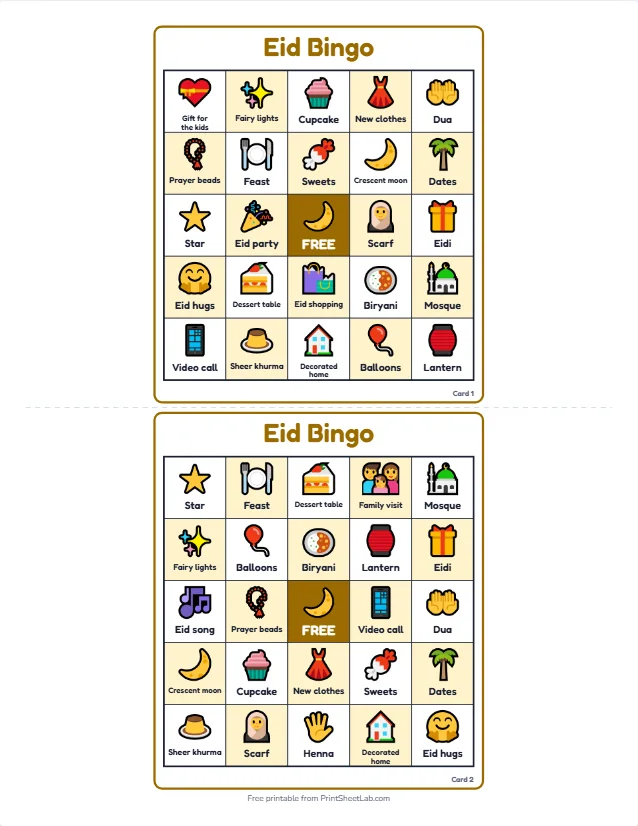
How to play Eid bingo
The rules are the bingo rules everyone already knows, with one change: nobody has to call numbers, because the celebration makes the calls. Each guest holds a card and a pencil, and when one of the squares happens in front of them, they mark it. Five in a row, across, down or on a diagonal, wins. The free center square is already marked, so a first line needs only four more squares.
- Give every guest a card and something to mark with. Pencils, crayons or small round stickers all work. Wet markers bleed through thin paper.
- Agree on what counts. A square counts when you see it yourself, and it counts once. Anyone can ask another player to point at the square they claim.
- Mark squares as the day unfolds. The sweets come out, the hugs begin, the lanterns are lit: each of those is a square on an Eid bingo card.
- Announce a line out loud. The winner reads the five squares aloud, a friend checks them, and the prize changes hands.
- Play another round. Switch to four corners, an X or a full card once the first line is won, or keep the same card going for the next visit.
One rule matters more than the others: the prayer is never part of the game. The Mosque, Dua and Prayer beads squares are there because they are part of the day, but they are marked quietly afterward, never during the prayer itself. Eid bingo works best as a game for the hours that follow, when families visit, eat and celebrate together.
What Eid is: two festivals and one greeting
The word Eid means festival, and there are two main ones in Islam. According to the Wikipedia article on Eid al-Fitr, it falls on the first day of Shawwal, the tenth month of the Islamic calendar, and marks the end of the month of dawn-to-dusk fasting during Ramadan.
It begins with a communal prayer and is followed by visits to relatives, gifts and shared meals. Food is so central that the festival is nicknamed “Sweet Eid” or the “Sugar Feast.” Muslims greet each other with Eid Mubarak, which means “Blessed Eid.” That mix of sweets, greetings and time together is what an Eid bingo card tries to capture.
The second festival is Eid al-Adha, the “Feast of the Sacrifice.” It falls on the 10th of Dhu al-Hijja, the twelfth and last month of the Islamic calendar, and its celebrations carry on for the next three days. In Islamic tradition it honors the willingness of Abraham to sacrifice his son as an act of obedience to God, and it comes at the time of the Hajj pilgrimage.
As with Eid al-Fitr, there is a morning prayer, and the article notes that the meat of the sacrificed animal is generally divided in three: one part for the family, one for friends and relatives, and one for the poor.
The squares in this Eid bingo template lean toward Eid al-Fitr, because they include the crescent moon, sheer khurma, Eidi and plenty of sweets. Nearly all of them still fit Eid al-Adha: new clothes, a family visit, a feast, hugs, a mosque, a dua. A section further down gives a few swaps for Eid al-Adha. Ask your guests which Eid they are celebrating before you print, and choose the list to match.
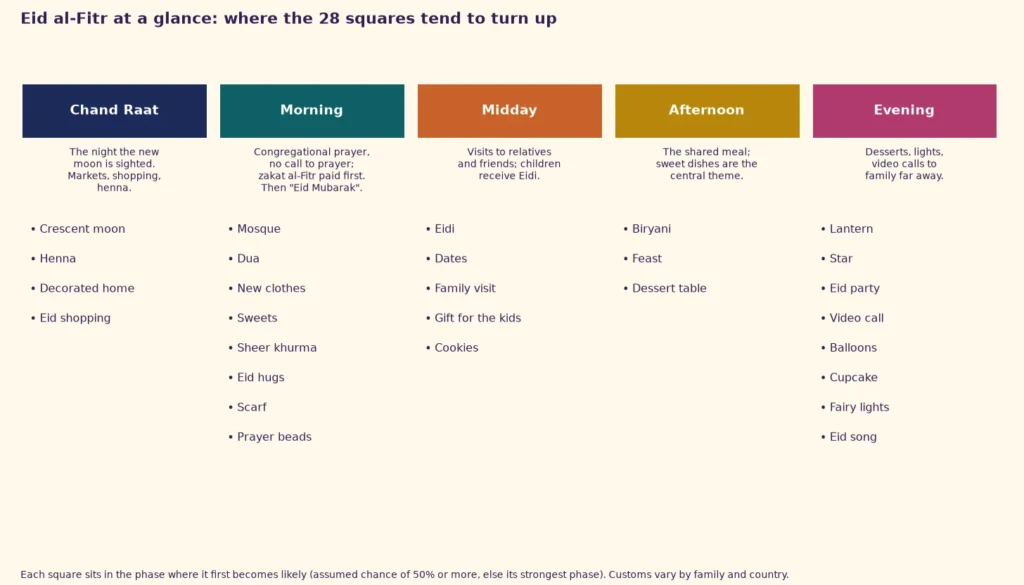
The day itself: from Chand Raat to the evening
The Wikipedia article describes a day with a clear shape. Eid al-Fitr begins at sunset on the night the new crescent moon is sighted, known as Chand Raat in places such as Bangladesh and India, when people finish their Eid shopping and prepare food and girls and women put henna on each other’s hands.
If the moon cannot be seen, the festival starts the next day. In the morning people go to a mosque or an open field for a prayer of two rakats, after paying the obligatory charity of zakat al-Fitr to the poor. Afterward come greetings, visits, meals and gifts.
That shape gives Eid bingo five natural phases: the night before, the morning prayer and greetings, midday visits, the afternoon feast, and the evening party. The squares are not spread evenly across them. The crescent moon, henna and decorations appear first, the mosque and dua belong to the morning, and the dessert table and the lights belong to the end of the day. The Eid bingo simulation later on this page uses exactly this shape.
When is Eid? Why the date moves about 11 days a year
Eid is always on the same day of the Islamic calendar, but the Islamic year is lunar and about 11 days shorter than the Gregorian year, so the date on the calendar on your wall moves earlier every year.
The article adds that the exact day also depends on when the new moon is sighted locally, so neighboring countries can celebrate a day apart, and that communities abroad sometimes follow the date of the nearest Muslim-majority country and sometimes their home country. Always confirm the date with your own mosque or community before you plan a party.
Because of this drift, the same Eid can fall twice in one Gregorian year. The article says it happened for Eid al-Fitr in 2000 and will happen next in 2033. The table shows how far the date slides, using the length of 12 lunar months (about 354.4 days) against a Gregorian year of 365.24 days.
| Time passed | Date has moved by about | What that means |
|---|---|---|
| 1 year later | 11 days | About a week and a half earlier |
| 2 years later | 22 days | About three weeks earlier |
| 3 years later | 33 days | About a month earlier |
| 5 years later | 54 days | About two months earlier |
| 10 years later | 109 days | About three and a half months earlier |
| 17 years later | 185 days | Roughly half a year away from where it started |
| 33 years later | 359 days | Back to almost the same date |
The practical lesson for a host is simple: print your Eid bingo cards after the date is confirmed, not months ahead on a guess, and keep a PDF saved so that you can reuse the card every year.
Eid bingo cards: all 28 squares
These Eid bingo cards are made from a list of 28 squares. A standard 5×5 card with a free center needs 24 of them, so each card leaves out four, and the cards are not all the same. The table sorts the list into the groups a host usually thinks in, so it is easy to decide which squares to keep and which to swap for something that belongs to your own home.
| Group | Squares on the list | Where you will see them |
|---|---|---|
| Sky and light | 🌙 Crescent moon, ⭐ Star, 🏮 Lantern, ✨ Fairy lights, 🏠 Decorated home, 🎈 Balloons | Windows, doorways, the evening sky and the table. The first squares to fill in, and the last to glow. |
| Prayer and faith | 🕌 Mosque, 🤲 Dua, 📿 Prayer beads | The morning prayer and the quiet moments around it. Mark them respectfully, afterward. |
| Clothes and care | 👗 New clothes, 🧕 Scarf, 🖐️ Henna | The best outfits and the henna from Chand Raat. Seen all day once they are worn. |
| Food and sweets | 🍬 Sweets, 🍮 Sheer khurma, 🍛 Biryani, 🌴 Dates, 🍽️ Feast, 🍰 Dessert table, 🍪 Cookies, 🧁 Cupcake | Breakfast tables, trays at every visit and the long afternoon meal. The biggest group on the list. |
| People and gifts | 🎁 Eidi, 👨👩👧 Family visit, 🤗 Eid hugs, 💝 Gift for the kids, 🎉 Eid party, 📱 Video call | After the prayer, at every doorway and across the miles for relatives who cannot travel. |
| Shopping and music | 🛍️ Eid shopping, 🎶 Eid song | Chand Raat markets and the speaker at the party. |
The Eid bingo list is balanced on purpose. Food, light and greetings fill in at nearly every home, so they are the engine of the game, while the rarer squares (prayer beads, a cupcake, balloons, a star in the decorations) turn a card into a treasure hunt. If every square on an Eid bingo card were as common as a plate of sweets, the first line would be over before the second visit.
How many different Eid bingo cards can you print?
With 28 squares and 24 places on a 5×5 card, the number of different sets of squares is 28 choose 24, which is 20,475. Each set can also be arranged in a huge number of orders, so a family gathering of 20 and a community hall of 200 can both give every player a different card. Smaller grids use fewer squares and have even more possible sets.
| Card size | Squares used | Different sets from the 28 | Best for |
|---|---|---|---|
| 3×3 with free center | 8 | 3,108,105 | Ages 3 to 5, and the very short game |
| 4×4 | 16 | 30,421,755 | A quick round between visits |
| 5×5 with free center | 24 | 20,475 | The classic Eid day game |
The squares, explained with care
Eid is celebrated by Muslims in very different countries, and the squares on any Eid bingo card are a short list of things that appear in many homes, not a rulebook. A few notes from the Wikipedia article on Eid al-Fitr show how the same square can look different in different places, which is a good thing to share with a class or a group of guests.
- Eidi. Children receive a small sum of money or a gift from relatives and elders to spend during Eid. In Bangladesh the gift is also called Salami, and the article notes that in Pakistan people often prefer fresh banknotes for the children. Treat Eidi as a gift, never as a prize or a bet.
- Sheer khurma and sweets. The article describes sheer khurma as a dessert of vermicelli, milk, butter, dry fruits and dates, and lists sivayyan (toasted sweet vermicelli), kheer and biryani among the foods of South Asian homes. In Turkey the festival is called Şeker Bayramı, the “Bayram of Sweets.”
- Lantern. Jordanians hang fanous, or Eid lanterns, and in many places homes, shops and streets are decorated with festive lights.
- Henna. In India and Bangladesh, girls and women put henna on their hands on Chand Raat, and in Saudi Arabia women also paint it on their hands or feet for the festival. It is not universal, so offer a substitute such as “A bracelet or a bangle” where it is not part of the culture.
- New clothes and Scarf. Families prepare new clothes and shoes for the day, and in Turkey the best clothes have their own word, bayramlık. The Scarf square only describes what someone is wearing, so never ask a guest to put on or take off any piece of clothing for the game.
- Family visit and hugs. After the prayer, people embrace and exchange greetings, and in some families everyone gathers at the oldest relative’s house before the meal.
- Cookies. Ma’amoul and kahk, filled and sugar-dusted cookies, are popular Eid treats in parts of the Middle East.
One festival, many names
The names of the festival change from place to place, which is why the card says simply “Eid.” If your guests use another name, print it as the title of your Eid bingo card using the Design tab.
| Where | What Eid al-Fitr is called | A tradition the article mentions |
|---|---|---|
| Turkey | Ramazan Bayramı or Şeker Bayramı | Best clothes (bayramlık) and a holiday of sweets |
| Indonesia | Hari Raya Idul Fitri or Lebaran | The great journey home (mudik) to ask forgiveness from parents and elders |
| Malaysia, Singapore and Brunei | Hari Raya Aidilfitri | Hari Raya means “Great Day”; many workers return to their home towns |
| Pakistan | The Lesser Eid or the “Sweet Eid” | Charity paid before the day, Eidi in fresh notes, a breakfast of sheer khurma |
| Bangladesh | Eid al-Fitr, with Chaand Raat as the night before | Salami for the children and a feast of biryani, polao, kabab and sweets |
| Nigeria | Small Sallah | Greetings exchanged between neighbors and friends during the day |
If your family or class celebrates in one of these ways, add the tradition as a square. “Calling a grandparent to ask forgiveness,” “A homecoming journey,” or “Greeting a neighbor with Eid Mubarak” are all good additions and make the card truly yours.
Three ways to play an Eid bingo game
One printed card supports three very different Eid days. Pick the Eid bingo game that fits your guests, or run two in a row. The table compares them, and the sections below give the rules and some prize ideas.
| Game | Who calls | Length | Best for |
|---|---|---|---|
| The Eid bingo day game | Nobody. The celebration does. | From Chand Raat to the evening | Families and open houses on Eid day |
| The Eid bingo visiting game | Nobody. Each stop on the round does. | A few minutes at each home | Families who visit several relatives and friends in one day |
| Calling cards | A host draws cut-out squares and reads them out | 10 to 20 minutes | Community centers, schools, Eid parties and video calls |
Game one: the Eid bingo day game
This is the simplest Eid bingo game. Hand out the cards on Chand Raat or after the morning prayer, and let each player mark squares as they appear. Because the day starts early, a card often has a line before lunch (the simulation below says how often), so a good host keeps a second round ready: four corners, an X, or a full card for the dessert table in the evening.
- Prize for the first line: first choice from the dessert tray, or the first cup of tea poured by someone else.
- Prize for four corners: choose the next Eid song on the speaker.
- Prize for everyone: a small bag of dates, a home-baked cookie, or a handwritten Eid card that every player takes home.
- Grown-up job: one adult carries a spare card for the child who has lost theirs in the excitement.
Game two: the Eid bingo visiting game
On Eid many families go from home to home, and each stop brings its own set of squares: a plate of sweets, a new outfit, a relative who has made biryani. In the visiting game, a player can mark at most three squares at each stop, so that one generous host does not hand over the whole card. The limit makes players choose which sightings to keep, and the card stretches across the whole round. The numbers are in the simulation below.
This Eid bingo version suits families who live close together and are happy to be on the move. Give every child a card at the first stop and collect the winners at the last one.
Game three: Eid bingo with calling cards
When the guests stay in one room, the drawn-card version is easier to run. In the Print tab, switch on the calling cards and the caller sheet. Cut the cards out, shuffle them in a bowl, and the host draws one at a time: “Lantern. Who has a lantern?” Everyone with that square marks it. For a live round on a screen, with guests joining by link, the play bingo online page hosts the 75-ball game, and the play custom bingo online page explains how to play with your own list.
This is also the version for relatives in different cities and countries. One person reads the calls on a video call, everyone has the same printable PDF, and the winners show their line to the camera. The Video call square is, of course, a free mark for everyone on that call.
An Eid al-Adha version of Eid bingo
To adapt the card for Eid al-Adha, keep the shared squares and change the ones that belong to the other festival. A few ideas follow, written to stay gentle and inclusive. Swap Sheer khurma for “A shared meal,” Dates for “Food shared with a neighbor,” Cupcake for “A gift for someone in need,” and Eid shopping for “A story or photo of the Hajj.” Because the festival centers on giving and on sharing meals, squares about sharing food and caring for others are always at home on the card.
Eid bingo game: a real simulation
A host planning an Eid bingo game always asks how long it will last. To answer with numbers instead of a guess, we simulated the day and a round of home visits. Every square has an assumed chance of showing up in each phase of the day, and we ran 8,000 days of each.
The chances are our assumptions, chosen to feel like a typical celebrating household. They are not survey data, and customs vary widely. We assumed, for example, that the mosque square is marked by 94% of players on the morning of Eid, that new clothes are seen by 100%, and that a cupcake appears for only 61%.
Eid bingo through the day: a first line comes by midday
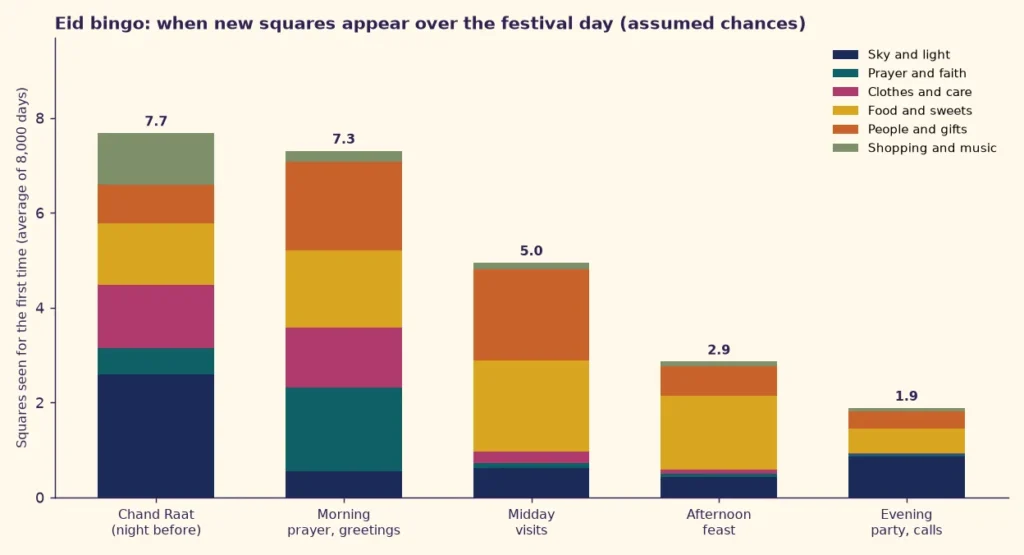
We split the festival into five phases: Chand Raat, the morning prayer and greetings, midday visits, the afternoon feast and the evening. In an average day a family sees about 25 of the 28 squares, so a 5×5 card with 24 squares ends the day with most of its squares marked. The first phases add the most: about 8 squares appear on Chand Raat, and the count rises to about 15 by the end of the morning.
| Cards in play (5×5) | Line by the end of Chand Raat | Line by the end of the morning | Line by the end of midday | Median phase of a first line |
|---|---|---|---|---|
| 1 card (one guest) | 3% | 46% | 90% | Midday |
| 6 cards | 15% | 89% | more than 99% | Morning |
| 12 cards | 24% | 96% | more than 99% | Morning |
| 6 cards on a 3×3 grid | 80% | 100% | more than 99% | Chand Raat |
A single guest has a first line by the end of the morning 46% of the time, and 90% by the end of midday. With six players the chance by the end of the morning is already 89%. A 3×3 card is much quicker: with six players, 80% of games have a line on Chand Raat alone. A full card is a long game: even with 12 players, only 15% of days end with someone covering every square. That is why the dessert table in the evening makes a good finale for a second round.
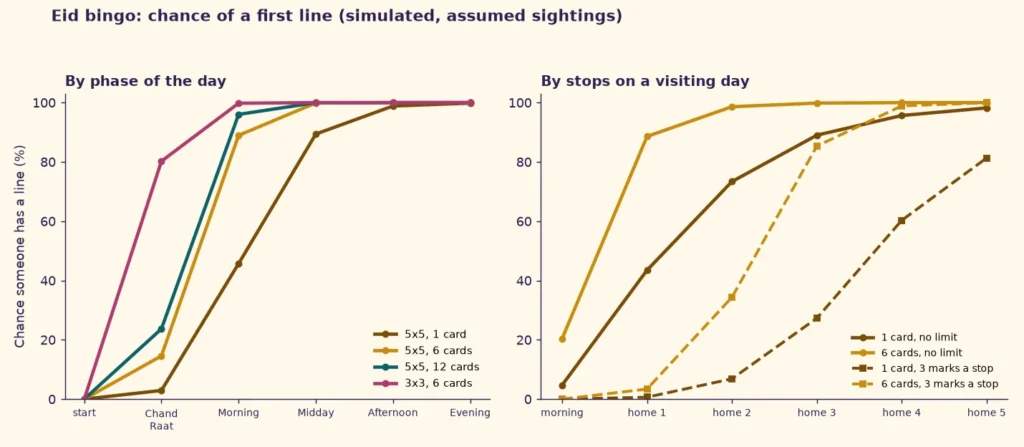
The assumptions matter, and a careful player does a little better than the simulation, because they can choose the square that completes a row. Guests who forget to mark do worse. Treat the table as a guide for how long to plan the game, not a promise. If you want the game to last longer than the morning, use a bigger grid or the visiting limit in the next section.
The Eid bingo visiting game: how many homes does a line take?
For the Eid bingo visiting game we assumed a morning at home or at the mosque followed by up to five visits. The morning block holds the personal squares (new clothes, a hug, a dua, the mosque), and each visit adds the things a host puts out: sweets, a feast, a dessert table, Eidi, decorations. On average a player has marked about 9 squares after the morning and 18 after the second home.
| Rule | Cards | Line after the morning | After home 1 | After home 2 | After home 3 | After home 4 |
|---|---|---|---|---|---|---|
| No limit | 1 | 5% | 43% | 73% | 89% | 96% |
| No limit | 6 | 20% | 89% | 99% | more than 99% | more than 99% |
| 3 marks a stop | 1 | 0% | 1% | 7% | 27% | 60% |
| 3 marks a stop | 6 | 0% | 3% | 34% | 85% | 99% |
| 4 marks a stop | 6 | 0% | 18% | 82% | 98% | 100% |
With no limit, one card has a line by the end of home 2 in 73% of days, and six cards by home 1 in 89% of days, so the first line arrives early. A three-mark limit changes the pace completely: six cards then reach a line after home 2 in only 34% of days and after home 3 in 85%, while a single card needs five homes to reach 81%. A limit of four marks sits in the middle. Choose the number that matches how many homes your family will really visit.
Calling cards: how many calls, and how often do players tie?
The calling-card version of Eid bingo is the most predictable. All 28 squares are called exactly once in random order, so we simulated 8,000 games for each group size to see when someone has a line and how often two players finish on the same call.
| Cards in play (5×5) | Calls to the first line (median) | Calls to a full card (median) | Games where 2 or more players tie | Average winners on that call |
|---|---|---|---|---|
| 1 card | 16 | 28 | not applicable | 1.00 |
| 4 cards | 13 | 28 | 14% | 1.16 |
| 8 cards | 11 | 27 | 18% | 1.21 |
| 15 cards | 10 | 27 | 20% | 1.26 |
| 25 cards | 9 | 27 | 23% | 1.31 |
| 50 cards | 8 | about 27 | 27% | 1.37 |
| 100 cards | 7 | about 27 | 31% | 1.46 |
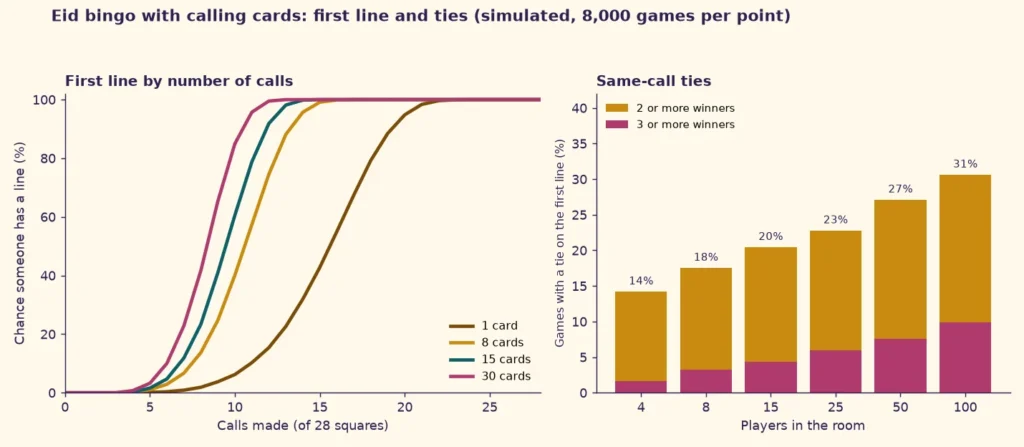
A party with 15 players usually sees a first line after 10 calls, and 25 players after 9. A full card needs nearly the whole list, around 27 calls with 15 players. The list is short and each card uses 24 of its 28 squares, so cards overlap heavily and ties are common: with 25 players there are two or more winners on the same call in 23% of games, and with 100 players in 31%. Agree a tie rule before the first call, such as sharing the prize or a one-square play-off.
For a quicker game, 4×4 cards with 8 players reach a first line at 10 calls and 3×3 cards with 8 players at 5. The assumptions: every call is equally likely at each step, cards are independent random draws from the list, and nobody misses a call.
Printable Eid bingo: print, cut and hand out
For printable Eid bingo, the Print tab has the controls you need and nothing you do not. Choose how many different cards to print, from 1 to 100, how many go on a page (1, 2, 4 or 6), Letter or A4 paper, and portrait or landscape. Cut guides are available for sheets that need trimming. For a family of 14, print 16 cards, two per page, and keep two spares for the guest who arrives late.
- Use light cardstock. An Eid bingo card that travels from home to home survives the day better when it is thicker than copy paper.
- Print names on the cards. The Design tab can put a name on each card, which settles the question of whose card is whose.
- Use big squares for little hands. One card per page in portrait gives the biggest squares, which suits ages 3 to 5.
- Print the caller sheet and calling cards for the drawn-card game. They come out of the same Print tab.
- Pick gold and midnight blue. The Design tab holds color themes, and a gold card looks the part beside a lantern.
- Bring a few blank Eid bingo cards. Print one set with no changes and one with your family squares, and let guests choose.
Hosts who are away from a printer can save the PDF to a phone or a USB stick and print it anywhere. The shareable link in the card maker keeps only your word list, with no names or photos, so you can send it to relatives in other cities and let everyone print their own.
Eid bingo for kids
Eid bingo for kids is a gentle way to keep a very excited day from spilling over. Children who are hunting for a lantern are children who are standing still and noticing the decorations. The pictures on every square let pre-readers play without help, and the squares teach the names of things that adults in the room have known for years. The right setup depends on age.
| Age | Card | How to play |
|---|---|---|
| 3 to 4 | 3×3, one per page | A grown-up reads the pictures. Sticker dots, no pens. Everybody wins at the first line. |
| 5 to 7 | 3×3 or 4×4 | Words with pictures. Kids spot and shout. Play for a line, then four corners. |
| 8 to 10 | 5×5 | Three marks a stop for the visiting game, plus two squares they invent themselves, like a favorite cousin or a pet. |
| 11 and up | 5×5 with a custom list | Let them write the list for the family, or add a rule that every square needs a one-sentence story. |
Schools with Muslim students can use Eid bingo as part of a celebration of the day. A round of Eid bingo fits into the last half hour before a break, and it needs no preparation beyond printing. Pair it with the Ramadan activities for kids for the lead-up to Eid and with the classroom bingo page for ideas on turning any list into a lesson. Invite a student who celebrates to explain a square to the group if they would like to, and never ask a child to speak for everyone.
In a mixed class, use Eid bingo to build understanding. Children who do not celebrate Eid can mark squares as observers, and the squares open natural questions: Why a crescent moon? Why dates? What is Eidi? A teacher who asks one question per square gets a short, friendly lesson on the festival and a classroom that feels seen.
Eid bingo for family and friends
Eid bingo for family gatherings is a different animal from the version with sticker dots, and it needs a lighter touch. Guests at an Eid lunch already have plates to carry and relatives to greet, so the card should ask for very little.
The best rule is that a square counts when someone else points it out to you. That makes Eid bingo for family and friends a way to start a conversation: “Is that a new outfit? That is a square on my card!” It also gives shy children and visiting cousins an easy reason to talk to each other.
Three tweaks make Eid bingo work across generations. First, add squares only your family would know, such as “Grandpa tells the story of his first Eid” or “Aunt’s famous dish.” Second, use a 4×4 card with no free space so the game ends within about 40 minutes. Third, give prizes everyone can enjoy: first pick of the dessert tray, a dua card, or the chance to decide where the group photo is taken. Large-print cards, like those in the bingo for seniors template, help older relatives join in comfortably.
The same Eid bingo card works for a neighborhood or a mosque community open house. Invite neighbors of every background and let the card do the explaining: a lantern here, a plate of dates there. Eid bingo for family and friends becomes a gentle way to share a festival with people who are curious about it. For more party ideas, the party games for kids guide and the kitty party bingo page pair well with a round of bingo.
Eid bingo free printable: what you get
Free, private and nothing to install
This Eid bingo free printable does not ask for an email or an account, and nothing is added to your PDF but the card itself and a small footer. The editor runs in your browser, so your word list never goes to a server. You need only a printer or a PDF viewer.
What you can change
The card maker has five tabs: Setup, Items, Design, Templates and Print. On the Items tab you can rewrite any square, add an emoji or upload your own picture, and decide what the free space shows. The Design tab holds color themes, fonts, text size, ALL CAPS, borders, rounded corners, tiles or plain grids, and a card background that can be a color, a pattern or your own picture.
You can also add a title, a logo and a footer line, for example “Ahmed family Eid”. The Templates tab holds the other ready-made lists, and the Print tab holds the numbers: how many cards, which paper, which layout.
You do not have to start from this page. The bingo card generator offers every card type in one place, and the blank bingo cards page gives you an empty grid to fill by hand.
Customize the cards in the card maker
The best Eid bingo card names your own home. Open the Items tab and every square turns into a text box. Here is how a few common situations change the list.
- Your family. “Grandma’s sheer khurma,” “The cousin who always arrives last,” “A new outfit.”
- A school or library event. Swap the dessert squares for a drawing of a lantern, add “Someone tells a story of Eid,” and keep the snacks nut-free.
- A very young group. Delete the squares that need a long trip (Eid shopping, Mosque) and add friendly ones such as a smiling lantern or a paper star.
- A mixed workplace. Use “Colleague says Eid Mubarak,” “Sweets on a desk,” and “A card on the notice board.”
- A language class. Write each square in Arabic, Urdu, Turkish, Bengali or Malay next to the English word, and let learners say the word aloud when they mark it.
When your list has more than 24 words, the card maker gives every card a different mix. With exactly 24, every card has the same words in a different order. The free space can say “Free” or show its own emoji, text or picture, so a family could put a photo of its own front door in the center. Shuffle re-deals the squares across all cards, Undo takes back your last change, and the preview lets you zoom in before you download.
If you rewrite more than a third of the list, check the balance. Keep a handful of easy squares so that players get going, a few medium ones, and two or three long shots. A list made only of long shots frustrates players, and one made only of easy squares ends before the first visit.
Playing Eid bingo with respect
Eid is a religious and cultural celebration, and a game of Eid bingo should sit comfortably beside it. A few habits make that easy. They apply to any bingo you play at a festival, not just this one.
- Keep prayer separate from play. Never play during the prayer, and mark the Mosque, Dua and Prayer beads squares quietly, afterward. Remove those squares if the group would rather leave them out.
- Let hosts decide. A family may prefer to hold the Eid bingo game until after the meal. Ask before you hand out cards.
- Name the festival with care. Say Eid, Eid al-Fitr or Eid al-Adha as your hosts do, and learn the greeting they use. Some families say Eid Mubarak, and others use a different phrase.
- Eidi is a gift, not a prize. Do not tie money to winning, and do not turn the game into a bet.
- Think about food. Many sweets contain nuts, milk or flour. Ask about allergies, and check that any prizes made of sweets suit the guests who keep halal.
- Respect every guest. The Scarf, Henna and New clothes squares describe things people may or may not wear. Never ask anyone to show or explain their clothing, and add an inclusive free space such as “Someone helps in the kitchen.”
- Remember those who are alone. Include a call or a message to a friend or relative who cannot be with you. The Video call square is a good reminder.
None of this is a rulebook. It is the kind of care a good host already takes, and an Eid bingo card works best when it is made together with the people who celebrate. Ask a grandparent or a neighbor to look over the list before you print it. They will find the square you forgot.
More festive bingo cards and games
Eid bingo is one of a whole set of occasion lists in the card maker. Other festivals have their own lists, including Diwali bingo, Holi bingo and Navratri bingo, and for celebrations that gather everyone there are wedding bingo and birthday bingo. For a number-based version with tickets, see Eid tambola and the illustrated Eid celebration tambola tickets: in bingo you mark squares for things you see or find, while tambola uses numbers called from a bag on a 3×9 ticket.
Every template is gathered on the printable bingo cards hub. For the number game, the bingo caller draws the numbers and the how to play bingo guide explains the rules and patterns. Hosts who want to build a list from scratch can follow the how to make bingo cards guide, and a large community gathering will find help in the bingo for large groups guide.
Frequently asked questions
10 quick answers
What is Eid bingo?
Eid bingo is a bingo variation in which every square names something you see or do at Eid, such as a crescent moon, a lantern, sheer khurma or Eidi. Players mark squares as they spot them or as a host calls them, and the first to complete a line wins.
Are these Eid bingo cards really free?
Yes. You can make, edit and print the Eid bingo cards without an account or a payment. The editor runs in your browser, so the words and pictures you add never leave your device.
How many squares does the template have?
It has 28 squares. A 5×5 card with a free center uses 24 of them, a 4×4 card uses 16 and a 3×3 card with a free center uses 8. Because the list holds more words than a card has squares, cards differ from one another.
How many different cards can I print?
Up to 100 different cards in one PDF. There are 20,475 different sets of 24 squares to choose from, so even a large community hall can give every guest an Eid bingo card without repeats.
Does Eid bingo work for both Eid al-Fitr and Eid al-Adha?
Mostly yes. The template leans toward Eid al-Fitr with the crescent moon, sheer khurma and sweets, but squares such as the mosque, new clothes, a family visit and a feast suit both. For Eid al-Adha, swap a few food squares for sharing and giving squares.
When is Eid?
Eid moves about 11 days earlier each Gregorian year, and the exact day depends on the local sighting of the new moon. Confirm the date with your own mosque or community, and print the Eid bingo cards after it is announced.
Can I play Eid bingo as a visiting game?
Yes. In the Eid bingo visiting game, each player marks at most three squares at each home. In our simulation six cards with that rule reach a first line after home 3 about 85% of the time and after home 4 about 99%.
How do I run the calling-card version?
In the Print tab, add the calling cards and the caller sheet. Cut the cards out, shuffle them and draw one at a time. A game of Eid bingo with 15 players on 5×5 cards usually has a winner after about 10 calls, and ties are common, so agree a tie rule first.
Can I change the squares to match my family?
Yes. In the card maker, every Eid bingo square can be rewritten, given an emoji or a picture. Add your family jokes, swap a dish for your own, and use the free space for something personal.
Is Eid bingo suitable for people who do not celebrate Eid?
Yes, with a little care. Eid bingo names things anyone can see, and friends and classmates can play as guests. Leave out the prayer squares if the group prefers, and invite someone who celebrates to explain a few squares.