Play the sliding puzzle online for free: slide the numbered tiles one at a time into the empty gap until the numbers run in order. Choose a 3×3 board (the 8 puzzle), a 4×4 board (the 15 puzzle) or a 5×5 board, with a move counter and a timer, and every game starts from a fresh shuffle that can always be solved. This sliding puzzle game works on phones and tablets, needs no sign-up, and comes with a printable 3×3 version with tiles to cut out.
Sliding puzzle game: play and print
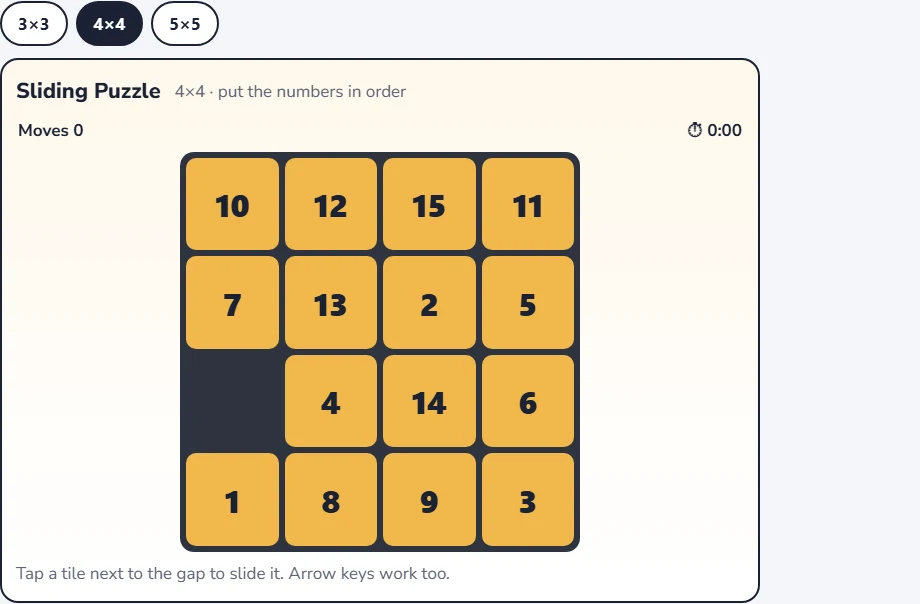
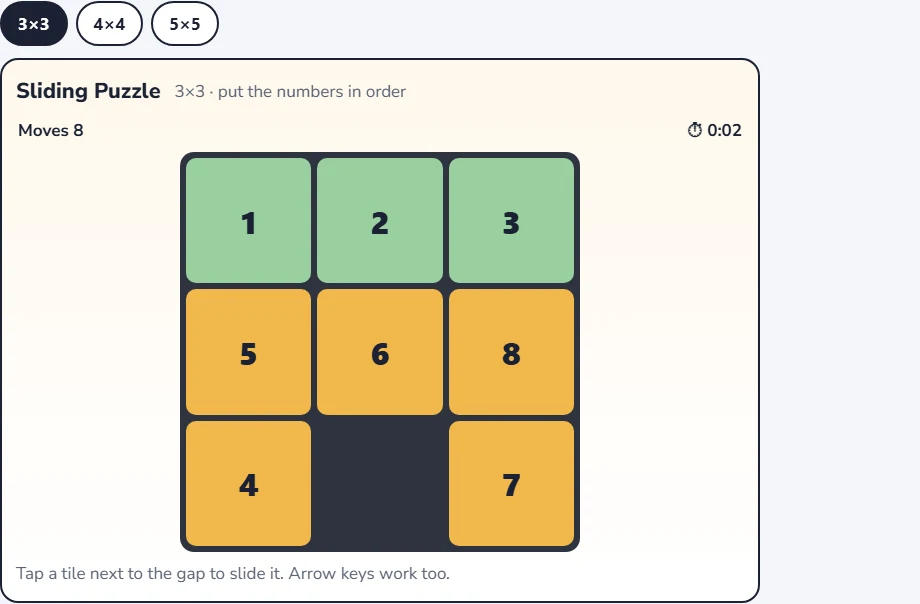
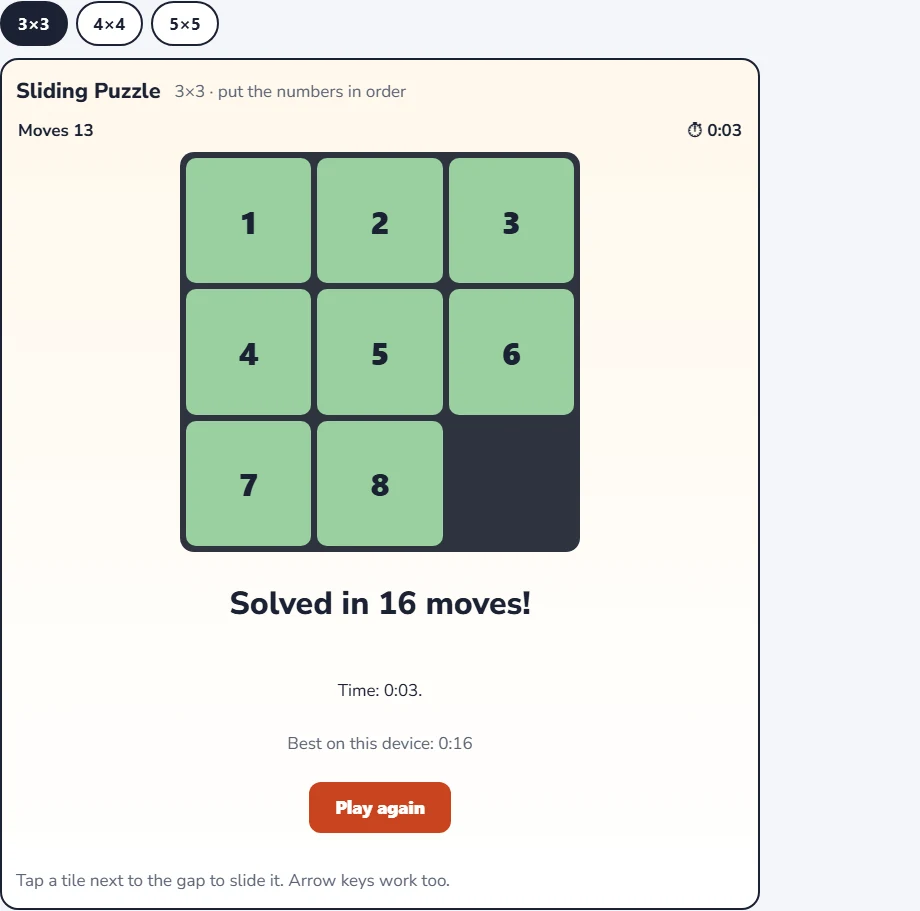
Play the game above, then print the paper version: eight numbered tiles to cut out, a how-to-play box and a move log. The pictures show a new 4×4 puzzle, a 3×3 puzzle half way through and the finished puzzle with its move count.

How to play the sliding puzzle
- Tap a tile next to the gap to slide it. Arrow keys work too.
- Keep going until the numbers read 1, 2, 3 and so on, left to right and top to bottom, with the gap at the bottom right.
- Watch the counters: the game counts your moves and your time.
- Move up a size when you can solve the 3×3 comfortably.
Sliding tile puzzle sizes: how big is each one?
A bigger board has far more arrangements, and exactly half of them can be solved. This is why every puzzle in the game starts by shuffling with real slides, never by placing the tiles randomly, which would leave half the games impossible. The table shows each size, and the number of random slides used to shuffle it:
| Size | Name | Tiles | Arrangements | Solvable arrangements | Longest shortest solution | Shuffle slides |
|---|---|---|---|---|---|---|
| 3 × 3 | 8 puzzle | 8 | 362,880 | 181,440 | 31 | 360 |
| 4 × 4 | 15 puzzle | 15 | 20,922,789,888,000 | 10,461,394,944,000 | 80 | 640 |
| 5 × 5 | 24 puzzle | 24 | 15,511,210,043,330,985,984,000,000 | 7,755,605,021,665,492,992,000,000 | not known exactly | 1000 |
For the 3×3 puzzle, any start can be solved in at most 31 moves, found by computer search. For the 15 puzzle the longest shortest solution is 80 moves, which was proved by computer in 2010. Wikipedia’s 15 puzzle article explains the maths and the history.
Sliding puzzle strategy: solve it row by row
Most people solve a sliding puzzle with a layer-by-layer method. It works for any size:
- Solve the top row from left to right. Place 1, then 2, and so on. For the last tile of a row, park it below its home square first, then slide it up.
- Solve the next row the same way, taking care not to undo the top row.
- Keep going until two rows are left. Then switch to columns: solve the left column of the last two rows, then the next, and so on.
- Finish the last 2×2 corner by rotating the three remaining tiles around the gap.
| Size | Layers to solve | Rows done first |
|---|---|---|
| 3×3 | Row 1, then a 2-row finish | 1 |
| 4×4 | Row 1, row 2, then a 2-row finish | 2 |
| 5×5 | Rows 1 to 3, then a 2-row finish | 3 |
The history of the 15 puzzle
The 15 puzzle was invented in the 1870s and became a craze in 1880, when people played it in offices and trains. A famous prize of $1,000 was offered for a position that could not be solved, an impossible swap of two tiles, because exactly half of all positions cannot be reached by sliding. Mathematicians showed why in 1879. The shuffle in this game uses only real slides, so you can always win.
Number slide puzzle: why only half the arrangements can be solved
Sliding a tile into the gap swaps the gap with one neighbor. On a 3×3 board, a sideways slide leaves the order of the tiles unchanged when they are read row by row, and an up or down slide moves one tile past exactly two others. Both kinds of move keep the arrangement in the same family, so a board that starts in the “wrong” family can never reach the solved position. Exactly half of all arrangements are in the right family, and the other half are not, and bigger boards follow a similar rule. This is why a toy bought from a shop can sometimes be impossible if someone has swapped two tiles.
Sliding puzzle printable: make a paper version
The printable sheet has eight numbered tiles to cut out along the dashed lines, and a how-to-play box. Draw a 3 by 3 frame on a sheet of paper, mix the tiles, and slide them one at a time. Write each game’s move count in the log, and try to beat it. Playing on paper is slower than on a screen, which makes it easy to talk about each move, and children can see the whole board at once.
Ways to use the game with children
- Race a friend: two children shuffle the same board on paper, and the first to finish wins.
- Estimate first: ask how many moves it will take before starting, then compare the guess with the counter.
- Talk it through: a child who explains each move aloud is practicing reasoning as well as patience.
- Set a goal: beat the best time on the 3×3 board before moving up to the bigger board.
Tips for solving faster
- Think two moves ahead: before sliding a tile, ask where it will leave the gap.
- Do not undo your last move. Sliding the same tile back and forth only wastes moves.
- Work in the corners: the corners and edges need the most care, and the middle fixes itself at the end.
- Look for patterns: the same short sequence of slides turns a corner tile into place, and learning it saves many moves.
- Try the smaller board first, and move up to the bigger boards when the 3×3 takes under a minute.
Why sliding puzzles are good for kids
A sliding puzzle teaches planning ahead, because a move that helps now can undo earlier work. It also builds patience and spatial reasoning, and a move counter makes it easy to try again and improve. For more logic practice, try tower of Hanoi, tic tac toe and the medium sudoku.
Sliding puzzle: frequently asked questions
What is a sliding puzzle?
A sliding puzzle is a board of numbered tiles with one empty space. You slide tiles into the space until the numbers are in order.
What is the difference between the 8 puzzle and the 15 puzzle?
The first is a 3×3 board with 8 tiles, and the second is a 4×4 board with 15 tiles, which is much harder, with trillions of arrangements.
Is every game solvable?
Yes. Each puzzle is made by sliding tiles from the solved position, so there is always a way back.
Can I print a sliding puzzle?
Yes. The printable 3×3 sheet has eight tiles to cut out and a frame to draw, so you can play on paper.
Is the sliding puzzle game free, and do kids need an account?
Yes, it is free, and no account is needed. Best scores are saved only in the browser on this device.
Does it work on phones and tablets?
Yes. Every game is built for touch first and also works with a mouse on a computer.