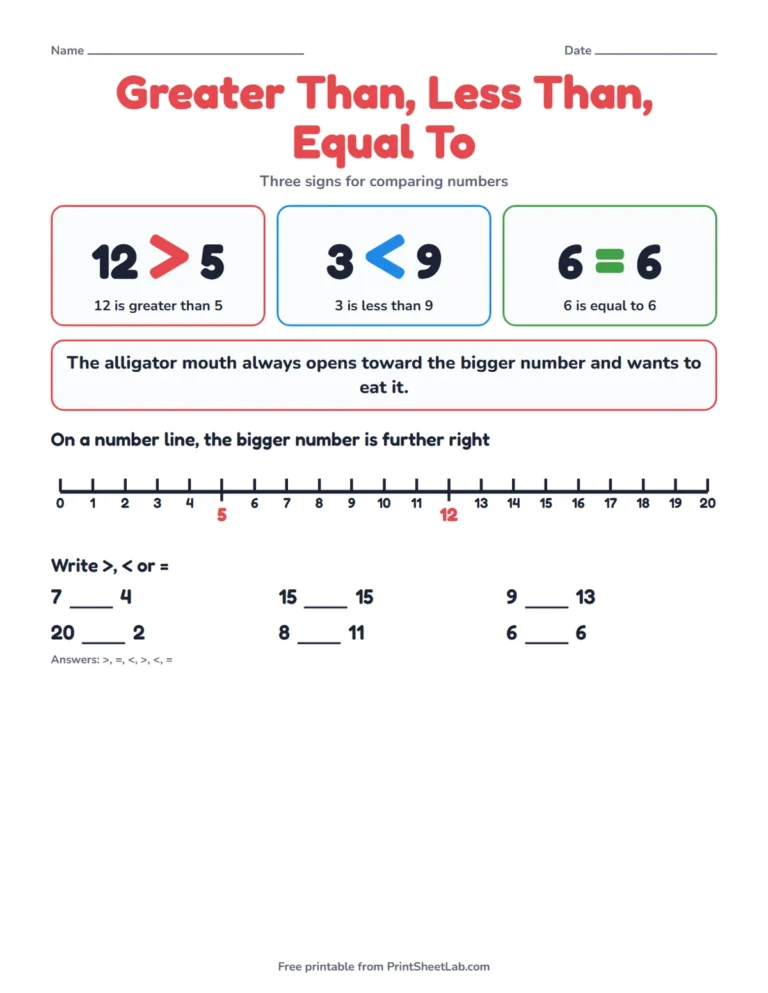
This greater than less than game helps first and second graders compare numbers by playing: race cars, pop balloons or sprint through true and false sentences. Every question shows two numbers from 0 to 99 with a question mark between them, such as 47 ? 52, and you choose the sign greater than (>), less than (<) or equal to (=). It is free, needs no sign-up, works on phones and tablets, and comes with a printable alligator-mouth comparing numbers poster.
Greater than less than game: see how it plays
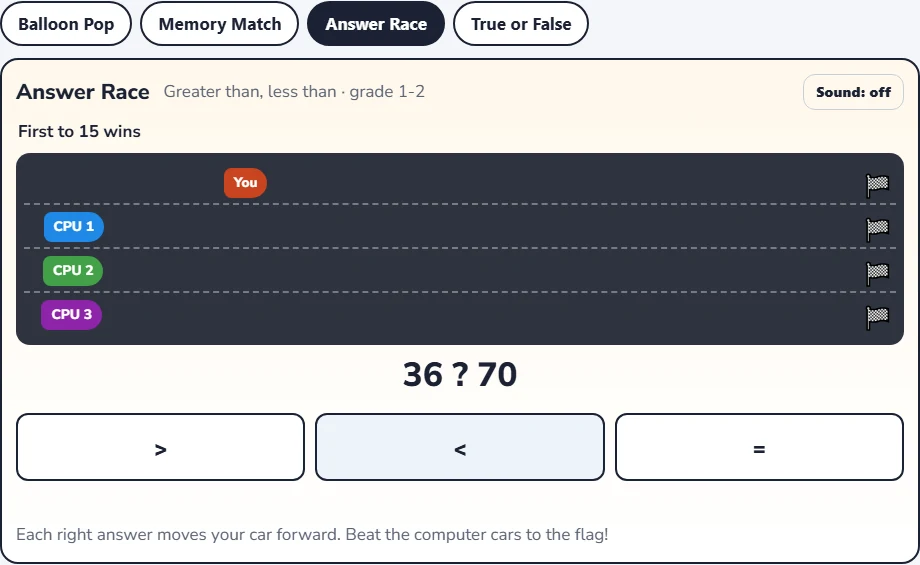
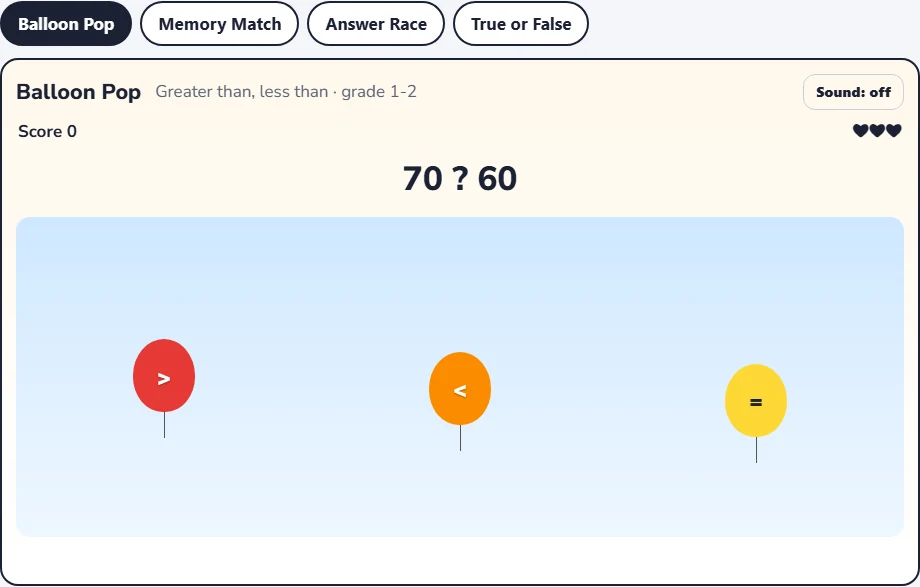
The game below opens in Answer Race and has two more modes. The printable poster shows the three signs with examples and a number line, and the pictures show Balloon Pop, Answer Race and True or False on this page.

How the greater than less than game works
- Answer Race: every right answer moves your car forward, and you race three computer cars to the finish flag. The first to 15 wins, and wrong taps cost time, not places.
- Balloon Pop: answers float up on balloons, and you pop the right one before it drifts off the top. There are three balloons, one for each sign, and the two numbers to compare appear above them. The game speeds up as your score climbs, and three misses ends the round.
- True or False: sixty seconds on the clock. Decide whether each comparison, such as 34 ? 81 = =, is right or wrong. A streak of five or more scores double.
Memory Match is not offered for this game, because every answer is one of only three signs.
Greater than, less than, equal to: what the signs mean
| Sign | Name | Example | How to read it |
|---|---|---|---|
| > | Greater than | 12 > 5 | 12 is greater than 5 |
| < | Less than | 3 < 9 | 3 is less than 9 |
| = | Equal to | 6 = 6 | 6 is equal to 6 |
The greater than less than game uses these three signs in every question. The signs for greater than and less than were first used by the English mathematician Thomas Harriot, in a book published in 1631 after his death. Wikipedia’s inequality article tells the story and shows how the symbols are used in algebra.
Alligator game math: the alligator greater than less than trick
A classic way to remember the signs is the alligator, or crocodile. The alligator’s mouth always opens toward the bigger number because it wants to eat the most food. So 12 > 5 has the mouth open to the 12, and 3 < 9 has the mouth open to the 9. Another way is to see that the small point of the sign always faces the smaller number. If the two numbers are equal, the alligator is not hungry and the equal sign sits in the middle.
Comparing numbers game: strategies that work
- Count the digits: a number with more digits is bigger, so 100 is greater than 99.
- Compare the tens first: in two-digit numbers, the tens digit decides, as in 47 and 52, where 4 tens is fewer than 5 tens.
- If the tens match, compare the ones: 56 is less than 59, because 6 ones is fewer than 9 ones.
- Use a number line: numbers further to the right are greater.
- Say the sentence aloud: “56 is less than 59” tells you which sign to write.
Worked examples of comparing two-digit numbers
| Question | Thinking | Answer |
|---|---|---|
| 47 ? 52 | Compare the tens first: 4 tens is fewer than 5 tens | 47 < 52 |
| 83 ? 38 | Compare the tens first: 8 tens is more than 3 tens | 83 > 38 |
| 65 ? 65 | The tens and the ones are both the same, so the numbers are equal | 65 = 65 |
| 19 ? 91 | Compare the tens first: 1 tens is fewer than 9 tens | 19 < 91 |
| 70 ? 7 | Compare the tens first: 7 tens is more than 0 tens | 70 > 7 |
| 56 ? 59 | The tens are the same, so compare the ones: 6 is fewer than 9 | 56 < 59 |
The example 19 and 91 shows a common trap: both numbers use the same digits, but the tens place decides, and 91 has 9 tens against only 1. Our place value chart makes this clear with colored columns.
Compare numbers on a number line
A number line puts every number in order from left to right, so the number further right is always greater. On the printed poster, 5 and 12 are marked in red: 12 is to the right of 5, so 12 > 5. Number lines also help with questions such as which number is between 29 and 31. Our number line maker prints blank and labeled number lines in many sizes.
Greater than less than word problems
- Mia has 24 stickers and Leo has 42. Who has more? Answer: Leo, because 42 > 24.
- Write the sign: 67 ___ 67. Answer: =.
- A pencil costs 35¢ and an eraser costs 53¢. Which costs less? Answer: the pencil, because 35 < 53.
- Put these in order from least to greatest: 82, 28, 58. Answer: 28, 58, 82.
Where the greater than less than game fits at school
| Level | What children are expected to do |
|---|---|
| Kindergarten (US) | Compare two groups of objects, and compare two written numerals from 1 to 10 (K.CC.C.6 and K.CC.C.7) |
| Grade 1 (US) | Compare two two-digit numbers based on the tens and ones digits, using >, = and < (1.NBT.B.3) |
| Grade 2 (US) | Compare two three-digit numbers using >, = and < (2.NBT.A.4) |
The greater than less than game supports these standards. The Common Core grade 1 number and operations in base ten standards give the full wording. Our comparing numbers worksheets have matching paper practice for each step, including comparing numbers to 20.
Greater than less than game: frequently asked questions
How do you remember greater than and less than?
Think of an alligator mouth that always opens toward the bigger number. Or remember that the small point faces the smaller number.
What age is the greater than less than game for?
It suits ages 6 to 8, first and second grade, when children compare two-digit numbers.
What numbers does the greater than less than game use?
Whole numbers from 0 to 99. Equal numbers are rare, so watch for them, because they need the equal sign.
Which sign means greater than?
The sign > means greater than: the number on the left is bigger. The sign < means less than.
Is the greater than less than game free, and do kids need an account?
Yes, it is free, and no account is needed. Best scores are saved only in the browser on this device.
Does the greater than less than game work on phones and tablets?
Yes. Every game is built for touch first and also works with a mouse on a computer.