This free random name picker chooses one or more winners from a list you paste, with no repeats, or shuffles everyone into random teams of the size you choose. Type or paste up to 5,000 names, press Pick now, and every name has exactly the same chance. Nothing leaves your browser.
The random name picker is built for teachers who need to call on a student, hosts who run a giveaway, managers who rotate meeting roles, and coaches who need fair teams. You can also remove each picked name from the pool, so the next draw never repeats, and copy the result with one click.
Quick answer: With N names and k winners, each name has a k ÷ N chance of being picked, and no name can win twice in one draw. Pick 1 winner from 30 names and each has a 1 ÷ 30 = 3.33% chance. For teams, divide the names by the team size and round up: 22 names in teams of 5 make 5 teams.
How to use this random name picker
- Paste your names into the box, one per line. A single line with commas also works, for example “Ava, Ben, Chloe”.
- Choose Pick winners or Make teams.
- For winners, type how many to pick. Tick Remove picked names from the pool if you want the next draw to skip them.
- For teams, choose a team size or a number of teams, and decide whether to balance the teams.
- Press Pick now. Press it again for a fresh draw, and use Copy result to paste the result into a chat.
| Setting | What it does | Default |
|---|---|---|
| Names | Your list, one name per line or comma separated, up to 5,000 names | 10 sample names |
| Pick winners / Make teams | Chooses between a draw and a team shuffle | Pick winners |
| Number of winners | How many different names to draw | 1 |
| Remove picked names | Takes winners out of the pool for later draws, so nobody wins twice | Off |
| Split by team size or number of teams | Sets the size of each team, or how many teams there are | Team size, 3 |
| Balance the teams | Spreads leftover people so team sizes differ by at most one | On |
| Ignore repeated names | Counts a name that appears twice as one entry | On |
Everything is private. The random name picker keeps the list in your browser, nothing is saved, and the Reset button clears it. Changing the list starts a fresh pool, so removed names come back.
How the random name picker works
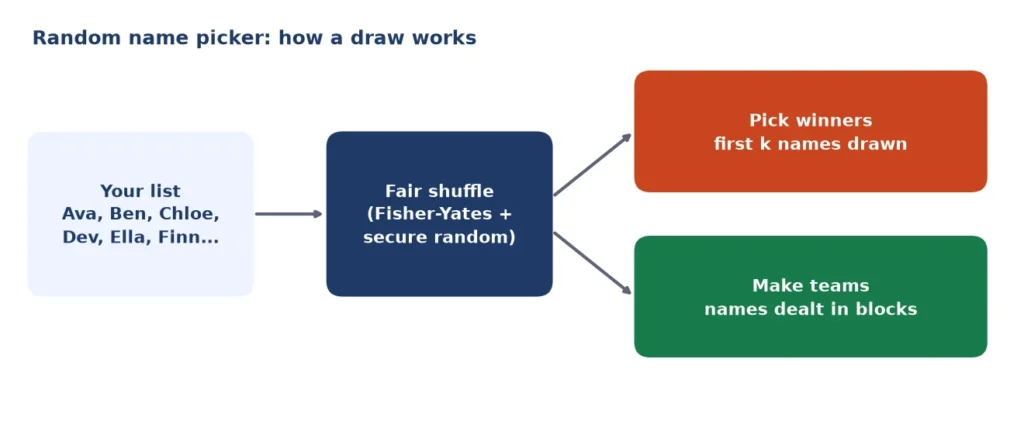
The random name picker cleans your list (it trims spaces, drops blank lines and, if you like, repeated names), then shuffles it with the Fisher–Yates method. Starting from the end, each position swaps with a randomly chosen earlier position. This produces every possible order with exactly the same probability, which is the standard fair shuffle.
The random numbers come from your browser’s secure generator, and values that would favor some positions are thrown away (rejection sampling). The first k names of the shuffled list are the winners. For teams, the shuffled list is dealt out in blocks.
- Chance each name wins: k ÷ N.
- Number of possible winner sets: C(N, k) = N! ÷ (k! × (N − k)!).
- Number of teams (by size s): N ÷ s, rounded up.
- Balanced team sizes: N ÷ T rounded down, with N mod T teams getting one extra person.
Worked example 1: pick 3 winners from 30 names
With 30 names and 3 winners, each name has a 3 ÷ 30 = 10% chance. The number of different possible winner groups is C(30, 3) = 4,060, and each one is equally likely. After the draw, the three winners are never the same person, because a picked name leaves the pool before the next pick.
Worked example 2: 22 names into teams of 5
22 ÷ 5 = 4.4, rounded up to 5 teams. With Balance the teams on, the sizes are 5, 5, 4, 4 and 4 (22 = 5 × 4 + 2, so two teams get an extra person). With balance off, you get four full teams of 5 and one team of 2. Both are fair, so pick the one that suits the game.
Pick a random name from a list: giveaways, classrooms and meetings
When you need to pick a random name from a list, the best method is one that everyone can see and trust. The random name picker is quick enough to run live, and the steps are simple to explain: the list is shuffled, and the first names win.
Random name picker from list: paste, clean and draw
A random name picker from list needs no setup. Paste the names, and the tool trims spaces, skips blank lines and drops repeats, so a stray space or a blank row does not create an extra entry. If your list has two columns, such as first and last names, paste only the column you want drawn, or join them into one cell first.
Random winner picker for giveaways and raffles
A random winner picker is useful for a prize draw on a call, a stream or in a classroom. Paste the entrants, set the number of prizes, and draw while people watch. Winners are listed in the order drawn, so you can award first, second and third prize. Share your screen or record the draw to show it was fair. Rules for giveaways vary by country and platform, so check yours before you run one.
Pick a random student: classroom use
Teachers use the random name picker for cold calls, helpers of the day and presentation order. Tick Remove picked names and everyone gets a turn before anyone is called twice. When the last name is drawn, the pool refills automatically and the cycle begins again.
Meetings, standups and chores
The random name picker also works for small decisions at work or at home. Pick who takes notes, who presents first, or who does the dishes. For a rotation, use the no-repeat option and note the order. For a quick yes or no, use the coin flip.
Odds by list size
With any random name picker, the chance of being picked depends only on the size of the list and the number of winners. It does not depend on where a name sits in the list.
| Names in the list | 1 winner | 3 winners | 5 winners | Odds with 1 winner |
|---|---|---|---|---|
| 10 | 10% | 30% | 50% | 1 in 10 |
| 20 | 5% | 15% | 25% | 1 in 20 |
| 30 | 3.33% | 10% | 16.67% | 1 in 30 |
| 50 | 2% | 6% | 10% | 1 in 50 |
| 100 | 1% | 3% | 5% | 1 in 100 |
| 500 | 0.2% | 0.6% | 1% | 1 in 500 |
| 1000 | 0.1% | 0.3% | 0.5% | 1 in 1,000 |
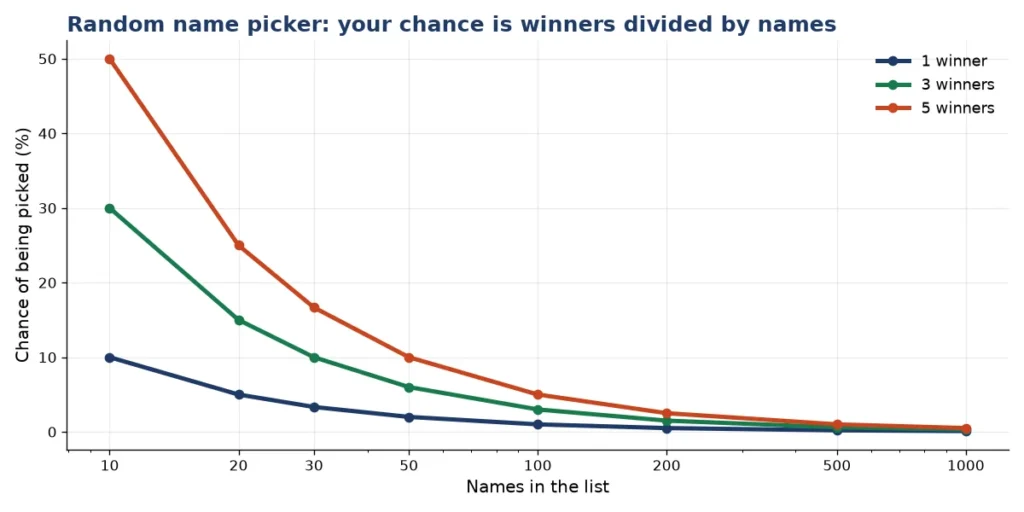
If a person enters more than once, give that person extra lines: with t entries out of N total, their chance for one winner is t ÷ N. Turn off Ignore repeated names if repeated names should count as extra tickets.
Random name picker no repeats: how removing picked names works
The random name picker no repeats setting keeps each name from winning more than once. Within one draw this is automatic: 3 winners are always 3 different names. Across draws, tick Remove picked names from the pool, and the names you just picked stay out until everyone has had a turn.
Why does it matter? Without removal, each draw is independent, so the same name can come up twice in a row. That is correct random behavior, but it feels unfair in a classroom. With 30 names and no removal, the chance that at least one name repeats within 5 draws is 29.63%, and within 10 draws it is 81.54%.
| Draws of 1 name from 30 | Chance someone repeats (no removal) | Chance someone repeats (removal on) |
|---|---|---|
| 2 | 3.33% | 0% |
| 3 | 9.78% | 0% |
| 5 | 29.63% | 0% |
| 8 | 64.03% | 0% |
| 10 | 81.54% | 0% |
| 15 | 98.59% | 0% |
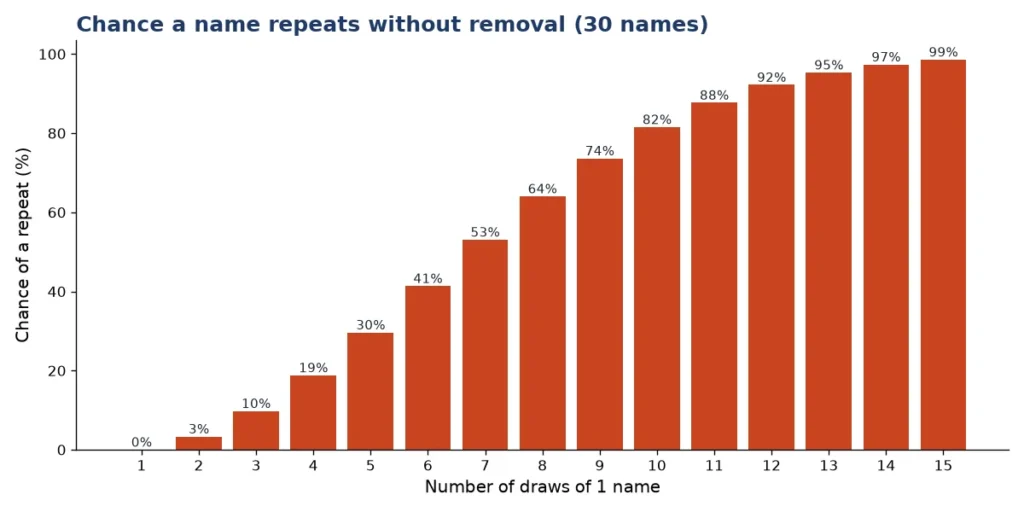
This is the same effect as the birthday problem: a repeat appears much sooner than most people expect. Remove picked names when you want a fair rotation, and leave removal off when each draw should be independent, such as a weekly raffle.
Random team generator: shuffle names into teams
Besides winners, this random name picker works as a random team generator: it shuffles the whole list and deals it into teams in one step. Choose a team size, such as 4 per team, or a number of teams, such as 3. The same names can be re-shuffled any time by pressing the button again, and the result table lists each team with its members and size.
Random group maker: balanced or full teams
As a random group maker, the picker has two ways to handle a leftover. A balanced split keeps teams within one person of each other, which is best for fairness. A full-teams split fills each team to the chosen size and puts the leftovers in a smaller last team, which is useful when the game needs a fixed size.
| Names | Teams of up to 4 | Balanced sizes | Full-teams sizes | Possible ways to split (balanced) |
|---|---|---|---|---|
| 12 | 3 | 4, 4, 4 | 4, 4, 4 | 5,775 |
| 15 | 4 | 4, 4, 4, 3 | 4, 4, 4, 3 | 2,627,625 |
| 18 | 5 | 4, 4, 4, 3, 3 | 4, 4, 4, 4, 2 | 1,072,071,000 |
| 20 | 5 | 4, 4, 4, 4, 4 | 4, 4, 4, 4, 4 | 2,546,168,625 |
| 22 | 6 | 4, 4, 4, 4, 3, 3 | 4, 4, 4, 4, 4, 2 | 1,960,549,841,250 |
| 25 | 7 | 4, 4, 4, 4, 3, 3, 3 | 4, 4, 4, 4, 4, 4, 1 | 1,503,088,211,625,000 |
| 28 | 7 | 4, 4, 4, 4, 4, 4, 4 | 4, 4, 4, 4, 4, 4, 4 | 13,189,599,057,009,375 |
| 30 | 8 | 4, 4, 4, 4, 4, 4, 3, 3 | 4, 4, 4, 4, 4, 4, 4, 2 | 26,774,886,085,729,031,250 |
The last column shows why a re-shuffle is always different. Even 20 names in 5 teams of 4 can be split in 2,546,168,625 different ways, and each is equally likely.
Ideas for fair teams
- Sports and PE: shuffle the class into teams of 5 for a quick scrimmage, and re-shuffle after each game.
- Group projects: use teams of 3 or 4 and reshuffle until nobody has an unlucky pair.
- Trivia and game nights: make teams of 2 to 6 from the people in the room.
- Secret Santa style pairs: teams of 2 give random pairs in one press.
Is the random name picker fair?
Yes, this random name picker is fair. Fairness comes from three design choices. First, the shuffle is a Fisher–Yates shuffle, which gives every order the same probability; shortcuts such as sorting by a random number can favor some orders. Second, the random numbers use the browser’s cryptographic generator, which cannot be predicted from earlier results. Third, rejection sampling removes the small bias that the remainder method adds.
- No seed and no memory: a new draw is independent of earlier ones, except when you choose to remove picked names.
- No hidden weighting: the position, spelling and length of a name never change its chance.
- Private: the random name picker never sends the list anywhere, so you can use real names.
- Transparent: the “How it works” steps below the result explain each draw.
Two honest limits: the tool cannot verify who entered, and it treats “Ann” and “ann” as the same name when repeats are ignored. Share your list before the draw if others need to trust it.
Common mistakes when picking names at random
- Redrawing until you like the result. Decide the rules first, then draw once.
- Leaving duplicates in the list. A name pasted twice gets two tickets unless repeats are ignored.
- Expecting a “balanced” draw. Random picks can pick the same type of person twice. Use the team balance for sizes, not for skills.
- Forgetting hidden spaces. Names with extra spaces are trimmed, but different spellings count as different names.
Questions people ask about the random name picker
Random name picker wheel: is there a spinning wheel?
This random name picker draws instantly instead of spinning a wheel. The odds are identical, because a wheel with equal slices also gives each name the same chance. The instant draw is quicker for large lists and works well in full screen on a projector.
Random name picker Excel: how do I use a list from a spreadsheet?
Copy the column of names from Excel or Google Sheets and paste it into the box. Each row becomes one line. The tool then does the draw, so no formulas are needed.
Is there a random name picker app to install?
You do not need an app. The picker runs in any modern browser on a phone, tablet or computer, and it works with the page open even if your connection drops.
How many names can I enter?
The random name picker accepts up to 5,000 names. You can pick as many winners as there are names, or make as many teams as there are people.
Frequently asked questions
10 quick answers
How does the random name picker choose a winner?
It shuffles your list with a Fisher–Yates shuffle that uses secure random numbers, then takes the first names. Every name has the same chance, k ÷ N for k winners and N names.
Can the random name picker choose the same name twice?
Not within one draw. Across draws it can, unless you tick Remove picked names from the pool.
How do I pick several winners at once?
Set Number of winners to 3, for example, and press Pick now. You get 3 different names in the order drawn, so you can assign first, second and third place.
How do I make random teams?
Choose Make teams, pick a team size or a number of teams, and press Pick now. The result table lists each team and its members.
What if the names do not divide evenly into teams?
With Balance the teams on, sizes differ by at most one, for example 5, 5, 4, 4, 4 for 22 names. With it off, the last team is smaller.
Can I paste names from Excel or Google Sheets?
Yes. Copy the column and paste it. Each row becomes one name.
Is my list saved or shared?
No. The list stays in your browser and is gone when you close or reset the page.
What is the chance of winning with 100 names?
With 1 winner it is 1 in 100, or 1%. With 5 winners it is 5%.
Does the order of names change the odds?
No. The shuffle gives every order the same probability, so the first and last name have the same chance.
Can I use it for a classroom?
Yes. Paste the class list, tick Remove picked names, and everyone gets a turn before anyone is called twice.
Related calculators
- Random number generator: pick numbers instead of names
- Coin flip: settle a two-way decision
- Dice roller: roll dice for turn order
- Dice probability calculator
- Percentage calculator: convert odds to percent
- Printable bingo cards and worksheets for class prizes and game time
Sources and further reading
- Fisher–Yates shuffle on Wikipedia: the algorithm that gives every order the same probability.
- Simple random sample on Wikipedia: why equal chances make a draw fair.
- MDN: Crypto.getRandomValues(): the secure browser generator used for every draw.
Last updated: October 2026.