Hexagon graph paper tiles the page with equal six-sided cells, with no gaps and no overlaps. These free printable hexagon graph paper sheets come in six sizes from 1/8 inch to 1 inch, with flat-top or pointy-top hexagons. Use them for game maps, quilt designs, drawing organic chemistry rings and art, then download the PDF.
Hexagon graph paper to print (PDF)
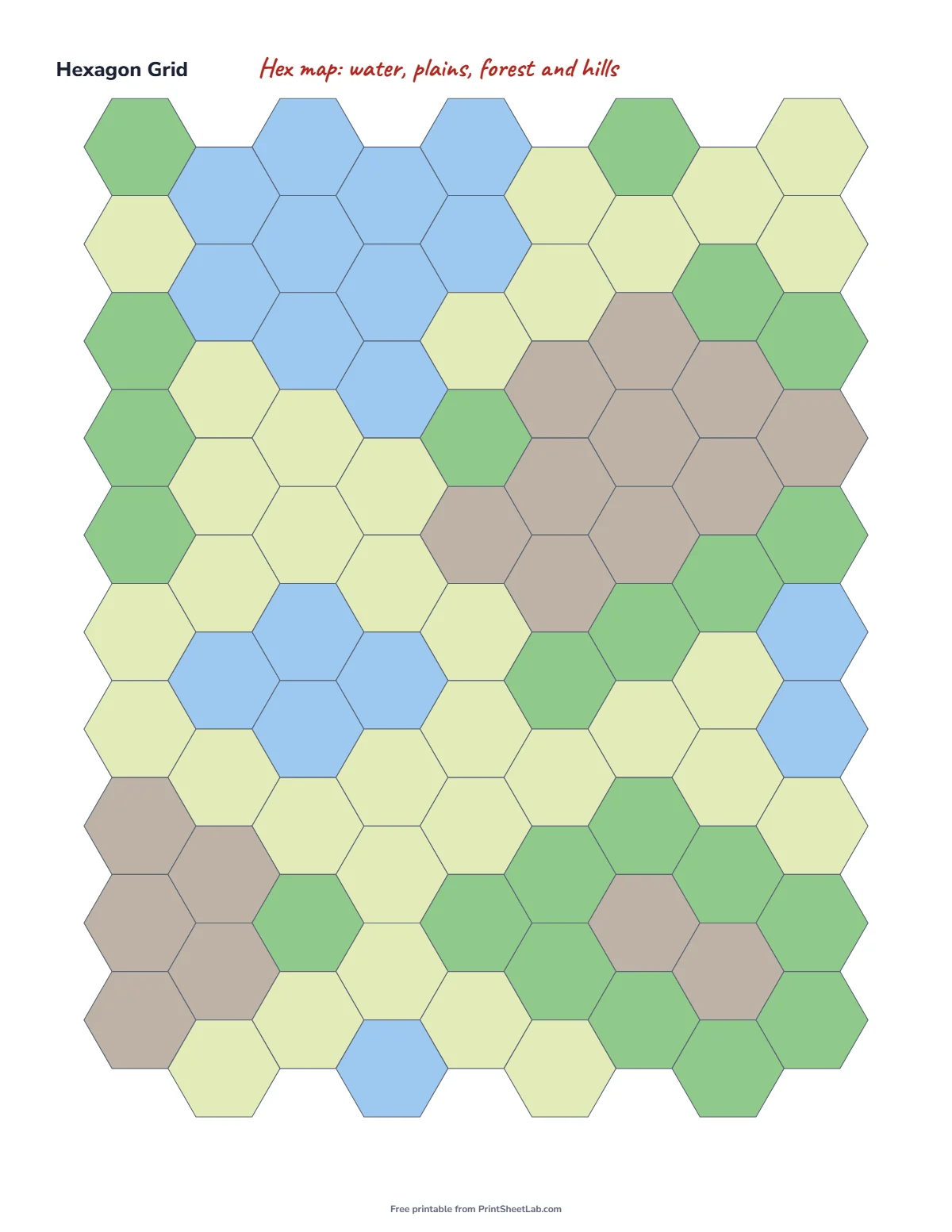
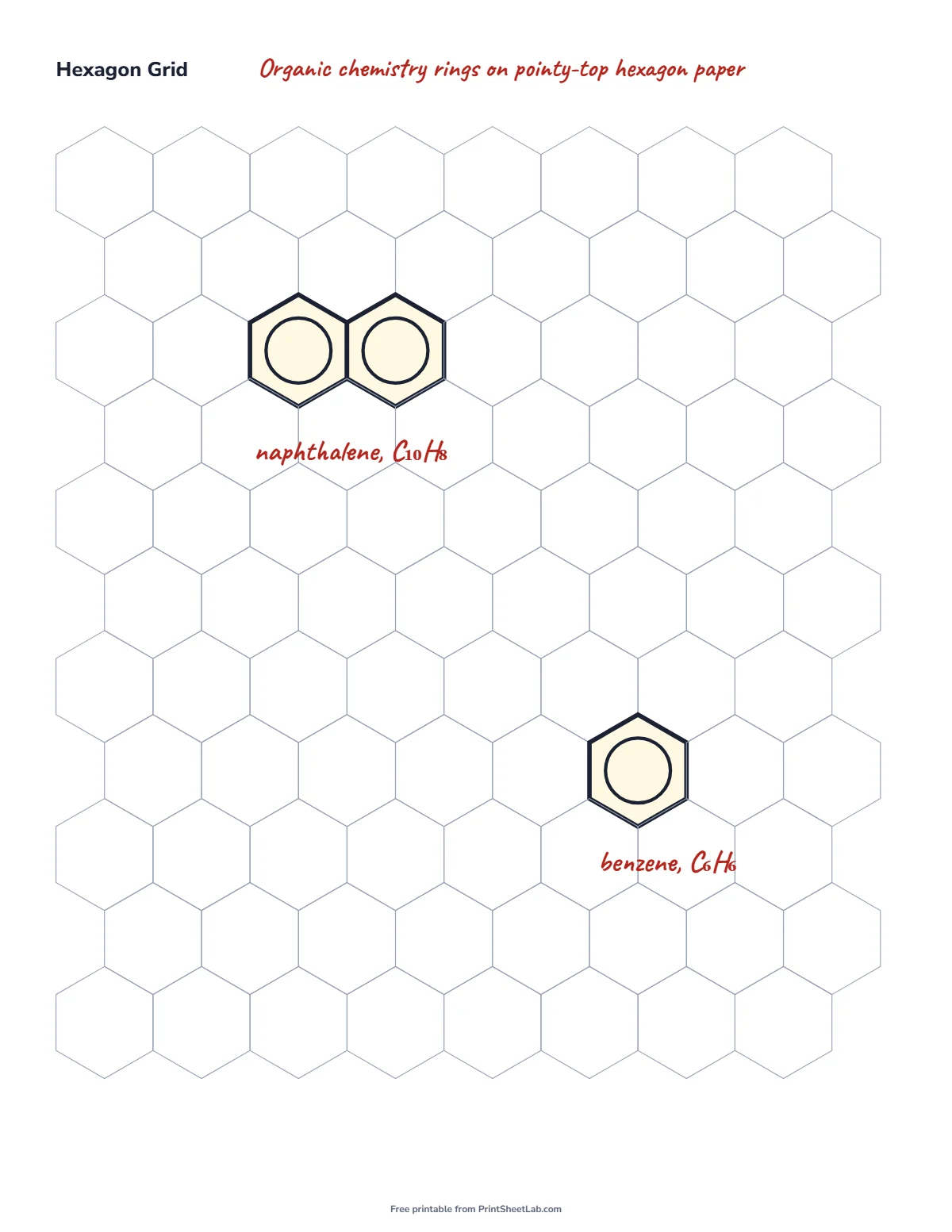
These four pages show the choices: 1/4 inch flat-top hexagons, 1/2 inch pointy-top hexagons in blue, a hex map colored in with terrain, and two organic chemistry rings. Click a picture for the PDF, or use the generator above to choose the size, the orientation and the color.


Hexagon graph paper sizes: how many hexagons fit on a page?
The generator offers six sizes. The size is the length of one side of the hexagon, which is also the distance from the center to any corner. This table is measured from the PDFs on a US Letter page with half-inch margins:
| Hexagon side | Width across the flat sides | Width across the corners | Area of one hexagon | Hexagons per page, flat top | Hexagons per page, pointy top |
|---|---|---|---|---|---|
| 1/8 in | 0.217 in (5.5 mm) | 0.250 in | 0.041 sq in | 1,677 | 1,666 |
| 3/16 in | 0.325 in (8.2 mm) | 0.375 in | 0.091 sq in | 741 | 743 |
| 1/4 in | 0.433 in (11.0 mm) | 0.500 in | 0.162 sq in | 399 | 396 |
| 3/8 in | 0.650 in (16.5 mm) | 0.750 in | 0.365 sq in | 168 | 176 |
| 1/2 in | 0.866 in (22.0 mm) | 1.000 in | 0.650 sq in | 90 | 88 |
| 1 in | 1.732 in (44.0 mm) | 2.000 in | 2.598 sq in | 18 | 18 |
Flat-top and pointy-top sheets hold almost the same number of cells. A 1/4 inch grid has about 400 hexagons, and the 1/8 inch grid has about 1,670. Hexagons that would cross the margin are left out, so every cell on the sheet is whole.
Hex grid printable: flat top or pointy top?
A flat-top hexagon has a flat edge on top and bottom, so each column of hexagons is offset half a cell from the next. A pointy-top hexagon has a corner at the top, and each row is offset half a cell from the one above. Both are the same grid turned 30 degrees. Choose by the way you want to read the map:
- Flat top suits maps where you move left and right, with columns that zigzag up the page. Many game maps use it.
- Pointy top suits drawings where rows matter, such as building a wall of bricks, and it is the way organic chemists draw benzene.
Why hexagons? Every neighbor is the same distance away
Each hexagon touches six others along a full edge, and the centers of all six are the same distance away. On a square grid it is different: a square has four neighbors that share an edge and four more that touch at a corner, and the corner neighbors are about 41% farther away (the square root of 2 is 1.414). That is why wargame designers moved from squares to hexagons: moving in any direction costs the same, and there are no corner shortcuts. It is also why a hex grid looks more natural for maps of land and sea.
Hexagons are also efficient. Of all the shapes that tile a plane in equal cells, a regular hexagon has the least edge for the area it covers. Bees use it in the honeycomb, and mathematicians proved this in 1999, a result known as the honeycomb conjecture.
Hex map paper for board games and role-playing
To draw a map with a start hex in the middle, the number of hexagons in a map with r rings around the center is 3r(r + 1) + 1. This table shows the first few sizes:
| Rings around the center hex | Hexagons in the map | How to count them | Example |
|---|---|---|---|
| 1 | 7 | 1 + 6 | A flower rosette in quilting |
| 2 | 19 | 1 + 6 + 12 | The island in the board game Catan |
| 3 | 37 | 1 + 6 + 12 + 18 | A small battlefield or region map |
| 4 | 61 | 1 + 6 + 12 + 18 + 24 | A large region map |
| 5 | 91 | 1 + 6 + 12 + 18 + 24 + 30 | A campaign map |
The standard island in the board game Catan has 19 land hexagons arranged in rows of 3, 4, 5, 4 and 3. If you print 1 inch hexagons you get 18 on a page, which is nearly enough for that island, and 1/2 inch hexagons give 88 to 90, enough for a map with 4 rings (61 hexagons). The terrain example in the gallery uses 1/2 inch hexagons with water, plains, forest and hills, and you can color your own map the same way. Use pencil first, then pen over the border hexagons you want to keep.
Hex paper for organic chemistry: benzene and naphthalene
Hex paper for organic chemistry gives you the right shape for every ring. Organic chemists draw benzene (C₆H₆) as a hexagon with a circle inside, and many other molecules are built from the same ring. Naphthalene (C₁₀H₈) is two rings that share an edge, which is easy to draw on pointy-top hexagon paper because the rings share a vertical side. The gallery example shows both. Choose 1/4 inch to 1/2 inch hexagons so that you have room to write atoms and bonds at the corners.
Hexagonal graph paper for quilting, crafts and art
Hexagon quilts such as the traditional “grandmother’s flower garden” are made from rosettes: one center hexagon surrounded by six more, which is 7 cells. A larger flower has two rings, which is 19 cells. Print hexagonal graph paper at the size you want, color a design, and count the hexagons of each color to see how many pieces you need to cut. The same grid works for mosaics, tessellation drawings and pixel art.
Choose the hexagon size from the job:
| Use | Hexagon side to choose | Why |
|---|---|---|
| Organic chemistry rings | 1/4 to 1/2 in | Big enough to write atoms and bonds inside |
| Board game and role-playing maps | 1/2 or 1 in | Room for a counter, a miniature or a short label |
| Detailed region or world maps | 3/8 or 1/4 in | More cells, smaller terrain features |
| Quilting and tile designs | 1/2 to 1 in | Close to the size of real pieces; add seam allowance yourself |
| Pixel art and mosaics | 1/8 to 3/16 in | Over 700 cells for a fine image |
| Young children | 1 in | 18 large cells to color in |
Tips for using hexagon grid paper
- Print one sheet of hexagon grid paper first if you want the hexagons to match real pieces, and turn off “Fit to page”.
- Mark a coordinate system on the border, letters across and numbers down, if you need to refer to cells in a game.
- Use a light color such as gray or blue for the grid so your pen or pencil lines stand out.
- Two colors help when you are counting cells in a pattern, such as a quilt rosette.
For square cells see graph paper, and for triangle grids see isometric paper in the paper generator.
Printing tip
Print at 100% or “Actual size” and turn off “Fit to page”, so every measurement on the sheet is exact. Choose Letter or A4 paper in the generator before you download the PDF.
Hexagon graph paper: frequently asked questions
What sizes of hexagon graph paper can I print?
The generator prints hexagons with sides of 1/8, 3/16, 1/4, 3/8, 1/2 and 1 inch. The 1/4 inch size gives about 400 hexagons on a Letter page.
Is a flat top or pointy top hexagon better?
It is a matter of style. Many board games and maps use flat tops, and organic chemistry is usually drawn on pointy tops. The two layouts hold nearly the same number of cells.
How many hexagons are on a page of hex grid paper?
It depends on the size. On US Letter, a 1 inch hexagon gives 18 cells, a 1/2 inch hexagon gives about 90, and a 1/4 inch hexagon gives about 400.
Can I use hexagon graph paper for organic chemistry?
Yes. Use pointy-top hexagons of 1/4 to 1/2 inch, draw an inner circle for aromatic rings, and write the atoms at the corners.
Is this hexagon graph paper free?
Yes. It is free to print for home and classroom use, with no sign-up.
More printable paper
- Specialty paper generator with every layout on this site
- Paper generator for lined, graph, dot grid, isometric and handwriting paper
- Graph paper, lined paper and dot grid paper