How to make a chore chart that works: keep it simple, visible and fair. A good chart has three to five age-appropriate jobs, pictures or clear words, a place to check off each day, and a small, predictable reward. Most charts fail because they list too many chores, the jobs are vague, or the reward is forgotten. Here is how to build one that lasts past the first week, step by step.
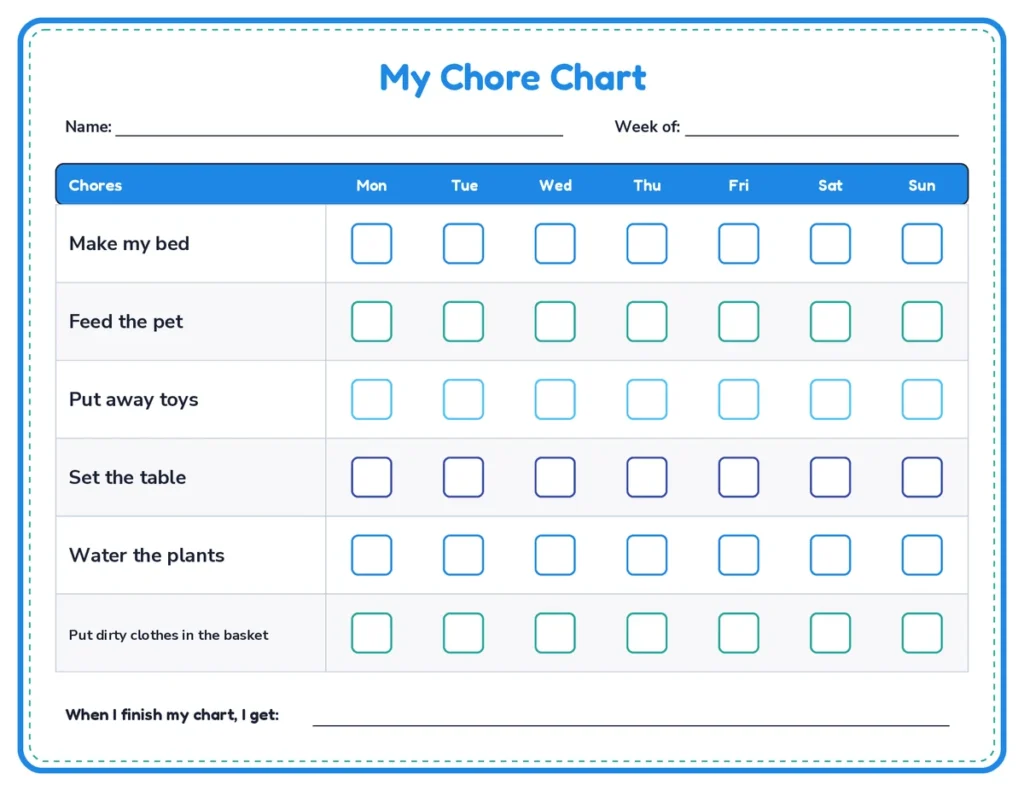
What every chore chart that works has in common
- Few jobs: three to five regular chores, not fifteen.
- Clear “done” rules: each job says exactly what finished looks like.
- Right for the age: jobs a child can do alone after a little teaching.
- Visible: the chart hangs where the chores happen, at the child’s eye level.
- A fixed review day: check marks are counted and any reward is given on the same day every week.
The five steps below build each of these into your chore chart.
How to make a chore chart, step 1: pick 3 to 5 chores
Fewer chores done every day beat a long list done sometimes. A good mix is:
- One self-care job, such as making the bed or packing the backpack.
- One or two family jobs, such as setting the table or feeding a pet.
- One bigger weekly job for children aged about 6 and up, such as changing sheets or taking out the recycling.
Let your child choose one of the jobs from a short list you have already approved. Having a say makes the chart feel less like a list of orders.
Age-appropriate chores for a chore chart
The biggest decision in how to make a chore chart is choosing jobs your child can really finish alone.
The table below starts with toddler jobs and, from age 5, follows the lists on the American Academy of Pediatrics’ HealthyChildren.org site. Every age band can also do the jobs listed above it.
| Age | Chore ideas | Safety notes |
|---|---|---|
| 2 to 3 | Put toys in a basket, put clothes in the laundry basket, wipe a small spill with a cloth | Only with an adult nearby; no sprays |
| 4 to 5 | Set napkins and spoons, water plants, match socks, fill the pet bowl with help | Plastic plates and cups only |
| 6 to 7 | Make the bed, set and clear the table, sort laundry by color, empty small trash cans, pack the backpack | No glass or sharp knives when clearing |
| 8 to 9 | Vacuum a room, put away groceries, fold and put away own laundry, make a simple snack | Snacks without the stove or oven, or with an adult |
| 10 to 12 | Unload the dishwasher, change bed sheets, clean the bathroom sink, simple meals with supervision, walk the dog | Teach safe cleaning products first; supervise cooking |
| 13 and up | Cook a family meal, clean the kitchen after cooking, yard work, help with younger siblings | Walk-behind power mowers from 12, ride-on mowers from 16 (AAP) |

Chores for kids by age: how much time should the chart ask for?
When you decide how to make a chore chart, the number of jobs matters as much as the choice of jobs, because a chart that takes too long is dropped within a week. This table multiplies a guideline number of jobs by a guideline time for each job, and shows the daily and weekly total. The numbers are our own planning guidelines, not research findings, so change them to suit your child:
| Age | Jobs on the chart | Minutes per job | Minutes a day | Minutes a week | Hours and minutes a week |
|---|---|---|---|---|---|
| 2 to 3 | 2 | 3 min | 6 min | 42 min | 42 min |
| 4 to 5 | 3 | 4 min | 12 min | 84 min | 1 h 24 min |
| 6 to 7 | 4 | 5 min | 20 min | 140 min | 2 h 20 min |
| 8 to 9 | 4 | 8 min | 32 min | 224 min | 3 h 44 min |
| 10 to 12 | 5 | 10 min | 50 min | 350 min | 5 h 50 min |
| 13 and up | 5 | 12 min | 60 min | 420 min | 7 h 00 min |
A 5-year-old with three small jobs spends about 12 minutes a day, or an hour and a half a week, while a 10-year-old with five bigger jobs spends 50 minutes a day. Keep this time guide in mind whenever you set up a chart for a new age.
If your child needs much longer than the guideline for the age, the jobs are probably too big or too vague, and the fix is to split a job or to rewrite what “done” means. These age appropriate chores should leave time for homework, play and rest, so keep the daily total to about an hour at most, even for teenagers. A realistic time budget is what keeps a chart going for months, not days.
Safety first when choosing chores
Safety belongs in every chore plan, especially for jobs near heat, sharp tools or chemicals.
- Chemicals: store cleaning products out of reach and give younger children a damp cloth instead of sprays. Older children should learn to read labels before using any product.
- Heat and blades: stoves, ovens, kettles and sharp knives stay adult-led until you have taught and watched the job several times.
- Heavy or high jobs: no ladders, heavy trash cans or lifting furniture for young children.
- Mowers: the AAP advises that children should be at least 12 to use a walk-behind power mower and 16 for a ride-on mower, and that younger children stay indoors while anyone mows.
- Your child, not the table: age bands are rough. A careful 7-year-old and a distracted 10-year-old may need the same level of supervision.
Step 2: choose a format that fits your child’s age
For a young child, pictures matter more than words.
The best chore chart layout depends on whether your child can read and how they like to track progress.
| Format | Best for | How it works |
|---|---|---|
| Picture chart | Ages 2 to 5 | A picture for each job and a sticker or magnet when it is done |
| Weekly check-off grid | Ages 5 to 10 | Jobs down the side, days across the top, one check mark per box |
| Points chart | Ages 7 to 12 | Each job earns points toward a goal agreed in advance |
| Rotation chart | Siblings and whole families | Jobs move to the next person each week so nobody is stuck with the worst one |
| Checklist or planner | Ages 11 and up | A simple list in a planner or on the fridge, checked off without reminders |
Our chore chart printable lets you add each child’s name and jobs and print a weekly grid. Older children can track jobs alongside homework in the homework planner, and whole families can use the family planner.
Step 3: teach each chore, then define “done”
“Clean your room” means something different to a six-year-old. Before a job goes on the chore chart, teach it in four short stages:
- Show: do the job while your child watches, saying each step aloud.
- Together: do it side by side.
- Watch: your child does it while you stay nearby.
- Alone: the job goes on the chart.
Then write down what “done” means. For a tidy room, that might be: toys in the basket, books on the shelf, clothes in the laundry basket, bed made. HealthyChildren.org advises parents not to expect perfection and to praise the effort, not only the result.
Step 4: decide on a reward
Families handle rewards differently, and there is no single right answer. Common set-ups include:
- Stickers and a weekly treat for ages 3 to 7: five check marks earn a small reward chosen in advance, such as choosing Saturday’s park.
- Points toward a bigger goal for ages 7 to 10: a new book or a trip out.
- An allowance for older children, with everyday jobs done simply because “we all help at home” and extra jobs earning money.
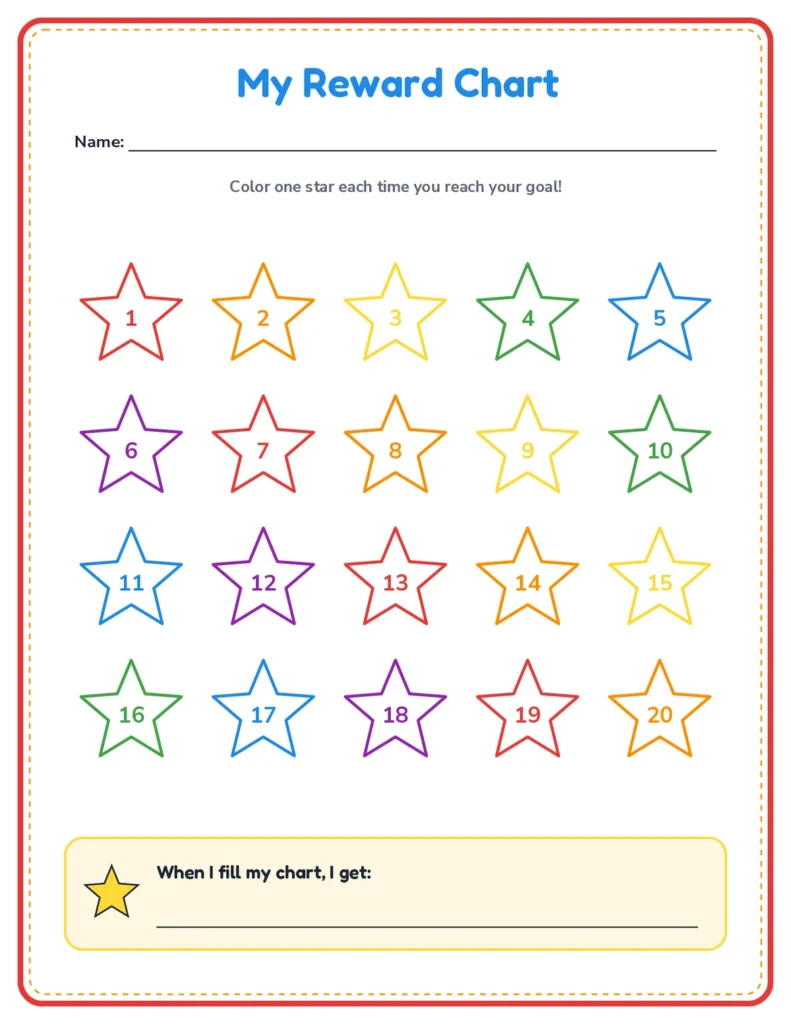
Keep behavior goals, such as bedtime or homework without reminders, on a separate reward chart or behavior chart. Mixing the two makes it unclear what each check mark means.
Kids chore chart ideas: points, rewards and how long a goal takes
Many kids chore chart ideas use points toward a bigger goal, and the reward is the part families change most often, so it helps to know how long the goal will take.
If every check mark is worth one point, a chart with three daily jobs can earn at most 21 points a week. A realistic target is 80% of the maximum, because even a keen child misses a day. This table shows the target and how many weeks it takes to reach three common goals at that rate:
| Jobs on the chart | Most check marks in a week | Target at 80% | Weeks to reach 50 points | 100 points | 150 points |
|---|---|---|---|---|---|
| 3 | 21 | 17 | 3 weeks | 6 weeks | 9 weeks |
| 4 | 28 | 23 | 3 weeks | 5 weeks | 7 weeks |
| 5 | 35 | 28 | 2 weeks | 4 weeks | 6 weeks |
With four jobs the target is 23 points a week, so a 100-point goal takes 5 weeks. That is a useful number to know before you settle on a points reward. For children aged 5 to 8, choose a goal that can be reached in two to four weeks, since a longer wait feels endless.
For older children, a goal of 100 or 150 points works well. Whatever goal you choose, a small weekly reward every Sunday can sit alongside the bigger goal, so that there is always something to look forward to.
Step 5: review the chart every week
Pick one day, such as Sunday, and spend five minutes together. Count the check marks, give any reward straight away, and adjust: swap a chore that has become too easy, split one that caused daily battles, and let your child pick a new job to try. Print a fresh copy each week so it never looks old and ignored.
Worked example: how to make a chore chart for two children
| Chore | Maya (5) | Arjun (9) |
|---|---|---|
| Daily: make bed | Pull up the comforter, pillow on top | Make bed properly |
| Daily: after dinner | Clear own plastic plate | Clear the table and wipe it |
| Daily: backpack | Put lunchbox in the kitchen | Pack bag for tomorrow |
| Weekly | Water the plants | Take out the recycling |
| Reward | 5 check marks = choose Saturday’s park | Points toward a new book |
Each child’s jobs match their age, but the chart looks the same for both, so it feels fair.
Worked example: a rotation for three children
With three children aged 7, 10 and 13, list three shared jobs: set the table, clear and wipe the table and feed the dog. In week 1, the 7-year-old sets the table, the 10-year-old clears it and the 13-year-old feeds the dog. Each Sunday every job moves one name down the list. Personal jobs, such as making beds and packing bags, stay fixed. Nobody gets stuck with the least-liked job, and arguments about fairness mostly stop.
Worked example: a teenager’s weekly list
A 14-year-old rarely wants stickers. A plain list works better: cook dinner on Wednesday, clean the kitchen after family meals on Monday and Thursday, wash own clothes on Saturday and mow the lawn every other week. Agree the list together, put it in a planner or on the fridge, and check it once a week rather than every day. Extra jobs, such as washing the car, can earn money if that is how your family works.
Chore chart for kids who share jobs: a four-week rotation
A chore chart for kids who share jobs is fairest when the jobs rotate, so that nobody has the worst one for long. With four children and four shared jobs, every child does every job exactly once in four weeks if each name moves one place to the right every Sunday. This table shows the schedule:
| Week | Set the table | Clear and wipe | Feed the pet | Take out the recycling |
|---|---|---|---|---|
| Week 1 | Maya | Arjun | Leo | Zoe |
| Week 2 | Zoe | Maya | Arjun | Leo |
| Week 3 | Leo | Zoe | Maya | Arjun |
| Week 4 | Arjun | Leo | Zoe | Maya |
Each column contains all four names once, and each row contains each child once, so the plan is fair by construction, which is the fairest set-up for siblings. Personal jobs, such as making beds, stay fixed. For two or three children, use the same pattern with two or three jobs. Print the rotation on your chore chart for kids and move the names on the review day. Moving the names is the part that stops most arguments.
Your first week with a new chart
Once you have worked out how to make a chore chart for your family, the first seven days decide whether it sticks.
- Day 1: introduce the chart when everyone is calm, not in the middle of an argument about mess. Read each job and its “done” rule aloud.
- Days 2 to 3: do the jobs alongside younger children and check the boxes together straight away.
- Days 4 to 6: step back. Point to the chart instead of giving reminders, and praise specific effort.
- Day 7: hold the first weekly review, give the agreed reward, and change one thing that did not work.
If interest drops once the novelty wears off, resist adding bigger rewards. Keep the review day and the reward steady, check that each job still fits, and give children a new job to choose if they are bored.
Why chore charts stop working (and the fixes)
Knowing how to make a chore chart is half the job; keeping it going is the other half. These are the usual problems.
| Problem | Fix |
|---|---|
| Too many chores | Cut back to three and add one only when those are steady |
| Rewards forgotten | Pay out on the same day every week, straight after the review |
| Chart hidden or out of date | Print a fresh one each week and keep it at eye level |
| Nagging | Point to the chart instead of repeating the request |
| Siblings comparing | One chart each, with jobs matched to age, or a rotation chart |
| Jobs done badly | Go back to “show, together, watch” and rewrite what “done” means |
When a child refuses to do a chore
Even a well planned chart meets resistance, and a plan for refusals is part of the job. These responses work for most families:
- Stay calm and brief: “Plates go in the sink before dessert.” Then follow through.
- Offer a choice: “Do you want to set the table or feed the cat?” Both get done; they choose which.
- Make it social: do the chore alongside them for the first few days.
- Check the chore fits: frequent refusals can mean it is too hard, too boring or unclear.
- Praise effort specifically: “You folded every sock. That was careful.”
For teenagers, HealthyChildren.org makes the point that part-time jobs and activities do not cancel home chores, in the same way that parents still do chores when they work.
Free chore chart printables and planners
The quickest way to learn how to make a chore chart is to start from a template and change it to suit your family.
- Weekly jobs grid: names, jobs and check boxes for every day, ready to print.
- Reward chart printable: for one behavior goal at a time.
- Habit tracker: good for teenagers who prefer a plain grid to stickers.
- Weekly planner: plan who does what on busy days.
- Planner maker: build your own family layout.
Sources
- American Academy of Pediatrics, HealthyChildren.org: Age-Appropriate Chores for Children.
- American Academy of Pediatrics, HealthyChildren.org: Household Chores for Teens.
- American Academy of Pediatrics, HealthyChildren.org: Lawn Mower Safety: Information for Families.
Frequently asked questions
11 quick answers
At what age should kids start a chore chart?
Simple jobs like putting toys away can start at 2 or 3, and a picture chore chart usually works from about age 3 or 4. At that age the goal is the habit, not a perfect result.
How many chores should a child have?
Three to five regular chores is plenty for most children, with one bigger weekly job for children aged about 6 and over.
Should kids be paid for chores?
Families differ. Many use stickers or points for young children and an allowance for extra jobs as children get older, while some chores are simply part of family life.
What is the difference between a chore chart and a reward chart?
A chore chart tracks household jobs. A reward chart tracks a behavior goal such as bedtime or homework. Keeping them separate makes both clearer.
Where should I put a chore chart?
Put it where the jobs happen and where your child looks every day: on the fridge, inside a bedroom door or by the front door. Hang it at your child’s eye level and keep a pen or stickers next to it.
How to make a chore chart for a toddler?
Use two or three picture jobs, such as putting toys in a box or socks in the laundry basket, do them together, and let your child add a sticker straight after each one.
How to make a chore chart for more than one child?
Give each child their own column or chart with age-matched jobs, and put shared jobs on a rotation that moves one name along each week.
What is the quickest way to learn how to make a chore chart?
Start with three jobs, a picture or a check-off grid, and a fixed review day. Once those work for a week, you have a chart that lasts, and you can add a fourth job or a points goal.
How long should chores take for a young child?
About 10 to 20 minutes a day is plenty for a child aged 4 to 7, split into three or four small jobs. If a job takes much longer than planned, split it or define “done” more clearly.
How do I choose a reward when I make a chore chart?
Count the most check marks possible in a week, aim for 80% of that, and pick a goal that takes two to four weeks for children aged 5 to 8. With four jobs a day, the target is 23 points a week.
How do I choose a reward goal for a points chart?
Count the most check marks possible in a week, aim for 80% of that, and pick a goal that takes two to four weeks for children aged 5 to 8. With four jobs a day, the target is 23 points a week.