A time zone converter changes a date and time from one place to the time on the clock in another. Pick the date, type the time, choose two cities and it shows the local time in both, the UTC offset of each and the time difference, with daylight saving time applied for that exact date.
It covers 60 cities and works as a meeting planner: add two more cities and a table shows every hour of the day in all four places, so you can see which times fall inside office hours.
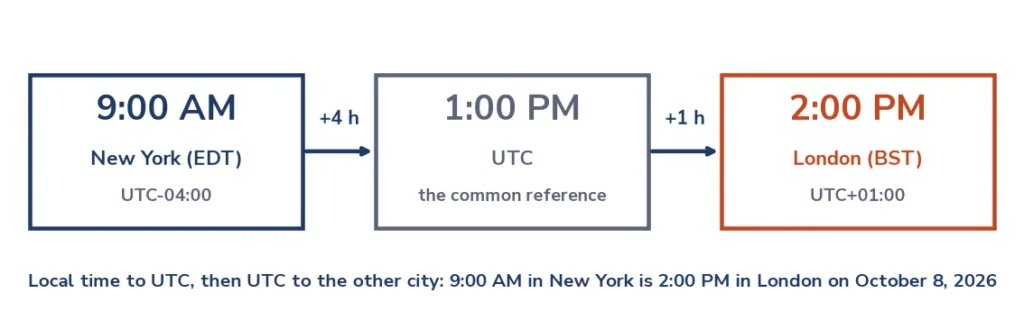
Quick answer: To convert a time, subtract the first city’s UTC offset to get UTC, then add the second city’s UTC offset. Example: 9:00 AM in New York (UTC-4 in October) is 1:00 PM UTC, which is 2:00 PM in London (UTC+1) on October 8, 2026.
How to use the time zone converter
- Pick the date. The date matters because daylight saving time starts and ends on different days in different countries.
- Type the time in the first city (9:00 AM, 14:30, 6pm or noon all work).
- Choose the From and To cities from the list of 60. The answer appears at once.
- Choose a third and fourth city to fill the meeting planner table, and read the Overlap line for a good time.
- Use Copy result to share the converted time or Copy link to share the whole setup.
| You see | What it means |
|---|---|
| Big answer | The time and date in the second city, with +1 or -1 if the day changes |
| Both cities | The local time, the abbreviation (such as EDT) and the UTC offset on that date |
| Time difference | How many hours one city is ahead of or behind the other on that date |
| Meeting planner table | Each hour of the day in the first city, with the matching local times in the other three |
| Overlap | The hours when all four cities are between 8 AM and 6 PM |
How a time zone converter works: UTC offset arithmetic
Every time zone is defined by its UTC offset: the number of hours and minutes it differs from Coordinated Universal Time. New York is UTC-5 in winter and UTC-4 in summer. London is UTC+0 in winter and UTC+1 in summer. Mumbai and Delhi are UTC+5:30 all year. To convert, the time zone converter makes two moves.
Move one: local time – offset = UTC. Move two: UTC + offset of the other city = local time there. The offsets come from the time zone database that is built into your browser (the IANA database), so they already include every daylight saving rule for the date you chose, including past and future years.
Worked example 1: New York to London on October 8, 2026
New York is on daylight time (UTC-4), so 9:00 AM becomes 1:00 PM UTC. London is on British Summer Time (UTC+1), so 1:00 PM UTC becomes 2:00 PM. The gap is 5 hours.
Worked example 2: a time that lands on the next day
At 3:00 PM in London on October 8, 2026 the time in Sydney is 1:00 AM (+1). London is UTC+1 and Sydney has been on daylight time since October 4 (UTC+11), a gap of 10 hours, so 3:00 PM plus 10 hours is 1:00 AM on October 9. The converter shows +1 for the next day.
Worked example 3: India to New York
6:30 PM in Mumbai or Delhi (UTC+5:30) is 1:00 PM UTC, which is 9:00 AM in New York (UTC-4) on the same date. Half-hour zones such as India, Newfoundland and Adelaide are the reason to use a tool instead of a rule of thumb.
Time difference between New York and London
The time difference between New York and London is 5 hours for most of the year, with London ahead. For two short periods it is 4 hours, because the US and the UK change their clocks on different dates. In 2026 the United States moved clocks on March 8 and the UK on March 29, so for three weeks a 9:00 AM meeting in New York was 1:00 PM in London, not 2:00 PM. The same happens between October 25 and October 31.
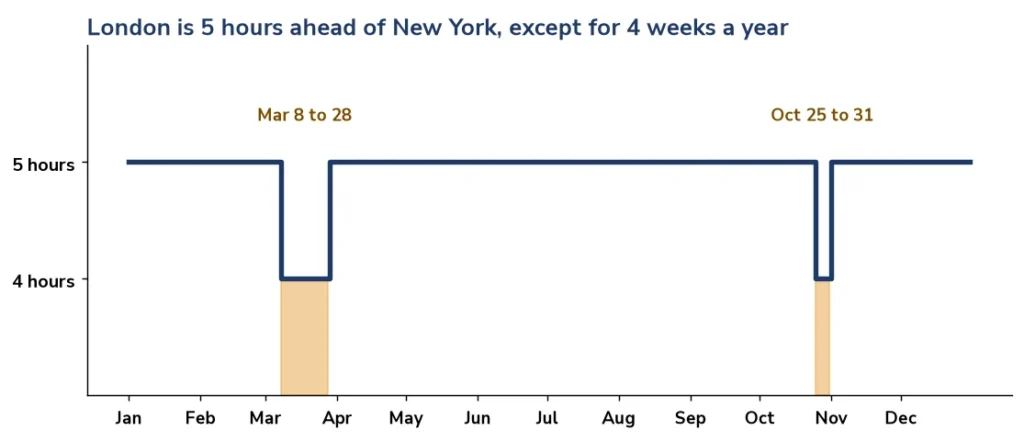
In 2026, 9:00 AM in New York on March 2 is 2:00 PM in London, but on March 15 it is 1:00 PM. The table lists these mismatch weeks for 2026 and 2027.
| Year | US on daylight time, UK not yet (4 hour gap) | UK back to GMT, US not yet (4 hour gap) |
|---|---|---|
| 2026 | Mar 8 to Mar 28 | Oct 25 to Oct 31 |
| 2027 | Mar 14 to Mar 27 | Oct 31 to Nov 6 |
Daylight saving time by region
Daylight saving time (DST) moves clocks forward in spring and back in autumn. The rules are set by each country or region, so a time zone converter must apply them by date. These are the main ones as of October 2026; check an official source for decisions that matter.
United States
US law starts daylight saving time at 2:00 a.m. on the second Sunday of March and ends it at 2:00 a.m. on the first Sunday of November (15 U.S.C. 260a). In 2026 that is March 8 to November 1. Hawaii and most of Arizona do not observe it, nor do Puerto Rico and the other US territories, according to NIST. Congress has not enacted a law to make daylight time permanent.
Canada
Provinces and territories set their own time. Where daylight saving time is observed, the dates match the US. Saskatchewan stays on one time year-round. British Columbia made its March 8, 2026 change its last: from November 1, 2026 it stays on UTC-7 (Pacific time) permanently, the provincial government says. Alberta also adopted permanent Alberta Time (UTC-6) from November 2026. Other provinces may follow, so check yours.
If your device or browser is out of date, it may still show the old rule for these provinces until the time zone data is updated.
United Kingdom and Europe
In the UK the clocks go forward at 1 a.m. on the last Sunday in March and back at 2 a.m. on the last Sunday in October (GOV.UK). EU countries change at the same moment, 01:00 UTC, on those two Sundays, under an EU directive. In 2026 that is March 29 and October 25. Proposals to end the twice-yearly change in the EU have not been adopted.
Australia and New Zealand
New South Wales, Victoria, Tasmania, the ACT and South Australia start daylight saving time on the first Sunday in October and end it on the first Sunday in April. Queensland, Western Australia and the Northern Territory do not observe it. New Zealand runs from the last Sunday in September to the first Sunday in April. In the southern hemisphere, daylight time is in effect from October to April, so offsets are higher in January than in July.
| Region | Daylight time starting in 2026 | Daylight time starting in 2027 | Clocks change at |
|---|---|---|---|
| United States | Mar 8, 2026 to Nov 1, 2026 | Mar 14, 2027 to Nov 7, 2027 | 2:00 a.m. local time |
| UK and EU | Mar 29, 2026 to Oct 25, 2026 | Mar 28, 2027 to Oct 31, 2027 | 1:00 UTC |
| Australia (NSW, Vic, SA, Tas, ACT) | Oct 4, 2026 to Apr 4, 2027 | Oct 3, 2027 to Apr 2, 2028 | 2:00 a.m. standard time |
| New Zealand | Sep 27, 2026 to Apr 4, 2027 | Sep 26, 2027 to Apr 2, 2028 | 2:00 a.m. standard time |
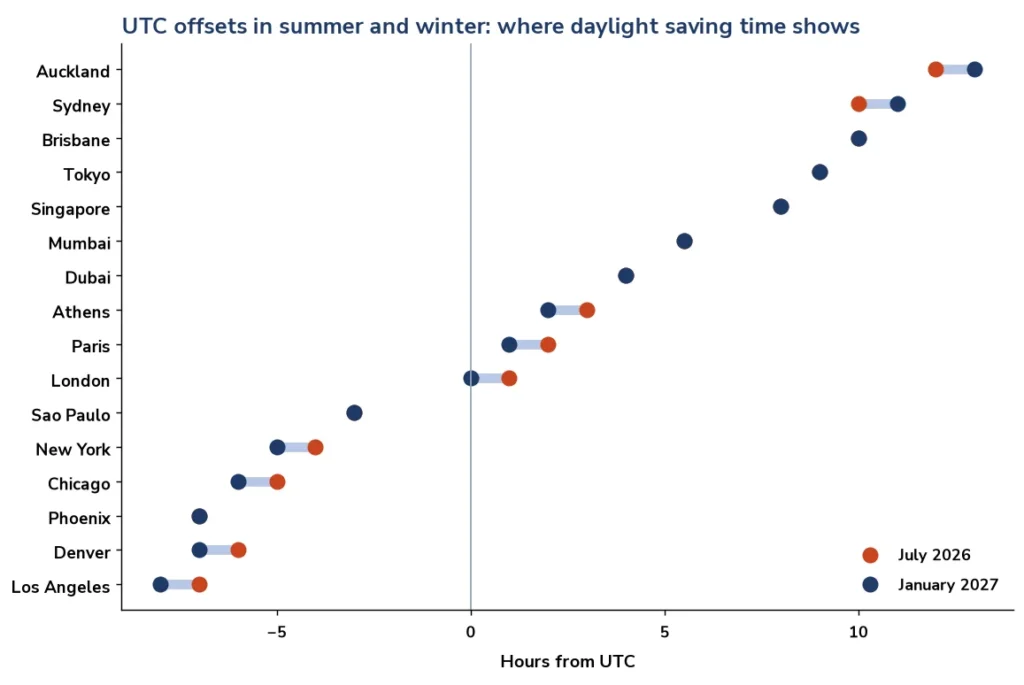
Countries such as India, Japan and China do not use daylight saving time, and Brazil stopped in 2019 and most of Mexico has stopped too, according to Wikipedia. Their offsets never change, which is why they appear as single dots in the chart.
UTC offset and time zone abbreviations
An abbreviation is not a safe way to name a time zone. The letters EST, PST and IST are shorthand that people use, and the same letters can mean different things. The converter shows the abbreviation next to the numeric UTC offset, which is unambiguous. Time zone abbreviations that people search for most are listed here.
| Abbreviation | Meaning | UTC offset |
|---|---|---|
| EST / EDT | US Eastern Standard / Daylight Time | UTC-5 / UTC-4 |
| CST / CDT | US Central Standard / Daylight Time | UTC-6 / UTC-5 |
| MST / MDT | US Mountain Standard / Daylight Time | UTC-7 / UTC-6 |
| PST / PDT | US Pacific Standard / Daylight Time | UTC-8 / UTC-7 |
| GMT / BST | Greenwich Mean Time / British Summer Time | UTC+0 / UTC+1 |
| CET / CEST | Central European (Summer) Time | UTC+1 / UTC+2 |
| IST | India Standard Time (also Irish and Israel Standard/Summer Time) | UTC+5:30 (India) |
| JST | Japan Standard Time | UTC+9 |
| AEST / AEDT | Australian Eastern Standard / Daylight Time | UTC+10 / UTC+11 |
EST to PST: the most common conversion
EST to PST is a 3 hour difference: Pacific time is 3 hours behind Eastern time. So 2:30 PM in New York is 11:30 AM in Los Angeles. The gap stays 3 hours all year because both zones change their clocks on the same days. To convert PST to EST, add 3 hours. For CST to EST add 1 hour, and for MST to EST add 2 hours.
Time zone converter meeting planner
The time zone converter meeting planner lists each hour of the first city’s day with the matching time in three other cities. Rows that are inside 8 AM to 6 PM everywhere are marked, and the overlap line gives the window. For New York, London, Dubai and Los Angeles on October 8, 2026 the answer is none; for London, Mumbai, Dubai and New York the overlap is 1:00 PM to 2:00 PM.
The table shows how many hours two cities share on a typical day in July and in January, using the same 8 AM to 6 PM rule. Use it to see which pairs are easy to schedule.
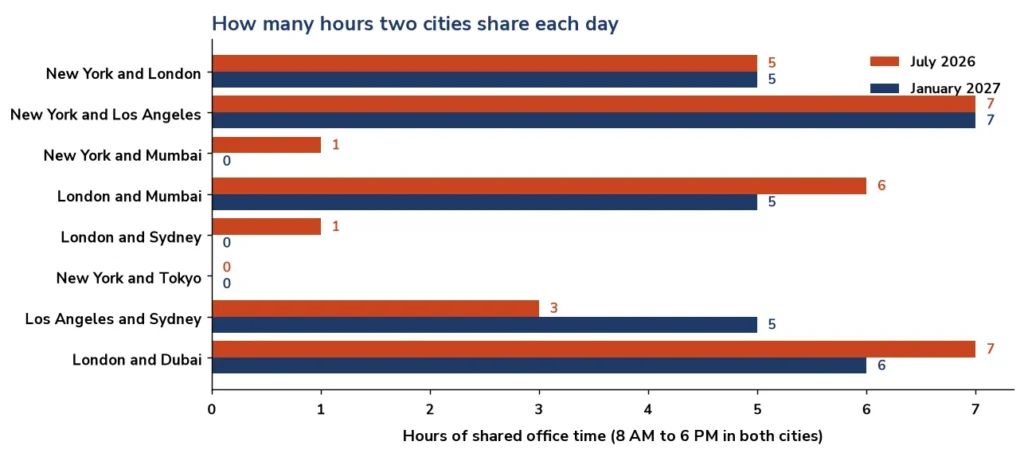
| City pair | July 15, 2026 (window in first city time) | January 15, 2027 (window in first city time) |
|---|---|---|
| New York and London | 8:00 AM to 1:00 PM (5 h) | 8:00 AM to 1:00 PM (5 h) |
| New York and Los Angeles | 11:00 AM to 6:00 PM (7 h) | 11:00 AM to 6:00 PM (7 h) |
| New York and Mumbai | 8:00 AM to 9:00 AM (1 h) | None |
| London and Mumbai | 8:00 AM to 2:00 PM (6 h) | 8:00 AM to 1:00 PM (5 h) |
| London and Sydney | 8:00 AM to 9:00 AM (1 h) | None |
| New York and Tokyo | None | None |
| Los Angeles and Sydney | 3:00 PM to 6:00 PM (3 h) | 1:00 PM to 6:00 PM (5 h) |
| London and Dubai | 8:00 AM to 3:00 PM (7 h) | 8:00 AM to 2:00 PM (6 h) |
Tips for scheduling across time zones
- Rotate unfriendly times so one city does not always take the early or late slot.
- Write the time with the zone and the UTC offset in the invitation, for example 14:00 UTC.
- Check the date, not just the hour: Sydney and Tokyo are often a day ahead of New York.
- Look at mismatch weeks in March, October and November, when a regular meeting can move by an hour.
- Use Copy link to send the exact conversion to your team.
DST changes: skipped and repeated times
Two clock times each year are special. When clocks go forward, an hour does not exist: 2:30 AM on March 8, 2026 never happened in New York, because 2:00 AM jumped to 3:00 AM. The converter tells you and moves the time forward to 3:30 AM EDT, which is 7:30 AM in London.
When clocks go back, an hour happens twice: 1:30 AM on November 1, 2026 occurs once in daylight time and once in standard time. The converter uses the first one and says so. If you need the second, convert an hour later.
Frequently asked questions
10 quick answers
How does a time zone converter work?
It subtracts the first city’s UTC offset to get UTC, then adds the second city’s offset. Our time zone converter takes the offsets from the time zone database in your browser, so daylight saving time is applied for the date you choose.
What is the time difference between New York and London?
London is 5 hours ahead of New York for most of the year. It is 4 hours ahead for two to three weeks in March and one week in late October, when the US and UK change clocks on different dates.
How do I convert EST to PST?
Subtract 3 hours: 12:00 PM EST is 9:00 AM PST. The same 3 hour gap applies to EDT and PDT, because both zones change on the same dates.
What time is 9 AM New York in India?
In October, when New York is on daylight time, 9:00 AM New York is 6:30 PM in India. In winter, with New York on standard time, 9:00 AM is 7:30 PM. India has no daylight saving time.
What does UTC offset mean?
A UTC offset is how far a time zone is ahead of or behind Coordinated Universal Time, written like UTC-5 or UTC+5:30. Add the offset to UTC to get the local time.
Does the converter handle daylight saving time?
Yes. It uses the full time zone database for the date you pick, so a time in July uses summer offsets and a time in January uses winter offsets, including past and future years.
Why is IST confusing?
IST can mean India Standard Time (UTC+5:30), Irish Summer Time (UTC+1) or Israel Standard Time (UTC+2). Use the city name or the UTC offset to avoid mistakes.
How do I find a meeting time for four cities?
Choose the first two cities, then pick a third and a fourth in the meeting planner boxes. The table marks every hour that falls between 8 AM and 6 PM in all four places.
What happens to a time that does not exist?
On the spring clock change, the skipped hour is moved forward. For example 2:30 AM on March 8, 2026 in New York becomes 3:30 AM, and the converter shows a note.
Which countries do not use daylight saving time?
Many do not, including India, Japan and China, and Hawaii and most of Arizona in the US. Brazil ended it in 2019. British Columbia and Alberta in Canada are moving to permanent time from November 2026.
Related calculators and printables
- Time calculator to add and subtract hours and minutes.
- Work hours calculator for shifts, breaks and pay.
- Date calculator to add or subtract days from a date.
- Days until calculator for countdowns to holidays and events.
- Printable calendars for scheduling meetings and trips.
- All calculators
Sources and further reading
- 15 U.S.C. 260a: daylight saving time (US law) for the US start and end dates.
- GOV.UK: when do the clocks change for UK dates and times.
- IANA time zone database for the data browsers use, and NIST: daylight saving time.
- Government of British Columbia: end of time changes and Alberta Time.
Last updated: October 2026.