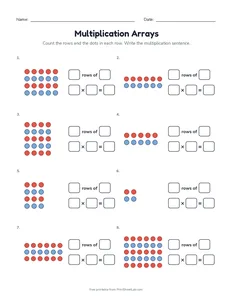
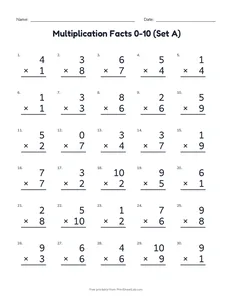
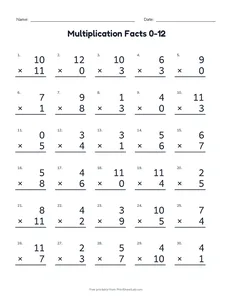
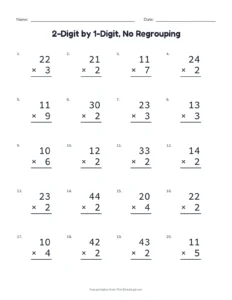
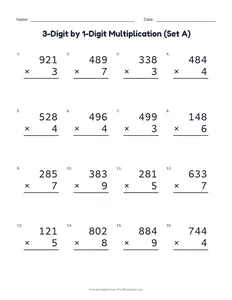
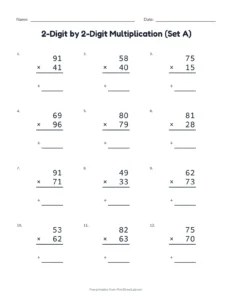
Print free multiplication worksheets with answer keys: times tables facts, 2-digit by 1-digit, 2-digit by 2-digit and multi-digit multiplication. Choose a times table to focus on, the number of digits, vertical or horizontal problems, missing factors and 10 to 100 problems per page, then download a PDF for US Letter or A4.
Printable multiplication worksheets to print (PDF)
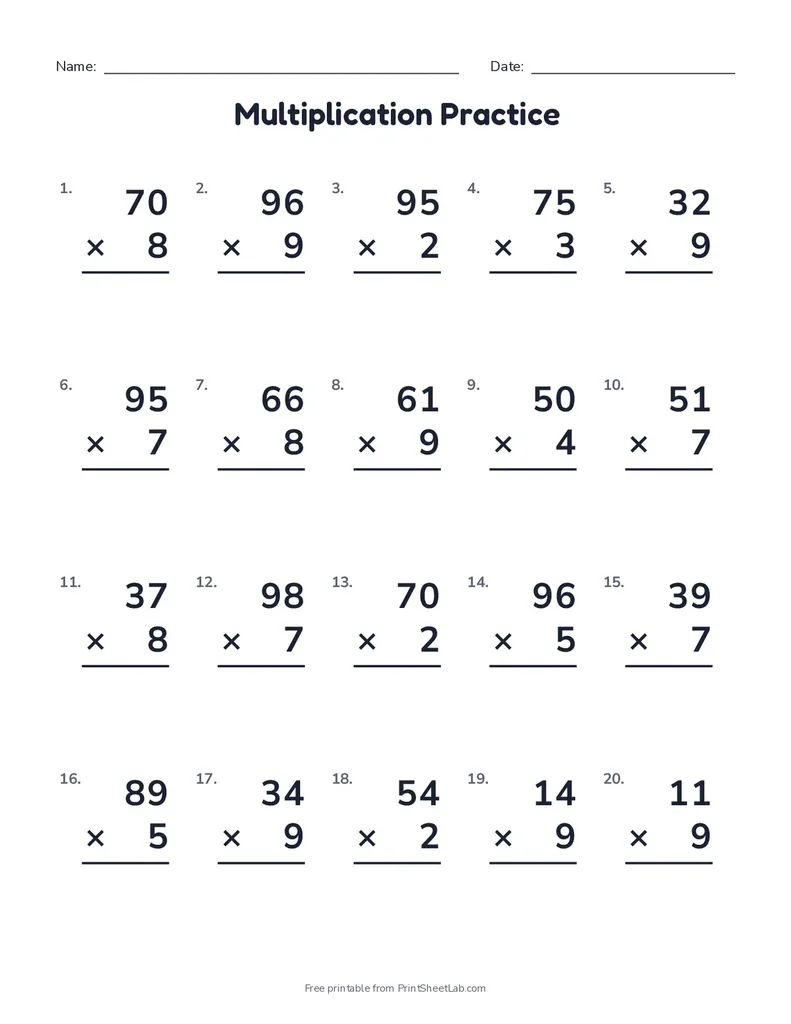
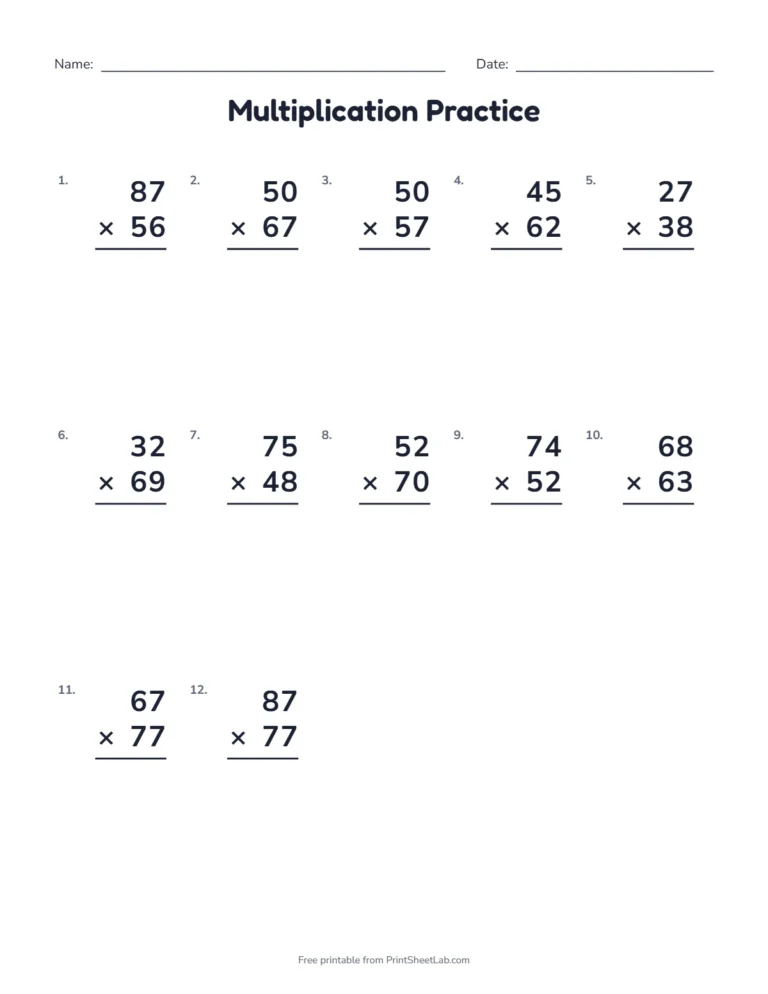
These printable multiplication worksheets show what the generator prints: 2-digit by 2-digit multiplication, a timed drill of 40 mixed facts, a missing factor page for the 7 times table, and the answer key. Click a picture for the PDF, or use the generator above to choose the table, the digits and the layout.
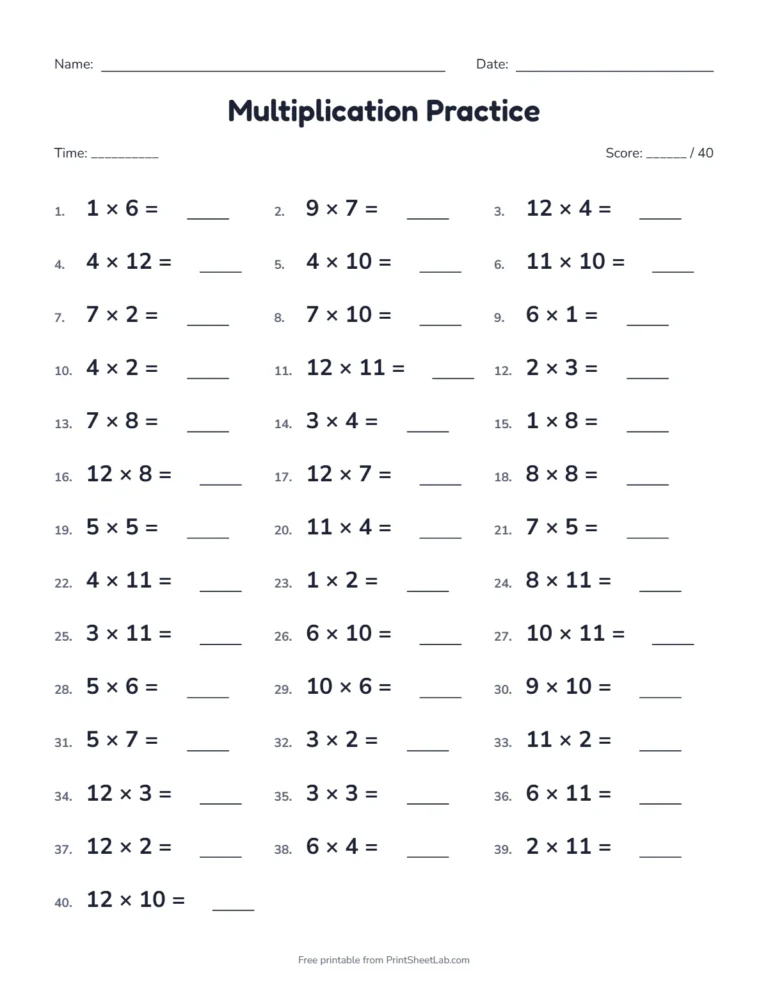
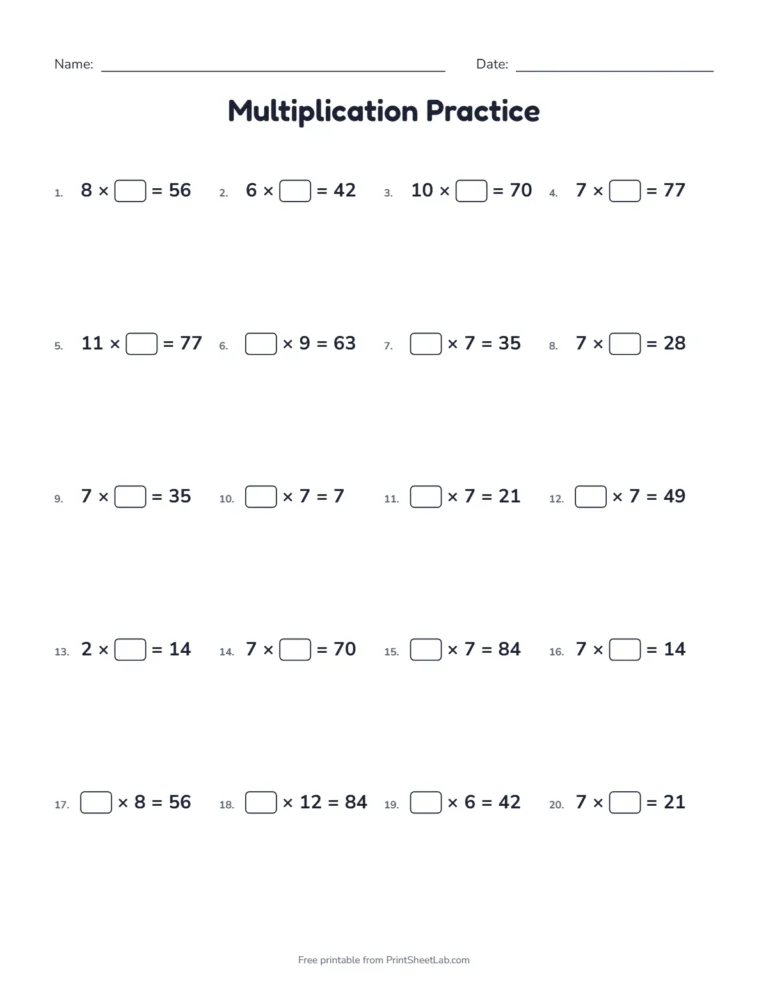
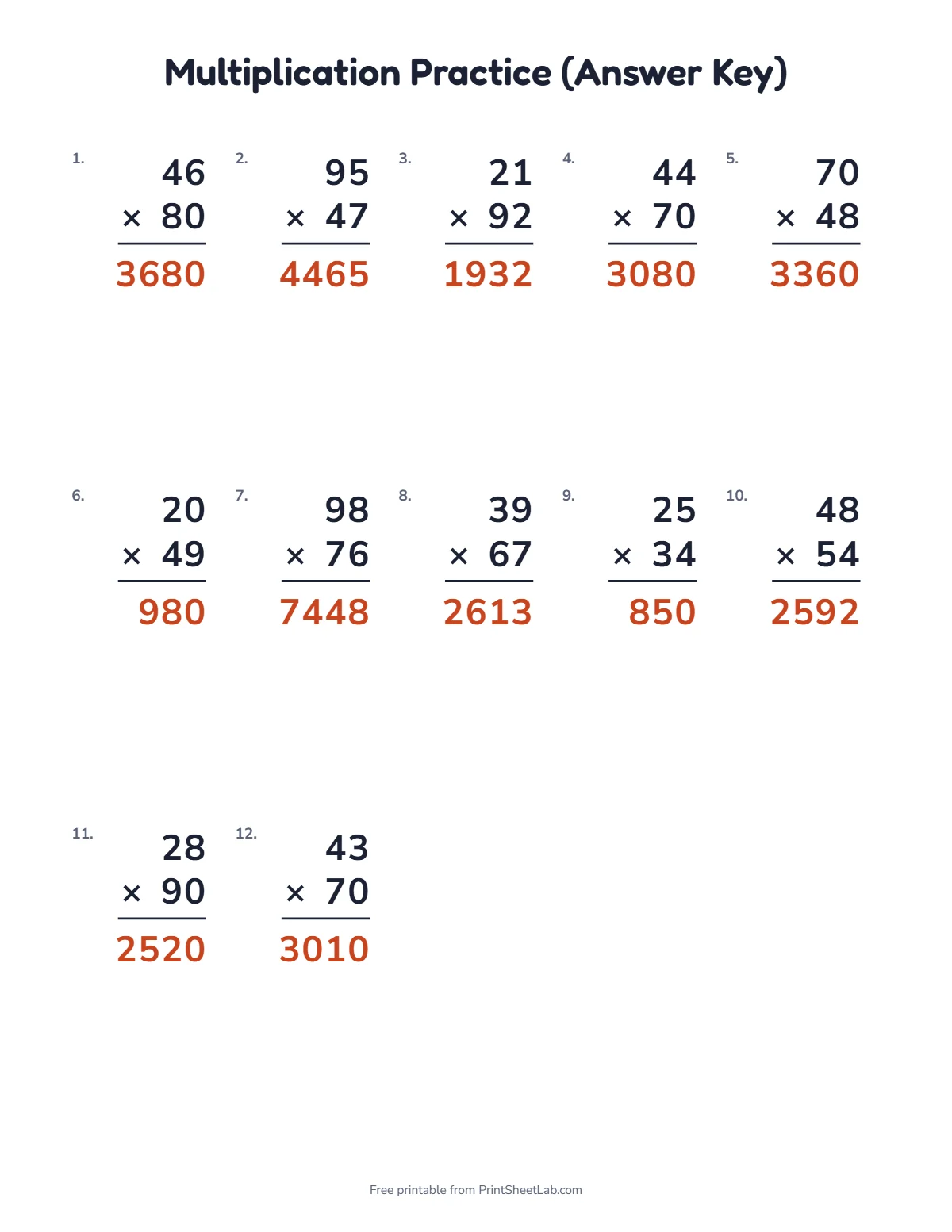
Keep a printable multiplication chart beside these worksheets while the facts are still new.
Multiplication worksheets by grade
| Grade | What children practice | Settings to use |
|---|---|---|
| Grade 2 | Equal groups and repeated addition, doubles, 2s, 5s and 10s | 2 times table, 5 times table |
| Grade 3 | All products of two one-digit numbers from memory; multiplying by multiples of 10 | Mixed facts drill |
| Grade 4 | Up to 4-digit by 1-digit, and 2-digit by 2-digit | 3-digit by 1-digit, 2-digit by 2-digit |
| Grade 5 | Multi-digit multiplication with the standard algorithm | 3-digit by 2-digit |
Grades follow the Common Core math standards: 3.OA.C.7 (know all products of two one-digit numbers from memory by the end of grade 3), 3.NBT.A.3 (multiply by multiples of 10), 4.NBT.B.5 (up to four digits by one digit, and two two-digit numbers) and 5.NBT.B.5 (the standard algorithm).
How to multiply a 2-digit number by a 2-digit number
Take 23 × 14:
- Multiply by the ones digit: 23 × 4 = 92. Write it on the first line.
- Multiply by the tens digit: 23 × 1 ten = 230. Write it on the second line (the 0 holds the ones place).
- Add the two lines: 92 + 230 = 322.
The generator leaves extra space under multi-digit problems for these working lines.
Types of multiplication worksheets you can print
- Single times table: practice one table from 2 to 12, with facts starting at 0, 1 or 2.
- Mixed facts drill: facts from 2 to 12 with time and score boxes. See the times tables worksheets page for drills.
- 2-digit by 1-digit and 3-digit by 1-digit column multiplication.
- 2-digit by 2-digit and 3-digit by 2-digit long multiplication.
- Missing factor (7 × ☐ = 56), which is the start of division.
- Mixed multiplication and division on one page.
Multiplication facts worksheets: 66 facts to learn
The multiplication facts from 2 × 2 to 12 × 12 look like 121 separate facts, but the turn-around rule (3 × 8 = 8 × 3) halves the work. Only 66 facts are new, because each times table includes facts from the tables before it. The 2s table has 11 new facts, and every table after it has one fewer, down to a single new fact, 12 × 12, in the 12s. This table shows how it adds up:
| Times table | New facts to learn | Facts already known from smaller tables | The new facts |
|---|---|---|---|
| 2 | 11 | 0 | 2 × 2 = 4 up to 2 × 12 = 24 |
| 3 | 10 | 1 | 3 × 3 = 9 up to 3 × 12 = 36 |
| 4 | 9 | 2 | 4 × 4 = 16 up to 4 × 12 = 48 |
| 5 | 8 | 3 | 5 × 5 = 25 up to 5 × 12 = 60 |
| 6 | 7 | 4 | 6 × 6 = 36 up to 6 × 12 = 72 |
| 7 | 6 | 5 | 7 × 7 = 49 up to 7 × 12 = 84 |
| 8 | 5 | 6 | 8 × 8 = 64 up to 8 × 12 = 96 |
| 9 | 4 | 7 | 9 × 9 = 81 up to 9 × 12 = 108 |
| 10 | 3 | 8 | 10 × 10 = 100 up to 10 × 12 = 120 |
| 11 | 2 | 9 | 11 × 11 = 121 up to 11 × 12 = 132 |
| 12 | 1 | 10 | 12 × 12 = 144 only |
That makes the order of learning important when you plan multiplication worksheets. By the time a child reaches the 7s and 8s, most of their facts have been met in earlier tables, and only 7 × 7, 7 × 8, 8 × 8 and a few more remain. For a chart that shows every product at once, print the multiplication chart. Wikipedia’s multiplication table article explains the layout.
2 digit by 2 digit multiplication worksheets: how big is the answer?
The size of the numbers decides the size of the product. This table is counted from every possible problem that the generator can make, so you know what to expect before you print:
| Type | Possible problems | Digits in the product |
|---|---|---|
| 2-digit × 1-digit | 720 | 15% of 2 digits, 85% of 3 digits |
| 3-digit × 1-digit | 7,200 | 14% of 3 digits, 86% of 4 digits |
| 2-digit × 2-digit | 8,100 | 18% of 3 digits, 82% of 4 digits |
| 3-digit × 2-digit | 81,000 | 18% of 4 digits, 82% of 5 digits |
For example, 47 × 36 gives two partial products: 47 × 6 = 282 and 47 × 30 = 1,410, which add up to 1,692. Because most products of two 2-digit numbers have four digits, children need space for the two working lines and the sum, and the generator leaves that space under each problem on the 2-digit by 2-digit worksheets.
Printable multiplication worksheets: a six-week plan for the tables
Printable multiplication worksheets work best in short daily sessions. This plan teaches the tables in an order that uses each new table to support the next, with one page a day:
| Weeks | Tables to learn | Why this order |
|---|---|---|
| 1 | 2, 5 and 10 | Counting by 2, 5 and 10 is already familiar |
| 2 | 3 and 4 | Doubling the 2s gives the 4s |
| 3 | 6 and 9 | The 9s have a finger trick, and the 6s build on the 3s |
| 4 | 7 and 8 | The hardest tables, with most of the facts known by now |
| 5 | 11 and 12 | Patterns for 11, and 12 is 10 plus 2 |
| 6 | Mixed review | Timed drills for every table |
Print a timed drill from these multiplication worksheets at the end of each week, and let the child try to beat last week’s score. Progress is more motivating than comparison with other children.
Multiplication worksheets with answers: how the key works
Every PDF of multiplication worksheets ends with an answer key page. On a worksheet with 20 problems, the key shows the same problems with the answers in a color, so a child can check the work in a minute. Turn the key off if you want to give a test, and turn it on for homework. You can also print up to five versions with different problems and the same settings, which helps when two children sit next to each other.
Tips for teaching multiplication
- Show multiplication as equal groups and arrays before memorizing facts.
- Learn the easy tables first (2, 5, 10), then 3, 4 and 6, then 7, 8, 9, 11 and 12.
- Use the turn-around rule: 3 × 8 is the same as 8 × 3, so every fact learned counts twice.
- For long multiplication, remind children to put a 0 in the ones place on the second line.
- Estimate first (23 × 14 is about 20 × 15 = 300) to catch big mistakes.
Common multiplication mistakes
- Forgetting the placeholder zero on the second line of long multiplication, which makes the answer ten times too small.
- Adding the carried digit before multiplying: multiply first, then add what you carried.
- Mixing up close facts such as 6 × 8 and 7 × 8. Short daily practice with these multiplication worksheets helps them stick.
- Not estimating: a quick estimate catches answers that are far too big or too small.
Practice it as a game
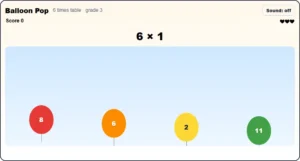
Free online games for the same skill: balloon pop, memory match, races and more. No sign-up.
Frequently asked questions
5 quick answers
Are these multiplication worksheets free?
Yes, with answer keys, no sign-up and no watermark.
Can I make worksheets for just one times table?
Yes. Choose a times table from 2 to 12 under “Times table focus”. Every problem then uses that table.
What multiplication do 3rd graders need to know?
By the end of grade 3, children are expected to know all products of two one-digit numbers from memory and to multiply one-digit numbers by multiples of 10.
Can I make 2-digit by 2-digit multiplication worksheets?
Yes. Choose 2 digits for both numbers, or 3 and 2 digits for harder problems.
Do the worksheets have answers?
Yes. Answer key pages come after the worksheets.