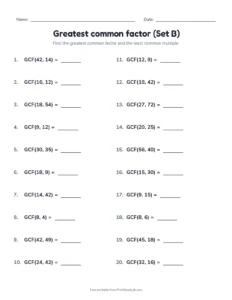
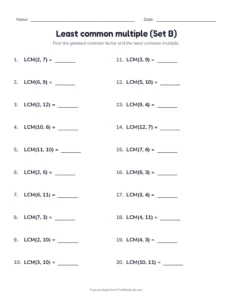
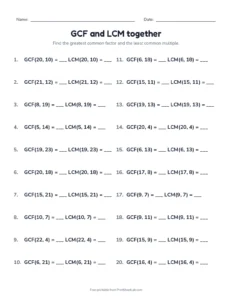
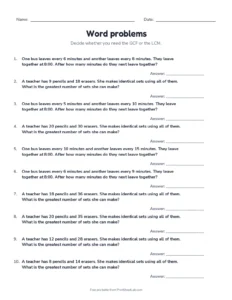
GCF and LCM worksheets teach students to find the greatest common factor and the least common multiple of two numbers, skills needed for simplifying fractions and adding fractions with unlike denominators. These free printable GCF and LCM worksheets cover factors, GCF, LCM, prime factorization and word problems, with an answer key on every PDF and a maker for new problems.
Quick answer: The GCF (greatest common factor) is the largest number that divides two numbers evenly, and the LCM (least common multiple) is the smallest number both divide into. For 12 and 18, the GCF is 6 and the LCM is 36. This page has 8 free GCF and LCM worksheets (PDF) with answer keys for grades 4 to 6, plus a maker. Updated October 2026.
Ready-to-print samples
A few of the ready PDFs on this page. The full list is under Ready-to-print worksheets, and the maker above makes new problems on demand.
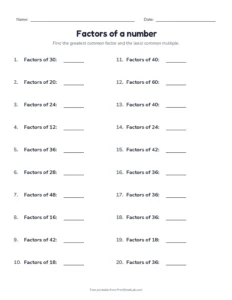
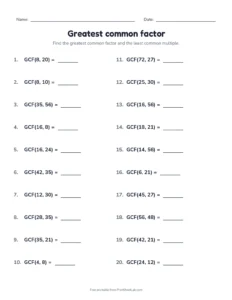
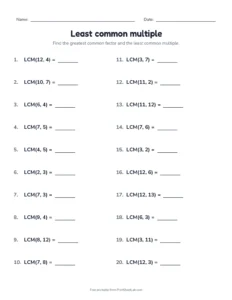
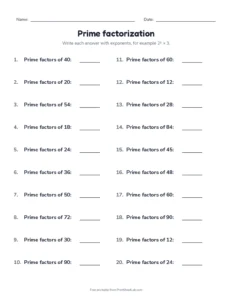
Factors of a numberLevel 1 with a full answer key.PDFGreatest common factorLevel 2 with a full answer key.PDFLeast common multipleLevel 3 with a full answer key.PDFPrime factorizationLevel 5 with a full answer key.PDF
How to find the GCF and LCM
List the factors of each number, or write the prime factorization.
GCF: pick the largest factor that appears in both lists, or multiply the shared prime factors.
LCM: list multiples of each number until the first match, or multiply every prime factor the greatest number of times it appears.
GCF and LCM worksheet: six worked examples
Each row shows the prime factors, the GCF and the LCM. Notice that GCF × LCM always equals the product of the two numbers, which is a handy way to check:
Numbers
Prime factors
GCF
LCM
GCF × LCM
12 and 18
22 × 3; 2 × 32
6
36
216
24 and 36
23 × 3; 22 × 32
12
72
864
15 and 25
3 × 5; 52
5
75
375
16 and 40
24; 23 × 5
8
80
640
18 and 45
2 × 32; 32 × 5
9
90
810
28 and 42
22 × 7; 2 × 3 × 7
14
84
1176
Factors and multiples worksheet: what is the difference?
Factors divide a number evenly, so they are never larger than the number. Multiples are what you get by multiplying, so they are never smaller. These tables show both:
Number
All factors
Prime?
12
1, 2, 3, 4, 6, 12
No
17
1, 17
Yes
24
1, 2, 3, 4, 6, 8, 12, 24
No
30
1, 2, 3, 5, 6, 10, 15, 30
No
36
1, 2, 3, 4, 6, 9, 12, 18, 36
No
49
1, 7, 49
No
Number
First six multiples
4
4, 8, 12, 16, 20, 24
6
6, 12, 18, 24, 30, 36
8
8, 16, 24, 32, 40, 48
9
9, 18, 27, 36, 45, 54
12
12, 24, 36, 48, 60, 72
Prime factorization worksheet: factor trees
Break a number into prime factors with a factor tree. Prime factorization is the quickest route to both the GCF and the LCM of larger numbers:
Number
Factor tree
Prime factorization
60
2 × 2 × 3 × 5
22 × 3 × 5
72
2 × 2 × 2 × 3 × 3
23 × 32
84
2 × 2 × 3 × 7
22 × 3 × 7
90
2 × 3 × 3 × 5
2 × 32 × 5
100
2 × 2 × 5 × 5
22 × 52
126
2 × 3 × 3 × 7
2 × 32 × 7
Try ten GCF and LCM problems
Use these as a warm-up. List factors or multiples on scratch paper if you need to.
#
Problem
Answer
1
GCF of 18 and 24
6
2
GCF of 28 and 42
14
3
GCF of 15 and 40
5
4
LCM of 6 and 8
24
5
LCM of 9 and 12
36
6
LCM of 5 and 7
35
7
Prime factorization of 48
24 × 3
8
Prime factorization of 90
2 × 32 × 5
9
Two buses leave together and return every 12 and 15 minutes. When are they together again?
60 minutes
10
Cut ribbons of 24 in and 36 in into equal pieces as long as possible
12 in pieces
GCF worksheet, greatest common factor worksheet and least common multiple worksheet
A GCF worksheet asks for the largest number that divides two or more numbers, so the answer is never larger than the smaller number. A greatest common factor worksheet usually starts with short lists of factors, then moves to prime factorization for larger numbers. A least common multiple worksheet works the other way: the answer is never smaller than the larger number, and it is found by listing multiples or combining prime factors.
An LCM worksheet and a GCF worksheet are often set together, because students mix the two up. The GCF and LCM worksheets on this page keep them apart at first and mix them at level 4, so students learn to decide which one a problem needs.
GCF and LCM word problems
GCF and LCM word problems hide the skill inside a story. If the problem asks for the largest equal groups or pieces, use the GCF. If it asks when two repeating events happen together again, use the LCM:
Word problem
Skill needed
Work
Answer
A baker has 48 muffins and 72 cookies and makes identical boxes using all of them. How many boxes at most?
GCF
GCF of 48 and 72
24 boxes
One bell rings every 9 minutes and another every 12 minutes. When do they ring together?
LCM
LCM of 9 and 12
Every 36 minutes
Two ropes of 30 m and 45 m are cut into equal pieces, as long as possible. How long is each piece?
GCF
GCF of 30 and 45
15 m
Two runners lap a track in 5 and 7 minutes. When do they meet at the start?
LCM
LCM of 5 and 7
After 35 minutes
How to use these GCF and LCM worksheets
Use the GCF and LCM worksheets in order. Start with the factors sheet, then move to the greatest common factor, the least common multiple and prime factorization. Every one of the GCF and LCM worksheets has an answer key on the last page, so students can check their own work, and one short session is a good source of quick retests.
Once the methods are secure, finish with the word problem sheet. Print a GCF and LCM worksheet for homework and review it together the next day. Students who need more GCF and LCM worksheets can generate a new set in the maker, and GCF and LCM worksheets with fresh numbers make a reliable weekly check.
GCF and LCM vocabulary
Students answer questions faster when they know the words. These are the terms used on the worksheets and answer keys:
Find all factor pairs for a number from 1 to 100; recognize multiples and prime numbers
Grade 6
6.NS.B.4
Find the greatest common factor and the least common multiple of two whole numbers, and use the distributive property
Common mistakes with GCF and LCM
Mistake
Example
Fix
Mixing up GCF and LCM
Finding 36 when asked for the GCF of 12 and 18
The GCF is the largest number that divides both: 6. The LCM is 36
Stopping at a common factor
Taking 3 as the GCF of 12 and 18
Check for larger common factors: 6 divides both
Using the product as the LCM
LCM of 6 and 8 = 48
List multiples: 24 is the first common one
Calling 1 a prime number
Prime factors of 12 include 1
A prime has exactly two factors; 1 is not prime
Missing repeated primes
72 = 2 × 3 × 4
Break down fully: 72 = 23 × 32
Real-life uses of GCF and LCM
The GCF answers “what is the biggest group size”, and the LCM answers “when do things line up”:
Situation
Skill
Answer
Pack 24 pencils and 36 erasers into identical kits, using all of each
GCF of 24 and 36
12 kits
Two lights blink every 6 and 8 seconds. When do they blink together?
LCM of 6 and 8
24 seconds
Cut a 40 in board and a 56 in board into equal pieces, as long as possible
GCF of 40 and 56
8 in pieces
Buses leave every 15 and 20 minutes from 8:00. Next time together?
LCM of 15 and 20
9:00
Add 1/6 and 1/4
LCM of 6 and 4
Common denominator 12
Which GCF and LCM worksheet should you start with?
Start with factors, then GCF and LCM one at a time, and combine them at level 4. Set B gives a retest for levels 2 and 3.
Level
Skill
Best for
Level 1
Factors of a number
Grades 4 and 5
Level 2
Greatest common factor
Grade 6
Level 3
Least common multiple
Grade 6
Level 4
GCF and LCM together
Grade 6
Level 5
Prime factorization
Grades 5 and 6
Level 6
Word problems
Grade 6
A weekly plan for GCF and LCM
Day
Focus
Suggested block
Monday
Factors and primes
15 min
Tuesday
Greatest common factor
15 min
Wednesday
Least common multiple
15 min
Thursday
Prime factorization and word problems
15 min
Weekly total
Four short sessions
60 min
Frequently asked questions
5 quick answers
Where can I download free GCF and LCM worksheets?
Open any worksheet in the Ready-to-print list on this page, choose US Letter or A4, then print or save the PDF. They are free, with answer keys, and no account is needed.
How do you find the GCF?
List the factors of each number and pick the largest one they share, or multiply the prime factors they have in common. The GCF of 24 and 36 is 12.
How do you find the LCM?
List multiples of each number until you find the first match. The LCM of 6 and 8 is 24.
What is the relationship between GCF and LCM?
For two numbers, GCF × LCM = the product of the numbers. For 12 and 18, 6 × 36 = 216 = 12 × 18.
What grade learns GCF and LCM?
Factors and multiples start in grade 4, and the GCF and LCM are grade 6 standards (6.NS.B.4).