Classroom bingo is the review game that students ask for by name. You print a set of cards, call out the clues, and every child leans over a card with a pencil or a bingo chip, listening harder than they ever do for a worksheet. This page gives you 30 free school-themed squares on classroom bingo cards that you can print today, plus a plan for turning the same cards into bingo for the classroom that teaches vocabulary, sight words, math facts and more.
In short: press Edit and print this card in the card maker above to open the full-screen editor with the 30 classroom squares loaded. Replace them with your own words in the Items tab, choose 1 to 100 different cards, and download one PDF. It is free, needs no sign-up, and nothing you type leaves your browser.
Why a classroom bingo game works
A classroom bingo game sits in a useful spot between a worksheet and a party. Students have to listen, hold a word in mind and find it on a card, which is a form of retrieval practice, and they stay quiet enough to hear the next clue.
In classroom bingo every card is a different arrangement of the same list, so nobody can copy a neighbor, and a child who is a little behind still has a real chance of winning. The prep for classroom bingo is also light: one list of words and one print job.
The classroom bingo format works for every grade because the content changes, not the rules. A kindergarten teacher uses pictures and a 3×3 grid, a fifth-grade teacher uses science terms on a 5×5 grid, and a high school teacher plays a blackout round with vocabulary from last week. The sections below show the setup, the card sizes, a computed guide to list sizes and a full table of ideas by subject.
What is on the classroom bingo cards
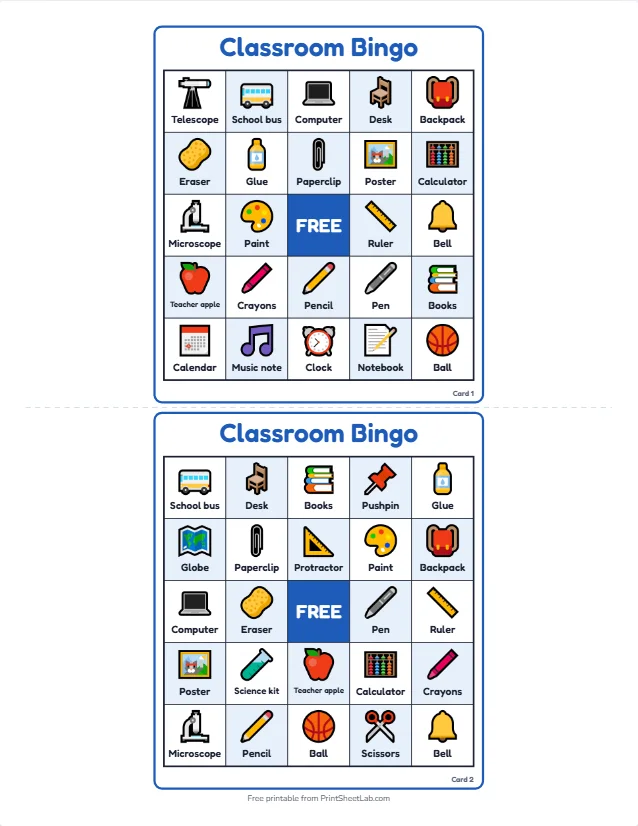
The template above is an icebreaker built from objects you find in school. Students listen for a clue, such as “you write with it” or “it tells you when class is over”, and find the matching square. It uses 30 squares so that a 5×5 card with a free center needs 24 and the rest are shuffled between cards.
| Group | Squares on the list | Example clue |
|---|---|---|
| Writing and art | ✏️ Pencil, 🖊️ Pen, 🖍️ Crayons, 🧽 Eraser, 📝 Notebook, 🎨 Paint | “You can fix a mistake with it.” |
| Math and time | 📏 Ruler, 🧮 Calculator, 📐 Protractor, ⏰ Clock, 📅 Calendar | “It measures angles.” |
| Science and the world | 🧪 Science kit, 🔬 Microscope, 🔭 Telescope, 🗺️ Globe | “You use it to see tiny things.” |
| Supplies and furniture | ✂️ Scissors, 🧴 Glue, 📌 Pushpin, 📎 Paperclip, 🪑 Desk, 🖼️ Poster, 💻 Computer | “It holds papers together.” |
| School day | 🎒 Backpack, 🥪 Lunch box, 🚌 School bus, 🔔 Bell, 🍎 Teacher apple, 📚 Books, 🎵 Music note, 🏀 Ball | “You ride it to school.” |
That classroom bingo list works as a first-week game, as a vocabulary warm-up for English learners, or as the start of a longer unit on classroom manners. When you want a different topic, you only change the squares. The tips for building your own list are in the next sections.
Classroom bingo free printable: set up in five minutes
This classroom bingo free printable is made in the browser, so there is no file to download and edit first. Follow these steps from the card maker above.
- Pick the card size on the Setup tab: 3×3, 4×4 or 5×5 (up to 7×7 for blackout games). See the grade table further down.
- Enter your words on the Items tab. Type one per square, or paste a list. You can add emoji or your own pictures for pre-readers.
- Add more words than squares. A 5×5 card with a free space needs 24, and a list of 30 means different words land on different cards.
- Design it on the Design tab: color theme, font, text size, ALL CAPS, borders, and a title such as “Week 12 Vocabulary Bingo”. You can print each student’s name on their card.
- Print: choose the number of cards (one per student, plus a few spares), 1, 2, 4 or 6 per page, Letter or A4, and turn on the caller sheet and calling cards if you want them. Download the PDF or print directly.
If the same classroom bingo set will be used all year, use the shareable link, which stores the words only, and put it in your lesson plan or class page. Next term you can open the link, change five words, and print again. Nothing is uploaded, so there is nothing to clean up afterward.
Bingo for the classroom: ways to teach with it
Once you have the cards, classroom bingo covers many lessons. These are the formats teachers use most. Each one changes only the list of squares and the clue you read aloud.
Vocabulary bingo
Put 24 or more target words on the card. Read a definition, a sentence with a blank or a synonym, and students mark the word that fits. Because students must match a meaning to a word, it checks understanding rather than recall of a spelling. Use the words from the unit, not random ones, so that every call is also a mini-review.
Sight word bingo
For early readers, fill a 3×3 or 4×4 card with the high-frequency words you are teaching, and call one word at a time. Children match the word they hear to the word they see, which is the core of word recognition. If you need the word lists first, our guide to what sight words are explains the lists and how to teach them, and the sight word worksheets give written practice that matches the cards.
Math facts bingo
Put the answers on the cards and call the problems: “7 times 8” sends children looking for 56. You can use addition facts for grade 1, multiplication facts for grade 3, or square numbers for older students. For skip counting, put multiples on the cards and call the next number in the pattern; the skip counting guide has patterns by step size.
First-day icebreaker
The classroom bingo template on this page is a ready-made version: objects around the room. For a getting-to-know-you version, write squares like “has a pet” and “speaks two languages” and let students walk around finding a different classmate for each square. That turns classroom bingo from listening into a conversation game.
Reading and comprehension
After a story, put characters, settings, and key events on the card. Read a line from the book and students mark who said it or where it happened. A classroom bingo blackout round at the end of the chapter works as a quick exit check: if a student has not marked a square, you know which part to revisit.
Science terms
Use a unit’s vocabulary: “photosynthesis”, “condensation”, “habitat”. Call by describing the process or showing a photo. Pair it with the template’s microscope, telescope and science kit squares for an introduction to lab tools.
Behavior and routines bingo
Make a card of positive behaviors: “pushed in a chair”, “helped a classmate”, “raised a hand”. Students mark a square when they catch themselves, or you mark it when you see it, and a full line earns a class reward. This one is played quietly over a week instead of a single session.
Classroom bingo ideas by subject
Use this table of classroom bingo ideas when you are planning the week. The right-hand column tells you what to read aloud, because that is the part students respond to.
| Subject | Squares contain | You call out | Suggested size |
|---|---|---|---|
| Reading (K-1) | Sight words, letters, CVC words | The word or its first sound | 3×3 |
| Reading (2-5) | Vocabulary words, characters, genres | A definition or a quote | 4×4 or 5×5 |
| Phonics | Words with a vowel team or blend | A picture or the word | 3×3 or 4×4 |
| Math | Answers, multiples, shapes | A problem or a clue | 4×4 or 5×5 |
| Science | Terms, tools, animals, planets | A description or a photo | 5×5 |
| Social studies | States, capitals, people, vocabulary | A clue about the place or person | 5×5 |
| Languages | Words in the target language | The word in English | 4×4 or 5×5 |
| Music and art | Instruments, note names, colors, artists | A sound clip or an image | 3×3 or 4×4 |
| Class community | Positive behaviors, getting to know you | Nothing: students self-mark | 5×5 |
If your class cannot read yet, do not forget picture bingo: our picture bingo for kids pages have ready-made cards of animals, fruit and other topics that need no reading at all. They also work for a substitute who must run a game with no preparation.
How many words per card? Sizes by grade
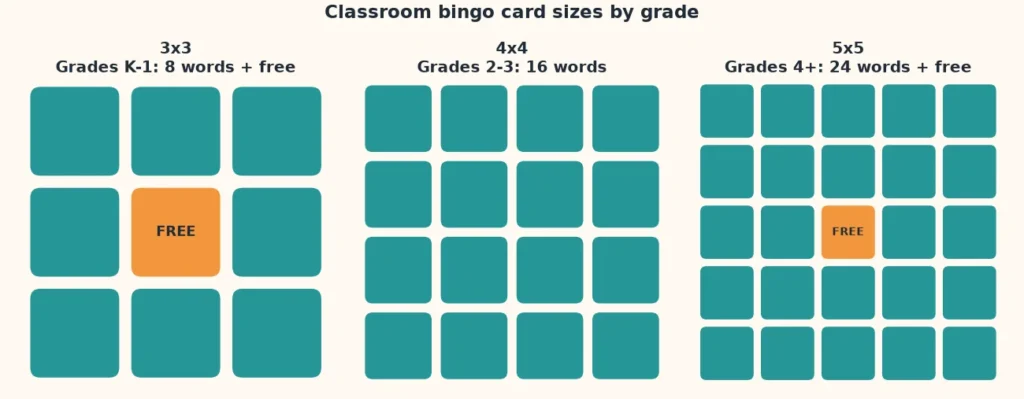
For classroom bingo the card size should match the youngest reader in the group. A 3×3 card has 9 squares, and with a free center it needs only 8 words, which is about right for kindergarten and grade 1. A 4×4 card needs 16 words and is a good fit for grades 2 and 3. From grade 4, a 5×5 card with 24 words and a free square is the standard.
A longer word list than the grid has squares is useful, because every extra word shuffles the cards further apart. The number of different sets of words you can put on a card is the number of ways to choose the words, C(N, k), where N is the size of your list and k is the number of squares.
Each set can then be arranged in many orders, so the real number of distinct cards is far higher than this table shows, which is why a list of 30 words makes plenty of different cards for a class.
| Words on your list (N) | 3×3 with free center: C(N, 8) | 4×4: C(N, 16) | 5×5 with free center: C(N, 24) |
|---|---|---|---|
| 8 | 1 | – | – |
| 10 | 45 | – | – |
| 12 | 495 | – | – |
| 16 | 12,870 | 1 | – |
| 20 | 125,970 | 4,845 | – |
| 24 | 735,471 | 735,471 | 1 |
| 25 | 1.1 x 10⁶ | 2.0 x 10⁶ | 25 |
| 30 | 5.9 x 10⁶ | 1.5 x 10⁸ | 593,775 |
| 36 | 3.0 x 10⁷ | 7.3 x 10⁹ | 1.3 x 10⁹ |
| 40 | 7.7 x 10⁷ | 6.3 x 10¹⁰ | 6.3 x 10¹⁰ |
| 50 | 5.4 x 10⁸ | 4.9 x 10¹² | 1.2 x 10¹⁴ |
Read it like this: with a list of exactly 24 words, a 5×5 card can only hold one set of words, so all cards share the same words and differ only in order.
With 30 words there are 593,775 possible sets, and with 40 words about 6.3 x 10¹⁰. For a class of 30 students, 30 words is the practical minimum for a 5×5 card, and 36 to 40 gives you room to keep the cards varied. For a 3×3 card on a short list, 10 to 12 words is enough: with 12 words there are 495 sets.
How to run a classroom bingo game: the call-out
In classroom bingo, calling is where the teaching happens, so it deserves some thought. These methods all work with the same cards. Pick the one that fits the lesson and the classroom bingo list, and switch partway through to keep the game fresh.
| Method | What you say or show | Best for |
|---|---|---|
| Read the definition | “A tool that measures angles.” Students mark “Protractor”. | Vocabulary, science terms, social studies |
| Show the picture | Hold up a calling card or an image; students find the matching word. | Early readers, English learners |
| Say the problem | “6 times 7.” Students mark 42. | Math facts, skip counting |
| Fill in the blank | “The ___ is the powerhouse of the cell.” | Reading comprehension, science |
| Student caller | A student draws the calling card and reads it. You check the answer. | Confident readers, a change of pace |
In the Print tab you can turn on a caller sheet and calling cards to cut out. The calling cards carry the words from your list; if you want definition-style calls, write the definition on the back of each card or keep a short list of your own clues. Shuffle the calling cards, draw one at a time, and set each called card aside in a face-up pile. The pile is your proof if there is a dispute about whether a word was called.
For number-based bingo, such as skip counting or times tables on classic 1-75 cards, use the bingo caller on a projector or smartboard. It calls every number once in random order, shows the call board, repeats the last call on request and has a check-a-winning-card feature, so a student’s claim can be confirmed in seconds. For a group that wants to play on tablets, host a live round at play bingo online.
How long does a classroom bingo game take?
We simulated a classroom bingo game for a class of 25 on 5×5 cards with a free center, calling words from your list in random order (6,000 simulated games per row). The tables show the median number of words called until the first student has a line and until the first blackout. A “call” is one word, so at one call every 20 seconds you can estimate the time directly.
| Words on the list | First line (median call) | Middle half of games | First blackout (median call) |
|---|---|---|---|
| 24 | 8 | 7 to 9 | 24 |
| 30 | 10 | 8 to 11 | 28 |
| 40 | 12 | 10 to 14 | 37 |
| 50 | 15 | 12 to 17 | 45 |
| 75 | 21 | 18 to 24 | 67 |
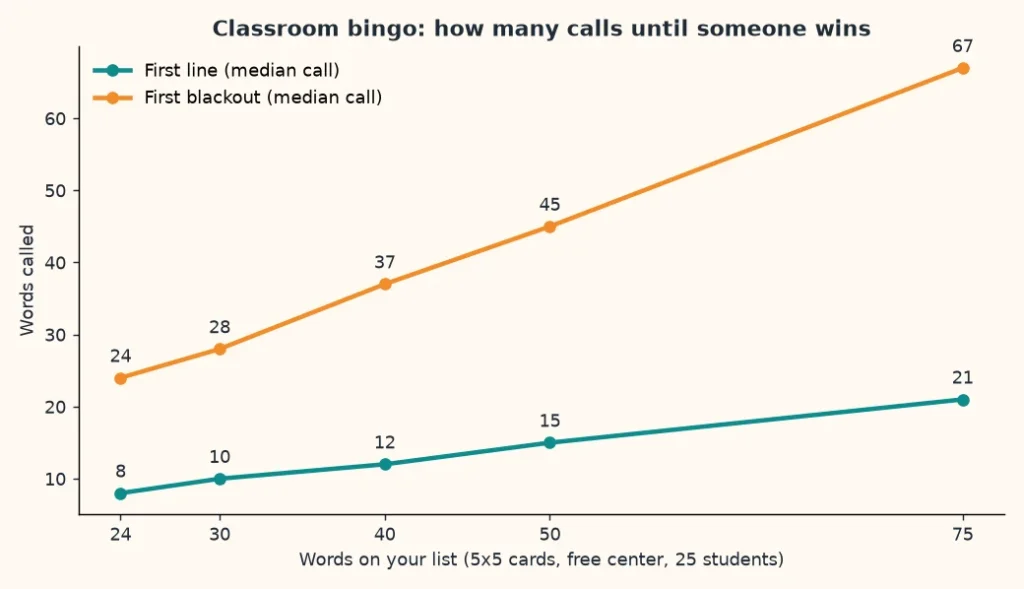
With 30 words, a line usually appears after 10 calls and a blackout after about 28, so a first round fits in a five-minute warm-up. A 75-word list needs about 21 calls for a line, which is a better match for a full lesson. Class size barely matters once you have 10 or more cards: for 30 words, the median line is 11 calls with 10 cards and 9 with 30.
Smaller classroom bingo grids end much faster, which is a feature for young children but a reason to play several rounds. Here are the medians for the same class of 25:
| Card and list | First line (median call) | First blackout (median call) |
|---|---|---|
| 3×3 with free center, 10 words | 2 | 9 |
| 3×3 with free center, 12 words | 2 | 10 |
| 4×4, 16 words | 5 | 16 |
| 4×4, 20 words | 6 | 18 |
| 4×4, 24 words | 7 | 22 |
The assumptions behind these classroom bingo numbers are simple: words are called in a uniformly random order, each card is a random selection of words from the list, and a line is any row, column or diagonal. Real classes are lumpier, since children miss calls and mark the wrong square, so allow a few extra calls in practice.
Bingo cards for teachers: management tips
The best bingo cards for teachers are the ones you can reuse, hand out quickly and check fast. These habits keep a 30-student classroom bingo game from turning into chaos.
- Laminate or use sleeves. Slide each card into a clear sleeve and use dry-erase markers or bingo chips, then wipe and reuse. A class set lasts all year.
- Use chips, not pencils, for little ones. Counters, buttons, torn paper and small erasers all work. Pencils also work, but you cannot reuse the sheets.
- Name every card. Turn on names in the card maker so cards come back to the right child. It also makes it easy to see who still needs a card.
- Print spares. Print 2 or 3 more cards than students for late arrivals and torn corners.
- Set the win condition before you start. Say whether it is any line, four corners or blackout, and write it on the board.
- Check winners with the calling pile. Ask the winner to read their line out loud while you check each word against the called pile.
- Give a small prize, then play again. A sticker, first choice of a seat or a pencil is enough; the game itself is the reward.
If you teach several sections, put each class’s name in the footer and print them on different paper colors so cards do not get mixed up in the copy bin. A parent volunteer or a student helper can cut the calling cards while you prepare the next activity.
Differentiate classroom bingo for every learner
| Need | Adjustment |
|---|---|
| Early readers | Use a 3×3 card, large text, a picture on every square and a call-out that shows the picture. |
| English learners | Put emoji or images next to each word. Say the word twice and let students point first. |
| Students who need a challenge | Use a 5×5 card, call out definitions instead of the word, and ask for a sentence before they mark the square. |
| Students who need more time | Slow the calls, repeat each one, or let a partner share a card. |
| Mixed-level classes | Print the same list on three card sizes and let each student choose, or have students make their own cards in pairs. |
Student-made classroom bingo cards are a strong activity in their own right. Have students pick 24 vocabulary words from the unit, write them in a blank grid, and swap with a partner. Blank cards for this are on the blank bingo cards page, and the full editor is the bingo card generator.
Skills a classroom bingo game practices
Teachers often need to justify game time, so here is the skill list for classroom bingo. The matches are general ones; check your own state or district standards for exact wording.
- Listening and following directions: students act on what they hear, not what they see.
- Word recognition: matching a spoken word to a printed word, a core early-reading skill. In the Common Core State Standards for English, grade K reading foundations include recognizing common high-frequency words by sight.
- Vocabulary: matching a definition or a context clue to a term.
- Math fluency: recalling facts quickly, for example addition and subtraction within 20 in grade 2 and multiplication facts in grade 3.
- Categorizing and logic: noticing lines, rows, columns and patterns on a grid.
- Social skills: turn-taking, being a good winner, helping a friend with a card.
Bingo itself has a long history; the Wikipedia article on American bingo covers the standard 75-ball game, which is the origin of the line, four-corners and blackout patterns that classroom games borrow. The rules of the game are fixed, which is exactly why teachers can swap the content freely.
When you are ready to go beyond one list, browse the full set of printable bingo cards, or see how the same maker handles other themes such as baby shower bingo and Christmas bingo for the class party at the end of term. For a break from the classroom, road trip bingo fills the bus ride on a field trip.
Frequently asked questions
10 quick answers
What is classroom bingo?
Classroom bingo is a review game for any subject. Students get cards with words, pictures or numbers and mark the squares you call out with a clue, definition or problem. The first to complete a line wins.
Are these classroom bingo cards really free?
Yes. You can create, shuffle and print cards without an account, and nothing you type is uploaded. You only need a printer or a way to save the PDF.
How many cards can I print?
Anywhere from 1 to 100 different cards in a single PDF, with 1, 2, 4 or 6 cards on each page, on Letter or A4 paper.
Can I use my own words?
Yes. Open the Items tab and type or paste your own list: vocabulary, sight words, math answers or anything else. Add emoji or pictures for pre-readers in your classroom bingo cards.
What grade is classroom bingo for?
All of them: classroom bingo suits every grade. Use a 3×3 card for kindergarten and grade 1, 4×4 for grades 2 and 3, and 5×5 from grade 4 up. The content matters more than the card size.
How many words do I need for a 5×5 card?
24 words plus the free space. If your list has more than 24 words, the extra words land on different cards, so each student has a different card.
How do I make sure the game is fair?
Keep the calling cards in a pile and set each called card aside. When someone says bingo, check their line against that pile. For number games, the bingo caller has a built-in check.
Can I play classroom bingo without printing?
Yes. You can show the card on a screen, or host a live game where students join by link and cards mark themselves. See the online bingo page for details.
How long does a classroom bingo game take?
In our simulation of a class of 25 on 5×5 cards, a 30-word list gives a first line after about 10 calls and a blackout after about 28.
Can students make their own cards?
Yes, and it is a great review activity. Give each student a blank grid, have them choose words from the unit, and let them swap cards with a partner.