Decimal multiplication worksheets teach one reliable method: multiply the numbers as if they were whole numbers, then place the decimal point by counting the decimal places in both factors. These free printable multiplying decimals worksheets go from decimals times whole numbers to tenths, hundredths and powers of ten, with an answer key on every PDF and a maker for new problems.
Quick answer: To multiply decimals, ignore the decimal points and multiply as whole numbers, then count the decimal places in both factors and put that many places in the product: 0.6 × 0.4 = 0.24. This page has 8 free decimal multiplication worksheets (PDF) with answer keys for grades 5 and 6, plus a maker for new problems. Updated October 2026.
Ready-to-print samples
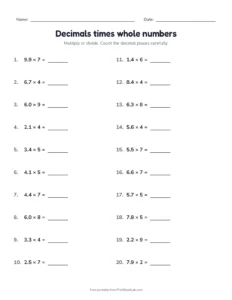
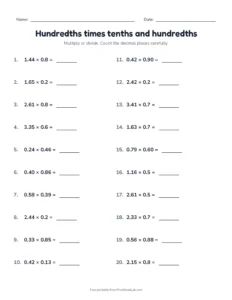
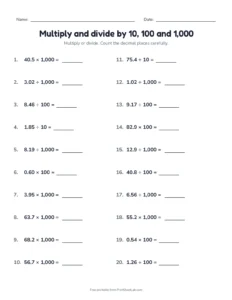
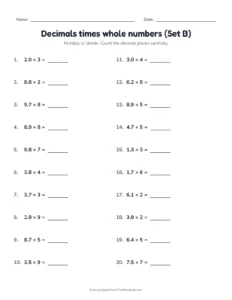
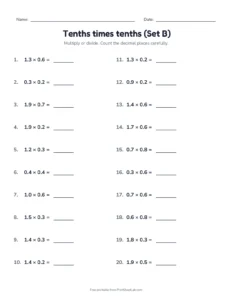
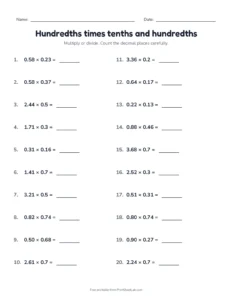
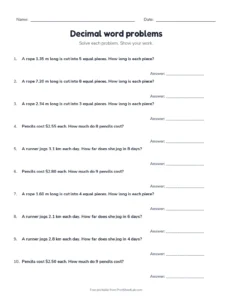
A few of the ready PDFs on this page. The full list is under Ready-to-print worksheets, and the maker above makes new problems on demand.
Decimals times whole numbersLevel 1 with a full answer key.PDFTenths times tenthsLevel 2 with a full answer key.PDFHundredths times tenths and hundredthsLevel 3 with a full answer key.PDFMultiply and divide by 10, 100 and 1,000Level 6 with a full answer key.PDF
How to multiply decimals in three steps
Multiply as whole numbers: ignore the decimal points, so 0.6 × 0.4 becomes 6 × 4 = 24.
Count the decimal places in both factors: 0.6 has one place and 0.4 has one place, so two in all.
Place the decimal point so the product has that many places: 0.24.
Unlike adding decimals, you do not line up the decimal points. The method works because tenths times tenths are hundredths.
Multiplying decimals: six worked examples
Each row shows the whole-number multiplication, the number of decimal places and the final answer. Cover the last column and try each problem first:
Problem
Multiply as whole numbers
Decimal places in the factors
Answer
0.6 × 0.4
6 × 4 = 24
2
0.24
0.5 × 0.3
5 × 3 = 15
2
0.15
1.2 × 0.5
12 × 5 = 60
2
0.6
0.25 × 0.4
25 × 4 = 100
3
0.1
3.5 × 2.4
35 × 24 = 840
2
8.4
0.12 × 0.34
12 × 34 = 408
4
0.0408
Multiplying decimals by 10, 100 and 1,000
Multiplying by a power of ten just moves the decimal point to the right, one place for each zero. This is a shortcut that fifth graders should know well:
Problem
Move the decimal point
Answer
0.45 × 10
1 place right
4.5
0.45 × 100
2 places right
45
0.45 × 1,000
3 places right
450
3.7 × 10
1 place right
37
0.082 × 100
2 places right
8.2
Estimate first: does the answer make sense?
Rounding the factors gives a quick check on the placement of the decimal point. If the estimate and the exact answer are close, the point is in the right place:
Problem
Round to estimate
Estimate
Exact answer
Reasonable?
4.8 × 3.2
5 × 3
15
15.36
Yes
0.9 × 6.1
1 × 6
6
5.49
Yes
2.4 × 0.5
2 × 0.5
1
1.2
Yes
Multiplying decimals by whole numbers worksheet
A decimal times a whole number is the easiest case: multiply as whole numbers, then count the decimal places in the decimal factor only. For 1.25 × 4, 125 × 4 = 500, and two places gives 5.00, which is 5. The first sheets above start here, with money and measurement problems as examples.
Decimal multiplication worksheet, practice and PDFs
This page is also searched as decimal multiplication worksheet, multiply decimals worksheet, multiplying decimals worksheets, decimal multiplication practice, multiplication of decimals worksheets and a decimals multiplication worksheet pdf. All of these are the free PDFs above, each with an answer key, for US Letter or A4, with no sign-up. Customize loads the same level into the maker for a fresh set of problems.
Add, subtract, multiply and divide decimals to hundredths
Grade 5
5.NBT.A.2
Multiply and divide by powers of 10 and explain the pattern of the decimal point
Grade 6
6.NS.B.3
Fluently add, subtract, multiply and divide multi-digit decimals
Common mistakes when multiplying decimals
Mistake
Example
Fix
Lining up the decimal points
0.6 × 0.4: lining up points like addition
Multiplication does not need aligned points: multiply as whole numbers, then place the point
Counting the places in only one factor
0.6 × 0.4 = 2.4
Count the places in both factors: two places, so 0.24
Dropping a zero
0.5 × 0.3 = 0.015
5 × 3 = 15, with two places gives 0.15
Moving the point the wrong way
0.45 × 10 = 0.045
Multiplying by 10 moves the point one place right: 4.5
A weekly plan for decimal multiplication
Day
Focus
Suggested block
Monday
Decimals times whole numbers
15 min
Tuesday
Tenths times tenths
15 min
Wednesday
Hundredths and powers of ten
15 min
Thursday
Word problems and mixed review
15 min
Weekly total
Four short sessions
60 min
Try ten decimal multiplication problems
Use this set as a warm-up or a quick check. Multiply as whole numbers first, then count the decimal places in both factors. Answers are shown without trailing zeros.
#
Problem
Answer
1
0.7 × 0.8
0.56
2
1.5 × 4
6
3
0.35 × 0.2
0.07
4
2.4 × 0.5
1.2
5
6.3 × 0.1
0.63
6
0.08 × 0.9
0.072
7
1.2 × 1.2
1.44
8
5.5 × 3
16.5
9
0.25 × 0.04
0.01
10
3.14 × 10
31.4
Why the decimal point goes where it does
A tenth of a tenth is a hundredth, which is why 0.1 × 0.1 = 0.01. Each decimal place divides by 10, so two factors with one place each give a product with two places. This is the reason for counting the places in both factors, and why 0.6 × 0.4 = 0.24 and not 2.4.
Sometimes the product needs a zero placeholder. In 0.08 × 0.9, 8 × 9 = 72 and there are three decimal places, so the answer is 0.072, with a zero added before the 7. Remind students that a product with three places must show three digits after the point.
Decimal multiplication vocabulary
Students answer questions faster when they know the words. These are the terms used on the worksheets and answer keys:
Word
Meaning
Example
Factor
A number being multiplied
0.6 and 0.4
Product
The answer to a multiplication
0.24
Decimal place
A digit position after the decimal point
0.24 has two
Tenths and hundredths
The first and second places after the point
0.3 and 0.03
Placeholder zero
A zero used to keep digits in the right place
0.072
Power of ten
10, 100, 1,000 and so on
10 × 10 = 100
Real-life uses of multiplying decimals
Money and measurement problems use decimal multiplication every day. These examples work well as discussion starters:
Situation
Multiplication
Answer
Four notebooks cost $2.75 each
2.75 × 4
$11.00
A recipe uses 0.75 kg of flour and you make 1.5 batches
0.75 × 1.5
1.125 kg
A fuel pump charges $3.40 per gallon for 8.5 gallons
3.40 × 8.5
$28.90
A tile is 0.3 meters long and you lay 12 in a row
0.3 × 12
3.6 meters
Sales tax of 0.08 on a $25 purchase
25 × 0.08
$2.00
Tips for teachers and parents
Use a hundred grid to show 0.4 × 0.6: shade 4 tenths across and 6 tenths down, and the overlap is 24 of 100 squares, so 0.24. Pair the grid with the whole-number method so students see the two ideas match.
Encourage estimation every time. If 4.8 × 3.2 is close to 5 × 3 = 15, then an answer of 1.536 or 153.6 is clearly wrong. This quick check does more to prevent decimal point errors than any rule. Review the place value chart page if place value is still shaky.
Which decimal multiplication worksheet should you start with?
Start with decimals times whole numbers, since the decimal point rule is easiest there. Move to tenths and hundredths when students can explain where the point goes. Set B can be used a week later.
Level
Skill
Best for
Level 1
Decimal times whole number
Grade 5
Level 2
Tenths times tenths
Grade 5
Level 3
Hundredths times tenths and hundredths
Grades 5 and 6
Level 6
Multiply and divide by 10, 100 and 1,000
Grade 5
Level 7
Word problems with decimals
Grades 5 and 6
Frequently asked questions
5 quick answers
Where can I download free decimal multiplication worksheets?
Open any worksheet in the Ready-to-print list on this page, choose US Letter or A4, then print or save the PDF. They are free, with answer keys, and no account is needed.
How do you multiply decimals?
Multiply the numbers as whole numbers, count the decimal places in both factors, and put that many places in the product. For example, 0.6 × 0.4 = 0.24.
Do you line up the decimal points when you multiply?
No. Lining up decimal points is for adding and subtracting. For multiplication, multiply as whole numbers and then place the point.
How do you multiply a decimal by 10?
Move the decimal point one place to the right. Multiplying by 100 moves it two places, and by 1,000 three places.
What grade multiplies decimals?
Grade 5 multiplies decimals to hundredths, and grade 6 extends this to multi-digit decimals.