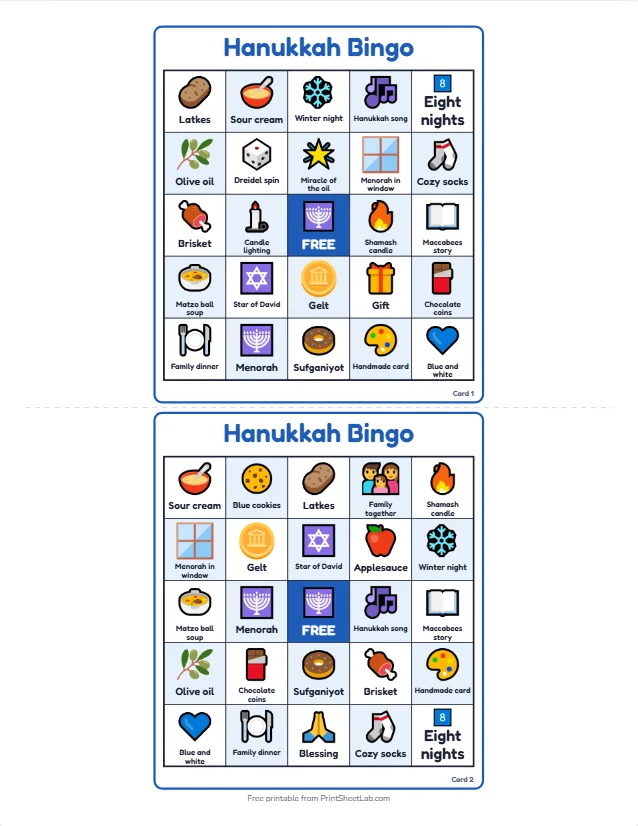
Hanukkah bingo turns the eight nights of candles, latkes and dreidel spinning into a game that every generation at the table can play. The card on this page has 28 squares that most Hanukkah homes produce at some point in the holiday, from the menorah in the window and a plate of sufganiyot to a pile of gelt and the grandparent who tells the story of the oil one more time. Pick a card size, press print, and every guest gets a different card.
In short: open the card maker above and press Edit and print this card, choose how many cards you need and download one PDF. It is free, there is no account, and nothing you type leaves your browser. Every square can be rewritten, so a family, a classroom and a community party can each get their own list.
How to play Hanukkah bingo
The rules are the bingo rules everyone already knows, with one change: nobody has to call numbers, because the holiday makes the calls. Each player holds a card and something to mark with. When one of the squares happens in front of them, they mark it. Five in a row, across, down or on a diagonal, wins. The free center is already marked, so a first line needs only four more squares.
- Give every guest a card and a way to mark it. Pencils, crayons and small round stickers work well. Wet markers bleed through thin paper, and a pile of foil-wrapped chocolate coins makes a fun set of markers that doubles as a prize.
- Agree on the rules first. A square counts when you see it yourself, and it counts once. Anyone may ask a player to point out the square they are claiming.
- Mark Hanukkah bingo squares as the evening unfolds. The candles are lit, the latkes arrive, a dreidel is spun: each of those is a square.
- Announce a line out loud. The winner reads the five squares, a neighbor checks them, and the prize changes hands.
- Play another round of Hanukkah bingo. Switch to four corners, an X or a full card once the first line is won, or keep the same card for tomorrow night.
Hanukkah suits bingo because the holiday is built from small, visible things. According to the Wikipedia article on Hanukkah, it lasts eight nights and days, each night marked by lighting a nine-branched menorah, and its common practices include prayers, music, the game of dreidel and fried foods such as latkes and sufganiyot. A Hanukkah bingo card names those things, so children look closely at the table instead of only at the dessert tray. For the full rule set and every winning shape, see the how to play bingo guide and the bingo patterns guide.
Hanukkah bingo cards: all 28 squares
These Hanukkah bingo cards are made from a list of 28 squares. A standard 5×5 card with a free center needs 24 of them, so each card leaves out four and the cards differ from one another. The table sorts the list into the groups a host usually thinks in, so it is easy to decide which squares to keep and which to swap for something that belongs to your own table.
| Group | Squares on the list | Where you will see them |
|---|---|---|
| Light | 🕎 Menorah, 🕯️ Candle lighting, 🔥 Shamash candle, 🪟 Menorah in window | The window, the door and the table at nightfall. |
| Oil and food | 🥔 Latkes, 🍩 Sufganiyot, 🫒 Olive oil, 🍎 Applesauce, 🥣 Sour cream, 🍖 Brisket, 🍲 Matzo ball soup, 🍪 Blue cookies | The kitchen and the table. Fried foods are the heart of the menu; soup and brisket are extras some families serve. |
| Games and gifts | 🎲 Dreidel spin, 🪙 Gelt, 🍫 Chocolate coins, 🎁 Gift | After the candles are lit. |
| Symbols and atmosphere | ✡️ Star of David, 💙 Blue and white, ❄️ Winter night, 🧦 Cozy socks, 🎨 Handmade card | Decorations, cards and the weather. |
| Words and stories | 🙏 Blessing, 🎶 Hanukkah song, 8️⃣ Eight nights, 📖 Maccabees story, 🌟 Miracle of the oil | Spoken and sung at the candles. |
| People | 🍽️ Family dinner, 👨👩👧 Family together | The gathering, in person or on a screen. |
The Hanukkah bingo list is not random. The light squares fill in at nearly every home, while rarer squares (a handmade card, matzo ball soup, blue cookies) turn a card into a treasure hunt.
How many different cards can you print?
With 28 squares and 24 places on a 5×5 card, the number of different sets of squares is 28 choose 24, which is 20,475. Each set can also be arranged in a huge number of orders, so a family of 12 and a community hall of 120 can both give every player a different card. Smaller grids use fewer squares, so a 4×4 or 3×3 card has far more possible sets.
| Card size | Squares used | Different sets from the 28 | Best for |
|---|---|---|---|
| 3×3 with free center | 8 | 3,108,105 | Ages 3 to 5 and the very short game |
| 4×4 | 16 | 30,421,755 | A quick round before the latkes |
| 5×5 with free center | 24 | 20,475 | The classic evening or the eight-night game |
The eight nights of Hanukkah and why people play games
Hanukkah is a Jewish holiday that commemorates the Maccabean Revolt against the Seleucid Empire in the second century BCE, when the Maccabees recovered Jerusalem and rededicated the Second Temple. It begins on the 25th of Kislev on the Hebrew calendar and lasts eight nights and days.
The English spelling varies, and Chanukah is just as common as Hanukkah, so use whichever your family uses. The Wikipedia article describes it as a relatively minor holiday in strictly religious terms but one of major cultural importance, especially among secular Jews, because it often falls in the Christmas season.
That cultural importance is why games belong here. Playing dreidel is one of the best-known customs, children receive small gifts or gelt, and families gather every night at the same hour. The holiday gives Hanukkah bingo something rare: eight evenings in a row with the same ritual and a new surprise each time, so a card can be started on the first night and finished on the last.
The menorah and the candle count
The Hanukkah menorah has nine branches: eight for the nights and one for the shamash, the attendant light used to kindle the others. One candle is lit on the first night, two on the second, and so on up to eight.
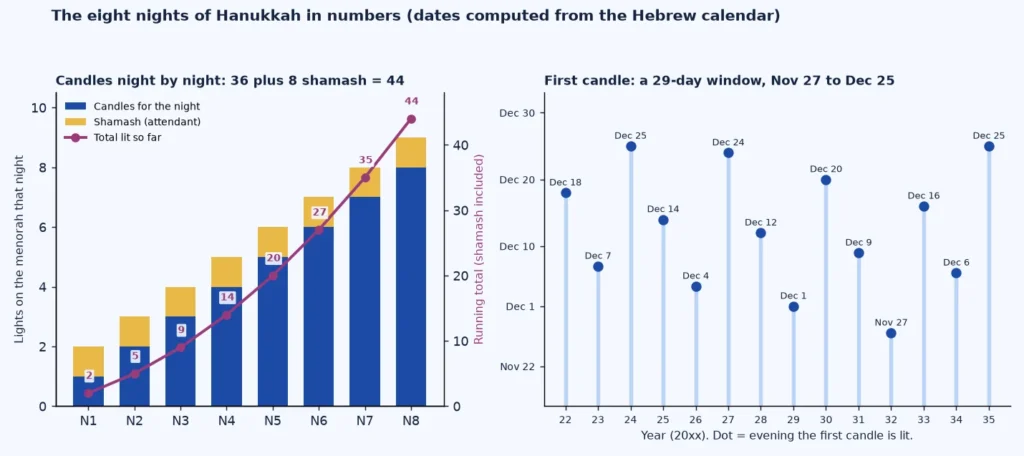
The practice follows the opinion of the House of Hillel, which argued for adding a light each night, and Jewish law adopted it. Counting the shamash, two lights burn on night one and nine on night eight, for a total of 44 over the holiday, or 36 without the shamash. That is why the standard box of Hanukkah candles holds 44.
| Night | Candles lit | Running total of lights | Evening in 2026 |
|---|---|---|---|
| Night 1 | 1 + 1 shamash | 2 | Friday, December 4 |
| Night 2 | 2 + 1 shamash | 5 | Saturday, December 5 |
| Night 3 | 3 + 1 shamash | 9 | Sunday, December 6 |
| Night 4 | 4 + 1 shamash | 14 | Monday, December 7 |
| Night 5 | 5 + 1 shamash | 20 | Tuesday, December 8 |
| Night 6 | 6 + 1 shamash | 27 | Wednesday, December 9 |
| Night 7 | 7 + 1 shamash | 35 | Thursday, December 10 |
| Night 8 | 8 + 1 shamash | 44 | Friday, December 11 |
The candles are lit after dark. Small wax candles burn for about half an hour, so they are lit at nightfall, and the tradition places the menorah by a door or window to publicize the miracle. That is the idea behind the Menorah in window square of the Hanukkah bingo list, and it is why a neighborhood at Hanukkah looks different from the street. Friday nights are an exception to the nightfall rule: the Hanukkah lights are kindled before the Shabbat candles, so the first and last nights of 2026 are early-evening events.
When is Hanukkah? Dates for 2026 to 2028
The holiday moves on the Gregorian calendar because it follows the Hebrew calendar, and the Jewish day begins at sunset. The table gives the evening of the first candle and of the eighth candle, computed from the Hebrew calendar and checked against an independent calendar service. Always confirm the dates for your location before you plan a party, and print the cards a week ahead.
| Year | First candle (evening) | Eighth candle (evening) | Notes |
|---|---|---|---|
| 2026 | Friday, December 4 | Friday, December 11 | The holiday ends at nightfall on the day after the eighth candle. |
| 2027 | Friday, December 24 | Friday, December 31 | The first candle falls on Christmas Eve and the holiday ends in early January 2028. |
| 2028 | Tuesday, December 12 | Tuesday, December 19 | The holiday ends at nightfall on the day after the eighth candle. |
Across the 14 years from 2022 to 2035 the first candle is lit as early as November 27 (in 2032) and as late as December 25 (in 2024 and 2035), a window of 29 days. In 2013 the American holiday of Thanksgiving fell during Hanukkah, which gave the world the word Thanksgivukkah, and the Wikipedia article notes that this will not happen again in the foreseeable future. If you plan a bingo night around Thanksgiving, see the Thanksgiving bingo page instead.
Latkes, doughnuts and the oil
The foods on the Hanukkah bingo list follow one idea: oil. A custom of eating foods fried or baked in oil, preferably olive oil, commemorates the miracle of a small flask of oil keeping the menorah of the Second Temple alight for eight days. Ashkenazi families fry potato pancakes called latkes.
Sephardi, Polish and Israeli families eat jam-filled doughnuts, bimuelos (fritters) and sufganiyot. In Israel latkes are less popular and sufganiyot have largely replaced them, and bakeries sell many fillings beyond strawberry jelly. Some families also eat dairy foods in memory of Judith, who defeated Holofernes in the story the article tells.
The dreidel and the gelt
The dreidel is a four-sided spinning top. Each side carries a Hebrew letter: nun, gimel, hei and shin. Folk etymology reads them as the first letters of the phrase meaning “a great miracle happened there,” and most dreidels sold in Israel replace the shin with a pe, for “a great miracle happened here.”
According to the dreidel article, the letters are also a Yiddish mnemonic for the rules of the pot game, with nun for nothing, gimel for all, hei for half and shin for put in. The game is not required for Hanukkah, but spinning the dreidel after the candles is a traditional pastime.
Gelt means money in Yiddish, and Hanukkah gelt is often given to children during the holiday. The custom is traced to a long-standing Eastern European practice of children presenting their teachers with a small sum at this time of year as thanks. One tradition favors the fifth night for giving gelt, because the fifth night never falls on Shabbat. Today many children know gelt as chocolate coins in gold foil, which is the version on the card. Both squares, Gelt and Chocolate coins, are on the Hanukkah bingo list because homes differ.
Three ways to play a Hanukkah bingo game
One printed card supports three very different evenings of Hanukkah bingo. Pick the version that fits your guests, or run two in a row. The table compares them, and the sections underneath give the rules and prize ideas.
| Game | Who calls | Length | Best for |
|---|---|---|---|
| The eight-night family game | Nobody. Each night does. | Eight nights, a few minutes a night | Households and relatives on a group chat who keep one card from the first candle to the last |
| The latke-party spotting game | Nobody. The evening does. | 1 to 3 hours | Open houses, community parties and the family dinner |
| Calling cards for a crowd | A host draws cut-out squares | 10 to 20 minutes | Classrooms, synagogue halls, offices and video calls |
Game one: the eight-night Hanukkah bingo family game
Because the holiday spans eight nights, one Hanukkah bingo card can last through all of them. The rule that makes it work is a daily allowance, and the best one comes straight from the menorah: on each night you may mark as many squares as there are candles lit. One mark on the first night, two on the second, eight on the last. The allowance grows with the light, no player can finish too early, and the game ends while the menorah is still burning. The simulation below puts numbers on it.
This version suits families who live apart. Send everyone the same Hanukkah bingo PDF before the first candle, let each household play at its own pace, and ask for a photo of the winning line on the eighth night. A grown-up can keep the card on the fridge beside the menorah so the marking becomes part of the nightly routine.
- Prize for the first line: first pick of the gelt bag, or the job of lighting the shamash the next night.
- Prize for four corners: choose the song after dinner.
- Prize for everyone: a small dreidel or a bag of chocolate coins that every player takes home.
- Grown-up job: one adult carries a spare card for the child who loses theirs under the wrapping paper.
Game two: the latke-party spotting game
This is the version of Hanukkah bingo most hosts want for a party. Guests arrive with a card and a pencil, and every time they notice a square (the menorah in the window, a plate of latkes, a spinning dreidel, someone singing) they mark it. Treat the candle lighting with care.
It is a religious act with blessings, so guests should mark that square quietly afterwards, and only when the hosts are happy to have a game around the table. A gentler version lets the Candle lighting square count once the host says that the blessings are finished.
The party version of Hanukkah bingo also works as an icebreaker. Add a rule that a square counts when someone else points it out to you. “Are those blue cookies? That is a square on my card!” The card becomes a reason to talk to people you have not met.
Game three: calling cards for a crowd
When the guests do not move around the house, the drawn-card Hanukkah bingo game is easier to run. In the Print tab, switch on the calling cards and the caller sheet. Cut the cards out, shuffle them in a bowl and draw one at a time: “Spin the dreidel… who has a Dreidel spin?” Everyone with that square marks it.
For a live round on a screen, with guests joining by link, the play bingo online page hosts the 75-ball game, and the play custom bingo online page explains how to play with your own list. For a video call with relatives, the virtual bingo ideas guide has timing and group-size advice.
Hanukkah bingo game: a real simulation
A host planning a Hanukkah bingo game always asks how long the Hanukkah bingo game will last. To answer with numbers instead of a guess, we simulated the eight nights. Every square has an assumed chance of showing up on each night, and we ran 8,000 holidays.
The chances are our assumptions, chosen to feel like a typical family. They are not survey data. The menorah is seen on 99 of 100 nights, latkes on 40 to 70 of 100, a bowl of matzo ball soup on 10, and gelt on the fifth night 70 times out of 100, because tradition favors that night.
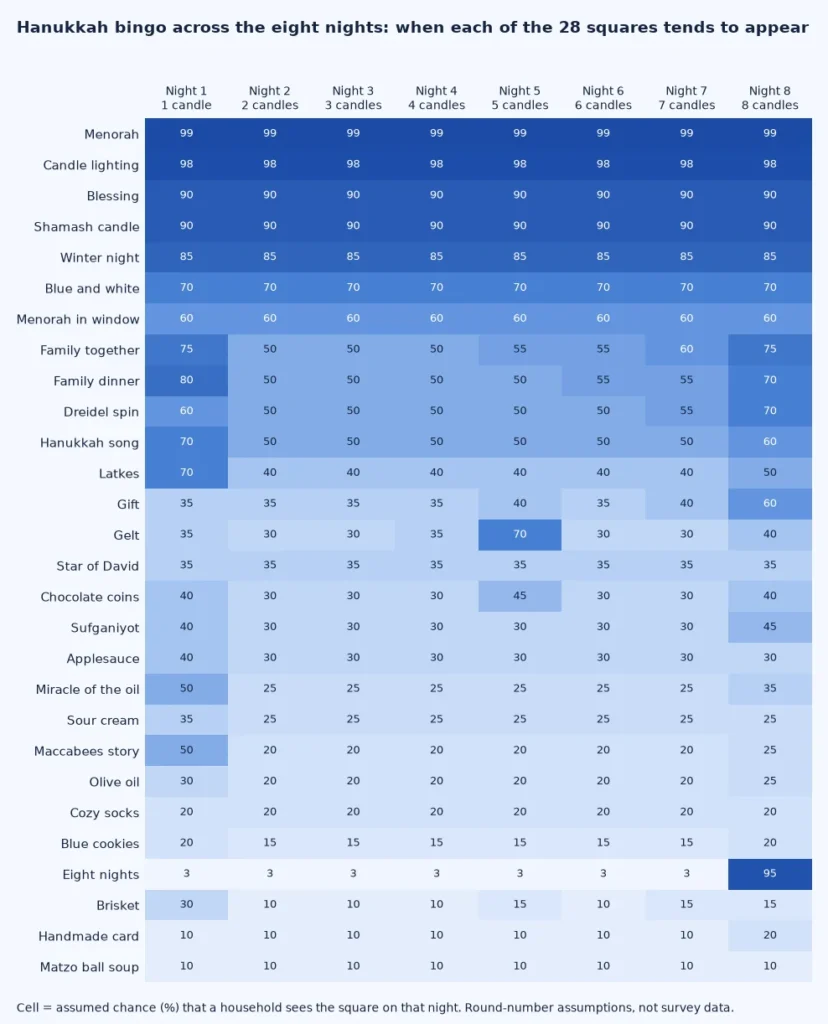
In an average holiday a household sees about 26 of the 28 squares, and 14 of them on the first night alone. The running total after each night is about 14, 18, 20, 22, 23, 24, 25, 26. A 5×5 Hanukkah bingo card with 24 squares has nearly everything within reach, so without a limit the Hanukkah bingo game is over almost at once.
Eight nights of Hanukkah bingo: the rule decides the length
With no limit, a single 5×5 card has a line by the end of the first night 38% of the time, by the second night 75% and by the fourth 97%. A group of six players has a first line on the first night 85% of the time. That is a game that ends before the dreidel comes out. The table compares the daily allowances a host can choose, for one card and for a family group of six cards.
| Rule for marks | One card: median night of a first line | Six cards: median night of a first line | Six cards: line by Night 4 | Six cards: line by Night 6 | Six cards: line by Night 8 |
|---|---|---|---|---|---|
| No limit | Night 2 | Night 1 | 100% | 100% | 100% |
| 3 marks a night | Night 5 | Night 4 | 88% | 100% | 100% |
| Marks = candles lit (1, 2, 3 … 8) | Night 5 | Night 4 | 55% | 100% | 100% |
| 2 marks a night | Night 7 | Night 5 | 20% | 89% | 100% |
| 1 mark a night | only 3% by Night 8 | only 21% by Night 8 | 0% | 4% | 21% |
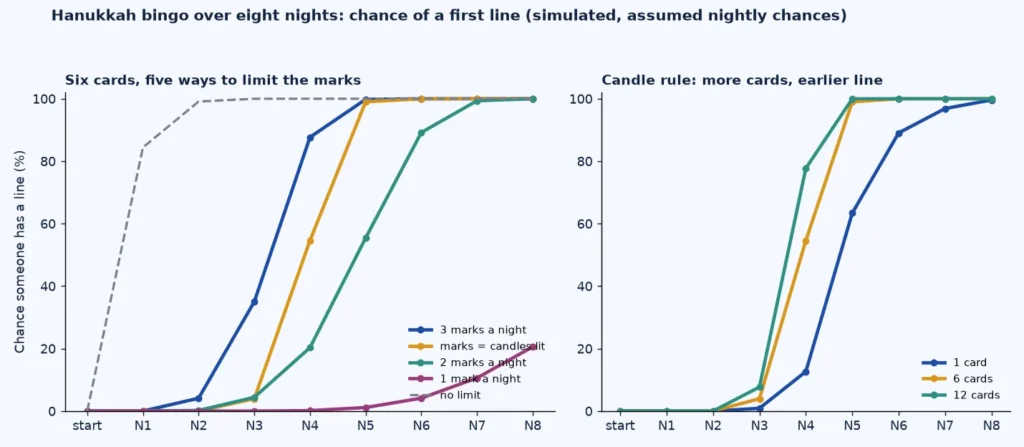
For Hanukkah bingo over eight nights, the candle rule is the best fit. One card has a line by Night 5 at a median, and more than 99% of single cards have one by Night 8. A family group of six cards has a first line on Night 4, and with twelve cards 78% have a line by Night 4, so the winner appears while the menorah is still growing.
A limit of one mark a night is too strict: only 3% of single cards and 21% of six-card groups reach a line in eight nights, because eight marks on random squares seldom line up. Two marks a night works for groups of six or more, but a single player may wait until Night 7.
The marks in the simulation are chosen at random among the squares a player has seen that night, so a careful player does a little better. Treat the table as a guide to how long to plan the game, not a promise. A full card is rare: only 12% of single cards reach a blackout in eight nights even with no limit.
Hanukkah bingo with calling cards: how many calls?
The drawn-card version of Hanukkah bingo is the most predictable. All 28 squares are called exactly once, in random order, so we simulated 8,000 games to see how many calls it takes before someone has a line.
| Cards in play (5×5) | Calls to the first line (median) | Middle half of games | Calls to a full card (median) |
|---|---|---|---|
| 1 card | 16 | 14 to 18 | 28 |
| 4 cards | 13 | 11 to 14 | 28 |
| 8 cards | 11 | 10 to 13 | 27 |
| 15 cards | 10 | 9 to 11 | 27 |
| 25 cards | 9 | 8 to 10 | 27 |
| 30 cards | 9 | 8 to 10 | 27 |
A party with 15 players usually sees a first line after 10 calls, a little over a third of the way through the list. A full card needs almost everything: a median of 27 calls with 15 players. For a quicker game, 4×4 cards with 8 players reach a first line at 10 calls and 3×3 cards with 8 players at 5. The assumptions: every call is equally likely at each step, cards are independent random draws, and nobody misses a call.
How often two players win on the same call
With many cards in play, a call can finish a line for two players at once. We counted how often the first line is shared in the same 8,000 games, and the tie-break rule a host should announce before the first call follows from the answer.
| Cards in play (5×5) | First line shared by 2 or more players | Shared by 3 or more | Most winners seen at once |
|---|---|---|---|
| 4 cards | 13% | 2% | 4 |
| 8 cards | 18% | 3% | 5 |
| 15 cards | 21% | 5% | 6 |
| 30 cards | 24% | 6% | 7 |
| 60 cards | 28% | 8% | 10 |
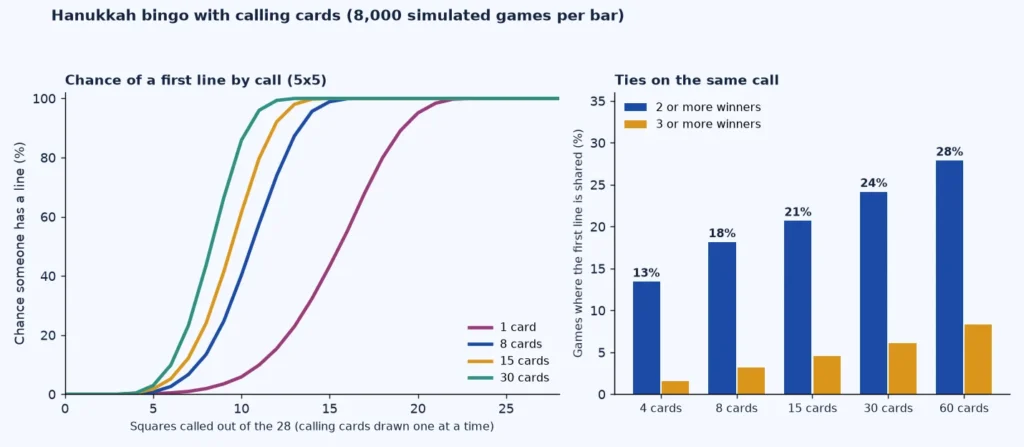
With 15 cards about 21% of games have a shared first line, and with 60 cards about 28%. Decide the tie rule in advance: share the prize, draw a gelt coin from a bag, or let the tied players spin the dreidel and give the prize to the highest letter in the order nun, gimel, hei, shin. A tie is not a problem when the prize is small enough to share, and it is a fine reason for a play-off spin.
The dreidel by the numbers
The dreidel is the best-known game of the holiday, and it makes a fine warm-up for Hanukkah bingo, so we simulated it too, with the same care as the Hanukkah bingo game above. A fair four-sided dreidel lands on each letter one time in four.
The chance of at least one gimel in four spins is 1 minus three-quarters to the fourth power, which is 68%, and in eight spins it is 90%. To see all four letters at least once takes an average of 25/3, or about 8.3 spins, which is the classic coupon collector problem: 1 spin for the first letter, then 4/3 spins on average for the second, 2 for the third and 4 for the last. Our simulation of 20,000 tries gave an average of 8.4 and a median of 7 spins.
The pot game follows the rules in the Wikipedia article. Every player starts with the same number of pieces, usually 10 to 15, and puts one in the pot. On a nun nothing happens, on a gimel the player takes the pot, on a hei the player takes half rounded up, and on a shin the player puts one piece in. Everyone adds one piece when the pot is empty or holds one. A player with no pieces is out. Our simulation uses exactly those rules with a fair dreidel and 1,500 games per row.
| Game | Spins until the first player is out (median) | Middle half | Spins until one player has everything (median) | At 10 seconds a spin |
|---|---|---|---|---|
| 3 players, 10 gelt each | 51 | 33 to 79 | 204 | 34 minutes |
| 4 players, 10 gelt each | 44 | 30 to 65 | 393 | 66 minutes |
| 4 players, 15 gelt each | 103 | 71 to 153 | 952 | 159 minutes |
| 6 players, 10 gelt each | 32 | 24 to 44 | 1,020 | 170 minutes |

The result surprises most hosts. A four-player game with 10 pieces each takes a median of 44 spins to find one player who is out, and about 393 spins to produce a single winner, which is more than an hour at 10 seconds a turn. A game with six players takes much longer, because the pot keeps passing between players without anyone being knocked out.
The practical rule is to set a timer. Play for 20 minutes, stop, and let the player with the most gelt win. If you want a short game, use Hanukkah bingo for the main event and the dreidel as a break between rounds of Hanukkah bingo.
Printable Hanukkah bingo: print, cut and hand out
For printable Hanukkah bingo, the Print tab has the controls you need and nothing you do not. Choose how many different cards to print, from 1 to 100, how many go on a page (1, 2, 4 or 6), Letter or A4 paper, and portrait or landscape. Cut guides are available for sheets that need trimming. For a family of 14, print 16 cards, two to a page, and keep two spares for the guest who arrives late.
- Use light cardstock. A Hanukkah bingo card that will sit on the fridge for eight nights survives better when it is thicker than copy paper.
- Print names on the cards. The Design tab can put a name on each card, which prevents the usual argument over whose card is whose.
- Use big squares for little hands. One card per page in portrait gives the biggest squares, which is best for ages 3 to 5.
- Print the caller sheet and calling cards for the drawn-card Hanukkah bingo game. They come out of the same Print tab.
- Pick blue and silver. The Design tab holds color themes, and a blue card with a silver or white background looks the part beside a menorah.
Hosts who are away from a printer can save the PDF to a phone or a USB stick and print it anywhere. The shareable link in the card maker keeps only your word list, with no names or photos, so you can send it to relatives and let everyone print their own.
Hanukkah bingo for kids
Hanukkah bingo for kids is a calm way to make a loud, sugary week more fun, and Hanukkah bingo for kids needs no reading skills. Children who are busy looking for a menorah in a window are children who are standing still long enough to enjoy it. The pictures on every square let pre-readers play without help, and the squares teach the names of things that adults at the table have known for years. The right setup depends on age.
| Age | Card | How to play |
|---|---|---|
| 3 to 4 | 3×3, one per page | A grown-up reads the pictures. Sticker dots, no pens. Everyone wins at the first line. |
| 5 to 7 | 3×3 or 4×4 | Words with pictures. Children spot and shout. Play for a line, then for four corners. |
| 8 to 10 | 5×5 | The candle rule over eight nights, plus two squares they invent themselves, like a pet or a family joke. |
| 11 and up | 5×5 with a custom list | Let them write the list for the family, or add a rule that a square counts only when they can say a sentence about it. |
Classrooms get a lot from Hanukkah bingo. A round fits into the last half hour before a winter break, and it needs no preparation beyond printing. Pair it with the Hanukkah worksheets and the classroom bingo page for a full lesson, and see the bingo activities for the classroom guide for routines that keep a group of 25 calm.
If a class includes children who do not celebrate Hanukkah, let them play as guests and ask a child who does celebrate to say one sentence about a square, if that child wants to. Never ask a child to speak for a whole religion.
Chocolate coins and fried foods can hide allergens, so check labels before you hand out prizes, and leave real candles to adults.
Hanukkah party games for adults, families and community halls
Among Hanukkah party games, Hanukkah bingo is the one that needs no setup beyond printing and works for every age. A latke party with 30 guests can run a calling-card round before the food, a spotting game during it and a blackout round for the grand finale.
Grown-ups tend to like a 4×4 card with no free space, which ends in about 40 minutes of mingling, and prizes that match the evening: first pick of the dessert tray, the right to choose the next song, a jar of olive oil or a small set of candles.
Three tweaks make it a grown-up game. First, change the list: replace Cozy socks with “Someone tells a family story of a Hanukkah long ago,” and Handmade card with “A recipe someone asks for.” Second, add a free-space line, such as “Someone helps in the kitchen.” Third, keep it short: grown-ups lose interest after 20 minutes.
For a workplace, the office bingo guide has inclusive advice, and for mixed groups the human bingo page offers a get-to-know-you format. Remember that Hanukkah bingo at work should be open to anyone who wants to play and should never single out one colleague as the expert.
Hanukkah bingo free printable: what you get
Free, private and nothing to install
This Hanukkah bingo free printable does not ask for an email or an account, and nothing is added to your PDF but the card itself and a small footer. The editor runs in your browser, so your word list never goes to a server. You need only a printer or a PDF viewer to use these Hanukkah bingo cards.
What you can change
The card maker has five tabs: Setup, Items, Design, Templates and Print. On the Items tab you can rewrite any square, add an emoji or upload your own picture, and decide what the free space shows. The Design tab holds color themes, fonts, text size, ALL CAPS, borders, rounded corners, tiles or plain grids, and a card background that can be a color, a pattern or your own picture.
You can also add a title, a logo and a footer line, for example “Levin family Hanukkah”. The Templates tab holds the other ready-made lists, and the Print tab holds the numbers: how many cards, which paper, which layout.
You do not have to start from this page. The bingo card generator offers every card type in one place, the blank bingo cards page gives you an empty grid to fill by hand, and the how to make bingo cards guide explains the do-it-yourself methods.
Customize the cards in the card maker
The best Hanukkah bingo card names your own table. Open the Items tab and every square turns into a text box. Here is how a few common situations change the list.
- Your family. For a family Hanukkah bingo night, try “Grandma’s kugel,” “The cousin who always wins the dreidel,” “Uncle starts the singing.”
- A different food tradition. Replace Latkes with Bimuelos, Sufganiyot or Cheese pancakes, and add the dish that your family has made for generations.
- The Southern Hemisphere. Hanukkah falls in summer in Australia and South America, so swap Winter night and Cozy socks for Summer night and Barbecue.
- A school or library Hanukkah bingo event. Swap the candle squares for drawings of a menorah, add “Someone reads a Hanukkah story aloud,” and keep the food squares nut-free.
- A language class. Write the squares in Hebrew or Yiddish next to the English word.
When your list has more than 24 words, the card maker gives every card a different mix. With exactly 24, every card has the same words in a different order. The free space can say “Free” or show its own emoji, text or picture. Shuffle re-deals the squares across all cards, Undo takes back your last change, and the preview lets you zoom in before you download.
Playing Hanukkah bingo respectfully
Hanukkah is a religious and cultural holiday, and a game of Hanukkah bingo should sit comfortably beside it, whether it is Hanukkah bingo at home or in a classroom. A few habits make that easy. They apply to any bingo you play at a holiday, not only this one.
- Keep prayer separate from play. The Candle lighting and Blessing squares are marks you make quietly. Never interrupt the blessings to claim a line, and remove the squares from your Hanukkah bingo cards if a household prefers.
- Ask about Shabbat. Many observant families do not write on Shabbat, and Friday evenings fall inside Hanukkah in 2026. Offer tokens or a game played after Shabbat ends, or skip the card on those nights.
- Name the holiday on its own terms. Hanukkah is not a Jewish Christmas. It is its own holiday with its own story, and families who celebrate both can print two separate cards, such as this one and the Christmas bingo list.
- Think about food. Ask about allergies and about dietary laws such as kosher rules before you hand out prizes made of food.
- Keep it kind. Squares such as Gift should never be a way to compare who has more. Add an inclusive free space, such as “Someone shares a story.”
None of this is a rulebook. It is the kind of care a good host already takes. The best Hanukkah bingo cards are made together with the people who celebrate, so ask a grandparent, a rabbi, a teacher or a neighbor to look over the list before you print. They will find the square you forgot.
More Hanukkah games and bingo for the winter season
Hanukkah bingo is one of a whole set of occasion lists in the card maker, and Hanukkah bingo sits beside the winter holidays below. The next date on many calendars is New Year bingo, and the next big festival of lights has its own Lunar New Year bingo list.
For the autumn festival of lamps, see Diwali bingo. For more in the same vein, the printable bingo cards hub lists every template, and number-based bingo runs on the bingo caller. For a long gathering, the bingo for large groups guide covers cards, ties and prizes.
Frequently asked questions
10 quick answers
What is Hanukkah bingo?
Hanukkah bingo is a bingo variation in which every square names something you see or do at Hanukkah, such as a menorah, latkes, a dreidel or gelt. Players mark squares as they spot them or as a host calls them, and the first to complete a line wins.
Are these Hanukkah bingo cards really free?
Yes. You can make, edit and print the Hanukkah bingo cards without an account or a payment. The editor runs in your browser, so the words and pictures you add never leave your device.
How many squares does the template have?
It has 28 squares. A 5×5 card with a free center uses 24 of them, a 4×4 card uses 16 and a 3×3 card with a free center uses 8. Because the list holds more words than a card has squares, Hanukkah bingo cards differ from one another.
How many different cards can I print?
Up to 100 different Hanukkah bingo cards in one PDF. There are 20,475 different sets of 24 squares to choose from, so even a large community hall can give every guest a card without repeats.
Can I play Hanukkah bingo over all eight nights?
Yes. Use the candle rule, which lets each player mark as many squares as there are candles lit that night. In our simulation six cards with that rule produce a first line on Night 4, and a single card almost always gets a line by Night 8.
How do I run the calling-card version?
In the Print tab, add the calling cards and the caller sheet. Cut the cards out, shuffle them and draw one at a time. A game with 15 players on 5×5 cards usually has a winner after about 10 calls.
When is Hanukkah?
The holiday moves each year because it follows the Hebrew calendar. In 2026 the first candle is lit on the evening of Friday, December 4, and the eighth on Friday, December 11. Check a calendar for your location, and print the cards a week ahead.
Can I change the squares to match my family or school?
Yes. In the card maker, every Hanukkah bingo square can be rewritten, given an emoji or a picture. Swap latkes for bimuelos, add your own family jokes, and use the free space for something personal.
Is Hanukkah bingo suitable for people who do not celebrate Hanukkah?
Yes, with a little care. The squares name things anyone can see, and friends and classmates can play as guests. Remove the blessing square if the group prefers, and invite someone who celebrates to explain a few squares only if they want to.
What size should I print for young children?
For Hanukkah bingo with young children, print a 3×3 card, one per page, with large pictures for ages 3 to 5. It has only eight squares plus a free center, so a first line comes quickly and the child stays interested.