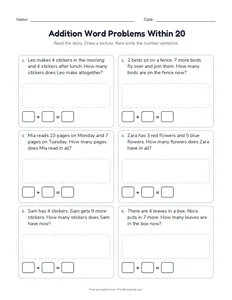
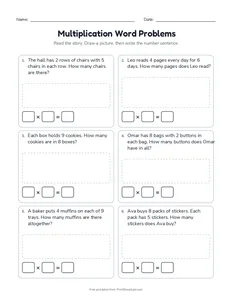

Quick answer: Math word problems worksheets are stories where children decide which operation to use and show the work. This page has 18 free printable math word problems worksheets with answer keys for addition, subtraction, multiplication, division and two-step problems. Updated October 2026.
Math word problems worksheets to print (PDF)
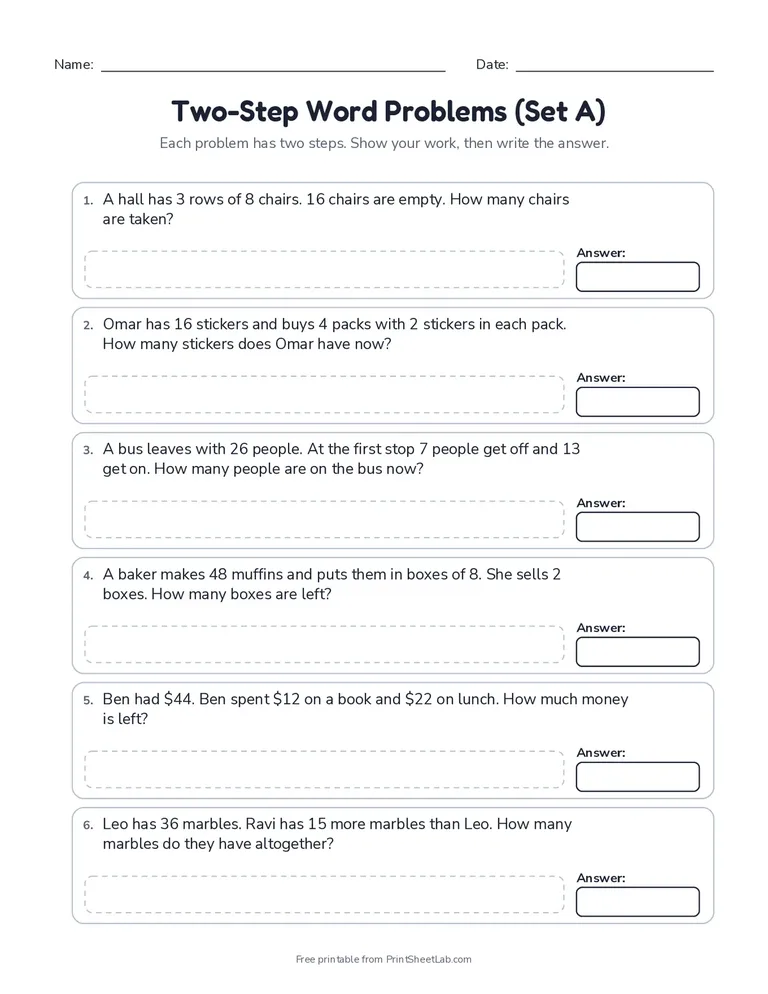
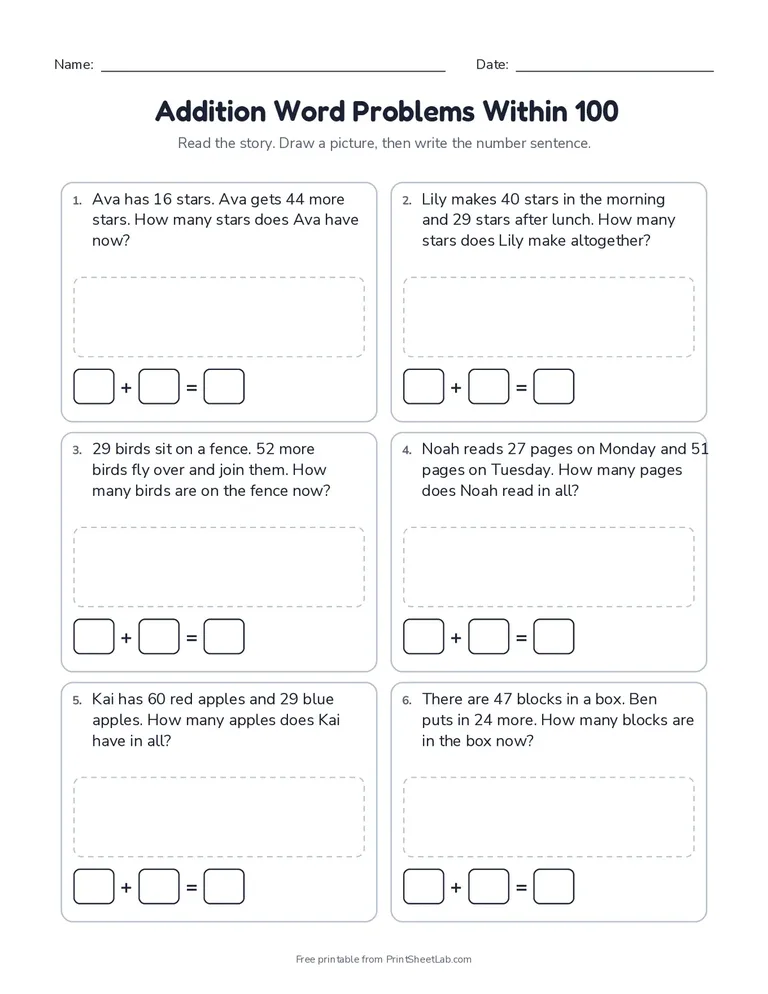
These math word problems worksheets are a sample of the 18 printable PDFs in this section, from one-step stories to two-step problems. Click a picture for the PDF, or open one of the sets below.
Reading math, not just doing math
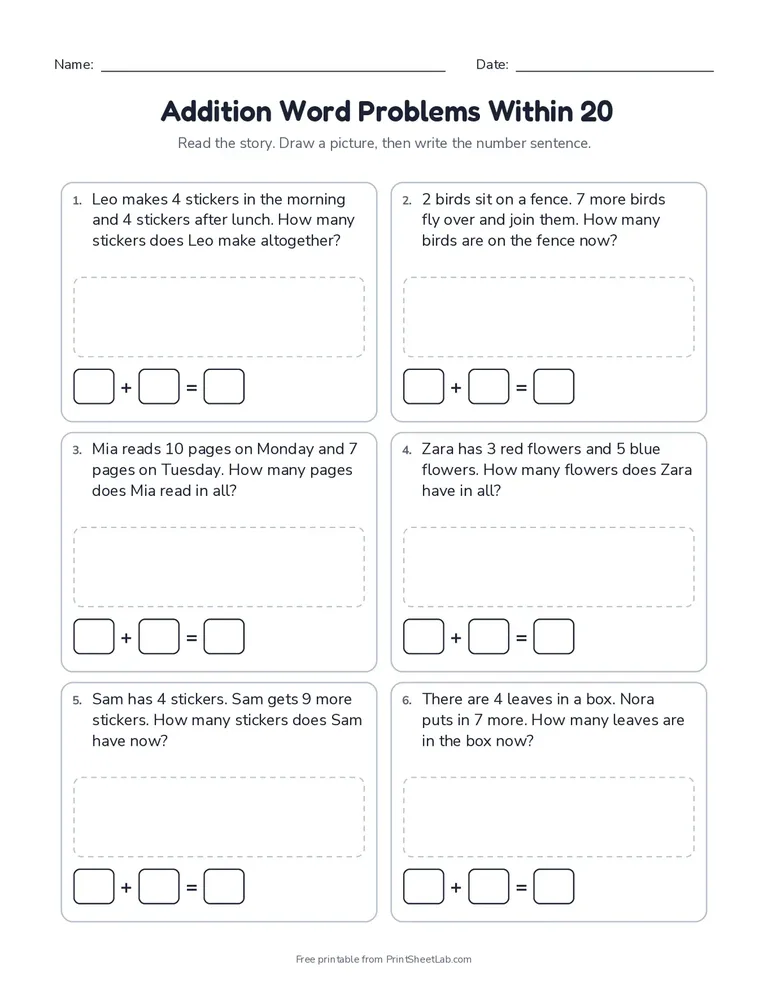
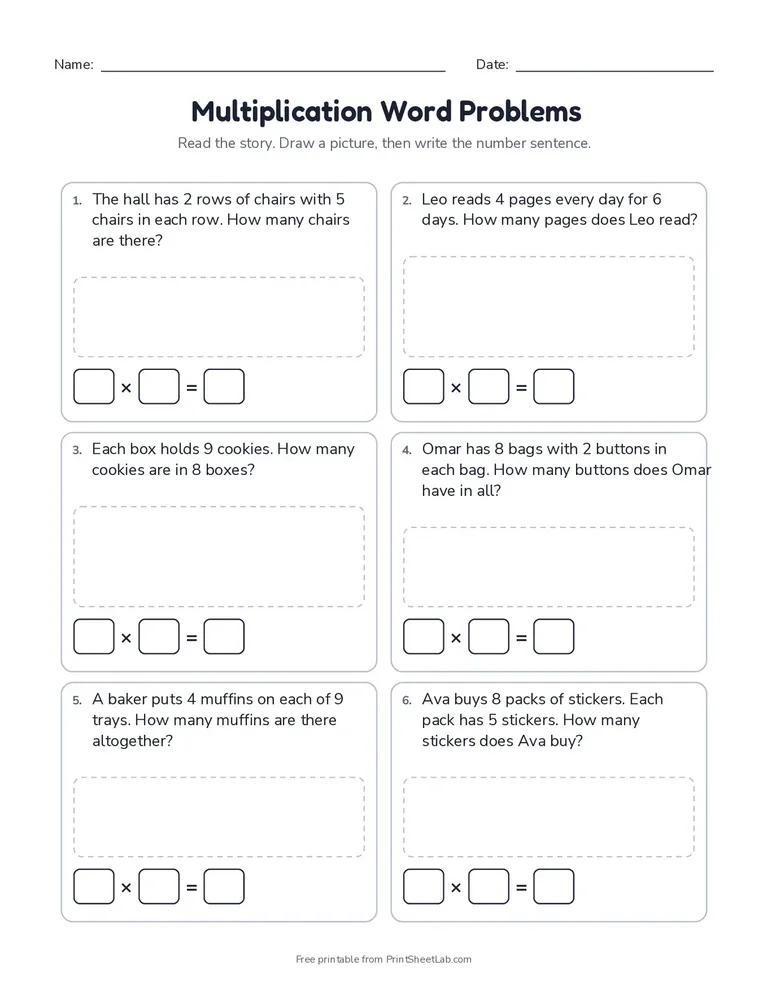
Word problems ask children to decide what to do, not just how to do it. The best habit is to picture the story: draw it, then write the number sentence. Every one-step worksheet here has a space to draw and boxes for the number sentence; the two-step problems have a work space, because they need a plan.
A simple plan for any word problem
- Read it twice. What is the question actually asking?
- Draw or picture what happens.
- Choose the operation: joining, taking away, equal groups or sharing.
- Solve, then check the answer makes sense in the story.
Word problems by grade
| Grade | What children solve | Standard |
|---|---|---|
| Grade 1 | Adding and subtracting within 20: joining, taking away and comparing stories | 1.OA.A.1 |
| Grade 2 | One- and two-step problems within 100 | 2.OA.A.1 |
| Grade 3 | Two-step problems with all four operations; equal groups and sharing | 3.OA.D.8 |
| Grade 4 | Multistep problems, including remainders that must be interpreted | 4.OA.A.3 |
Draw a bar model
A bar model (also called a tape diagram) turns the story into a picture of the numbers. Draw one long bar for the total and split it into parts. If the total is missing, add the parts; if a part is missing, subtract. For equal groups, draw a bar split into equal pieces and multiply or divide.
Worked example: a two-step problem
Maya buys 3 notebooks at $4 each and pays with a $20 note. How much change does she get?
- Step 1, the cost: 3 × $4 = $12.
- Step 2, the change: $20 − $12 = $8.
- Check: does $8 make sense? $12 + $8 = $20, so yes.
Keywords help, but only a little
Lists of “keywords” (in all means add, left means subtract) can mislead: “Sam has 5 more stickers than Leo. Sam has 12. How many does Leo have?” contains “more” but needs subtraction (12 − 5 = 7). Teach children to picture the story first and use keywords only as a hint.
Common mistakes
- Using every number in the problem, even ones that are not needed.
- Stopping after the first step of a two-step problem.
- Forgetting the units in the answer ($8, not 8).
- Not checking whether the answer is sensible (a child cannot be 70 years younger than their brother).
What is in the math word problems worksheets
There are 18 math word problems worksheets in three sets for grades 1 to 4, each with an answer key:
- Addition and subtraction word problems (Grades 1 and 2, 8 worksheets)
- Multiplication and division word problems (Grades 3 and 4, 5 worksheets)
- Two-step word problems (Grades 3 and 4, 5 worksheets)
Addition and subtraction word problems: the story types
There are only a few kinds of addition and subtraction word problems, and children who learn to recognize them solve problems much more easily. The Common Core describes these types, and the number that is unknown changes how hard a problem is. A child who finds “5 + 3 = ?” easy may find “? − 4 = 5” hard, even though the numbers are small:
| Story type | Example | Number sentence | Answer |
|---|---|---|---|
| Add to, result unknown | Maya has 5 stickers. Her friend gives her 3 more. How many does she have? | 5 + 3 = ? | 8 |
| Add to, change unknown | Maya has 5 stickers. Her friend gives her some more. Now she has 8. How many did she get? | 5 + ? = 8 | 3 |
| Take from, result unknown | There are 9 birds. 4 fly away. How many are left? | 9 − 4 = ? | 5 |
| Take from, start unknown | Some birds were on a wire. 4 flew away and 5 are left. How many were there? | ? − 4 = 5 | 9 |
| Put together | 6 red balls and 7 blue balls are in a bag. How many balls? | 6 + 7 = ? | 13 |
| Compare | Sam has 12 cards. Leo has 7. How many more does Sam have? | 12 − 7 = ? | 5 |
The addition and subtraction word problems worksheets mix these types on purpose. Drawing a picture or a bar model works for every one of them. The bar model is the main tool of Singapore math, and it carries over to fractions and algebra later on.
Multiplication word problems: groups, arrays and comparisons
Multiplication and division word problems also have types. Grade 3 children meet equal groups and arrays, and sharing and grouping problems, which are two kinds of division. Multiplication word problems with a comparison, such as “3 times as many”, come in grade 4:
| Story type | Example | Number sentence | Answer |
|---|---|---|---|
| Equal groups | 4 bags with 6 apples in each bag. How many apples? | 4 × 6 = ? | 24 |
| Sharing equally | 24 apples shared among 4 children. How many does each child get? | 24 ÷ 4 = ? | 6 |
| Grouping | 24 apples are put in bags of 6. How many bags? | 24 ÷ 6 = ? | 4 |
| Array | A garden has 5 rows of 8 plants. How many plants? | 5 × 8 = ? | 40 |
| Multiplicative comparison | A book has 3 times as many pages as a magazine with 32 pages. How many pages? | 3 × 32 = ? | 96 |
Notice that sharing and grouping use the same division fact, 24 ÷ 4 and 24 ÷ 6, with different meanings. This is why children should say what the answer counts, such as “apples per child” or “bags”.
Two step word problems: worked examples
Two step word problems need a plan, because the first answer is not the final one. A good habit is to ask: “What do I need to find first?” These three examples are typical for grade 3 (3.OA.D.8):
| Problem | Step 1 | Step 2 | Answer |
|---|---|---|---|
| Maya buys 3 notebooks at $4 each and pays with a $20 note. How much change does she get? | 3 × $4 = $12 | $20 − $12 = $8 | $8 |
| A baker makes 5 trays of 12 muffins and sells 38. How many are left? | 5 × 12 = 60 | 60 − 38 = 22 | 22 muffins |
| Sam has 48 marbles and gives 6 to each of 5 friends. How many does he have left? | 5 × 6 = 30 | 48 − 30 = 18 | 18 marbles |
Each answer should pass a check: does it make sense in the story? Four muffins left after selling 38 of 60 would be wrong, because 60 − 38 is 22.
Word problems grade 2: one step within 100
Word problems grade 2 use numbers within 100, with one step, and the Common Core expects children to solve all the types in the first table (2.OA.A.1). The word problems in the first set are written with short sentences, large print and room to draw, so that reading is not the barrier. Children can say each problem in their own words before they solve it.
Read, draw, write: a four-step routine
- Read the problem twice, and say what it asks.
- Draw a picture or a bar model of the story.
- Write a number sentence with a question mark for the unknown.
- Write a statement that answers the question, with units, such as “Maya gets $8 in change.”
The routine works for any of the math word problems worksheets, and the worksheet pages have a space for each step. Wikipedia’s article on the word problem in mathematics education explains why these problems are such an important part of the curriculum.
Frequently asked questions
5 quick answers
How do children know whether to add or subtract?
Picture the story. If things are joined together, add. If some are taken away, or two amounts are compared, subtract.
What makes a problem two-step?
It needs two calculations, such as multiplying to find the total cost and then subtracting to find the change.
What are good word problems for grade 2?
Stories within 100 that need one or two steps, such as “There were 45 apples. 18 were eaten and 20 more were picked. How many are there now?” (45 − 18 + 20 = 47).
How can I help my child who struggles with word problems?
Read the problem aloud together, act it out with toys or draw it, and ask “what is happening in the story?” before any numbers are written.
Where can I download free math word problems worksheets?
Open any worksheet on this page or on a topic page, choose US Letter or A4, then print or save the PDF. All are free, with answer keys.