A storyboard template lets you plan a video, an animation, a story or a presentation one frame at a time. These free printable storyboard templates have 3, 4, 6, 8, 9 or 12 frames in 16:9, 4:3 or square shape, with lines for notes under each frame. Pick the layout and print the PDF.
Storyboard template to print (PDF)
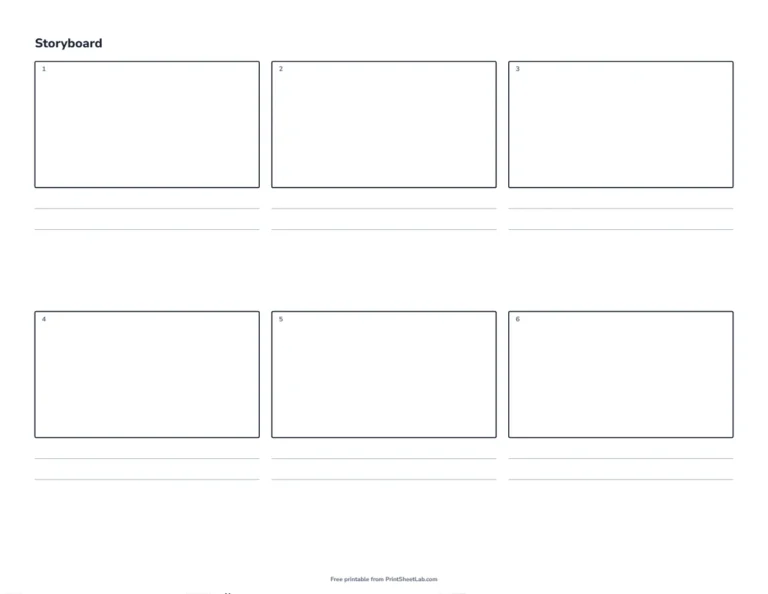
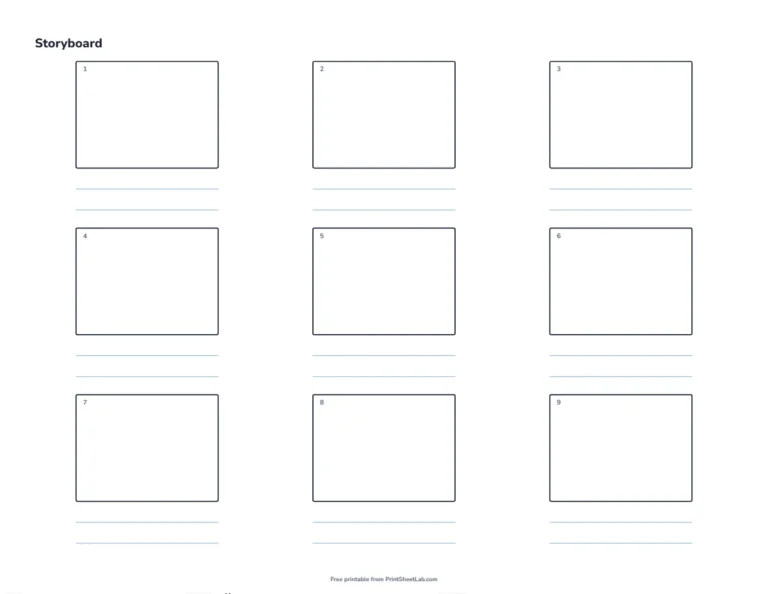
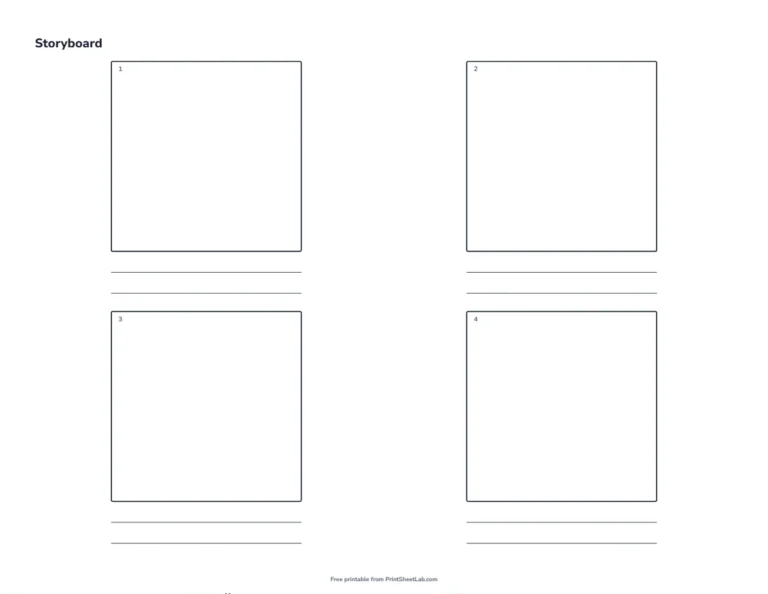
These four pages show the choices: 6 frames in 16:9, 9 frames in 4:3, 4 square frames, and a finished example of a school bus story. Click a picture for the PDF, or use the generator above to choose the number of frames, the frame shape and whether to print note lines.
Storyboard template sizes: how big is each frame?
Storyboard sheets print in landscape by default. Each frame is numbered in the corner, and two lines under it are for the shot description and the sound or dialogue. This table lists the size of one frame on US Letter paper:
| Frames | Layout | 16:9 frame | 4:3 frame | Square frame |
|---|---|---|---|---|
| 3 | 3 across, 1 down | 3.21 x 1.81 in | 3.21 x 2.41 in | 3.21 x 3.21 in |
| 4 | 2 across, 2 down | 4.84 x 2.72 in | 3.63 x 2.72 in | 2.72 x 2.72 in |
| 6 | 3 across, 2 down | 3.21 x 1.81 in | 3.21 x 2.41 in | 2.72 x 2.72 in |
| 8 | 4 across, 2 down | 2.37 x 1.33 in | 2.37 x 1.77 in | 2.37 x 2.37 in |
| 9 | 3 across, 3 down | 2.71 x 1.53 in | 2.04 x 1.53 in | 1.53 x 1.53 in |
| 12 | 4 across, 3 down | 2.37 x 1.33 in | 2.04 x 1.53 in | 1.53 x 1.53 in |
The 16:9 frame matches the shape of a modern video screen, 4:3 is the shape of older television and many slides, and the square frame suits social media posts and picture books. Turn the note lines off if you only want drawing space.
Printable storyboard: how many frames do you need?
A good rule for planning is to use one frame for each shot. Most shots in a short video last about three to five seconds, so the number of frames gives you an estimate of the running time. This table uses four seconds a shot as a planning guess:
| Frames | Running time at 4 seconds a shot | Good for |
|---|---|---|
| 3 | 12 seconds | A very short clip, a GIF or an ad idea |
| 4 | 16 seconds | A four-beat joke or a short social video |
| 6 | 24 seconds | A short story, a stop-motion clip or a class retelling |
| 8 | 32 seconds | A short scene with a build-up |
| 9 | 36 seconds | A scene with a twist |
| 12 | 48 seconds | A short film trailer or a longer sequence |
These are estimates, not rules. A long take can run on for a minute, and a fast montage can change every second.
Storyboard shot types: what to write under each frame
Professional storyboards name the kind of shot in each frame, so everyone on the team can picture it. Write the shot type on the first note line and the sound, dialogue or action on the second:
| Shot | What it shows | Use it for |
|---|---|---|
| Wide or establishing shot | The whole scene and where everyone is | The first frame of a scene |
| Medium shot | A person from the waist up | Conversation and action |
| Close-up | A face or an object filling the frame | Emotion and important details |
| Extreme close-up | A tiny part, such as an eye or a lock | Tension and surprise |
| Over-the-shoulder | One person seen from behind another | Dialogue |
| High angle and low angle | Looking down at, or up at, the subject | Making someone seem small or powerful |
| Pan, tilt, zoom | The camera sweeps sideways, up or down, or moves in | Following action or revealing something |
Wikipedia’s storyboard article explains how the method grew out of animation studios in the 1930s and spread to films, advertising and software design.
Storyboard example: a school bus in six frames
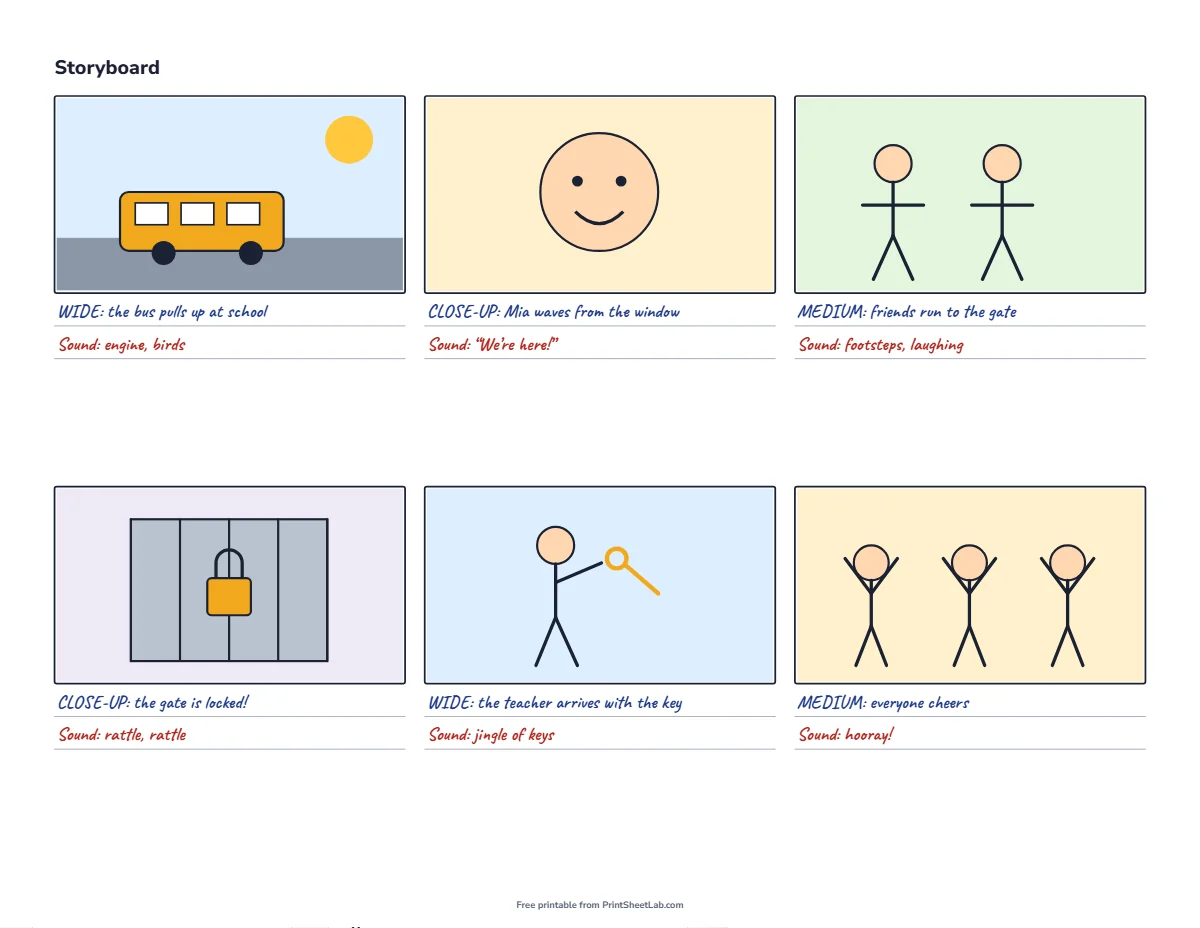
The filled example above is a six-frame story. Frame 1 is a wide shot that shows where we are. Frames 2 to 4 are the setup and the problem: a close-up of Mia, her friends running, and the gate that is locked. Frames 5 and 6 are the solution and the ending. Notice that every frame has one idea, and that the notes say what we hear as well as what we see. Rough stick figures are fine, because a storyboard is a plan, not a picture to hang on the wall.
Video storyboard template: planning a story in three parts
Most stories have a beginning, a middle and an end, and a six-frame video storyboard template splits them evenly:
- Frames 1 and 2, the setup. Who is the character, and where are they? What do they want?
- Frames 3 and 4, the problem. Something gets in the way, and the tension builds.
- Frames 5 and 6, the solution. The character solves the problem, and the story ends.
For longer stories, use 9 or 12 frames. Three rows of three give each part of the story one row.
Storyboard for kids: classroom uses
- Retelling a story. Children draw the beginning, middle and end of a book they have read, and write one sentence under each frame.
- Planning writing. A storyboard is a good way to plan a narrative before drafting. The pictures come first, and the sentences follow.
- Science and history. Show the steps of an experiment, the stages of a life cycle or the order of events in a battle.
- Video and animation projects. Plan every shot before the camera comes out, which saves a great deal of time.
- Presentations. Use 4:3 frames to plan slides and see how the talk flows.
For writing with a picture box, try story paper, and for a page of free-form panels see the comic book template.
Printing tip
Print at 100% or “Actual size” and turn off “Fit to page”, so every measurement on the sheet is exact. Choose Letter or A4 paper in the generator before you download the PDF.
Storyboard template: frequently asked questions
Which frame shape should I use?
Use 16:9 for video, 4:3 for slides and older video, and square for social media and picture books.
How many frames should a storyboard have?
Use one frame for each shot. Six frames suit a short story, and nine or twelve suit a longer scene.
Can I print a storyboard without lines for notes?
Yes. Turn off the note lines in the generator and the frames become taller. This suits a sketch-only storyboard.
What is the difference between a storyboard and a comic page?
A storyboard plans a video or a story with numbered frames of the same size, while a comic page has panels of different sizes. For that, see the comic book template.
Is this storyboard template free?
Yes. It is free to print for home and classroom use, with no sign-up.
More printable paper
- Specialty paper generator with every layout on this site
- Paper generator for lined, graph, dot grid, isometric and handwriting paper
- Graph paper, lined paper and dot grid paper