Camping bingo gives everyone at the campsite a reason to look up, look around and listen. The template on this page has 30 squares, from the tent and the campfire to a hooting owl, a shooting star and wet socks. You print a card for every camper, and the first person to mark a line wins a story, a s’more or the best seat by the fire.
In short: press Edit and print this card in the card maker above, choose a grid size and the number of cards, and download one PDF. It is free, it works offline once the page has loaded, and nothing you type is sent anywhere.
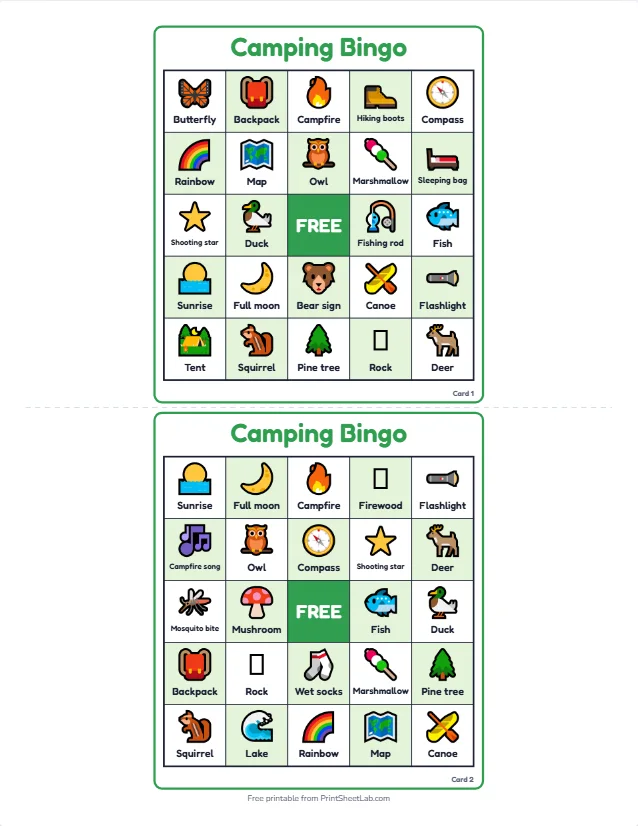
How to play camping bingo
A camping trip already runs on a rhythm: arrive, set up, cook, sit by the fire, sleep, wake, hike, repeat. Camping bingo sits on top of that rhythm. Each camper has one card and a pencil on a string or a stub of a crayon, and marks a square the moment they see, hear or do that thing.
- Give out cards after the tent is up. Setting up is work for the grown-ups; a camping bingo card is what keeps the kids from underfoot.
- Set the rules at the fire ring. Squares must be seen with your own eyes, or heard for the owl and the campfire song. One mark per square.
- Look but never touch. Wildlife squares are for spotting from a distance, and plants and mushrooms are never picked or eaten.
- Shout it out. The camper who completes a line announces it, and a second camper confirms the squares.
- Keep the cards for the next trip. A finished camping bingo card goes in the camp journal with the date and the place.
Camping bingo is a slower game than most. The squares you cannot control, such as a full moon, a rainbow or a bear sign, are exactly what makes a win feel earned. Players learn to scan the tree line at dawn and to switch off the flashlight for a minute at night to look for a shooting star, which is half the point of a camping trip anyway.
Camping bingo cards: all 30 squares by zone
The camping bingo cards use 30 squares. A 5×5 card with a free center needs 24 of them, so every card leaves out six and the mix of squares changes from camper to camper. The table groups the full list by where you will find each one.
| Zone | Squares | Notes |
|---|---|---|
| Camp and gear | ⛺ Tent, 🔥 Campfire, 🪵 Firewood, 🔦 Flashlight, 🍡 Marshmallow, 🎒 Backpack, 🧭 Compass, 🗺️ Map, 🛏️ Sleeping bag, 🥾 Hiking boots, 🎶 Campfire song, 🧦 Wet socks | The reliable squares. Nearly all are marked on the first evening. |
| Wildlife | 🦌 Deer, 🐿️ Squirrel, 🦉 Owl, 🦆 Duck, 🦋 Butterfly, 🐻 Bear sign, 🦟 Mosquito bite, 🐟 Fish | Depend on where you camp. Squirrels are everywhere, bear signs are rare, and most animals are seen at dawn and dusk. |
| Plants and ground | 🌲 Pine tree, 🍄 Mushroom, 🪨 Rock | Easy in a forest. A mushroom is a spotting square only. |
| Water and sky | 🌊 Lake, 🛶 Canoe, 🎣 Fishing rod, 🌙 Full moon, ⭐ Shooting star, 🌅 Sunrise, 🌈 Rainbow | The luck zone. The moon and the rainbow are mostly out of your control. |
Our chart ranks all 30 squares by how likely each one is to be marked during a Friday-to-Sunday campout. The percentages come from the assumptions in the simulation section further down, and they are an informed guess, not a survey. What the chart does show is the balance of camping bingo: about a third of the squares are close to certain, a third need some luck, and a handful, such as the bear sign, the rainbow and the full moon, are real long shots.
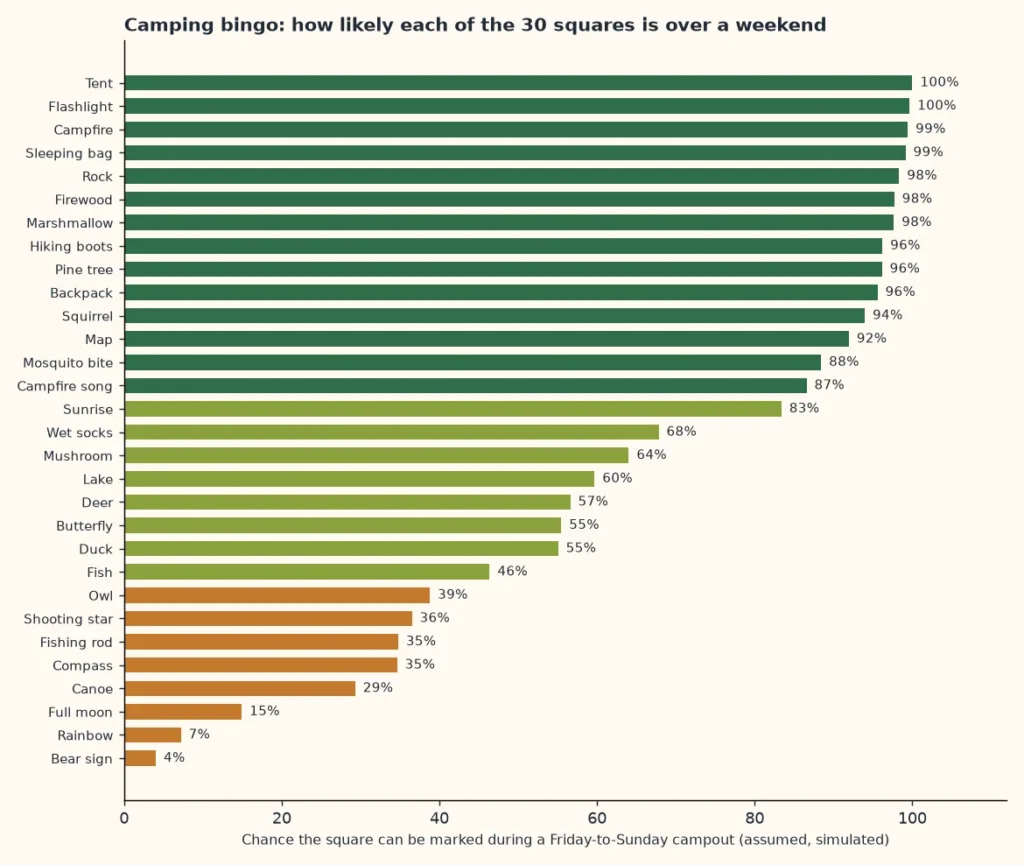
If you want a camping bingo card that everyone completes, edit the list: replace the full moon and the bear sign with squares such as “Hot chocolate” or “Someone snores.” If you want a challenge for experienced campers, do the opposite and keep the long shots.
How many different cards exist?
Thirty squares and 24 places on a 5×5 card give 30 choose 24 = 593,775 different sets of squares, and each set can be placed in a very large number of orders. For a 4×4 card (16 squares) there are 145,422,675 sets, and for a 3×3 card with a free center (8 squares) there are 5,852,925. Even a large scout troop can have different camping bingo cards for every camper.
Camping scavenger hunt bingo: the trail version
Camping scavenger hunt bingo takes camping bingo on a hike. Instead of waiting for things to appear, teams walk a loop and hunt for the squares. It suits scout groups, school trips, family reunions at a state park and any group of children who need a purpose for a walk. Pick a 4×4 card, set a time limit of about an hour, and send teams of two or three with a grown-up each.
- Photograph, do not collect. Take a picture of the square, and leave the pinecone, the feather and the rock where they are. Follow the Leave No Trace principles so the next group finds the same things.
- Scoring. One point per square, a bonus for a line, and a bigger bonus for a four-corners finish. Teams meet back at the fire ring and show their photos.
- Pick squares for the place. A trail without a lake cannot have a canoe. Swap those for things you can find: a log, a feather, a leaf with three points, a bird song.
- Stay together. A hunt that splits a group in the woods is a risk. Keep to the trail, and make sure each team has a map, a whistle and water.
- Time and weather. Set a firm turnaround time, and call the game off if the sky darkens.
A camping bingo scavenger hunt works with younger kids too, if the squares are changed to simple things: a stick shaped like the letter Y, something green, something that makes a sound. You can build the card in a few minutes in the Items tab and print one per team. The card maker also has a classroom bingo template for a school trip that comes before the camp.
Three ways to run a camping bingo game
One set of printed camping bingo cards supports three different games. A weekend trip often uses all of them.
| Game | When | How it runs | Prize idea |
|---|---|---|---|
| Campsite spotting | The whole trip | Everyone marks squares as they see them | First line: first marshmallow off the fire |
| Campfire calling game | One evening, 15 to 25 minutes | A caller draws cut-out squares from a hat and reads them out; campers mark what they have done or seen so far | Winner picks the next campfire song |
| Trail scavenger hunt | A morning hike | Teams find and photograph squares | The winning team chooses the lunch spot |
The weekend spotting game
This is the main camping bingo game, and it needs no caller. Hand out cards on Friday and let the weekend happen. Because many of the squares are certain to be marked on the first evening, the early game goes fast, and the slow part is the long-shot squares. Set two goals: a line for a small prize on Saturday morning, and as many squares as possible by the time the car is packed on Sunday. A blackout is possible only on a small card, as the numbers below show.
The campfire calling game
For one evening of this camping bingo game, use the Print tab to print calling cards to cut out. Put them in a camp mug or a hat. A caller draws one and reads it aloud, and each camper marks that square if it is on their card and they have really seen it on this trip.
It is a ten-minute recap of the weekend as much as a game. For a larger scouting group or a family reunion, host the game on a big screen with the play bingo online page, though most campgrounds have too little signal for that.
The trail scavenger hunt
The hunt uses the rules above. It is the best of the three camping bingo formats for a group of unrelated children, such as a day camp, because it teaches them to look at the ground, the trees and the sky.
Printable camping bingo: waterproof, windproof and kid-proof
Printable camping bingo faces tougher conditions than a card on a kitchen table: dew, smoke, sticky fingers and wind. A few choices at the printer help camping bingo survive. In the Print tab you pick how many different cards to print (1 to 100), how many per page (1, 2, 4 or 6), Letter or A4 paper, and portrait or landscape. Two camping bingo cards per page, cut in half and tucked into a zip bag, are a very good camping size.
- A zip bag or a plastic sleeve per card. It keeps dew and drink spills off the card, and a dry-erase marker works through some thin sleeves.
- Print on heavier paper. Cardstock stands up to damp tents better than copy paper.
- Use a pencil on a string. A pencil is more reliable than a pen on a damp page and does not dry out.
- Keep a clipboard or a hardcover notebook. A card needs a flat surface to be marked on.
- Print before you go. Few campgrounds have a printer, and the shareable link in the card maker stores only the words of your list, so a friend can print their own set.
The Design tab lets you choose a forest or sunset color theme, large text for reading by lantern light, and ALL CAPS if you like. High-contrast borders and bigger text are easier to read at dusk. The Print tab can also add cut guides and a caller sheet.
Camping bingo for kids
Camping bingo for kids is one of the few camping games that gets a child to sit still and look at nature for ten minutes. Younger kids need pictures and a short list, and older kids need a puzzle to solve. A grown-up should always be nearby, especially around fire, water and unfamiliar plants.
| Age | Card | How to play |
|---|---|---|
| 3 to 4 | 3×3, pictures only | A grown-up reads the square names and helps with the stickers. Skip the fire and water squares, or ask a grown-up to do them with the child. |
| 5 to 7 | 3×3 or 4×4 | Words and pictures together. Marks with a crayon. Celebrate every line. |
| 8 to 11 | 5×5 | Words only, with three squares the child writes. Add a rule that wildlife is marked by a drawing in the margin. |
| 12 and up | 5×5 or the scavenger hunt | Photos for proof, longer hikes and teams. Let them design the card for the next trip. |
A nice twist on camping bingo for school-age campers is the nature journal: when a square is marked, the child draws it in a notebook with the date. By the end of the weekend, the card is a record of a whole trip.
For a rainy day in the tent, camping bingo works as a quiet game, with squares such as the flashlight, the sleeping bag and wet socks all ticked without leaving the tent. And for the drive to the campground, the car games for kids guide has plenty of ideas that keep the back seat busy.
Camping bingo free printable: what you get
Free, private and offline-friendly
This camping bingo free printable asks for no account and no email, and has no watermark. The card maker runs in your browser, so the squares you write never leave your device. Open it once at home, make your camping bingo PDF and print or save it; nothing more is needed when you are in the woods.
What you can change
The editor has five tabs: Setup, Items, Design, Templates and Print. On the Items tab you can reword any square, add an emoji or your own photo, and give the free space its own text. Design handles color themes, fonts, text size, borders and rounded corners, backgrounds and a logo, and adds a title and footer such as the name of the campground. Templates holds the other starter lists, and Print produces the PDF, calling cards and a caller sheet.
How long does a camping weekend game last? A real simulation
How soon does somebody get a line in camping bingo? We simulated 8,000 weekend trips. The trip starts when you arrive on Friday at 5 p.m. and ends at 11 a.m. on Sunday, which is 42 hours. Each of the 30 squares has one to four chances to happen, each tied to a part of the trip and each with a probability.
A tent goes up in the first 90 minutes, a campfire is lit on Friday evening with 95% probability and again on Saturday evening, owls are heard on a given night with about a 22% chance, a shooting star shows with about 20% on each clear night, and a full moon with about 8% a night.
The bear sign is a 4% chance on Saturday. Each camping bingo card is 24 squares chosen at random from the 30, with the free center, and the first line is the earliest time any camper completes a row, column or diagonal.
Chance of a line and when it arrives
| 5×5 card | Median time of first line | Line by Saturday morning | Line by Saturday 8 p.m. | Line by Sunday 11 a.m. |
|---|---|---|---|---|
| 1 camper | Saturday 4:13 p.m. | 11% | 71% | 84% |
| 4 campers | Saturday 7:55 a.m. | 34% | 97% | 99% |
| 8 campers | Saturday 4:55 a.m. | 53% | 99% | 100% |
A lone camper with a 5×5 card has a line about 84% of the time by the end of the weekend, so roughly one in six lone campers goes home without one. With four campers, at least one of them gets a line in 99% of weekends, and with eight it is almost certain. The big jump comes on Saturday daytime, when hiking, wildlife and the lake add squares.
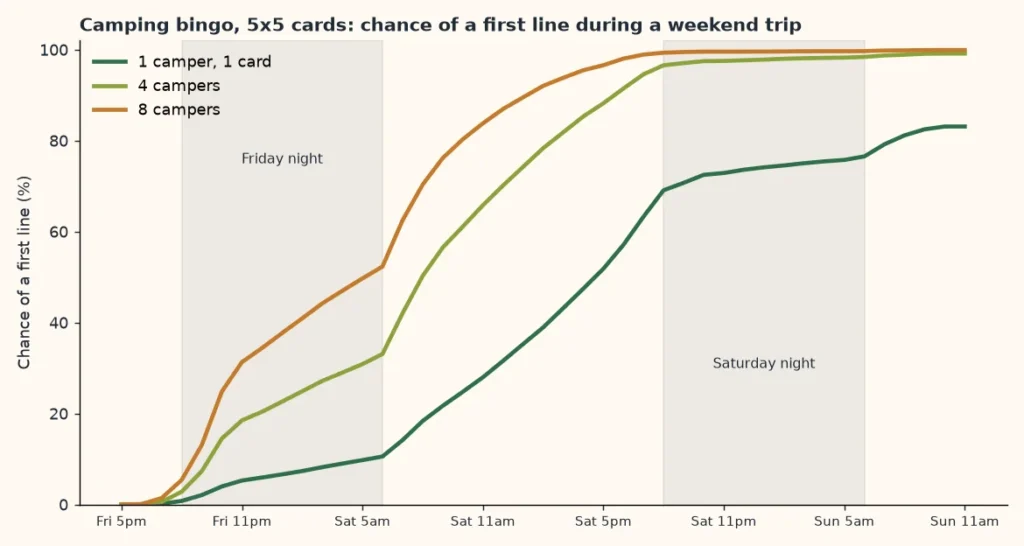
The shaded bands are the nights. The curves are nearly flat then, since little can be marked in the dark apart from the owl, the moon, the stars and the flashlight. The first evening of camping bingo gives a lot of squares quickly, but not enough for a line on its own: the average 5×5 card has only about 9 of its 24 squares marked by Saturday morning.
Smaller cards are a different game
| Card | Median first line, 4 campers | Line by Friday 10 p.m., 4 campers | Full card by Sunday, 1 camper | Full card by Sunday, 8 campers |
|---|---|---|---|---|
| 3×3 with free center | Friday 7:51 p.m. | 80% | 4% | 24% |
| 4×4 | Saturday 6:38 a.m. | 22% | 0% | 0% |
| 5×5 with free center | Saturday 7:55 a.m. | 14% | 0% | 0% |
A 3×3 card is a first-night game: with four campers, the median first line lands at Friday 7:51 p.m. and about 80% of weekends have a winner by Friday 10 p.m.
A 5×5 camping bingo card is a whole-weekend game, and a full 5×5 card is almost impossible in 42 hours: about 0% for a single camper, because squares like the bear sign and the full moon rarely happen. On a typical 5×5 card the camper ends the weekend with about 16 of the 24 squares marked (the middle 80 percent range from 14 to 19).
The assumptions, so you can judge the numbers: the chances above are our estimates for a wooded campground near a lake; events are independent; a camper marks every square that happens; and each camper has a different random card but shares the same events. A desert or a coastal site would change the list and the numbers. A bright full moon on the weekend you choose changes the odds dramatically, so check the moon calendar before you pack. The simulation is a planning aid, not a promise of what you will see.
Safety and wildlife: what the squares do not ask you to do
Camping bingo is a game about looking, so its rules should keep campers safe and keep wildlife wild. Some squares need a note.
- Bear sign. It is a square for noticing tracks, scat or scratched trees from a distance. Never follow a track. Store food and scented items properly, as the campground or park rules say, and tell a ranger if you see signs near camp.
- Mushroom. Look, photograph, do not pick and never taste. Many wild mushrooms look alike, and some are dangerous.
- Deer, squirrel and duck. Do not feed or approach them. Spotting from a distance is the game.
- Campfire and marshmallow. A grown-up supervises the fire, and children keep a safe distance and hold roasting sticks away from their faces. Put the fire out fully before bed.
- Canoe and lake. Life jackets on, and an adult in the boat or on the shore.
- Flashlight and night squares. Walk in pairs, and keep the flashlight pointed at the ground when you walk to the toilets.
Local rules and seasons change what is safe, so check with the campground or park office before you go. Camping bingo should never push a camper past what is safe. If a square cannot be done safely, it stays blank.
Customize your camping bingo in the card maker
Camping is local, and the best camping bingo card is the one that fits your site. The Items tab turns each square into a text box. Type a new word, paste an emoji, or add your own photo. A few popular swaps follow.
- Park-specific squares. A landmark, a trail marker, a ranger station, the name of the lake.
- Desert or coast. Replace pine tree with cactus or tide pool, and owl with a lizard or a seagull.
- RV and glamping. Swap the sleeping bag for a camp chair and add “Hot shower” or “Camp coffee.”
- Campfire humor. “Someone burns a marshmallow,” “Ghost story,” “Someone loses a shoe.”
- Skills squares. Tie a knot, pitch a tent, read a compass, name a constellation.
If your list has exactly 24 squares, every card shows the same words in a different order. With more than 24, each card gets its own mix. Use the Design tab to add the campground name to your camping bingo title, and the dates in the footer. Press Shuffle for a fresh arrangement, and Undo if you change your mind. For a card with nothing printed, the blank bingo cards page lets you fill in every square by hand, and the bingo card generator offers every card type.
More bingo for the season
Camping bingo often sits in the middle of a summer plan. The summer bingo card tracks the whole break, and road trip bingo covers the drive to the campground. Browse every template on the printable bingo cards hub, or look at animal squares on the animal bingo page when the kids want to learn the wildlife. When someone cannot make the trip, play custom bingo online explains how to run a live game with your own list.
Frequently asked questions
10 quick answers
What is camping bingo?
Camping bingo is a bingo variation whose squares name things you may see, hear or do on a camping trip, such as a tent, an owl, a campfire or a shooting star. Campers mark a square when it happens, and the first to complete a line wins.
Is camping bingo free to print?
Yes. You can edit and print the cards without an account, a payment or an upload. The editor runs in your browser, and the PDF has no watermark.
How many squares are on the template?
The template has 30 squares. A 5×5 card with a free center uses 24 of them, a 4×4 uses 16 and a 3×3 with a free center uses 8, so cards differ from each other.
What is camping scavenger hunt bingo?
It is the same card used on a hike: teams walk a loop and photograph each square instead of waiting for it to appear. It works for scout groups, day camps and families, as long as an adult stays with each team.
How long does a camping bingo game last?
In our simulation of a Friday-to-Sunday trip, a 5×5 card has a first line at around Saturday 4:13 p.m. for a single camper, and a group of four usually has a winner by Saturday 7:55 a.m..
Can the whole family play together?
Yes. Give each camper a different card, or share one card as a team. A shared card works well with toddlers and grandparents in the same group.
What age is camping bingo for?
From about three, with a 3×3 picture card and a grown-up helping, up to adults on a 5×5 card or the scavenger hunt. Adjust the card, not the game.
Can I change the squares for my campground?
Yes. Every square on the Items tab can be replaced with your own words, an emoji or a picture. Local wildlife, a landmark or a family joke all make good squares.
Do I need internet at the campsite?
No. Make and print the cards before you go. The shareable link stores only your words, so a friend can open it at home and print a set.
How do I keep the cards dry?
Put each card in a zip bag or a plastic sleeve, use a pencil, and print on heavier paper. A clipboard helps keep the card flat in the wind.