This handwriting paper for kindergarten has a solid top line, a dashed midline and a baseline on every row, with a gap below for letters with tails. It starts with 1 inch rows, the size many preschool and kindergarten classes begin with, and you can add a picture box, a name line or red and blue lines, then download a free PDF for US Letter or A4.
New: type a name and print name tracing worksheets on this same handwriting paper, or print letter tracing and number tracing pages.
New: want a drawing box and a writing prompt too? Try the story paper maker with comic strips, story planners and poems.
Handwriting paper for kindergarten to print (PDF)
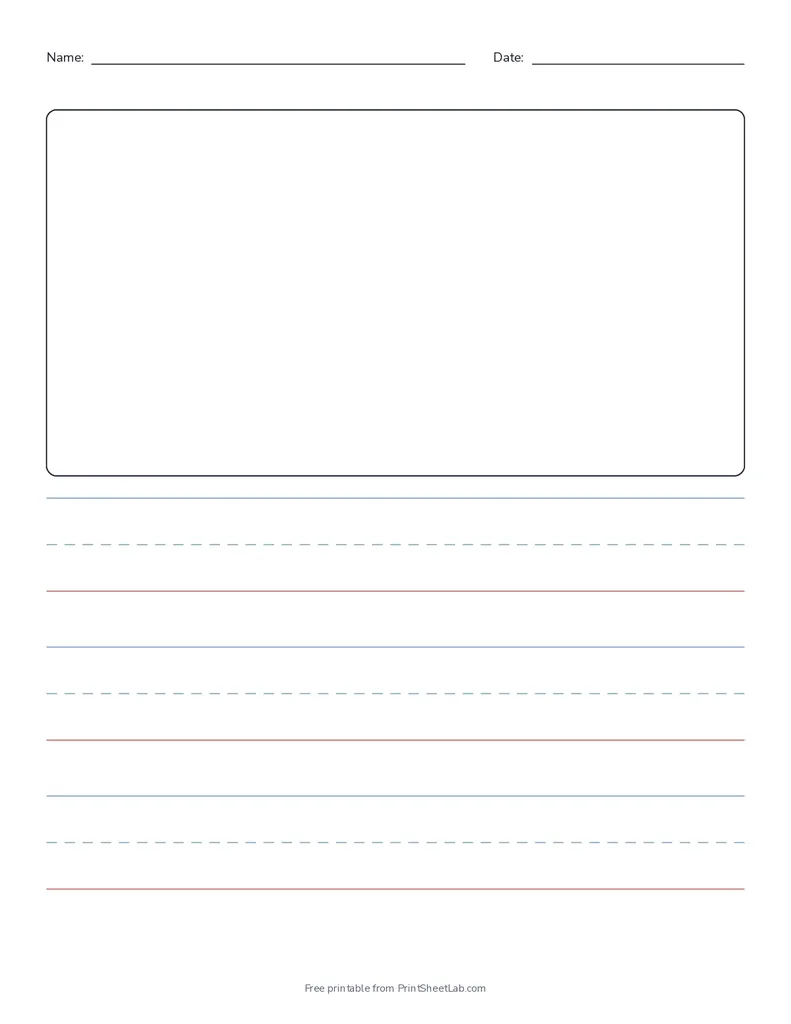
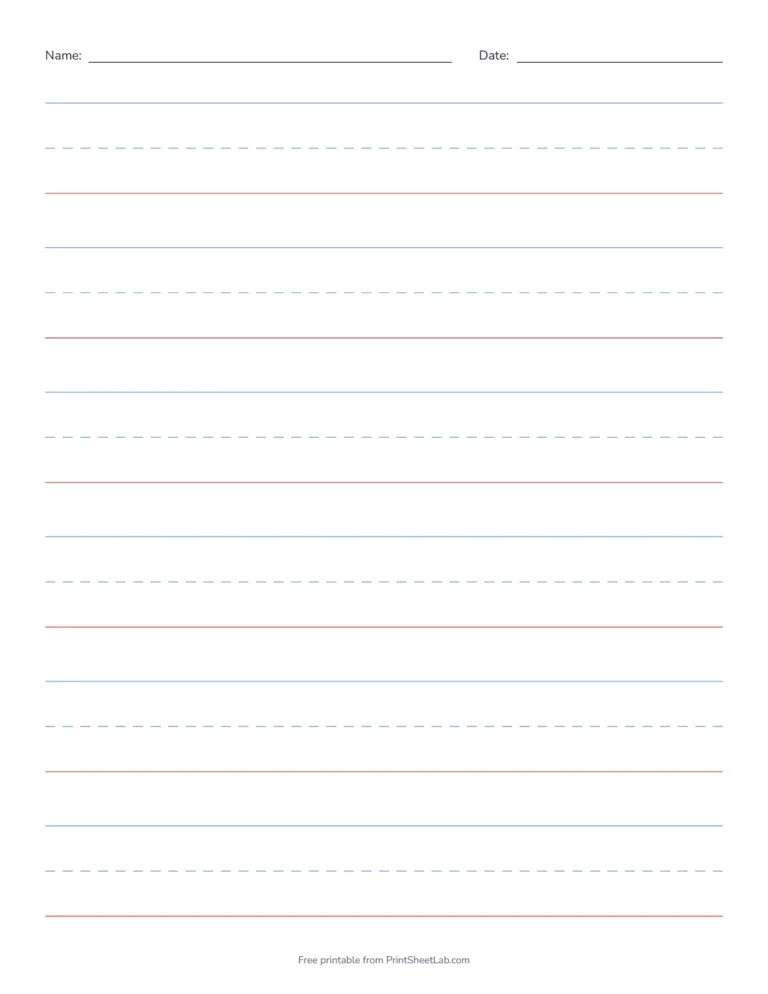
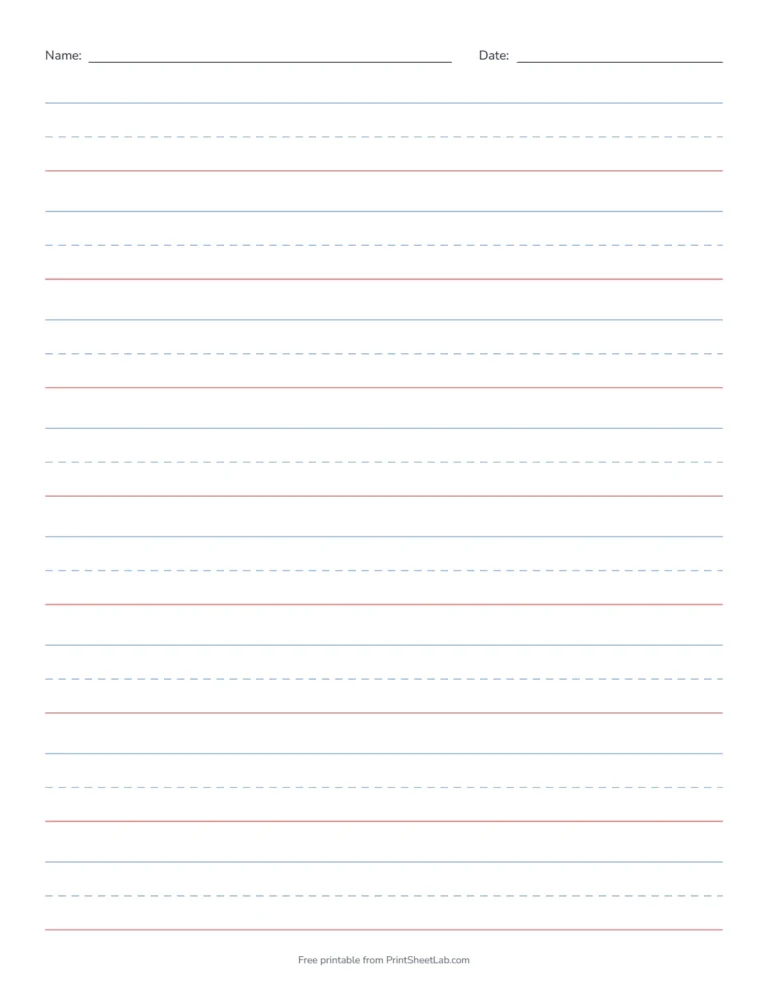
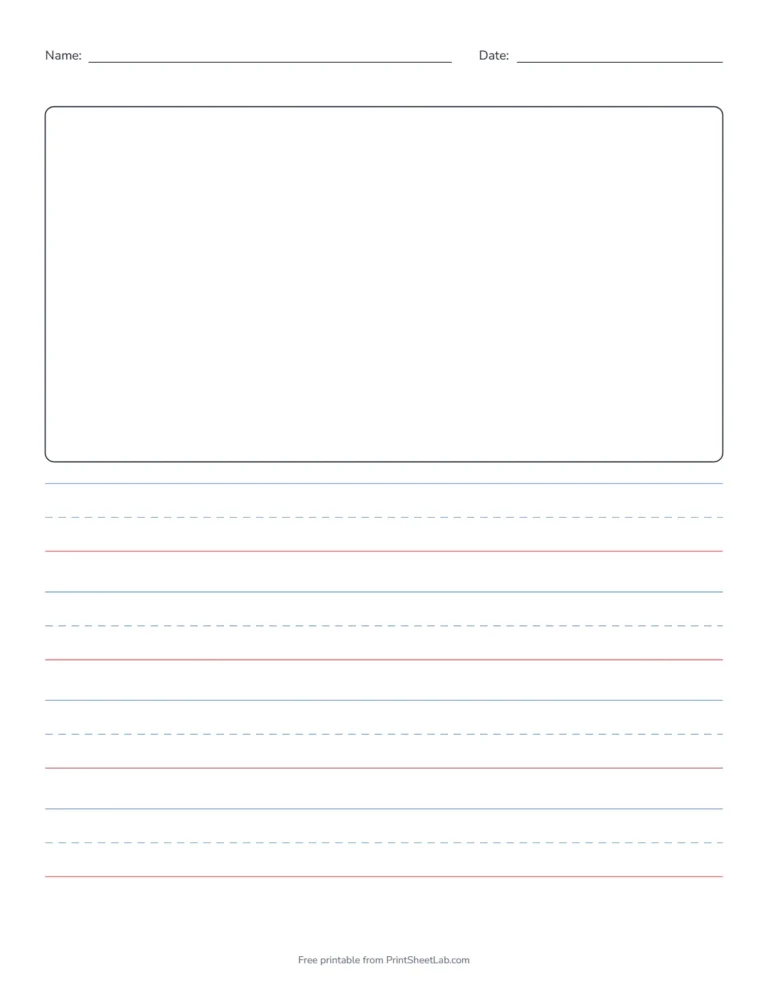
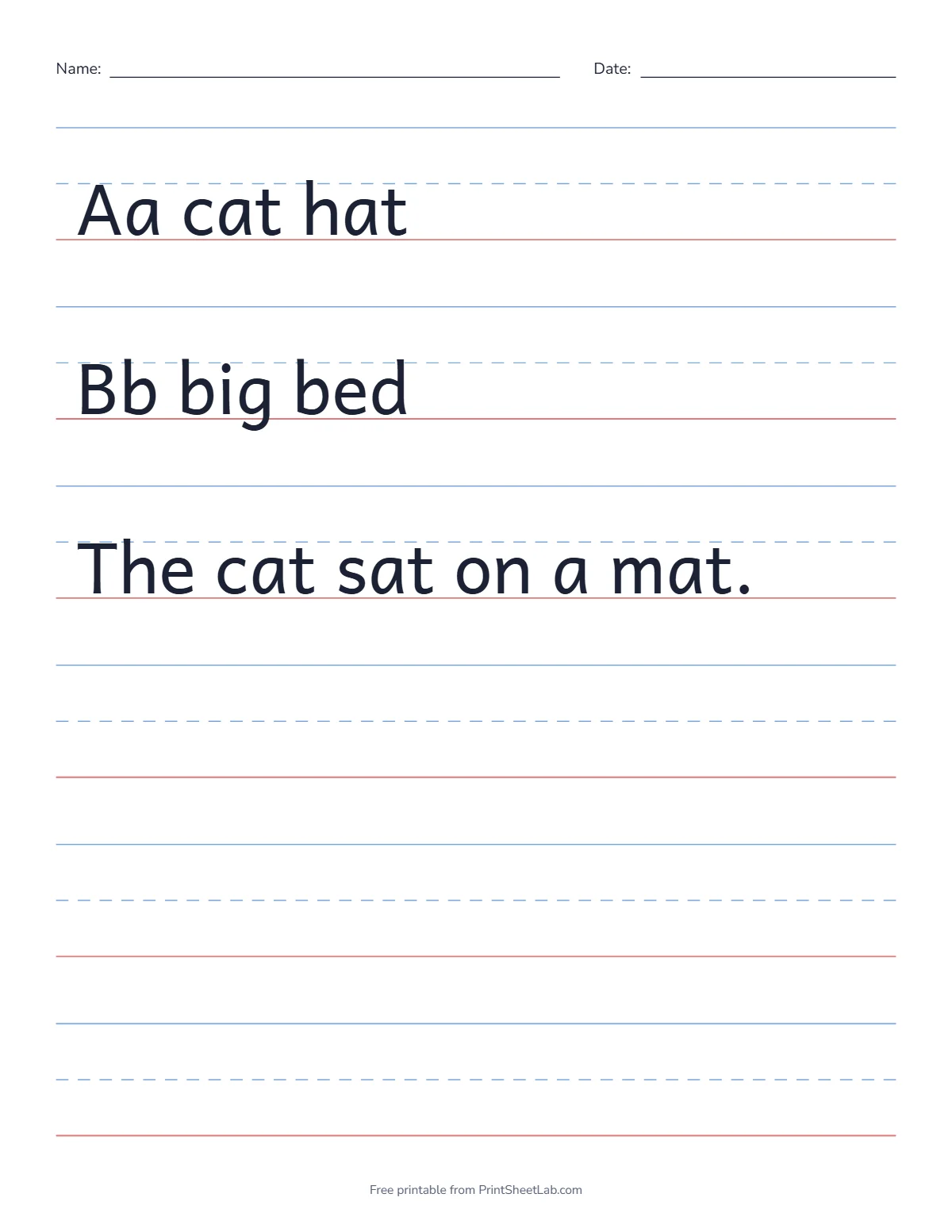
These four pages show the handwriting paper for kindergarten that the generator prints: 1 inch rows with a name line, 3/4 inch rows, primary writing paper with a picture box, and a filled example with first words. Click a picture for the PDF, or use the generator above to choose another row size.
What is kindergarten writing paper called?
Kindergarten writing paper goes by several names: primary writing paper, primary lined paper, handwriting paper, dotted line paper or story paper when it has a picture box at the top. In the UK it is often called handwriting practice paper or four-line paper. They all mean the same thing: rows made of a top line, a dashed midline and a baseline that show children how tall each letter should be.
What the lines on handwriting paper mean
| Line | Classroom name | What it shows |
|---|---|---|
| Top line | Sky line, headline | Where tall letters (b, d, f, h, k, l, t) and capitals reach |
| Dashed midline | Fence line, middle line | How tall short letters (a, c, e, m, n, o, r, s, u, v, w, x, z) are |
| Baseline | Ground line, red line | Where every letter sits |
| Space below | Worm space, basement | Room for the tails of g, j, p, q and y |
On the red and blue version, the baseline is red and the other lines are blue. Many teachers say “sit on the red line” so children always know where letters start and end.
Handwriting paper for kindergarten: which row size?
Children’s writing gets smaller as their control improves. These sizes are a common starting point; move down a size when letters start to fit comfortably.
| Stage | Row height (top line to baseline) | Rows per US Letter page |
|---|---|---|
| Preschool and early kindergarten | 1 inch | 6 (with name line) |
| Kindergarten to early grade 1 | 3/4 inch | About 8 |
| Grade 1 | 5/8 inch | About 9 |
| Grade 2 | 1/2 inch | About 12 |
| Grade 3 and up | 3/8 inch | About 15 |
Handwriting paper for kindergarten example: first words
The filled example above shows 1 inch rows with the first words a child might write: the letter pair Aa, the short words cat and hat, a second row for Bb, big and bed, and a sentence on the third row. Notice how the tall letters (h, b, d) reach the top line, the short letters touch the dashed midline, and every letter sits on the red baseline. When you print handwriting paper for kindergarten, write the model words at the start of each row in pencil, and let children trace and then copy them.
A five-day plan on handwriting paper for kindergarten
Short, regular sessions work better than one long one. This plan uses one sheet a day and takes about five minutes:
| Day | What to write on the handwriting paper for kindergarten | Time |
|---|---|---|
| Monday | Tall sticks from the top line to the baseline, then small circles | 5 minutes |
| Tuesday | Letters that start with a circle: c, a, d, g, o | 5 minutes |
| Wednesday | Letters that start with a stick: l, t, i, j, k | 5 minutes |
| Thursday | Your own name, one row of it | 5 minutes |
| Friday | A short sentence, such as “The cat sat on a mat.” | 5 to 10 minutes |
Print one sheet of handwriting paper for kindergarten for each day, and keep them in order, so that children can see how far they have come.
Handwriting paper with picture box: draw and write
Handwriting paper with picture box has a drawing space at the top and writing rows below. Ask your child to draw a picture first, then write one sentence about it on the lines. The picture gives children something to say, which makes the writing easier, and the drawing space gives the hand a break. Choose 3/4 inch rows for kindergarten and 5/8 inch rows for grade 1.
Red and blue handwriting paper: why the baseline is red
Red and blue handwriting paper uses blue for the top line and the dashed midline, and red for the baseline. The red line is the one children should write on, and it stands out as the line that matters most. If your printer is black and white, choose gray or black instead, because red and blue both print as gray.
How the alphabet uses the three lines of handwriting paper for kindergarten
Handwriting paper for kindergarten has three lines for a reason: the 26 lowercase letters sit in three zones. Just over half of them are short letters that stay between the dashed line and the baseline. The tall letters reach up to the top line, and the tail letters drop below the baseline:
| Group | Letters | How many | Share of the alphabet | Where they live on the row |
|---|---|---|---|---|
| Tall letters | b, d, f, h, k, l, t | 7 | 27% | Touch the top line and sit on the baseline |
| Short letters | a, c, e, i, m, n, o, r, s, u, v, w, x, z | 14 | 54% | Stay between the dashed midline and the baseline |
| Tail letters | g, j, p, q, y | 5 | 19% | Start at the midline and drop below the baseline |
This is why handwriting paper for kindergarten has a space below the baseline. Without it, the five tail letters would have nowhere to go, and children would write them too small or squeeze the next line.
Letter families on handwriting paper for kindergarten
Teaching letters in groups that share a first stroke is faster than teaching them in alphabet order, because one skill carries over from letter to letter. These are four families for lowercase letters:
| Stroke family | Letters | First stroke | Tip for the row |
|---|---|---|---|
| Curve letters | c, o, a, d, g, q, e, s | Start near the top right of a small circle and go around to the left | Make the circle between the dashed line and the baseline |
| Down-stick letters | l, i, t, j, u | Start at the top and pull straight down | Tall letters start at the top line, short ones at the dashed line |
| Hump letters | h, n, m, r, b, p | Pull straight down, then go back up and over | Keep the hump the same size as the circle letters |
| Slant letters | v, w, x, y, z, k | Start at the top and slant down, then slant back up | Check that the points touch the baseline |
Start with the curve letters, because the circle is the easiest shape for most young children, and they make nearly half of the letters children use in their first words.
Pre-writing strokes before the letters
Children learn to copy shapes in a typical order. The ages are only a guide, and some children are earlier or later. A child who cannot yet copy a circle will find the letters c, o, a and d hard, so practice the stroke on the row first:
| Stroke | Typical age to copy it | Practice on the row |
|---|---|---|
| Vertical line | About 2 years | Tall sticks from the top line to the baseline |
| Horizontal line | About 2 years | Lines that run along the baseline |
| Circle | About 3 years | Circles between the dashed line and the baseline |
| Cross | About 4 years | Crosses that touch the top line and the baseline |
| Square | About 4 to 5 years | Squares the height of one short letter |
| Triangle | About 5 years | Triangles with the point on the dashed line |
Problems and fixes on handwriting paper for kindergarten
Most handwriting problems at this age have a simple cause. Look at what the child’s writing does on the row, and match it to one of these:
| What you see | Why it happens | What helps |
|---|---|---|
| Letters float above the red line | The child has not found the baseline yet | Trace the red line with a finger, and say “sit on the red line” before each letter |
| Letters are too big for the row | The row is too small for the child’s control | Move up a size, for example from 3/4 inch to 1 inch rows |
| b and d are mixed up | Both letters are made from a stick and a circle, so the order of strokes matters | Always start b with the stick, and d with the circle, and say the stroke order out loud |
| Letters are all the same height | The child ignores the dashed midline | Color the space between the dashed line and the baseline for the short letters |
| Tails stop at the baseline | There is no room, or the child does not know about tails | Show the space below the baseline, and write g, j, p, q and y together |
| The child tires quickly | The session is too long, or the pencil grip is tight | Stop after 5 minutes and use a short, thick pencil |
A ten-minute handwriting routine
- Warm up for two minutes. Finger trace the lines on the sheet, or draw big shapes in the air.
- Watch a model for three minutes. Write one letter or word on the first row, and say the stroke order aloud as you write.
- Practice for five minutes. The child writes one row of the letter, then circles the best one. Stop when the writing gets messy.
Print a fresh sheet of handwriting paper for kindergarten each day. Keep the sheets in order in a folder, so that a child can look back at how much neater the last page is than the first.
Handwriting paper options in this maker
- Picture box: a drawing space at the top, so children can draw a picture and write a sentence about it (story paper).
- Name and date line: practice writing their own name on every page.
- Red and blue lines, or gray, blue, black, green or any custom color.
- Line weight: light for older children, bold for faint printers or children who need stronger guides.
- Landscape or portrait, and US Letter, A4 or A5 paper.
- Up to 10 pages in one PDF for a writing journal.
How to teach letter formation on handwriting paper
The three lines give children a simple set of landmarks, and using the same words every time helps. Writing letters by hand is worth the effort: in a 2012 brain-imaging study, preschool children who practiced printing letters freely showed stronger activity in reading-related brain areas when they later saw letters than children who practiced by typing or tracing (James and Engelhardt, Trends in Neuroscience and Education).
- Start with straight lines and circles. Before letters, fill a row with tall sticks from the top line to the baseline, then a row of small circles between the midline and the baseline.
- Teach letters in families. Group letters that start with the same stroke, such as c, a, d, g and o, or l, t, i and j.
- Start at the top. Most lowercase letters begin at the midline or the top line and move down.
- Keep sessions short. A few careful rows beat a page of rushed letters. Circle the best letter on each row together.
- Move to smaller rows gradually when letters sit neatly between the lines most of the time.
How to write on handwriting paper
- Tall letters touch the top line; short letters touch the dashed midline; every letter sits on the baseline.
- Tails of g, j, p, q and y drop into the space below the baseline.
- Leave a finger space between words.
- Capital letters always reach the top line.
Ideas for using handwriting paper at home and school
- Draw and write: switch on the picture box and ask for a drawing and one sentence about it.
- Letter practice: write one model letter at the start of each row and let your child copy it along the line.
- Name practice: turn on the name line so children write their name on every sheet.
- Journals: download 10 pages in one PDF, print double-sided and staple a simple writing journal.
- Thank-you notes: children write short notes after birthdays or holidays on landscape paper.
Printing tips
- Print one copy of the handwriting paper for kindergarten first, and check that the rows are the right height for your child before you print a class set.
- Print at 100% or “Actual size” so the row height stays exactly as chosen.
- Blue and red lines print as light gray on a black and white printer and stay visible without looking heavy.
- Choose A4 if you are in the UK, Europe, Australia or most of Asia, and US Letter in the US and Canada.
Frequently asked questions
9 quick answers
What is kindergarten writing paper called?
It is usually called primary writing paper, primary lined paper or handwriting paper. With a drawing space at the top it is called story paper.
What kind of paper do kindergarteners use?
Most kindergarten classes use primary paper with large rows, usually 3/4 inch to 1 inch high, with a dashed midline so children can see how tall short letters should be.
What is the dashed line in the middle for?
It shows how tall the short letters should be, which helps children keep lowercase letters a consistent size.
Why is the bottom line red on some handwriting paper?
The red baseline marks where every letter sits. It gives children one clear line to aim for, and teachers can simply say “sit on the red line”.
Can I get handwriting paper with a picture box?
Yes. Turn on “Drawing box at the top” in the maker and the page becomes story paper with room for a drawing above the writing lines.
Is this handwriting paper free to print?
Yes. Print as many copies as you need for home or your classroom, with no sign-up.
How many sheets of handwriting paper for kindergarten should I print?
Print one sheet for each practice day, and keep a few spares of the handwriting paper for kindergarten. For a school term, a pack of 30 sheets covers daily practice for six weeks.
Does it work on A4 paper?
Yes. Choose A4 (or A5) before downloading and the page is drawn at that size rather than scaled.
When should children move to smaller lines?
When their letters sit neatly between the lines on most rows, try the next size down. Many children move from 1 inch to 3/4 inch rows during kindergarten and to 5/8 or 1/2 inch in grades 1 and 2.
More printables
- Need lined, graph or dot grid paper? Use the full printable paper maker.
- Moving on to lined paper? Read wide ruled vs college ruled.
- See all printable paper.