A due date calculator estimates the day your baby is expected, 40 weeks after the first day of your last period. This free due date calculator also works from your conception date, an IVF embryo transfer or an ultrasound, shows how many weeks pregnant you are today, and lists your trimester dates, with each step of the working.
The date is a midpoint, not a deadline: most babies arrive in the weeks around it.
Quick answer: Due date = first day of your last period + 280 days (Naegele’s rule). For example, a last period that began on March 1, 2026 gives a due date of December 6, 2026. From conception, add 266 days: conception on March 15, 2026 also gives December 6, 2026. For a day 5 IVF transfer, add 261 days to the transfer date.
General information, not medical advice: a due date is an estimate that your doctor or midwife confirms, often with an early ultrasound, and may change. This calculator cannot diagnose anything. Contact a health professional about any symptom or concern in pregnancy.

How to use this due date calculator
Pick the method that matches the date you know, then type the date into the due date calculator. The due date calculator updates as you type.
- Choose Last period, Conception date, IVF transfer or Ultrasound.
- Type the date. For the last period, give the first day of bleeding, and set your average cycle length if it is not 28 days.
- For IVF, also pick the embryo age at transfer (day 3, 5 or 6). For an ultrasound, type the scan date and the weeks and days it measured.
- Leave the last box on today, or choose another date to see how far along you are then.
| Result | What it shows |
|---|---|
| Estimated due date | Day 280 of the count, shown with the weekday. |
| Weeks pregnant | Completed weeks and days on the date you choose. |
| Days until the due date | Days to go, or days past if the date has gone by. |
| Trimester and term table | The date each trimester and term window starts. |
Due date calculator by last period: Naegele’s rule
The standard method is Naegele’s rule. Doctors count 280 days (40 weeks) from the first day of the last menstrual period, written LMP. A common shortcut gives the same date: add one year, subtract three months and add seven days. ACOG explains that by convention the due date is 280 days after the first day of the LMP.
The rule assumes a regular 28-day cycle with ovulation on day 14. That is why it counts pregnancy from the last period, about two weeks before conception even happens, so you are “2 weeks pregnant” at the moment of conception.
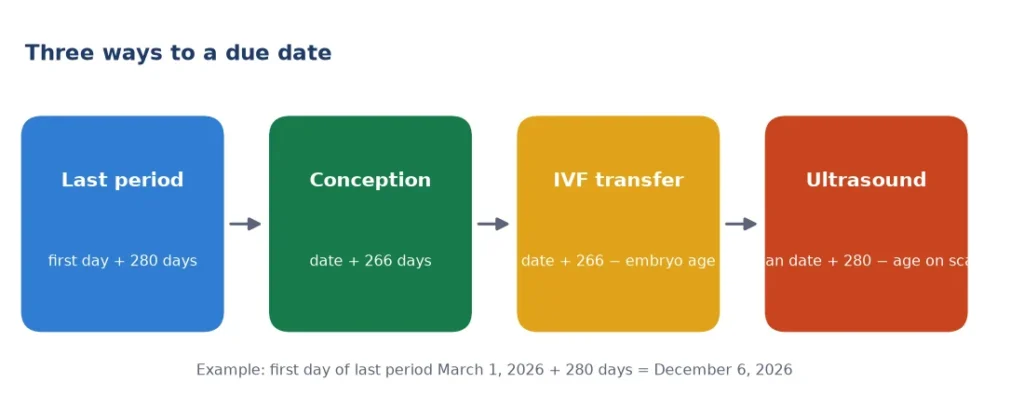
Worked example 1: last period on March 1, 2026
March 1, 2026 + 280 days = December 6, 2026. The shortcut agrees: add a year (March 1, 2027), subtract three months (December 1, 2026) and add seven days (December 8). The shortcut lands two days later because calendar months vary in length, so the 280-day count is the one the due date calculator uses.
Adjusting for cycle length
If your cycles are longer or shorter than 28 days, ovulation moves too. The NHS due date calculator lets you adjust the cycle length, and so does this due date calculator: add the number of days your cycle is longer than 28, or subtract the days it is shorter. For a 32-day cycle, ovulation is about day 18, which is 4 days later, so the due date moves 4 days later.
| Cycle length (days) | Ovulation (about) | Change in days | Due date if the last period began March 1, 2026 |
|---|---|---|---|
| 24 | Day 10 | -4 | December 2, 2026 |
| 26 | Day 12 | -2 | December 4, 2026 |
| 28 | Day 14 | 0 | December 6, 2026 |
| 30 | Day 16 | +2 | December 8, 2026 |
| 32 | Day 18 | +4 | December 10, 2026 |
| 35 | Day 21 | +7 | December 13, 2026 |
Due date by month of last period
Use this table for a quick lookup. It assumes a 28-day cycle and a last period beginning on the first of each month in 2026.
| First day of last period | Estimated due date |
|---|---|
| January 1, 2026 | October 8, 2026 |
| February 1, 2026 | November 8, 2026 |
| March 1, 2026 | December 6, 2026 |
| April 1, 2026 | January 6, 2027 |
| May 1, 2026 | February 5, 2027 |
| June 1, 2026 | March 8, 2027 |
| July 1, 2026 | April 7, 2027 |
| August 1, 2026 | May 8, 2027 |
| September 1, 2026 | June 8, 2027 |
| October 1, 2026 | July 8, 2027 |
| November 1, 2026 | August 8, 2027 |
| December 1, 2026 | September 7, 2027 |
Due date calculator from conception
If you know the date of conception, add 266 days, which is 38 weeks. Conception normally happens close to ovulation, about 14 days after the last period began, so 280 − 14 = 266. Conception on March 15, 2026 gives December 6, 2026.
This method is only as good as the date. Sperm can survive for days and ovulation varies, so most people know the day of intercourse rather than the exact day of conception. If dates are uncertain, the last period or an early ultrasound is usually more reliable.
IVF due date calculator: embryo transfer
With IVF the date of fertilization is known, so the due date can be very precise. ACOG advises that the due date for a pregnancy from assisted reproduction be assigned using the age of the embryo and the transfer date, and gives a day 5 embryo as an example: 261 days from the transfer.
The arithmetic is 266 days from fertilization minus the days the embryo had already grown. A day 5 embryo has had 5 days, so 266 − 5 = 261. A day 3 transfer uses 263 and a day 6 transfer uses 260. From a fresh egg retrieval, add 266 days.
| Embryo age at transfer | Add to transfer date | Due date if transferred June 10, 2026 |
|---|---|---|
| Day 3 embryo | 263 days | February 28, 2027 |
| Day 4 embryo | 262 days | February 27, 2027 |
| Day 5 embryo (blastocyst) | 261 days | February 26, 2027 |
| Day 6 embryo | 260 days | February 25, 2027 |
Some clinics count from the retrieval date instead, so ask your clinic which date it uses. The IVF due date calculator here, like any good due date calculator, counts from the transfer date and the embryo age, which gives the same answer when the days are consistent.
Due date calculator ultrasound: dating by a scan
An early ultrasound measures the embryo or fetus and estimates how many weeks and days along it is. To turn that into a due date, count forward to 280 days: due date = scan date + 280 − (days of gestational age on the scan). A scan on August 1, 2026 that measures 8 weeks 3 days (59 days) gives March 10, 2027.
Doctors keep the last-period date unless the scan disagrees by enough. ACOG says that before 9 weeks 0 days a difference of more than 5 days is a reason to change the due date, and that before 14 weeks 0 days the limit is more than 7 days. After that, changes should be rare, so the date you get early is usually the date you keep.
Weeks pregnant calculator: how pregnancy weeks are counted
A weeks pregnant calculator counts days since the first day of the last period (or the equivalent date from the due date), then divides by 7. Completed weeks and leftover days are written as, for example, 31 weeks 4 days, or 31w4d. The due date calculator shows this for any date you pick.
| Date | Days since March 1, 2026 | Weeks pregnant |
|---|---|---|
| Apr 1, 2026 | 31 days | 4 weeks 3 days |
| May 1, 2026 | 61 days | 8 weeks 5 days |
| Jun 1, 2026 | 92 days | 13 weeks 1 days |
| Aug 1, 2026 | 153 days | 21 weeks 6 days |
| Oct 8, 2026 | 221 days | 31 weeks 4 days |
| Nov 15, 2026 | 259 days | 37 weeks 0 days |
Pregnancy trimester calculator: trimester and term dates
A pregnancy trimester calculator splits the 40 weeks into three parts. A common medical convention is first trimester through 13 weeks 6 days, second trimester 14 weeks 0 days to 27 weeks 6 days, and third trimester from 28 weeks 0 days until birth. Some sources, including the NHS week-by-week guide, label slightly different week ranges, so a week or so of difference is normal.
ACOG also defines the timing of birth: early term is 37 weeks 0 days to 38 weeks 6 days, full term is 39 weeks 0 days to 40 weeks 6 days, late term is 41 weeks 0 days to 41 weeks 6 days and post-term is 42 weeks 0 days and beyond. The table shows every date for a last period on March 1, 2026.
| Milestone | Gestational age | Date (last period March 1, 2026) |
|---|---|---|
| Start of the count | 0w0d | March 1, 2026 |
| First trimester ends | 13w6d | June 6, 2026 |
| Second trimester starts | 14w0d | June 7, 2026 |
| Third trimester starts | 28w0d | September 13, 2026 |
| Early term starts | 37w0d | November 15, 2026 |
| Full term starts | 39w0d | November 29, 2026 |
| Due date | 40w0d | December 6, 2026 |
| Late term starts | 41w0d | December 13, 2026 |
| Post-term starts | 42w0d | December 20, 2026 |
How many babies are born on the due date?
Only about 4 to 5% arrive on the due date. The NHS says “only 1 in 20 will arrive on their due date”, and another NHS trust leaflet gives 4.4%. A US study of singleton births found a standard deviation of 14 to 16 days around the due date, and about 80% of births occur between 37 and 41 weeks.
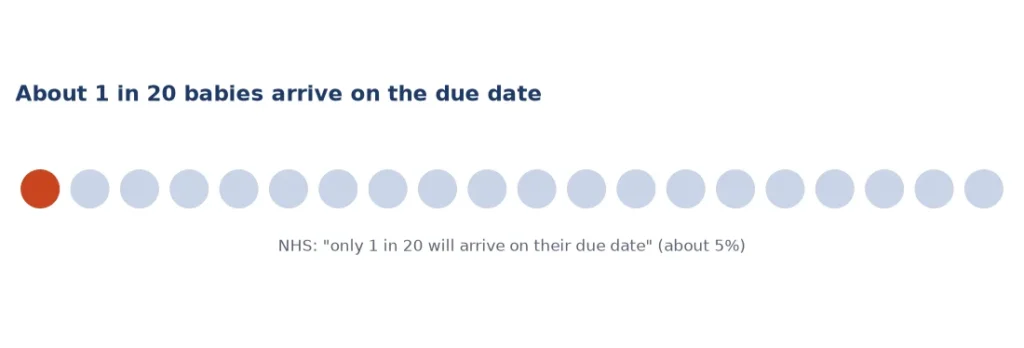
The NHS says a pregnancy normally lasts from 37 to 42 weeks counted from the first day of the last period. The full-term window in the due date calculator, 39 weeks 0 days to 40 weeks 6 days, is a good guide to when to have your bag packed.
Due dates in the US, UK and elsewhere
United States. ACOG sets out the 280-day convention, the ultrasound rules and the term definitions above. United Kingdom. The NHS due date calculator starts from the first day of the last period, lets you adjust for cycle length and gives a 37 to 42 week range. Your midwife confirms the date, often after the dating scan at around 12 weeks.
Other countries use the same 40-week count, though local clinics may use different scan schedules, charts or phrases. Follow your own maternity service for dates and appointments, and check the date with them. These rules were reviewed in October 2026.
Common mistakes with a due date calculator
- Using the date of intercourse as the date of the last period. They are about two weeks apart.
- Using a cycle length that is not your own. Count from day 1 of one period to day 1 of the next, and average several cycles.
- Forgetting to adjust for a long or short cycle, which can move the date by a week or more.
- Treating the date as exact. A due date is the middle of a window of about five weeks.
- Not telling your clinic about the IVF transfer date or an early scan. They set the official date.
Real-life uses for a due date calculator
- Planning leave and appointments. Use the due date calculator to mark the full-term window on a calendar, and print a monthly page from our free printable calendars.
- Telling family. Share the due month and the 37 to 42 week window rather than one fixed day.
- Tracking milestones. The trimester table shows when each stage starts.
- Checking an IVF date. Check the date your clinic gives against the due date calculator, using the embryo age and transfer date.
Questions people ask about the due date calculator
How accurate is a due date calculator?
The arithmetic is exact, but the date is an estimate because pregnancies vary in length. The standard deviation is about 14 days when dating comes from an early ultrasound and about 16 days when it comes from the last period, according to a US study.
Can I use the due date calculator if I do not know my cycle length?
Yes. Leave the cycle length at 28 days in the due date calculator, which is the standard assumption, and ask your clinic to confirm the date with an ultrasound.
How do I find my due date after a day 5 embryo transfer?
Add 261 days to the transfer date. For a transfer on June 10, 2026, the due date is February 26, 2027. Choose IVF transfer and Day 5 in the due date calculator.
Frequently asked questions
11 quick answers
How is a due date calculated?
The due date is 280 days (40 weeks) after the first day of the last menstrual period. If a last period began on March 1, 2026, the due date is December 6, 2026.
How do I calculate my due date from conception?
Add 266 days to the date of conception. Conception on March 15, 2026 gives December 6, 2026.
How is an IVF due date calculated?
Add 266 days to the fertilization date, which means transfer date plus 266 minus the embryo age. A day 5 transfer uses 261 days and a day 3 transfer uses 263 days.
How many weeks pregnant am I today?
Count the days since the first day of your last period and divide by 7. The due date calculator does this for any date and shows weeks and days, such as 10 weeks 0 days.
What is Naegele’s rule?
Naegele’s rule estimates the due date by adding a year, subtracting three months and adding seven days to the first day of the last period. It is the same as adding 280 days, apart from calendar month length.
How many babies are born on their due date?
Only about 1 in 20, or 4 to 5%. Most babies arrive in the weeks around the date, and about 80% are born between 37 and 41 weeks.
When does the first trimester end?
The first trimester ends at 13 weeks 6 days, and the second begins at 14 weeks 0 days. The third starts at 28 weeks 0 days. Some sources use slightly different week ranges.
What is full term?
Full term is 39 weeks 0 days to 40 weeks 6 days, according to ACOG. Early term is 37 to 38 weeks 6 days, late term is 41 weeks, and post-term is 42 weeks or more.
Can the due date change?
Yes. Your clinic may change it if an early ultrasound differs from the last-period date by more than 5 days before 9 weeks or more than 7 days before 14 weeks.
Does my cycle length change my due date?
It can. The 280-day rule assumes a 28-day cycle. Add the days your cycle is longer than 28, or subtract the days it is shorter, as the NHS calculator does.
Does the due date calculator store my dates?
No. The calculation happens in your browser, and nothing you enter is sent to a server.
Related calculators
- Age calculator: exact age in years, months and days
- Date calculator: add or subtract days from any date
- Days between dates calculator: count days between two dates
- BMI calculator and calorie calculator
- Pace calculator and all calculators
- Printable calendars for marking appointments and your due date window
Sources and further reading
- Pregnancy due date calculator (NHS)
- Methods for estimating the due date (ACOG Committee Opinion 700)
- Week 33 of pregnancy (NHS Best Start in Life)
- Gestational age (Wikipedia)
- Naegele’s rule (Wikipedia)
Last updated: October 2026.