A pace calculator finds the missing number among pace, time and distance. Enter any two and this free pace calculator gives the third, converts min per mile to min per km, and lists your 5K, 10K, half marathon and marathon times at that pace, with every step of the working shown.
Use it to plan a race, set a treadmill speed or check a training run. The running pace calculator works in miles or kilometers and rounds to the nearest second.
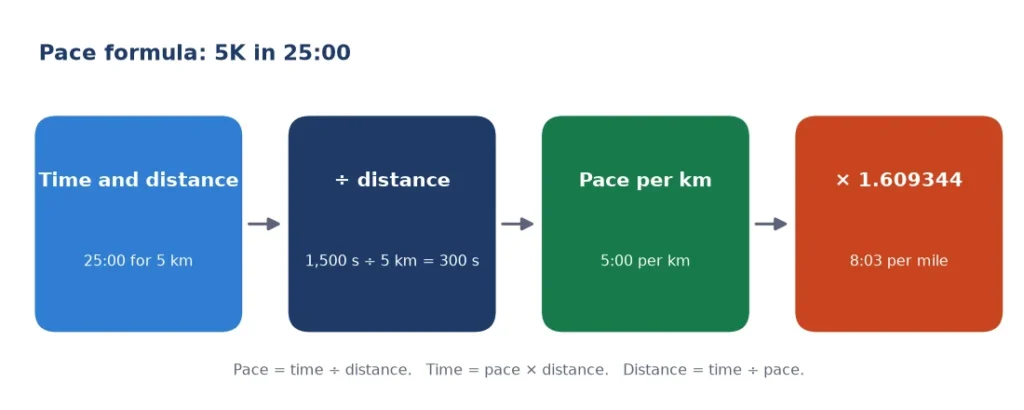
Quick answer: Pace = time ÷ distance. A 5K (5 km) in 25:00 is 1,500 seconds ÷ 5 = 300 seconds, or 5:00 per km. Multiply by 1.609344 to convert to 8:03 per mile, which is a speed of 12.0 km/h or 7.46 mph. To find a finish time, multiply pace by distance, and to find distance, divide time by pace.
Planning aid, not coaching or medical advice: predicted times are estimates, and heat, hills, wind and training change real results. Build up gradually, and check with a doctor before starting hard training if you have a health condition.
How to use this pace calculator
Choose what you want to find, then fill in the other two values. The answer updates as you type, so there is no Calculate button.
- Pick Pace, Finish time or Distance as the thing to solve.
- Pick Miles or Kilometers. This sets the unit for pace and for a custom distance.
- Pick a race (1 mile, 5K, 10K, 10 miles, half marathon, marathon or 50K) or choose a custom distance and type it in.
- Type your time as hours:minutes:seconds (1:45:30) or minutes:seconds (25:00), or your pace as minutes:seconds (8:30).
- Read the answer, the speed and the table of race times. Tick the splits box to see a time for every mile or kilometer.
| Result | What it means |
|---|---|
| Pace per mile and per km | Minutes and seconds to cover one mile and one kilometer. |
| Speed | Miles per hour and kilometers per hour. |
| Race table | Your time at this pace for six common distances, plus a Riegel estimate from your time. |
| Splits | The split and total time at each mile or kilometer. |
Pace formula: how the pace calculator works
Pace is a measure of slowness, expressed as minutes per mile or minutes per kilometer, and speed is its inverse. Three formulas cover every case, and the pace calculator uses whichever one matches what you ask for.
- Pace = time ÷ distance. For 1:45:00 over a half marathon: 6,300 s ÷ 21.0975 km = 4:59 per km, or 8:01 per mile.
- Time = pace × distance. A 9:30 per mile pace over 13.1094 miles takes 570 s × 13.1094 = 2:04:32.
- Distance = time ÷ pace. One hour at 10:00 per mile is 3,600 ÷ 600 = 6 miles, which is 9.66 km.
- Speed (km/h) = 3,600 ÷ pace in seconds per km. A 5:00 per km pace is 12 km/h.
Worked example 1: find the pace
You run a 5K in 25:00. The time is 25 × 60 = 1,500 seconds and the distance is 5 km, which is 5 ÷ 1.609344 = 3.1069 miles. Pace per km = 1,500 ÷ 5 = 300 s = 5:00. Pace per mile = 1,500 ÷ 3.1069 = 482.8 s = 8:03. Speed is 5 ÷ (1,500 ÷ 3,600) = 12.0 km/h.
Worked example 2: find the finish time
You want to hold 9:30 per mile for a half marathon. The distance is 21.0975 ÷ 1.609344 = 13.1094 miles, and the pace is 9 × 60 + 30 = 570 seconds. Time = 570 × 13.1094 = 7,472 seconds, which is 2:04:32. Choose Finish time in the pace calculator and type 9:30 to check it.
Min per mile to min per km: pace converter
One mile is exactly 1.609344 km. To convert a pace from min per mile to min per km, divide the seconds by 1.609344. To go from min per km to min per mile, multiply by 1.609344. For example, 8:00 per mile is 480 ÷ 1.609344 = 298 s, or 4:58 per km.
| Pace per mile | Pace per km | Speed (mph) | Speed (km/h) |
|---|---|---|---|
| 6:00 per mile | 3:44 per km | 10.00 mph | 16.09 km/h |
| 7:00 per mile | 4:21 per km | 8.57 mph | 13.79 km/h |
| 8:00 per mile | 4:58 per km | 7.50 mph | 12.07 km/h |
| 9:00 per mile | 5:36 per km | 6.67 mph | 10.73 km/h |
| 10:00 per mile | 6:13 per km | 6.00 mph | 9.66 km/h |
| 11:00 per mile | 6:50 per km | 5.45 mph | 8.78 km/h |
| 12:00 per mile | 7:27 per km | 5.00 mph | 8.05 km/h |
| 15:00 per mile | 9:19 per km | 4.00 mph | 6.44 km/h |
Treadmill speed to pace
Treadmills show speed, so convert it to pace by dividing 60 by the speed in mph (or km/h). A speed of 6.0 mph is 60 ÷ 6 = 10 minutes per mile.
| Treadmill speed | Pace per mile | Pace per km |
|---|---|---|
| 5.0 mph | 12:00 per mile | 7:27 per km |
| 6.0 mph | 10:00 per mile | 6:13 per km |
| 7.0 mph | 8:34 per mile | 5:20 per km |
| 8.0 mph | 7:30 per mile | 4:40 per km |
| 9.0 mph | 6:40 per mile | 4:09 per km |
| 10.0 mph | 6:00 per mile | 3:44 per km |
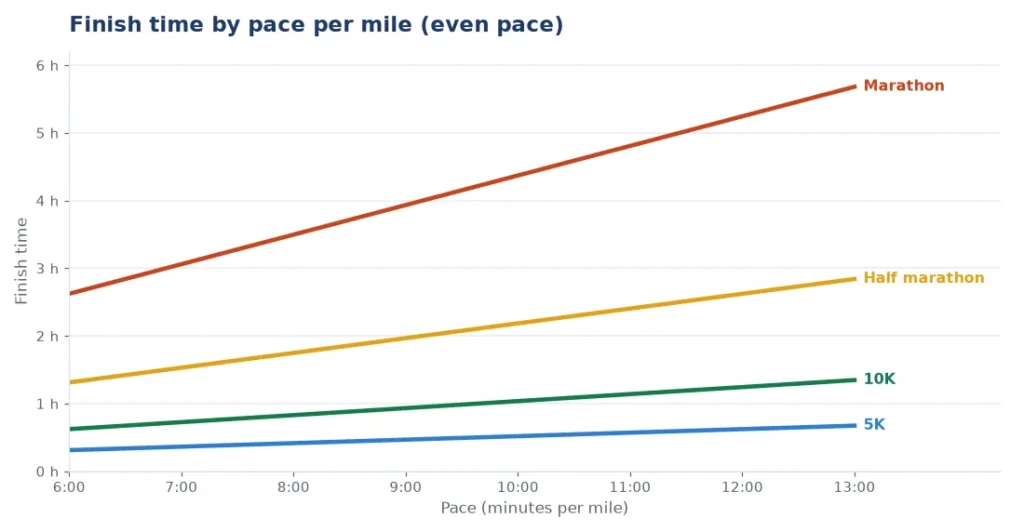
Running pace calculator chart: 5K, 10K, half marathon and marathon times
This running pace chart shows the time for each standard distance at an even pace. The 10K is 10 km, the half marathon is 21.0975 km and the marathon is 42.195 km, the distance standardized by the international athletics federation in 1921.
| Pace | 5K | 10K | Half marathon | Marathon |
|---|---|---|---|---|
| 7:00 per mile | 0:21:45 | 0:43:30 | 1:31:46 | 3:03:32 |
| 8:00 per mile | 0:24:51 | 0:49:43 | 1:44:53 | 3:29:45 |
| 9:00 per mile | 0:27:58 | 0:55:55 | 1:57:59 | 3:55:58 |
| 10:00 per mile | 0:31:04 | 1:02:08 | 2:11:06 | 4:22:11 |
| 11:00 per mile | 0:34:11 | 1:08:21 | 2:24:12 | 4:48:24 |
| 12:00 per mile | 0:37:17 | 1:14:34 | 2:37:19 | 5:14:38 |
5K pace calculator: target times
A 5K pace calculator turns a goal time into the pace you must hold. Divide the goal in seconds by 5 for the pace per km, then multiply by 1.609344 for the pace per mile. These are the paces for common goals.
| 5K goal time | Pace per km | Pace per mile |
|---|---|---|
| 20:00 | 4:00 per km | 6:26 per mile |
| 22:30 | 4:30 per km | 7:15 per mile |
| 25:00 | 5:00 per km | 8:03 per mile |
| 27:30 | 5:30 per km | 8:51 per mile |
| 30:00 | 6:00 per km | 9:39 per mile |
| 35:00 | 7:00 per km | 11:16 per mile |
Half marathon pace calculator: goal times
The same method works for 21.0975 km. A half marathon pace calculator divides the goal time by the distance, so a 2:00:00 half needs 7,200 ÷ 21.0975 = 341 s per km, or 5:41 per km and 9:09 per mile.
| Half marathon goal | Pace per km | Pace per mile |
|---|---|---|
| 1:30:00 | 4:16 per km | 6:52 per mile |
| 1:45:00 | 4:59 per km | 8:01 per mile |
| 2:00:00 | 5:41 per km | 9:09 per mile |
| 2:15:00 | 6:24 per km | 10:18 per mile |
| 2:30:00 | 7:07 per km | 11:27 per mile |
Marathon pace calculator: goal times and splits
A marathon pace calculator works the same way over 42.195 km. A 4:00:00 marathon is 14,400 ÷ 42.195 = 341 s per km, or 5:41 per km and 9:09 per mile. These are the paces for common goals.
| Marathon goal | Pace per km | Pace per mile | Half way (even pace) |
|---|---|---|---|
| 3:00:00 | 4:16 per km | 6:52 per mile | 1:30:00 |
| 3:30:00 | 4:59 per km | 8:01 per mile | 1:45:00 |
| 4:00:00 | 5:41 per km | 9:09 per mile | 2:00:00 |
| 4:30:00 | 6:24 per km | 10:18 per mile | 2:15:00 |
| 5:00:00 | 7:07 per km | 11:27 per mile | 2:30:00 |
Marathon splits for a 4:00:00 finish (even pace)
| Distance | Clock time |
|---|---|
| 5K | 0:28:26 |
| 10K | 0:56:53 |
| 15K | 1:25:19 |
| 20K | 1:53:45 |
| Half marathon | 2:00:00 |
| 25K | 2:22:12 |
| 30K | 2:50:38 |
| 35K | 3:19:05 |
| 40K | 3:47:31 |
| Finish | 4:00:00 |
Race time predictor: the Riegel formula
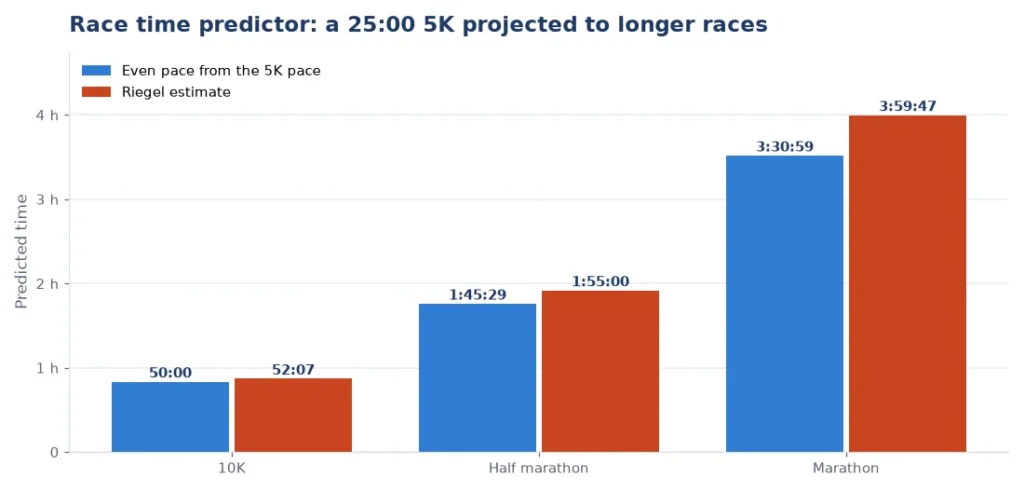
The Riegel formula predicts a time at a new distance from a time you have already run: T2 = T1 × (D2 ÷ D1)1.06. T1 is your time over distance D1, and T2 is the predicted time over D2. Peter Riegel published it in American Scientist in 1981, describing endurance efforts of roughly 3.5 to 230 minutes.
The exponent 1.06 is slightly above 1, so you slow down a little as the distance grows. From a 25:00 5K, the race time predictor gives 25:00 × 21.06 = 52:07 for 10K, 1:55:00 for a half marathon and 3:59:47 for a marathon, compared with 3:30:59 at an even pace.
| 5K time | Predicted 10K | Predicted half marathon | Predicted marathon |
|---|---|---|---|
| 20:00 | 41:42 | 1:32:00 | 3:11:49 |
| 25:00 | 52:07 | 1:55:00 | 3:59:47 |
| 30:00 | 1:02:33 | 2:18:00 | 4:47:44 |
| 35:00 | 1:12:58 | 2:41:00 | 5:35:41 |
Treat every prediction as an estimate. A marathon needs far more weekly mileage than a 5K, so a fast 5K runner who has not trained for 26.2 miles will usually run slower than the formula says.
Pace calculator for walking and cycling
Pace, time and distance work for any steady movement, so the same calculator helps with a brisk walk or a bike ride. Walkers tend to think in minutes per mile or kilometer, and cyclists in miles or kilometers per hour. This table converts between the two.
| Activity | Speed (mph) | Speed (km/h) | Pace per mile | Pace per km |
|---|---|---|---|---|
| Easy walk | 3.0 mph | 4.8 km/h | 20:00 per mile | 12:26 per km |
| Brisk walk | 4.0 mph | 6.4 km/h | 15:00 per mile | 9:19 per km |
| Very brisk walk | 5.0 mph | 8.0 km/h | 12:00 per mile | 7:27 per km |
| Relaxed ride | 10.0 mph | 16.1 km/h | 6:00 per mile | 3:44 per km |
| Steady ride | 15.0 mph | 24.1 km/h | 4:00 per mile | 2:29 per km |
| Fast ride | 20.0 mph | 32.2 km/h | 3:00 per mile | 1:52 per km |
How to pace a race
Running every mile in the same time, an even pace, is the simplest plan, and the splits table shows the clock time you should see at each marker. Some runners prefer a slightly faster second half, called a negative split. Either way, a very fast first mile usually costs more time later than it saves.
Use the pace calculator the night before a race to write your target splits on a wristband, and re-check them against hills and weather on the day. If the course has a steep climb, add a little time there and take it back on the descent.
Pace around the world: miles, kilometers and race distances
United States. Most runners and treadmills use miles, so pace is quoted in minutes per mile, while 5K and 10K races use kilometers. United Kingdom. Road races use miles and kilometers, and the weekly parkrun is a 5K. Canada, Europe, Australia and New Zealand. Pace is normally minutes per kilometer, and the race distances (5K, 10K, 21.0975 km, 42.195 km) are the same everywhere.
Only the unit changes between countries. The international mile is exactly 1.609344 km, so a pace converter works the same way for everyone. Pick the unit you race in and the pace calculator does the rest.
Common mistakes with a pace calculator
- Typing 5.30 for 5 minutes 30 seconds. Use a colon, 5:30, because 5.30 is 5.3 minutes (5:18).
- Mixing units: a pace per mile entered while Kilometers is selected gives a very different answer.
- Starting too fast. A pace you can hold for a mile is much faster than one you can hold for a marathon.
- Using a flat-course pace on a hilly course. Add time for climbs, heat and wind.
Real-life uses for a pace calculator
- Race planning. Set a goal time, read the pace and the splits, and print them on a wristband.
- Training runs. Find the pace for an easy 5 miles in 50 minutes: 50 ÷ 5 = 10:00 per mile.
- Walking and hiking. A 15:00 per mile walk is 4 mph, about 6.4 km/h.
- School. Pace, speed and time make good practice for division and unit conversion.
Questions people ask about the pace calculator
How do I calculate my running pace?
Divide your time by your distance. If you ran 4 miles in 36:00, that is 36 ÷ 4 = 9:00 per mile. Type the time and distance into the pace calculator for the pace per mile and per kilometer.
What pace do I need for a 4-hour marathon?
You need about 9:09 per mile or 5:41 per km, because 14,400 seconds ÷ 26.2188 miles is 549 seconds per mile. Use the Marathon option in the calculator to see the splits.
How do I convert min per mile to min per km?
Divide the pace in seconds by 1.609344. A 10:00 per mile pace is 600 ÷ 1.609344 = 373 s, or 6:13 per km.
Frequently asked questions
11 quick answers
How do you calculate pace?
Pace is time divided by distance. For 30:00 over 5 km the pace is 1,800 s ÷ 5 = 360 s, or 6:00 per km, which is 9:39 per mile.
How do I find my finish time from my pace?
Multiply your pace by the distance. At 8:00 per mile a 10K (6.2137 miles) takes 480 s × 6.2137 = 2,983 s, which is 49:43.
How many miles is a 5K, 10K, half marathon and marathon?
A 5K is 3.11 miles, a 10K is 6.21 miles, a half marathon is 13.11 miles and a marathon is 26.22 miles (42.195 km).
What is the Riegel formula?
It is a race time predictor, T2 = T1 × (D2 ÷ D1)^1.06, published by Peter Riegel in 1981. It estimates a time at a new distance from a time you have run.
Is the Riegel formula accurate?
It is a reasonable estimate for trained runners across distances from about a mile to a marathon, but it is not exact. Training for the longer distance matters more than the formula.
What is a good 5K time?
It depends on age, training and goals, so there is no single answer. The 5K pace table above shows the pace behind each time from 20:00 to 35:00.
How do I convert km/h to min per km?
Divide 60 by the speed. At 12 km/h the pace is 60 ÷ 12 = 5 minutes per km. For a speed in mph, 60 ÷ mph gives minutes per mile.
What does even pace mean?
Even pace means running every mile or kilometer in the same time. The splits table shows the clock time at each point for an even-paced race.
Why is my marathon prediction slower than my 5K pace?
Pace fades over longer distances because of fatigue and fuel. The Riegel exponent of 1.06 builds that slowdown into the estimate.
Can I use the pace calculator for walking or cycling?
Yes. Pace, time and distance work for any steady movement. For cycling you may prefer speed, which the calculator shows in mph and km/h.
Does the pace calculator save my data?
No. Everything is calculated in your browser, and nothing you type is sent to a server.
Related calculators
- Calorie calculator: daily calories and macros for training
- BMI calculator: BMI and healthy weight range
- Time calculator: add and subtract hours, minutes and seconds
- Unit converter: miles, kilometers and speed units
- Due date calculator and all calculators
- Division worksheets for practicing the division behind pace
Sources and further reading
- Peter Riegel and the Riegel formula (Wikipedia)
- Marathon distance and history (Wikipedia)
- Half marathon (Wikipedia)
- The international mile (Wikipedia)
- Pace in running (Wikipedia)
Last updated: October 2026.