Lohri bingo puts the bonfire, the dhol and the plate of winter treats on a card the whole family can play. The template on this page has 28 squares that most Lohri evenings produce, from the first flame and the first bhangra step to peanuts, gajak, sarson da saag with makki di roti and the family that has gathered around the fire. Pick a card size, press print, and every guest gets a different card.
In short: open the card maker above and press Edit and print this card, choose how many cards you need and download one PDF. It is free, there is no account, and nothing you type leaves your browser. Every square can be rewritten, so a village courtyard, a city terrace and a classroom can each get their own list.
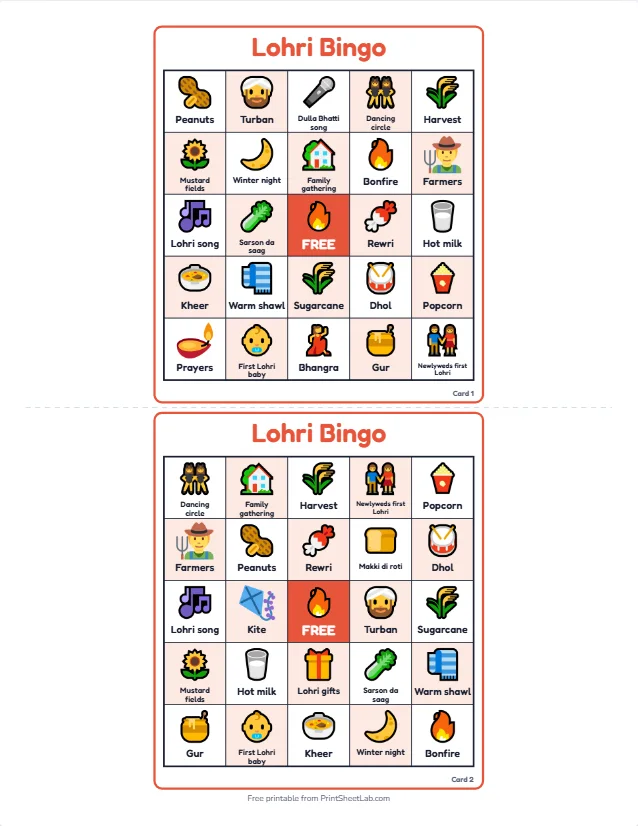
How to play Lohri bingo
The rules of Lohri bingo are the bingo rules everyone already knows, with one change: nobody has to call numbers, because the festival makes the calls. Each guest holds a card and a pencil, and when one of the squares happens in front of them, they mark it. Five in a row, across, down or on the diagonal, wins. The free center square, a little flame, is already marked, so a first line needs only four more.
- Give every guest a card and something to mark with. Pencils and stickers work in the cold. Fingers in gloves do better with a fat crayon.
- Agree on the rules first. A square counts when you see it yourself, and it counts once. Anyone may ask a player to point at the square they claim.
- Mark the Lohri bingo squares as the evening unfolds. The wood is stacked, the fire is lit, the popcorn goes around: each of those is a square.
- Announce a line out loud. The winner reads the five squares aloud, a friend checks them, and the prize changes hands.
- Play another round of Lohri bingo. After the first line, switch to four corners, an X or a full card, or keep the same card for the next day of the harvest season.
Lohri suits bingo because the evening is so easy to see. The Wikipedia article on Lohri describes a midwinter folk and harvest festival marked with a bonfire, festive food, singing, dancing and the collecting of gifts. All of those are things a child can point at, which is exactly what Lohri bingo needs.
What Lohri is, and why a bingo game suits the bonfire
Lohri is a midwinter folk and harvest festival that marks the passing of the winter solstice and the end of winter, and welcomes longer days. It is celebrated mainly in the Punjab region of India and Pakistan and in other parts of northern India, such as Jammu, Haryana and Himachal Pradesh. According to the article, it is celebrated by Hindus, Sikhs, Christians and Muslims in India, and it falls on the night before Maghi, which is the day of Makar Sankranti. This section follows the Wikipedia article, and families keep Lohri in their own ways.
The festival has a lovely shape for a game. During the day children go from door to door singing folk songs and are given sweets and savories, and sometimes money. The collection is itself called lohri, and it consists of sesame seeds, gajak, sugar candy, jaggery, peanuts and puffed rice or popcorn. At sunset the bonfire is lit. People toss sesame seeds, jaggery, sugar candy and rewari into the fire, sit around it, sing and dance until it dies down, and eat sarson da saag with makki di roti for dinner.
All of that happens in a few hours, outdoors, among people of every age. It is a gathering where children, parents and grandparents stand around the same flame, and a Lohri bingo card gives them a shared thing to look for. Lohri bingo asks nobody to perform. It also gives the quieter guests a way in: a child who is too shy to dance can still shout “Peanuts!” and mark a square.
When is Lohri? Usually January 13 or 14
Unlike Karwa Chauth or Diwali, which wander across a month, Lohri is anchored to the solar calendar. The Wikipedia article says that it commonly falls on January 13, and that in the 21st century it generally falls on January 13 or 14, depending on the year.
The article also notes that the date shifts by a day over very long periods, so in the late 19th century it fell on January 11. Because the date is so steady, a set of Lohri bingo cards can be printed well ahead of the festival and kept in a drawer for next year.
Lohri and its neighbors: one turn of the sun, many names
Lohri is one of several Indian harvest festivals that mark the winter solstice season around Makar Sankranti. The Wikipedia article lists the related festivals, and the table below puts them side by side, which helps when a class or a mixed community wants to play a whole harvest-season round.
| Festival | Where it is kept | What it has in common with Lohri |
|---|---|---|
| Lohri | Punjab, Haryana, Himachal Pradesh, Jammu and Delhi, plus Punjab in Pakistan | The bonfire on the night before Makar Sankranti |
| Makar Sankranti | Across India | The day after Lohri; the article lists kite flying, bonfires, fairs and feasts among its celebrations |
| Pongal | Tamil Nadu | A harvest festival of the same season |
| Bhogi | Southern India | Listed in the article as a related harvest festival |
| Magh Bihu | Assam | A harvest festival of the same season |
| Poush Sankranti | Bengal | A harvest festival of the same season |
| Lal Loi | Sindhi communities | Children bring wood sticks and light a fire at night, and people dance around it |
Dulla Bhatti and the songs of Lohri
One of the most popular Lohri folk songs is tied to the tale of Dulla Bhatti, a folk hero of Punjab. The Lohri article describes him as a figure celebrated in many Lohri songs, remembered for rescuing girls and for the stories of Sundri and Mundri.
The Dulla Bhatti article adds that the only evidence of his existence comes from Punjabi folk songs, so it treats him as a hero of folklore. When children sing, one person sings and the others end each line with a loud “Ho!” That call and response is exactly why the Dulla Bhatti song and Lohri song squares are easy to mark.
Lohri bingo cards: all 28 squares
These Lohri bingo cards are made from a list of 28 squares. A standard 5×5 card with a free center needs 24 of them, so each card leaves out four and no two cards are the same. The table sorts the list into the groups a host usually thinks in, so it is easy to decide which squares to keep and which to swap for something that belongs to your own home.
| Group | Squares on the list | Where you will see them |
|---|---|---|
| Fire and night | 🔥 Bonfire, 🪔 Prayers, 🌙 Winter night, 🧣 Warm shawl | The heart of the evening. The article notes that people circle the fire in respect and pour milk and water around it. |
| Music and dance | 🥁 Dhol, 💃 Bhangra, 🎶 Lohri song, 👯 Dancing circle, 🎤 Dulla Bhatti song, 👳 Turban | After the fire is lit. The article describes bhangra and giddha danced to the beat of the dhol. |
| Winter treats | 🍿 Popcorn, 🥜 Peanuts, 🍬 Gajak, 🍯 Gur, 🌾 Sugarcane, 🥬 Sarson da saag, 🍞 Makki di roti, 🍬 Rewri, 🍲 Kheer, 🥛 Hot milk | Trays and plates. The article lists gajak, jaggery, peanuts, popcorn, sugarcane products and sarson da saag with makki di roti. |
| Harvest and fields | 🌻 Mustard fields, 🌾 Harvest, 🧑🌾 Farmers | Mostly in the countryside, or in a story, a photo or a song when the party is in a city. |
| Family and firsts | 👶 First Lohri baby, 👫 Newlyweds first Lohri, 🎁 Lohri gifts, 🏡 Family gathering, 🪁 Kite | Homes with a recent birth or marriage celebrate with extra excitement, according to the article. Kites are most famous the next day, at Makar Sankranti. |
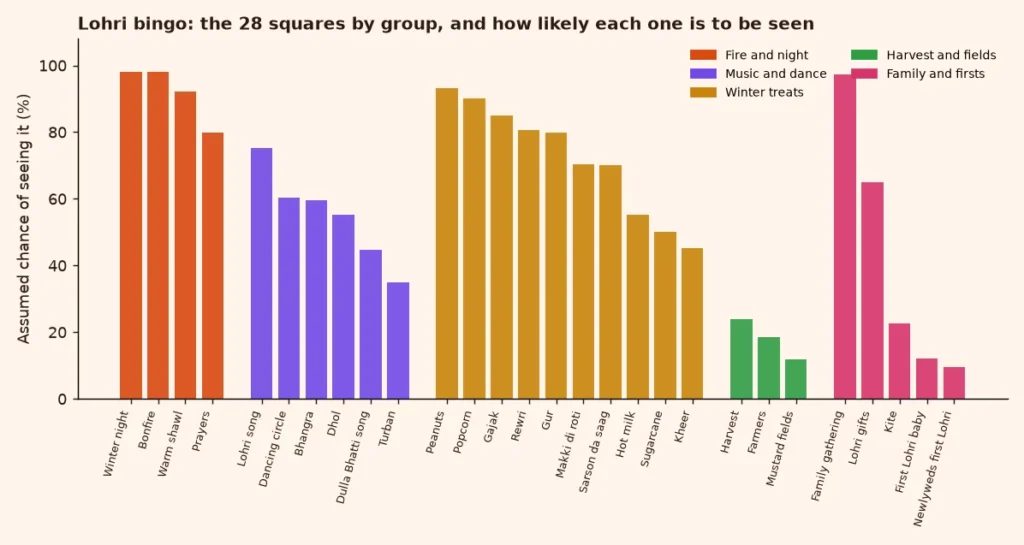
The Lohri bingo list is not random. Fire, family and food squares fill in at nearly every Lohri gathering, so they are the engine of the game. The rarer squares (a first Lohri baby, newlyweds, a kite, a field of mustard) turn a card into a treasure hunt. If every square on a Lohri bingo card were as common as a bonfire, the first line would be over before the second song.
How many different cards can you print?
With 28 squares and 24 places on a 5×5 card, the number of different sets of squares is 28 choose 24, which is 20,475. Each set can also be arranged in a huge number of orders, so a family of 20 and a community center of 200 can both give every Lohri bingo player a different card, and Lohri bingo never runs out of new cards. Smaller grids need fewer squares, so a 4×4 or 3×3 card has even more possible sets.
| Card size | Squares used | Different sets from the 28 | Best for |
|---|---|---|---|
| 3×3 with free center | 8 | 3,108,105 | Ages 3 to 5, and the very short game |
| 4×4 | 16 | 30,421,755 | A quick round before the dancing starts |
| 5×5 with free center | 24 | 20,475 | The classic bonfire evening |
Three ways to play the Lohri bingo game
One printed Lohri bingo card supports three very different evenings. Pick the Lohri bingo game that fits your group, or run two in a row. The table compares them, and the sections underneath give the rules and some prize ideas.
| Game | Who calls | Length | Best for |
|---|---|---|---|
| Spotting game around the bonfire | Nobody. The evening does. | 2 to 4 hours | Families and neighbors at a courtyard, terrace or park fire |
| Calling cards for a crowd | A host draws cut-out squares | 10 to 15 minutes | Community halls, schools, offices and any party without a real fire |
| The treat-collecting round for children | A grown-up reads the clues | 20 to 30 minutes | Kids who go door to door, or a class that acts out the tradition |
Game one: Lohri bingo around the bonfire
This is the Lohri bingo game most hosts want. Guests arrive in the late afternoon with their Lohri bingo cards and every time they notice a square (the fire catching, a plate of peanuts, a dhol in the lane, a grandmother in a warm shawl) they mark it.
The fire is the star, so a good rule for Lohri bingo is that nobody leans over the flames to read a card. Keep the cards in a pocket, or on a clipboard, and mark them while you stand a few steps back. A short pause in the dancing is the perfect time to announce a line.
- Prize for the first line: the first handful of popcorn or the first piece of gajak.
- Prize for four corners: choose the next song on the speaker, or the next dance.
- Prize for everyone: a small packet of revri and peanuts to take home.
- Grown-up job: one adult carries a spare card and a pencil for the child who has dropped theirs.
Game two: the Lohri bingo game with calling cards
When the guests do not move around, or when there is no real fire, the drawn-card version is easier to run. In the Print tab, switch on the calling cards and the caller sheet. Cut the cards out, shuffle them in a bowl, and the host draws one at a time: “Peanuts… who has peanuts?” Everyone with that square marks it.
For a live round on a screen, with guests joining by link, the play bingo online page hosts the 75-ball game, and the play custom bingo online page explains how to play with your own list.
This is also the version of Lohri bingo for relatives who live in a different country. Lohri is celebrated by Punjabi families around the world, and one person can read the calls on a video call while everyone prints the same PDF.
Game three: Lohri bingo for kids as a treat-collecting round
The article describes how children go from house to house singing and collecting lohri. A classroom or a living room can act that out with a safe twist, and Lohri bingo for kids becomes a walking game: place the squares as clues around the room (a picture of a bonfire, a bowl of popcorn, a drawing of a kite), and the children walk from clue to clue, singing a line each time they mark one. The caller-free structure keeps the whole group moving, and every child ends with a handful of marks and a song in their head.
Lohri bingo for kids
Lohri bingo for kids is a calm way to enjoy a loud, bright night. Children who are busy looking for a sugarcane stick or a dhol are children who stand still long enough to see what the festival is made of. The pictures on every square let pre-readers play without help, and the squares teach the names of things that adults in the room have known for years. The right setup depends on age.
| Age | Card | How to play |
|---|---|---|
| 3 to 4 | 3×3, one per page | A grown-up reads the pictures. Sticker dots, no pens. Everybody wins at the first line. |
| 5 to 7 | 3×3 or 4×4 | Words with emoji. Kids spot and shout. Play for a line, then four corners. |
| 8 to 10 | 5×5 | Mark by pointing: every square needs a friend to confirm it. Add two squares they invent themselves, such as a pet or a joke. |
| 11 and up | 5×5 with a custom list | Let them write the list for the family, or ask for a short sentence about each square they mark. |
Classrooms get a lot from Lohri bingo for kids. A round fits into the last half hour before a harvest-season assembly, and it needs no preparation beyond printing.
The festival also opens easy conversations about seasons, farming and the winter sun: why do people celebrate the return of longer days, and what do farmers do in January? If a class includes children who do not celebrate, let them mark squares as observers and ask a child who does to say one sentence about each one. That turns a game into an introduction, and children who celebrate often love being the expert.
Lohri bingo party for families, offices and communities
A Lohri bingo party is a different animal from the version with sticker dots, and it needs a lighter touch. Guests at a party already have conversation to make and plates to hold, so the card should ask for very little. The best rule is that a square counts when someone else points it out to you. That makes a Lohri bingo party a way for guests to talk to people they have not met: “Is that your first Lohri in this city? That counts for my card!”
Three tweaks make it grown-up. First, change the list: replace Farmers with “Someone tells a story from their village,” and Turban with “A colorful dupatta or pagri.” Second, use a 4×4 card with no free space so the Lohri bingo party ends in about 40 minutes. Third, give prizes that suit the party: first pick of the sweets, a small box of gajak, or the chance to choose the next song.
For a bhangra-led night, the sangeet dance bingo card and the Bollywood party games guide add ideas for the dance floor, and the Lohri di raat tambola tickets bring numbers into the evening: in bingo you mark squares for things you see, while tambola uses numbers called from a bag on a 3×9 ticket. For a workplace Lohri, the office bingo guide explains how to keep a game inclusive.
Lohri bingo game: a real simulation
A host planning a Lohri bingo game always asks how long it will last. To answer with numbers instead of a guess, we simulated 8,000 Lohri days. Every square has an assumed chance of showing up in a given window of the day. The chances are our assumptions, chosen to feel like a typical family gathering. They are not survey data.
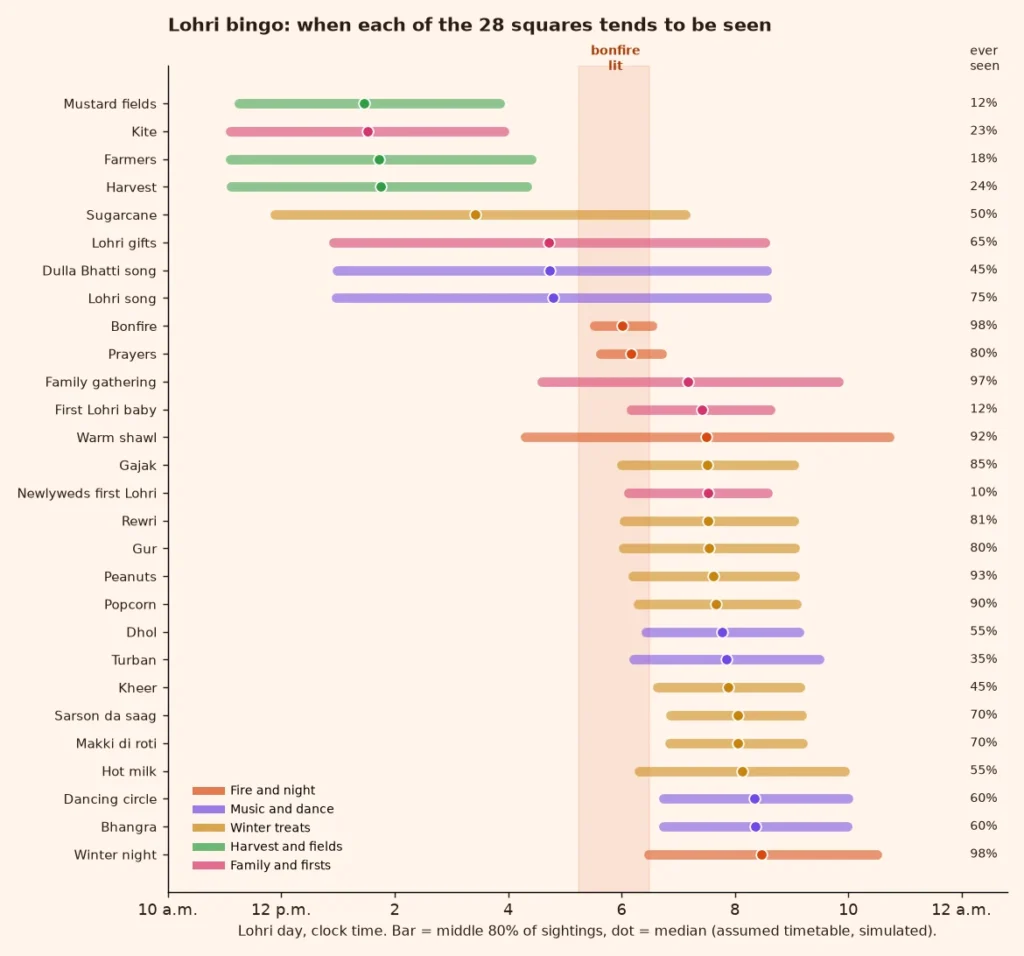
The bonfire in our Lohri bingo model is lit between 5:15 and 6:30 p.m., close to January sunset in northern India, and almost every home has one: the chance of seeing a bonfire is 98 in 100. Peanuts appear at 93 homes, a dhol at 55, and a mustard field at only 12, so some Lohri bingo squares are long shots.
The timeline shows what the Lohri bingo model assumes. The farm squares (mustard fields, farmers, harvest) and the kites are spotted by day, when many families are outdoors. The bonfire, the prayers and the treats all cluster around the lighting of the fire, and the dancing, the dhol and the sarson da saag dinner arrive later in the night.
Lohri bingo from 4 p.m.: a first line comes by about 8:00 p.m.
In an average Lohri bingo evening an observant guest sees about 17 of the 28 squares, so a 5×5 card ends the night with about 14 of its 24 squares marked, plus the free center. A full card never happened in 8,000 evenings. The squares that need a first-Lohri baby, newlyweds or a field of mustard keep it out of reach, which is why the usual prize is a line or four corners.
| Cards in the room (5×5) | Median time of a first line | Middle half of evenings | Line by 8 p.m. | Line by 9 p.m. |
|---|---|---|---|---|
| 1 card (one guest) | 9:27 p.m. (only 64% get a line at all) | from 8:27 p.m. | 16% | 39% |
| 6 cards | 8:00 p.m. | 7:18 p.m. to 8:43 p.m. | 50% | 83% |
| 12 cards | 7:36 p.m. | 6:59 p.m. to 8:16 p.m. | 66% | 92% |
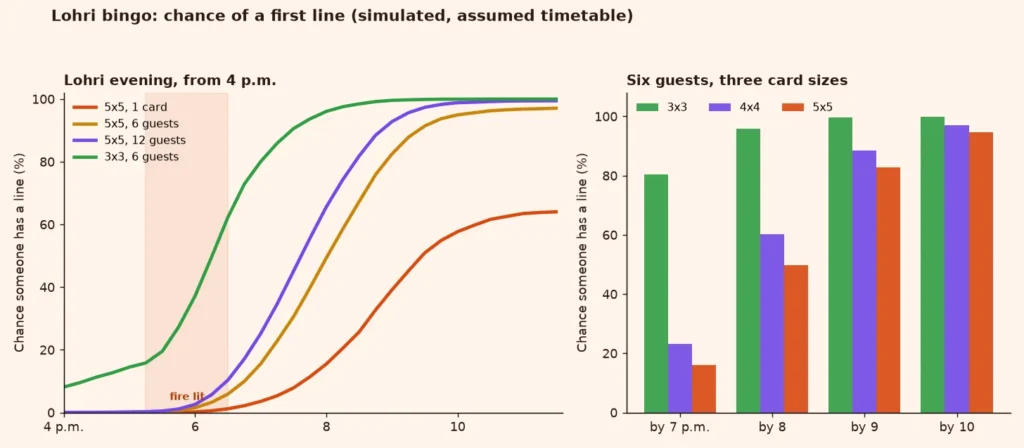
A single guest has a first line only 64% of the time before midnight, and just 39% of single cards have one by 9 p.m. With six guests the first line arrives around 8:00 p.m., soon after the fire is going, and 83% of six-card groups have one by 9 p.m. With twelve guests the median is 7:36 p.m.. A 3×3 card is much quicker: with six players the median is 6:16 p.m. and 80% of groups have a line by 7 p.m. The curves below show how fast the chance climbs.
City Lohri versus village Lohri
A farm family can spot a mustard field, a farmer and the harvest. A family in a city apartment block will not, unless someone shows a photo. To see what that does to Lohri bingo, we repeated the simulation with the field squares (sugarcane, mustard fields, harvest, farmers and kites) cut to a third of their chance.
The average guest then sees about 16 squares instead of 17. The first line for six guests moves from 8:00 p.m. to 8:17 p.m., and a single card has a line only 55% of the time instead of 64%.
The lesson is practical. If your Lohri bingo party is in a city, edit the field squares before you print. Replace Farmers with “Someone remembers a village Lohri” and Mustard fields with “A yellow flower on a dress or a table.” The game stays fast and every square stays findable.
Four corners, X and a full card
The first line is not the only prize in Lohri bingo. In the same simulation with six guests, four corners is reached by 50% of groups, at a median of 11:09 p.m.. The X pattern is rarer: only 7% of six-guest evenings produce one, and a full card (blackout) almost never. So four corners is a good second prize, and an X is a bonus round for next year.
Calling cards for a crowd: how many calls, and how often do two players tie?
Community Lohri bingo events can be big: a society ground or a school hall can hold 100 players. With all 28 squares called exactly once, in random order, we simulated 8,000 games to see how many calls it takes before someone has a line, and how often two or more players complete a line on the very same call. The table counts calls out of the 28.
| Cards in play (5×5) | Calls to the first line (median) | Middle half of games | Games with a tie for first line |
|---|---|---|---|
| 1 card | 16 | 14 to 18 | 0% |
| 4 cards | 13 | 11 to 14 | 14% |
| 8 cards | 11 | 10 to 13 | 18% |
| 15 cards | 10 | 9 to 11 | 21% |
| 30 cards | 9 | 8 to 10 | 25% |
| 60 cards | 8 | 7 to 9 | 27% |
| 100 cards | 7 | 6 to 8 | 30% |
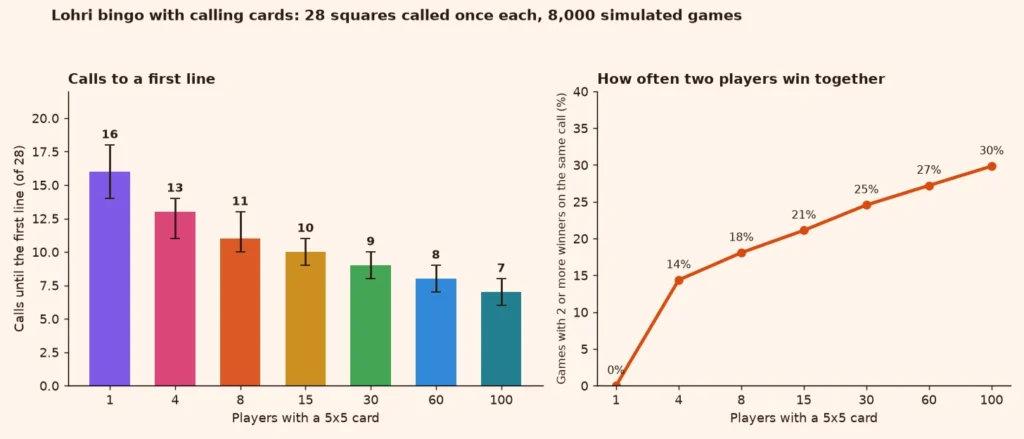
A Lohri bingo gathering of 15 players usually sees a first line after 10 calls, and in 21% of games two or more players win together. With 100 cards the median falls to 7 calls and ties climb to 30%, so a crowd needs a tie-break plan, such as a bhangra step or a Lohri song line, before the first call.
For a quicker game, 4×4 cards with 8 players reach a first line at 10 calls and 3×3 cards with 8 players at 5. The assumptions: every call is equally likely at each step, cards are independent random draws, and nobody misses a call.
Printable Lohri bingo: print, cut and hand out
For printable Lohri bingo, the Print tab has the controls you need and nothing you do not. Choose how many different cards to print, from 1 to 100, how many go on a page (1, 2, 4 or 6), Letter or A4 paper, and portrait or landscape. Cut guides are available for sheets that need trimming. For a family of 14, print 16 cards, two per page, and keep two spares for the cousin who arrives late.
- Use light cardstock. A Lohri bingo card that will be carried outdoors survives the evening better when it is thicker than copy paper.
- Keep paper away from the flames. A bonfire throws sparks, and a stack of Lohri bingo cards is easy to ignite. Keep the supply table at a safe distance and the cards in a pocket.
- Print names on the cards. The Design tab can put a name on each card, which prevents arguments about whose card is whose.
- Use big squares for gloves and cold fingers. One Lohri bingo card per page in portrait gives the biggest squares, which is best for ages 3 to 5.
- Print the caller sheet and calling cards for the drawn-card Lohri bingo game. They come out of the same Print tab.
- Add a clipboard or a folder. A cheap clipboard doubles as a hard surface in the cold, and a plastic sleeve keeps each Lohri bingo card dry when it snows or drizzles.
Hosts who are away from a printer can save the PDF to a phone or a USB stick and print it anywhere. The shareable link in the card maker keeps only your word list, with no names or photos, so you can send it to relatives and let everyone print their own.
Lohri bingo free printable: what you get
Free, private and nothing to install
This Lohri bingo free printable does not ask for an email or an account, and nothing is added to your PDF but the card itself and a small footer. The editor runs in your browser, so your word list never goes to a server. You need only a printer or a PDF viewer.
What you can change
The card maker has five tabs: Setup, Items, Design, Templates and Print. On the Items tab you can rewrite any square, add an emoji or upload your own picture, and decide what the free space shows.
The Design tab holds color themes, fonts, text size, ALL CAPS, borders, rounded corners, tiles or plain grids, and a card background that can be a color, a pattern or your own picture. You can also add a title, a logo and a footer line, for example “Gill family Lohri”. The Print tab holds the numbers: how many cards, which paper, which layout.
You do not have to start from this page. The bingo card generator offers every card type in one place, and the blank bingo cards page gives you an empty grid to fill by hand.
Customize the Lohri bingo cards in the card maker
The best Lohri bingo card names your own home. Open the Items tab and every square turns into a text box. Here is how a few common situations change the list.
- Your family. “Dadi tells the Dulla Bhatti story,” “Papa feeds the fire,” “The uncle who always gets the dhol out.”
- A school or library event. Swap the dhol for a drawing, add “Someone tells a story of the festival,” and keep the snacks nut-free.
- A very young group. Delete the squares that need explaining (Prayers, Newlyweds first Lohri) and add friendly ones such as “A bowl of popcorn” or “A warm hat.”
- A city party with no fire. Replace Bonfire with “Fairy lights” or “A candle on the table,” and keep the rest.
- A language class. Write the squares in Punjabi, Hindi or English, with the word next to the picture.
The Lohri bingo list has 28 words and a 5×5 card uses 24, so every card differs. With exactly 24 words, every card has the same words in a different order, and with more than 28 the mix between cards widens further. The free space can say “Free” or show its own emoji, text or picture. Shuffle re-deals the squares across all cards, Undo takes back your last change, and the preview lets you zoom in before you download.
Playing Lohri bingo respectfully and safely
Lohri is a cultural and seasonal festival, and the people who keep it have many different traditions. A game of Lohri bingo should sit comfortably beside it. These habits apply to any bingo you play at a festival, and some are especially important for Lohri bingo at a bonfire.
- Respect the fire. The bonfire is a place of prayer for many families. Keep children well back, never throw anything unsafe into it, and do not step in to claim a line while someone is performing a prayer.
- Treat the turban with care. For many Sikh men the turban is part of their faith, not a costume. The Turban square is for spotting one, never for putting one on a guest as a prop.
- Be kind about the first Lohri. Families with a new baby or a newly married couple celebrate a first Lohri with extra joy. Not every guest has the same story, so keep those squares light and optional.
- Think about food. Peanuts, sesame and other nuts are common allergens, and popcorn is a choking risk for children under four. Check allergies before you hand out prizes made of treats.
- Name the festival with care. Lohri is kept by people of several faiths, and some families call it by other names, such as Lal Loi. Ask how your guests refer to it.
- Ask an elder. A grandmother or an uncle can look over the list before you print. They will find the square you forgot.
None of this is a rulebook. It is the kind of care a good host already takes, and a Lohri bingo card works best when it is made together with the people who celebrate.
More bingo cards for the festive season
Lohri bingo is one of a whole set of occasion lists in the card maker. The other big winter night has its own New Years bingo card, and the autumn festivals have Karwa Chauth bingo, Diwali bingo and Navratri bingo. For a spring festival of colors, see Holi bingo. Every template is gathered on the printable bingo cards hub, and number-based bingo runs on the bingo caller.
Frequently asked questions
10 quick answers
What is Lohri bingo?
Lohri bingo is a bingo variation in which every square names something you see or do at Lohri, such as the bonfire, a dhol, gajak or sarson da saag. Players mark squares as they spot them or as a host calls them, and the first to complete a line wins.
Are these Lohri bingo cards really free?
Yes. You can make, edit and print Lohri bingo cards without an account or a payment. The editor runs in your browser, so the words and pictures you add never leave your device.
How many squares does the template have?
It has 28 squares. A 5×5 card with a free center uses 24 of them, a 4×4 card uses 16 and a 3×3 card with a free center uses 8. Because the list holds more words than a card has squares, cards differ from one another.
How many different cards can I print?
Up to 100 different cards in one PDF. There are 20,475 different sets of 24 squares to choose from, so even a large community event can give every guest a card without repeats.
When is Lohri?
According to the Wikipedia article, Lohri commonly falls on January 13, and in the 21st century it generally falls on January 13 or 14. It is the night before Makar Sankranti. Check a local calendar for the exact date where you live.
How long does a Lohri bingo game last?
In our simulation of an evening starting at 4 p.m., six guests on 5×5 cards usually have a first line by about 8:00 p.m., and twelve guests by about 7:36 p.m.. A 3×3 card for six guests is quicker, with a median of 6:16 p.m..
How do I run the calling-card version of Lohri bingo?
In the Print tab, add the calling cards and the caller sheet. Cut the cards out, shuffle them and draw one at a time. A game with 15 players on 5×5 cards usually has a winner after about 10 calls, and in about 21% of games two players tie.
Can I change the squares for a city party?
Yes. In the card maker, every Lohri bingo square can be rewritten, given an emoji or a picture. Swap farm squares for things your guests will actually see, such as fairy lights or a family story, and use the free space for something personal.
Is Lohri bingo suitable for people who do not celebrate Lohri?
Yes, with a little care. Lohri bingo names things anyone can see, so friends, classmates and neighbors can play as guests. Invite someone who celebrates to explain a few squares, and keep the fire and the prayers respectful.
What size should I print for young children?
For Lohri bingo with young children, print a 3×3 card, one per page, with large pictures for ages 3 to 5. It has only eight squares plus a free center, so a first line comes quickly and the child stays interested.