

Financial calculators turn a money question into a number you can check: a loan payment, the growth of savings, a yearly salary, a price with tax or a profit margin. These free financial calculators cover loans, interest, pay and tax, and every one shows the working step by step.
Quick answer: Pick the financial calculator that matches the question. Borrowing money: use the mortgage, loan or car loan calculator. Growing money: use compound interest or retirement. Earning money: use hourly to salary or overtime. Taxes and prices: use VAT, GST or sales tax. Example: a $280,000 loan at 6.5% for 30 years costs $1,769.79 a month.
How to choose the right financial calculator
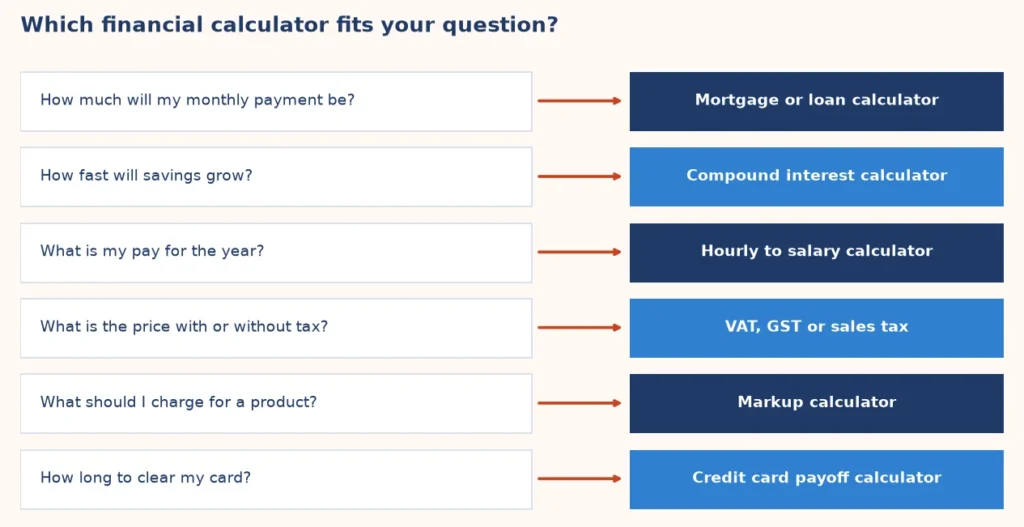
Most money questions fall into five groups: borrowing, saving, earning, taxes and pricing. The table below matches the question you have to the tool that answers it. Every link opens a free calculator that runs in your browser, so nothing you type is sent anywhere.
| If you want to… | Use this calculator | You get |
|---|---|---|
| Find the monthly payment on a home | Mortgage calculator | Payment with tax, insurance and PMI |
| Borrow for any other purpose | Loan calculator | Payment, payoff time, amount or APR |
| Compare 60 and 72 month car loans | Car loan calculator | Payment and total interest with trade-in |
| See how savings grow | Compound interest calculator | Future value with monthly deposits |
| Check interest on a simple loan | Simple interest calculator | Interest and total, no compounding |
| Plan for retirement | Retirement calculator | Savings target with the 4% rule |
| Pay off a credit card | Credit card payoff calculator | Months to payoff and interest paid |
| Turn an hourly rate into a salary | Hourly to salary calculator | Annual, monthly, biweekly pay |
| Work out time and a half | Overtime calculator | Weekly pay with overtime |
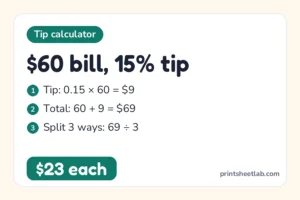
| Add or remove sales tax | Tip, discount and sales tax calculator | Price with tax, discount, tip split |
| Add or remove VAT | VAT calculator | Net, VAT and gross amounts |
| Add or remove GST | GST calculator | Net, GST and gross amounts |
| Find Canadian tax by province | Canada sales tax calculator | GST, HST, PST and QST |
| Price a product for profit | Markup calculator | Price, cost, markup and margin |
Loan and mortgage calculators: what a monthly payment really is
Loan and mortgage calculators all use the same idea. Each month part of your payment is interest on what you still owe and the rest repays principal, so early payments are mostly interest. The fixed payment comes from one formula: payment = P × i ÷ (1 − (1 + i)−n), where P is the amount borrowed, i is the monthly interest rate (annual rate ÷ 12) and n is the number of monthly payments.
Example: a 30-year mortgage. A $350,000 home with 20% down leaves a $280,000 loan. At 6.5% the monthly rate is 0.065 ÷ 12 = 0.5417%, and there are 360 payments. The payment is $1,769.79 for principal and interest, so over 30 years you pay $637,125, of which $357,125 is interest. Taxes and insurance come on top, which the mortgage calculator adds for you.
Example: a car loan. A $30,000 loan at 7% for 60 months costs $594.04 a month and $5,642 in interest. Stretching it to 72 months drops the payment to $511.47 but raises interest to $6,826. The car loan calculator shows this side by side.
Monthly payment per $100,000 borrowed
Use this lookup table to estimate a payment without a calculator: multiply the figure by your loan amount ÷ 100,000. It shows how much a higher rate or a longer term changes the monthly cost.
| Rate | 30-year payment | 15-year payment | 30-year interest | 15-year interest |
|---|---|---|---|---|
| 4% | $477.42 | $739.69 | $71,870 | $33,144 |
| 5% | $536.82 | $790.79 | $93,256 | $42,343 |
| 6% | $599.55 | $843.86 | $115,838 | $51,894 |
| 7% | $665.30 | $898.83 | $139,509 | $61,789 |
| 8% | $733.76 | $955.65 | $164,155 | $72,017 |
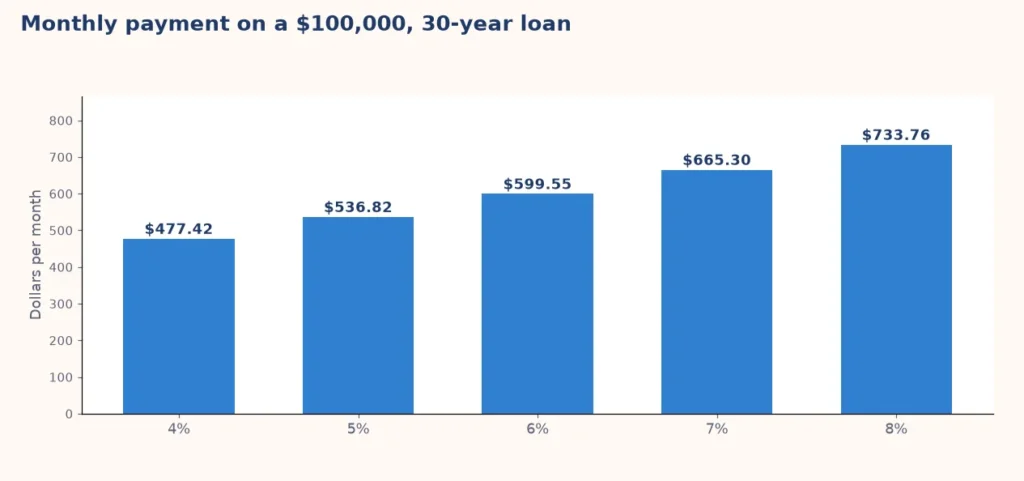
The shorter term has a higher payment but far less interest: at 6%, the 15-year loan costs about $51,894 in interest per $100,000 against $115,838 for 30 years. If you carry card debt instead, the credit card payoff calculator shows how a fixed monthly amount clears the balance. The loan calculator covers any other loan and can solve for the payoff time or the amount you can afford.
Interest calculators: simple interest, compound interest and retirement
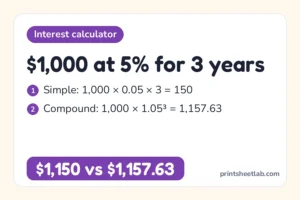
Interest calculators answer how much a balance earns or costs over time. Simple interest is charged on the original amount only: I = P × r × t, so $10,000 at 5% for 5 years earns $2,500. Compound interest is charged on the balance plus earlier interest: A = P × (1 + r ÷ n)nt, so growth speeds up over the years. The simple interest calculator and the compound interest calculator let you compare the two.
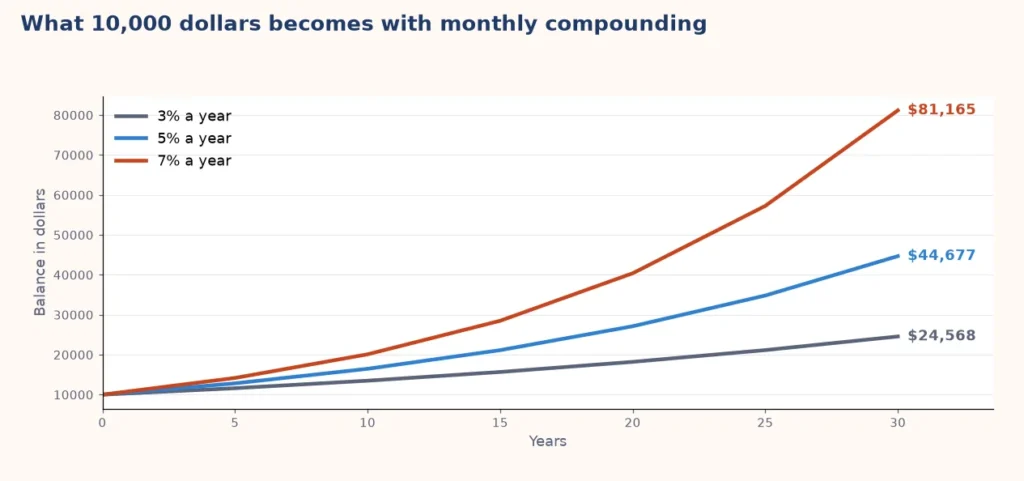
What $10,000 grows to with monthly compounding
Time matters more than the rate. The table uses monthly compounding and no extra deposits. Doubling the time from 10 to 20 years at 7% multiplies the balance by about 2, while the rate rise from 5% to 7% adds less over the same period.
| Rate | After 10 years | After 20 years | After 30 years |
|---|---|---|---|
| 3% | $13,494 | $18,208 | $24,568 |
| 5% | $16,470 | $27,126 | $44,677 |
| 7% | $20,097 | $40,387 | $81,165 |
Regular deposits matter even more. Saving $200 a month for 30 years at 7% builds about $244,000 from $72,000 of deposits. The retirement calculator extends this idea to a target nest egg and shows how much you can withdraw each year under the 4% rule.
Salary and pay calculators: hourly, overtime and hours worked
Salary and pay calculators convert the way you are paid into the way you plan. The standard full-time year has 40 hours × 52 weeks = 2,080 hours, so annual pay = hourly rate × 2,080. Divide by 12 for monthly pay, by 26 for a biweekly check and by 52 for weekly pay. The hourly to salary calculator does all four at once.
| Hourly rate | Weekly | Biweekly | Monthly | Annual |
|---|---|---|---|---|
| $15 | $600 | $1,200 | $2,600 | $31,200 |
| $20 | $800 | $1,600 | $3,467 | $41,600 |
| $25 | $1,000 | $2,000 | $4,333 | $52,000 |
| $30 | $1,200 | $2,400 | $5,200 | $62,400 |
| $40 | $1,600 | $3,200 | $6,933 | $83,200 |
| $50 | $2,000 | $4,000 | $8,667 | $104,000 |
Overtime changes the picture. In the United States, most non-exempt workers must be paid at least 1.5 times their regular rate for hours beyond 40 in a week. At $20 an hour, a 48-hour week pays 40 × $20 + 8 × $30 = $1,040. Try your own hours in the overtime calculator, or total a timesheet with breaks in the work hours calculator.
Tax calculators: sales tax, VAT and GST
Tax calculators add tax to a price or take it out again. Adding is simple: gross = net × (1 + rate). Removing is the step people get wrong: net = gross ÷ (1 + rate), not gross × (1 − rate). A price of $120 that includes 20% tax has a net price of $100 and tax of $20, which is 16.7% of the total.
| Tax rate | Add to $100 | Tax in a $100 total | Net price of a $100 total |
|---|---|---|---|
| 5% | $105.00 | $4.76 | $95.24 |
| 10% | $110.00 | $9.09 | $90.91 |
| 15% | $115.00 | $13.04 | $86.96 |
| 20% | $120.00 | $16.67 | $83.33 |
Which tax calculator to use depends on the country. The sales tax calculator covers United States purchases, tips and discounts. The VAT calculator handles United Kingdom and European rates, the GST calculator covers Australia, New Zealand and India, and the Canada sales tax calculator splits Canadian tax by province.
Markup and margin: money calculators for sellers
Markup is profit as a percent of cost, while margin is profit as a percent of the selling price. A product that costs $60 and sells for $90 has a $30 profit, a 50% markup and a 33.3% margin. Mixing them up is the most common pricing error, because a 50% markup never gives a 50% margin. The markup calculator converts between the two.
| Markup on cost | Margin on price | Selling price for $60 cost |
|---|---|---|
| 25% | 20.0% | $75.00 |
| 50% | 33.3% | $90.00 |
| 100% | 50.0% | $120.00 |
| 150% | 60.0% | $150.00 |
Financial calculators by country
Money rules differ by country, and a financial calculator is only as good as the rate and the terms you type in. The labels below are the ones to expect. Use the country page for each tax or rate and check official sources before any decision.
| Topic | United States | Canada | United Kingdom | Australia |
|---|---|---|---|---|
| Sales tax | Sales tax by state and city | GST, HST, PST, QST | VAT, 20% standard rate | GST, 10% |
| Retirement savings | 401(k), IRA | RRSP, TFSA | Workplace pension, ISA | Superannuation (super) |
| Typical mortgage | 30-year fixed | 25-year amortization, 5-year term | 25-year term, 2 to 5 year fix | 30 years, often variable |
| Overtime | 1.5x after 40 hours (federal) | Set by province | Set by contract | Set by award or agreement |
The UK government lists the standard rate of VAT at 20%, with a 5% reduced rate and a 0% zero rate. Australia’s GST is 10% and New Zealand’s is 15%. Browse the United States calculators, Canada calculators, UK and Europe calculators and Australia calculators for the rules that apply where you live.
Finance calculators glossary: key terms
| Term | Meaning |
|---|---|
| Principal | The amount borrowed or invested, before interest |
| APR | Annual percentage rate: the yearly cost of borrowing, including some fees |
| Amortization | Paying a loan off in equal installments over time |
| Compounding | Earning interest on interest as well as on the original amount |
| Net, gross | Net is the amount before tax, gross is the amount with tax included |
| Markup, margin | Profit as a percent of cost, or of the selling price |
| PMI | Private mortgage insurance, usually charged when the down payment is under 20% |
Real-life uses of financial calculators
Financial calculators earn their place in ordinary decisions, not only big ones. Loan and mortgage calculators, interest calculators, tax calculators and salary and pay calculators all answer questions people ask every week. Three quick cases show how the tools fit together.
Buying a car. You can afford $550 a month. The car loan calculator shows that $30,000 at 7% for 60 months costs $594.04, so you need a larger down payment, a longer term or a cheaper car. Raising the term to 72 months gives $511.47 but adds about $1,184 in interest.
Comparing two job offers. One pays $27 an hour, the other $54,000 a year. The hourly to salary calculator turns $27 into $56,160, so the hourly job pays $2,160 more before overtime. One of the best uses of salary and pay calculators is to put different pay styles on the same footing.
Pricing a handmade product. Materials and time cost $18 and you want a 40% margin. The price is cost ÷ (1 − margin) = 18 ÷ 0.60 = $30.00, which is a 66.7% markup. Money calculators like this stop you from underpricing.
Questions people ask about financial calculators
What is the best free financial calculator?
The best free financial calculator is the one built for your exact question, because a general tool hides the details that matter. Use a dedicated mortgage, loan, interest or tax calculator that lets you edit the rate and shows each step of the working.
How accurate are online finance calculators?
Finance calculators are exact when the formula and the inputs are right, but real loans add fees, rounding and rate changes. Treat results as a close estimate, compare them with the lender’s official disclosure and keep the interest rate editable.
Which calculators do I need to plan a budget?
A basic budget needs four: the hourly to salary calculator for income, the loan or mortgage calculator for the biggest bills, the credit card payoff calculator for debt and the compound interest calculator for savings goals.
Money calculators and finance calculators also share a habit worth copying: change one number at a time. Run the loan calculators with a rate one point higher and one point lower, and run the interest calculators with a shorter and a longer term. The spread tells you which input your result depends on most.
Common mistakes with financial calculators
- Using an old rate. Rates change, so type the current offer rather than relying on a default.
- Forgetting costs outside the payment. Property tax, insurance, fees and PMI can add hundreds of dollars a month.
- Removing tax the wrong way. Divide the total by 1 + rate; do not subtract a percent of the total.
- Confusing markup and margin. They use different bases and give different percentages.
- Comparing only the payment. A longer term lowers the payment but raises the total interest.
These tools give estimates, not financial advice. For decisions about loans, retirement or tax, check the figures with a lender, an accountant or your tax authority.
Frequently asked questions
9 quick answers
What are financial calculators?
Financial calculators are online tools that work out money figures such as loan payments, interest, salary, sales tax and profit margin from a few numbers you type. The best ones also show the formula and each step so you can check the answer.
Which financial calculator should I use for a loan?
Use the mortgage calculator for a home, the car loan calculator for a vehicle and the loan calculator for anything else. All three work out the monthly payment, the total interest and the payoff date from the amount, rate and term.
How do I calculate a monthly loan payment?
Use payment = P × i ÷ (1 − (1 + i)^−n), where P is the amount borrowed, i the monthly rate and n the number of payments. For $280,000 at 6.5% over 30 years the payment is $1,769.79 a month.
What is the difference between simple and compound interest?
Simple interest is paid only on the original amount: $10,000 at 5% for 5 years earns $2,500. Compound interest is paid on the growing balance, so $10,000 at 5% compounded monthly for 5 years earns about $2,834.
How do I turn an hourly wage into a yearly salary?
Multiply the hourly rate by 2,080, the hours in a 40-hour week over 52 weeks. For example, $25 an hour is $52,000 a year, $4,333 a month or $2,000 every two weeks before tax.
How do I remove tax from a price?
Divide the total by 1 plus the tax rate. For a $120 price with 20% tax, 120 ÷ 1.20 = $100, so the tax is $20. Subtracting 20% of $120 would give $96, which is wrong.
What is the difference between markup and margin?
Markup is profit divided by cost; margin is profit divided by selling price. A $60 item sold for $90 earns $30, which is a 50% markup but a 33.3% margin. Margin is always smaller than markup.
Are these financial calculators free and private?
Yes. Every calculator is free, needs no sign-up and runs in your browser, so the numbers you type stay on your device. Results are estimates and not financial advice.
Do financial calculators work for other countries?
Yes, the loan and interest formulas are the same everywhere. Tax and pay rules differ, so use the VAT, GST and Canada sales tax calculators for local rates and check your tax authority for the current rate.
More calculator hubs
- All free online calculators with steps for every topic
- Math calculators for percentages, fractions and ratios used in money problems
- Date and time calculators for loan dates, due dates and time between dates
- Grade and GPA calculators for grades and GPA
- Conversion calculators for units and temperature
- Home improvement calculators for project and utility costs
Sources and further reading
- GOV.UK: VAT rates (standard, reduced and zero rates)
- Investor.gov: Compound interest (U.S. Securities and Exchange Commission)
- Wikipedia: Overtime (time and a half by country)
- Wikipedia: Amortization calculator (the loan payment formula)
Last updated: October 2026.