A self-employment tax calculator works out the Social Security and Medicare tax you owe on freelance, gig and 1099 income, plus the federal income tax on the same money. Type your net profit, or your income and expenses, and this self-employment tax calculator shows the tax, the working, and what to pay at each 2026 quarterly due date.
Quick answer: Self-employment tax is 15.3% of 92.35% of your net profit: 12.4% for Social Security on up to $184,500 of earnings in 2026, and 2.9% for Medicare with no limit. On $60,000 of profit it is $8,477.73. You owe it once your net earnings reach $400.
How to use the self-employment tax calculator
The self-employment tax calculator updates as you type, so there is no Calculate button. Start with your filing status and your business income, then add the details that change the result.
- Choose your filing status: single, married filing jointly, head of household or married filing separately.
- Enter your net profit, or switch to Income and expenses and type your 1099 income, business expenses and business miles.
- Add any W-2 wages from a job, self-employed health insurance and SEP or solo 401(k) contributions.
- Type tax already withheld from wages and estimated tax you have already paid this year.
- Pick the next quarterly payment you will make, then read the total, the remaining payments and the share of each dollar to set aside.
| Box | What to type | Why it matters |
|---|---|---|
| Net profit | Income minus business expenses, Schedule C line 31 | Self-employment tax is figured from this number |
| Business miles | Miles driven for work in 2026 | Deducted at the IRS rate of 72.5 cents a mile |
| W-2 wages | Pay from a regular job | Uses up part of the $184,500 Social Security limit |
| Health insurance | Premiums you paid as a self-employed person | Lowers income tax, not self-employment tax |
| Estimated tax paid | Payments already sent to the IRS this year | Taken off what is left to pay |
Self-employment tax rate 2026: 15.3%
The self-employment tax rate is 15.3%. It is the same tax an employee and an employer share through payroll, except that a self-employed person pays both halves. The 15.3% is made of 12.4% for Social Security and 2.9% for Medicare.
The tax is not charged on your whole profit. You first multiply net profit by 92.35%, which mirrors the employer half that an employee never sees on a pay stub. The Social Security part then applies only up to the 2026 contribution and benefit base of $184,500, while the Medicare part has no cap.
| Part | Rate | Applies to (2026) |
|---|---|---|
| Social Security | 12.4% | The first $184,500 of wages plus self-employment earnings |
| Medicare | 2.9% | All self-employment earnings |
| Additional Medicare tax | 0.9% | Wages plus earnings above $200,000 single, $250,000 joint, $125,000 separate |
| Filing threshold | None | No self-employment tax if net earnings are under $400 |
How much is self-employment tax? A worked example
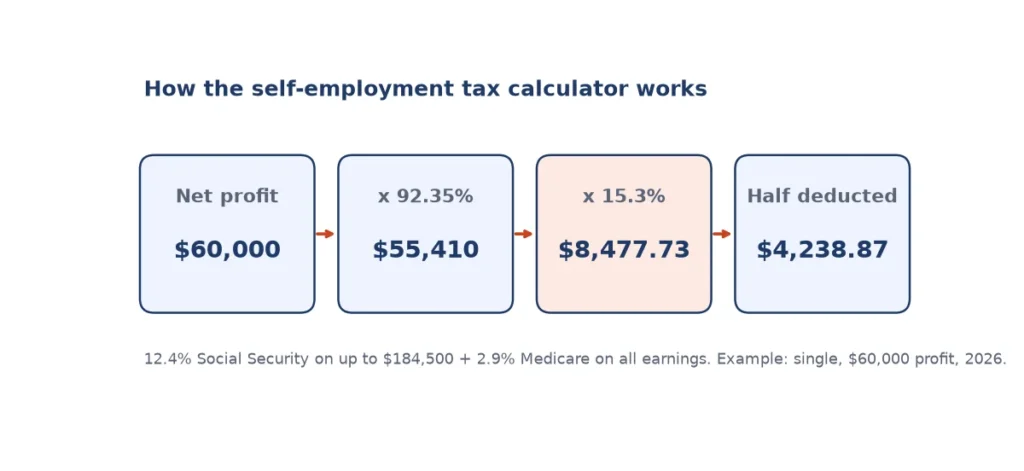
Take a single freelancer with $60,000 of net profit and no other income. The self-employment tax calculator follows the same steps as Schedule SE:
- Taxable earnings: $60,000 × 0.9235 = $55,410.00.
- Social Security: $55,410.00 × 12.4% = $6,870.84.
- Medicare: $55,410.00 × 2.9% = $1,606.89.
- Self-employment tax: $8,477.73, which is 14.13% of the $60,000 profit.
- Half of it, $4,238.87, is deducted before income tax is worked out.
- After the $16,100 standard deduction and a $7,932.23 qualified business income deduction, taxable income is $31,728.91 and federal income tax is $3,559.47.
- Total federal tax: $12,037.20, about 20.1% of profit, or $3,009.30 each quarter.
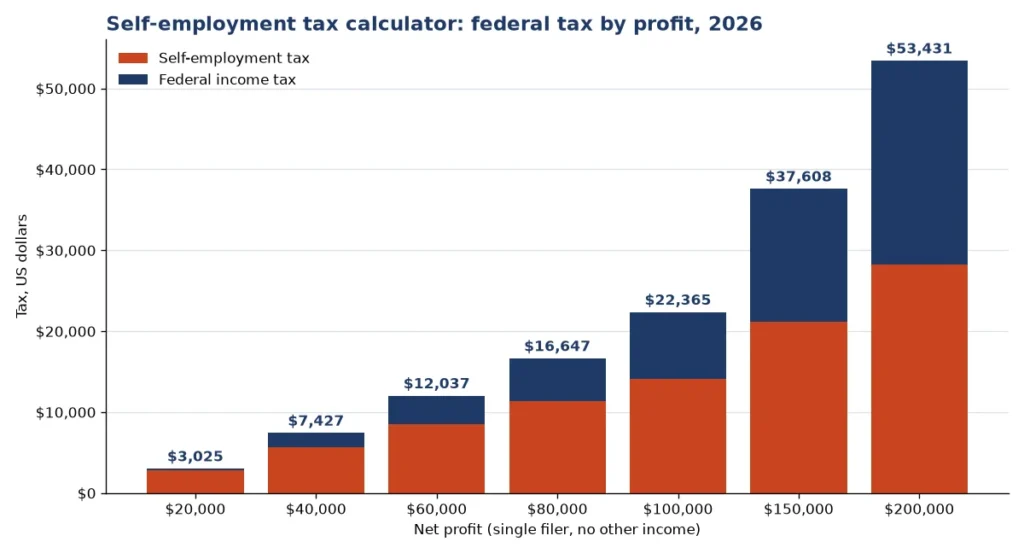
Self-employment tax at common profit levels
The table uses the 2026 figures for a single filer with no other income, the standard deduction and the qualified business income deduction. Use the self-employment tax calculator for your own numbers.
| Net profit | SE tax | Federal income tax | Total federal tax | Share of profit |
|---|---|---|---|---|
| $20,000 | $2,826 | $199 | $3,025 | 15.1% |
| $40,000 | $5,652 | $1,775 | $7,427 | 18.6% |
| $60,000 | $8,478 | $3,559 | $12,037 | 20.1% |
| $80,000 | $11,304 | $5,344 | $16,647 | 20.8% |
| $100,000 | $14,130 | $8,235 | $22,365 | 22.4% |
| $150,000 | $21,194 | $16,413 | $37,608 | 25.1% |
| $200,000 | $28,234 | $25,196 | $53,431 | 26.7% |
Quarterly estimated tax calculator: dates and amounts
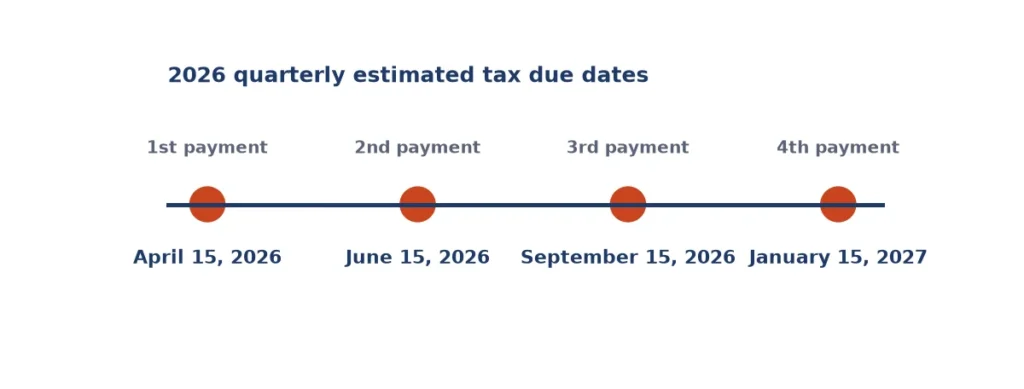
Nobody withholds tax from 1099 income, so the IRS expects you to pay during the year in four installments. The self-employment tax calculator splits what is left to pay evenly across the payments you still have, starting with the one you choose.
| Payment | Income earned | Due date |
|---|---|---|
| 1st | January 1 to March 31 | April 15, 2026 |
| 2nd | April 1 to May 31 | June 15, 2026 |
| 3rd | June 1 to August 31 | September 15, 2026 |
| 4th | September 1 to December 31 | January 15, 2027 |
The IRS generally does not require estimated payments if you expect to owe less than $1,000 after withholding and credits. Otherwise you avoid the underpayment penalty by paying at least 90% of this year’s tax or 100% of last year’s tax, whichever is smaller. If last year’s adjusted gross income was over $150,000, the prior-year figure is 110%.
1099 tax calculator with deductions
Deductions change the answer more than anything else. Business expenses lower your net profit, which lowers both self-employment tax and income tax. Other deductions lower income tax only. This is how each one works in the self-employment tax calculator:
- Business expenses. Software, phone, supplies, a home office and fees come off income before anything else. In Income and expenses mode you type them directly.
- Mileage. Business miles are deducted at the 2026 IRS standard rate of 72.5 cents a mile, so 4,000 miles is a $2,900 deduction.
- Half of self-employment tax. Deducted automatically when the calculator works out your adjusted gross income.
- Self-employed health insurance. Deductible up to your net profit. It lowers income tax but not self-employment tax.
- SEP IRA and solo 401(k) contributions. Lower income tax, not self-employment tax.
- Qualified business income deduction. Up to 20% of qualified business income. In 2026 the simple version applies when taxable income is $201,750 or less ($403,500 joint). Above that, limits apply and the calculator leaves it out.
1099 or W-2: which pays more?
An employee pays 7.65% of wages in payroll tax and the employer pays the other 7.65%. A 1099 worker pays the full 15.3% on 92.35% of profit. That is why the same income leaves a contractor with less, and why freelance rates are usually higher than a salary would be.
The self-employment tax calculator shows the W-2 salary that would leave you the same money as your freelance profit. For a single filer with $60,000 of profit, take-home after federal tax is about $47,963, and a job paying roughly $57,000 leaves about the same. Benefits such as health insurance, paid leave and a 401(k) match make a job worth more than its salary, so compare those too.

What hourly rate should a freelancer charge?
The hourly rate helper works backward from the take-home pay you want. It finds the profit that leaves that amount after self-employment and income tax, adds your yearly expenses, and divides by your billable hours. With a $50,000 take-home target, $6,000 of expenses and 25 billable hours a week for 46 weeks, the rate comes to about $59.69 an hour for a single filer.
Most freelancers bill fewer hours than they work, because time goes to admin, sales and learning. Counting only billable hours keeps the rate honest.
How much to set aside for taxes
The last line of the self-employment tax calculator result shows the share of each dollar of profit that goes to tax. For a single filer with $60,000 of profit it is about 20%. Many freelancers move that share into a separate savings account each time a client pays, so the quarterly payment is ready when it is due.
The share rises with income because of the income tax brackets, and it falls when you have more deductions. A state income tax adds to it; type your state’s rate in the calculator to include a rough figure.
Self-employed tax calculator for gig workers and side jobs
Drivers, delivery workers and online sellers are self-employed in the eyes of the IRS, even when the work is part time. Platforms usually send a Form 1099-NEC or 1099-K, but the tax is figured from your net profit, not the gross amount on the form. Use Income and expenses mode in the self-employment tax calculator, type the gross from your forms, and add your expenses and business miles.
Mileage is often the largest deduction for gig workers. At 72.5 cents a mile, 10,000 business miles is a $7,250 deduction, which on its own cuts self-employment tax by about $1,024. Keep a log with the date, purpose and miles of each trip, because the deduction needs a record to back it up.
If you also have a regular job, add your W-2 wages and the tax withheld from them. The self-employment tax calculator then shows how much extra to pay each quarter, or whether raising the withholding at your job would cover it instead.
Married couples and self-employment tax
Self-employment tax is figured for each person, not for the couple. If both spouses have a business, each one has their own $184,500 Social Security limit and files their own Schedule SE. The filing status still matters for income tax, the standard deduction and the additional Medicare tax threshold of $250,000 on a joint return.
To estimate a joint return with two businesses, run the self-employment tax calculator once for each spouse to get each self-employment tax, then add the two. For income tax, a single run with combined profit on married filing jointly gives a close figure.
Records to keep as a self-employed person
- Every 1099 form and a list of income that did not come with a form.
- Receipts or statements for each business expense, kept for at least three years after you file.
- A mileage log with dates, places, purpose and miles.
- Proof of each estimated tax payment, such as the IRS confirmation number.
- Health insurance and retirement contribution statements for the deductions.
Good records make the numbers you type into the self-employment tax calculator match what you file, and they are what the IRS asks for if a deduction is ever questioned.
What the self-employment tax calculator covers, and what it leaves out
The self-employment tax calculator covers the parts of a freelance tax bill that change the most: Schedule SE, federal income tax from the 2026 brackets, the standard deduction, half of self-employment tax, self-employed health insurance, retirement contributions, the qualified business income deduction below its limit, and a flat state rate you choose.
It does not cover tax credits such as the child tax credit or education credits, capital gains, rental income, itemized deductions, the alternative minimum tax or local income taxes. Each of those can raise or lower the final bill. If they apply to you, treat the self-employment tax calculator result as the self-employment part of the picture and add the rest with tax software or a professional.
Because the self-employment tax calculator runs in your browser, nothing you type is saved on a server. Copy worksheet puts a plain-text summary on your clipboard, including each remaining due date, so you can keep it with your records or send it to your accountant.
When to use a self-employment tax calculator during the year
- In January, to plan the first quarterly payment from last year’s numbers.
- Before each due date in April, June, September and January, to update the payment with your profit so far.
- When you take on a large project or a new client, to see how much more to set aside.
- Before you set or raise your rates, using the hourly rate helper.
- In December, to decide whether a retirement contribution or an expense before year end is worth it.
Running the self-employment tax calculator a few times a year keeps the quarterly payments close to what you will owe, which avoids both a penalty and a large bill in April.
Common mistakes with self-employment tax
- Applying 15.3% to the whole profit instead of to 92.35% of it, which overstates the tax by about 7.6%.
- Forgetting that W-2 wages use up part of the Social Security limit when you also have a job.
- Treating SEP or solo 401(k) contributions as if they lower self-employment tax. They lower income tax only.
- Waiting until April to pay everything, which can bring an underpayment penalty.
- Not keeping records of expenses and mileage, which are needed to support every deduction.
Frequently asked questions
10 quick answers
What is the self-employment tax rate for 2026?
It is 15.3%: 12.4% for Social Security and 2.9% for Medicare, applied to 92.35% of net profit. The Social Security part stops at $184,500 of combined wages and self-employment earnings.
How much is self-employment tax on $50,000?
On $50,000 of net profit, self-employment tax is $7,064.78: $50,000 × 0.9235 = $46,175, then 15.3% of that. Federal income tax comes on top.
Do I have to pay self-employment tax on 1099 income?
Yes, if your net earnings from self-employment are $400 or more for the year. That covers freelance work, gig apps and a side business, even if you also have a job.
How do I calculate quarterly estimated taxes?
Estimate your total tax for the year, subtract withholding and payments already made, and divide the rest by the payments you have left. The calculator does this for you.
When are 2026 estimated tax payments due?
April 15, June 15 and September 15, 2026, and January 15, 2027.
Can I deduct half of my self-employment tax?
Yes. Half of the tax is deducted when working out adjusted gross income. It lowers income tax, not the self-employment tax itself.
Does a W-2 job lower my self-employment tax?
It can. Wages count toward the $184,500 Social Security limit first, so a high salary can reduce or remove the 12.4% part on side income.
Is the qualified business income deduction included?
Yes, as an option. The calculator applies the 20% deduction when taxable income is within the 2026 limit of $201,750 ($403,500 joint) and leaves it out above that.
Does this calculator include state tax?
Only as a flat rate you type in, applied to adjusted gross income. State rules vary, so treat that line as a rough guide.
Is this self-employment tax calculator free and accurate?
It is free and uses the 2026 IRS and Social Security figures. It is an estimate, not tax advice, and it does not cover credits or every type of income.
Related calculators
- Hourly to salary calculator to turn a rate into yearly pay
- Markup and margin calculator to price your work
- Free invoice generator to bill your clients
- All financial calculators
- Calculators for the USA
Sources and further reading
- IRS Topic 554: Self-employment tax for the 15.3% rate, the 92.35% rule and the $400 threshold
- IRS: 2026 inflation adjustments for brackets and the standard deduction
- IRS Revenue Procedure 2025-32 for head of household and separate brackets and the QBI thresholds
- Social Security Administration: 2026 determinations for the $184,500 limit
- IRS: 2026 standard mileage rate for 72.5 cents a mile
- IRS Topic 306: Penalty for underpayment of estimated tax
This self-employment tax calculator gives general estimates, not tax advice. Check your figures with the IRS or a tax professional before you file.
Last updated: October 2026.