Diwali dhamaka tambola is the festival-of-lights housie: diyas, lanterns, phuljhadi, rangoli and mithai fill the ticket, and six prizes from Phuljhadi Five to the Shubh Diwali full house. You will find the free pack, an online game for family far away, a prize ladder, a planner for 15 to 60 guests and a run sheet for a Diwali evening below.
A ticket that glows like your doorstep on Diwali night
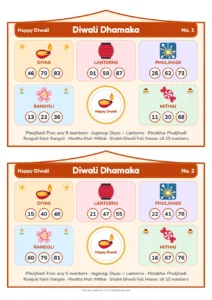
Open any ticket in this Diwali theme tambola set and the first thing you notice is the arched outline, shaped like a temple doorway or a carved jharokha (a decorated window). Under the title sits a small medallion that reads “Happy Diwali”, and below it the fifteen numbers are spread across five little pictures that every family will recognize.
- Diyas: clay lamps with tiny sparkles, the first thing lit at dusk.
- Lanterns: the hanging akash kandil (paper sky lantern) that goes up on balconies.
- Phuljhadi: the hand-held sparkler that children wave in circles.
- Rangoli: flower-and-powder floor art drawn at the entrance.
- Mithai: boxes of sweets, from kaju katli to gulab jamun.
Each picture holds three numbers, so players are not just hunting digits, they are “filling the diyas” or “finishing the mithai”. Every set of six tickets shares 1 to 90 between them exactly once, which keeps wins spread across the room instead of bunching on one table.
Ready-to-print Diwali Dhamaka Tambola pack
12 different picture tickets (2 on each A4 page) with a caller sheet, a prize sheet and a rules page. Print it as it is, or press Create your tambola ticket above for more tickets and your own party name.
The six Diwali prizes and how to win each one
The prize names are borrowed from the festival itself, which gives the caller lots to shout about. Here is what each one needs:
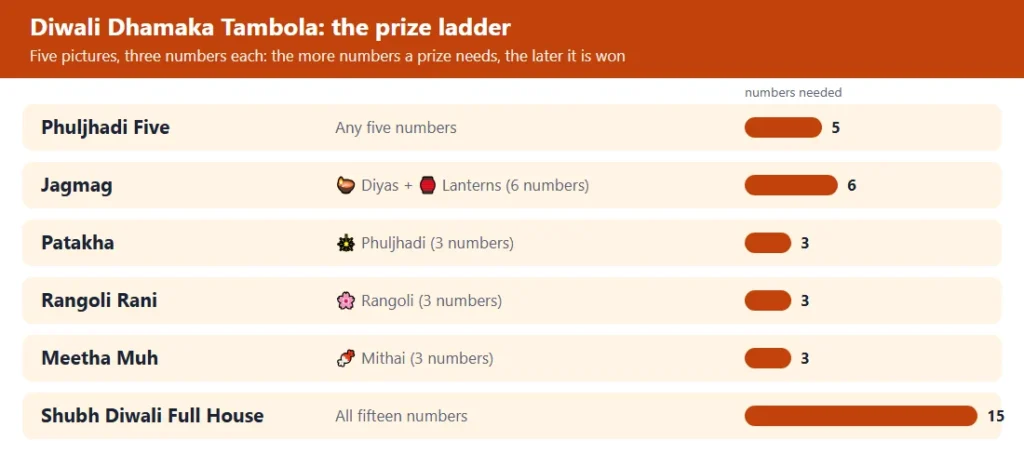
- Phuljhadi Five: the first player to strike off any five numbers anywhere on the ticket.
- Jagmag: both the Diyas and the Lanterns pictures complete, six numbers in all. “Jagmag” means shimmering, a nice fit for the two light sections.
- Patakha: all three numbers in the Phuljhadi picture. A patakha is a firecracker, so let the winner make the loudest noise in the room.
- Rangoli Rani: the three Rangoli numbers. Rani means queen, though uncles may win it too.
- Meetha Muh: the three Mithai numbers. The phrase means “sweet mouth”, from the custom of feeding someone a sweet to celebrate good news.
- Shubh Diwali Full House: all fifteen numbers. Shubh means auspicious, and this is the big one.
The prize sheet in the maker prints these names with their pictures, so you can stick it on the wall and nobody argues about what counts.
Hosting a Diwali tambola evening
Diwali evenings already have a rhythm: Lakshmi puja at the auspicious muhurat, lamps lit, then crackers and dinner. Tambola fits best in the gap after the puja and before the meal, when everyone is dressed up and nobody wants to sit idle.
Dress code and decor
Ask guests to come in something golden, or in traditional wear with one bright accessory. If you are hosting a Diwali card party or office celebration, a “lamp color” theme of yellow, orange and red looks lovely in photos. Put a diya on each table and use rangoli powder to number the table spots.
Prizes that suit the festival
- A small brass or clay diya set for Jagmag.
- A box of eco-friendly sparklers or a fun cracker-shaped chocolate for Patakha.
- A rangoli stencil kit or colored powder pack for Rangoli Rani.
- A dry fruit or mithai box for Meetha Muh.
- Something lasting for the Full House: a silver coin, a decorative thali or a scented candle hamper.
Seating and calling
Seat families together at low tables or on floor cushions with a white sheet, the way many homes do for festive card games. Keep the caller near the puja area so the lamps form a backdrop.
Play Diwali tambola online with family far away
Half the family abroad this year? The host can start an online game, share the link on the family group, and relatives join on their phones. Through the Diwali evening the game calls each number on its own, with a voice reading it out if you like, and every ticket marks itself. A Bingo claim appears on the host screen to be checked. Cast the TV view with its QR code in the living room so everyone at home can follow along too.
Printing tips and a Diwali twist
Color printing shows off the warm golds and pinks, but the black and white option works well if you want children to color the pictures in before the game starts. Two tickets per page on A4 gives a comfortable size for older eyes; four per page saves paper for a big building gathering.
For a twist, try “Lakshmi’s footsteps”: hide the Full House prize somewhere in the house and give the winner a short trail of rangoli-drawn clues to find it. It echoes the custom of drawing small footprints at the entrance to welcome the goddess. For the wider story behind the lamps and the puja, see the Wikipedia article on Diwali.
Prefer plain number tickets? Our classic Diwali tambola tickets and Diwali games page has you covered, and you can browse every design in the full theme tambola collection. If the party continues into Bhai Dooj or a family get-together, the Rang Barse Holi tambola and Kitty Queen tambola are good to save for later.
Diwali theme tambola: why this theme works
Diwali is celebrated on a new-moon night in autumn, with lamps, sweets, family gatherings and card games. The exact date changes every year because it follows the lunar calendar, and many families host a get-together in the days around it.
A game that uses diyas and sweets as pictures puts the festival on the table. Diwali dhamaka tambola fits the family card party, the office celebration and the society get-together, and it offers a quieter alternative to crackers for children and older relatives.
Here is how diwali theme tambola fits a Diwali party: the pictures need no explanation, the prizes give the host lines to announce, and the whole game fits comfortably around the other events of the day.
How to play diwali dhamaka tambola step by step
The rules of diwali dhamaka tambola are the rules of ordinary tambola, with pictures instead of rows. Here is the whole game in six steps, using the prize names printed on the sheet:
- Hand out the tickets. Give each player one ticket and read the prize list aloud, starting with Phuljhadi Five and ending with Shubh Diwali Full House.
- Call the numbers. The host calls numbers from 1 to 90 in random order, or lets the online game call them.
- Mark your pictures. Each player strikes off the numbers on their ticket, and each picture holds three of them.
- Claim a prize. The first player to complete a pattern shouts the prize name, such as “Jagmag!”, before the next number is called.
- Check the claim. The host reads the numbers back against the caller sheet. A wrong claim loses that ticket the prize.
- Finish with the full house. The game ends when a player marks all fifteen numbers and wins Shubh Diwali Full House.
New players learn diwali dhamaka tambola in about two minutes, because the pictures show them what to look for. If the group has never played tambola, our guide on how to play tambola explains the classic version.
Diwali dhamaka tambola: the prize ladder in numbers
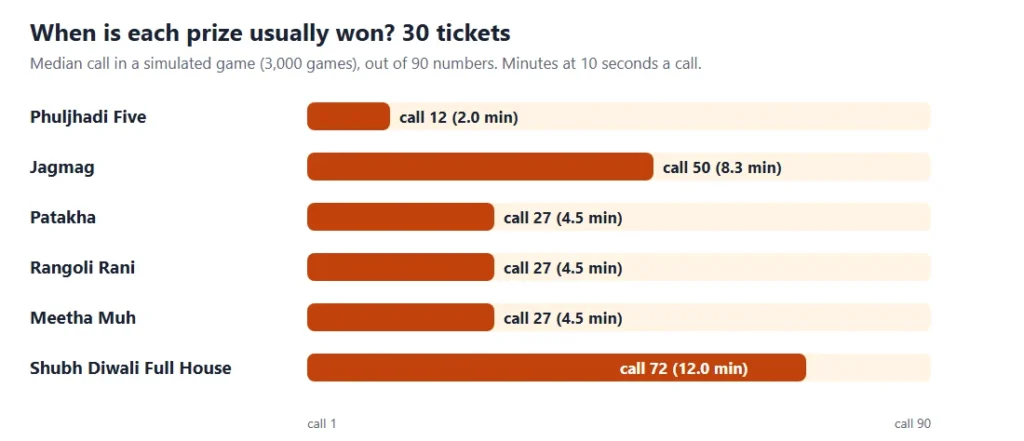
Every prize in diwali dhamaka tambola needs a different number of marked numbers, so the prizes arrive in a predictable order. We simulated 3,000 games with 30 tickets, which is 5 sets of six, and recorded the call on which each prize was first completed. The table shows the median, with the middle half of games alongside:
| Prize | What it needs | Numbers needed | Usually won on | Middle half of games |
|---|---|---|---|---|
| Phuljhadi Five | Any five numbers on the ticket | 5 | call 12 | calls 10 to 14 |
| Jagmag | The Diyas and Lanterns pictures together (6 numbers) | 6 | call 50 | calls 43 to 55 |
| Patakha | The Phuljhadi picture (3 numbers) | 3 | call 27 | calls 20 to 33 |
| Rangoli Rani | The Rangoli picture (3 numbers) | 3 | call 27 | calls 20 to 33 |
| Meetha Muh | The Mithai picture (3 numbers) | 3 | call 27 | calls 20 to 33 |
| Shubh Diwali Full House | All fifteen numbers | 15 | call 72 | calls 69 to 75 |
With 30 tickets the first five arrives on about call 12, and the full house on about call 72, so the whole ladder runs over 60 calls, or about 10 minutes at 10 seconds a call. A one-picture prize arrives around call 27, and a two-picture prize around call 50, so most of the excitement happens in the middle of the game. When you plan diwali dhamaka tambola, announce the prizes in the order they are likely to be won, and keep the biggest for last.
Diwali tambola tickets: how many to print and how long a game lasts
This planner answers the question behind diwali tambola tickets: how many to print and how long the game lasts. For a Diwali party, the right number of tickets depends on how many guests want to play. This planner rounds up to whole sets of six and uses the same simulation as above for each size of group. One ticket for each player is the usual choice, and you can print a few spares for latecomers:
| Guests | Tickets to print | Sets of six | First five | One picture | Two pictures | Full house | Full house at 10 seconds a call |
|---|---|---|---|---|---|---|---|
| 15 | 18 | 3 | call 13 | call 32 | call 53 | call 74 | 12.3 min |
| 30 | 30 | 5 | call 12 | call 27 | call 50 | call 72 | 12.0 min |
| 60 | 60 | 10 | call 11 | call 22 | call 44 | call 69 | 11.5 min |
For 15 guests, print 18 tickets (3 sets of six) and expect the full house around call 74, which is about 12.3 minutes of calling. For 60 guests you need 60 tickets and the full house arrives around call 69.
The bigger the group, the earlier each prize is won, because more tickets are in play: the first five comes on call 13 with 15 guests but on call 11 with 60. That is why diwali dhamaka tambola stays quick even at a large Diwali party, and why it suits a short slot in the program.
What one ticket looks like during diwali dhamaka tambola
A ticket holds 15 of the 90 numbers, which is one sixth of them, so on average it has one sixth of the numbers called so far marked. By call 30 a typical ticket has 5 of its 15 numbers marked:
| By call | Numbers marked on one ticket (on average) | Share of the ticket |
|---|---|---|
| 10 | 1.7 | 11% |
| 20 | 3.3 | 22% |
| 30 | 5.0 | 33% |
| 45 | 7.5 | 50% |
| 60 | 10.0 | 67% |
| 75 | 12.5 | 83% |
That is the average ticket, though. With 30 tickets in play, the best ticket reaches five marked numbers on call 12, and the best ticket completes all fifteen on call 72, long before an average ticket does. This gap between the average and the best ticket explains why the prizes in diwali dhamaka tambola are won so much earlier than the table above suggests.
A ready-made run sheet for diwali dhamaka tambola
Here is a run sheet for diwali dhamaka tambola that fits 85 minutes. The times are suggestions; stretch the snack break or shorten a round to suit your Diwali party.
| Clock | What happens | Time |
|---|---|---|
| 0:00 to 0:15 | Guests arrive; lamps lit and sweets served | 15 min |
| 0:15 to 0:35 | Diwali dhamaka tambola, round one: Phuljhadi Five, Jagmag and Patakha | 20 min |
| 0:35 to 0:50 | Puja or snack break | 15 min |
| 0:50 to 1:05 | Round two: Rangoli Rani and Meetha Muh | 15 min |
| 1:05 to 1:15 | Full house: Shubh Diwali, plus the prize reveal | 10 min |
| 1:15 to 1:25 | Exchange of gifts and sweets | 10 min |
The tambola rounds take 45 of the 85 minutes, which leaves room for food, photos and conversation. If you only have half the time, play one round and keep diwali dhamaka tambola for the full house, since the biggest prize makes the best ending.
Prize ideas for diwali dhamaka tambola: a gift for every pattern
Match the gift to the pattern: small gifts for the quick prizes and the best gift for the full house. These ideas fit a Diwali party:
| Prize | Gift idea | Pattern |
|---|---|---|
| Phuljhadi Five | A pack of sparklers (or sparkle candles) for Phuljhadi Five | 5 numbers |
| Jagmag | A diya set for Jagmag | 6 numbers |
| Patakha | A cracker-shaped chocolate for Patakha | 3 numbers |
| Rangoli Rani | A rangoli stencil for Rangoli Rani | 3 numbers |
| Meetha Muh | A dry fruit box for Meetha Muh | 3 numbers |
| Shubh Diwali Full House | A silver coin or thali for the full house | 15 numbers |
Decor and dress ideas to go with the prizes:
- A diya on every table
- Rangoli powder numbers for the seats
- Fairy lights and marigold strings
- A golden table runner
Keep the prizes simple, wrap them in the theme colors and put them on a table where everyone can see them before the first call. A prize table in view keeps interest high all through diwali dhamaka tambola.
Diwali housie game: three twists to try
Here is how diwali housie game can be varied. A small twist makes the game feel planned. Pick one, or use all three across the rounds of diwali dhamaka tambola, and diwali dhamaka tambola stays quick whichever you choose.
Lakshmi footsteps
Hide the full house prize and give the winner a trail of rangoli clues to find it.
Diya blessing
The winner of Jagmag lights a diya and shares a wish for the year.
Sweet swap
Winners of Meetha Muh feed a sweet to someone they have not spoken to yet.
If you like diwali dhamaka tambola, you may also enjoy Rang Barse Holi Tambola, Teej Ki Bahaar Tambola, Karwa Chauth Chand Tambola, or browse the whole theme tambola collection.
Frequently asked questions
9 quick answers
How many Diwali theme tambola tickets should I print?
Plan on one per player, with a few spares on top. Because each set of six uses every number once, printing in multiples of six (12, 18, 24 and so on) gives the fairest spread of prizes. The maker goes up to 600 tickets for large society events.
Can we play Diwali tambola on a WhatsApp or Zoom call?
Yes. For a video call, use the online game: send the join link in your WhatsApp group, keep everyone on Zoom or Meet for the chatter, and let the game call the numbers.
Is this suitable for an office Diwali party?
It works well at work because the pictures need no explanation and the game takes under an hour. Add the company name as the party name in the maker, pick the date, and print the caller and prize sheets for whoever runs it.
What is the difference between this and a normal Diwali housie ticket?
A normal ticket has three rows and early five, line and full house prizes. This Diwali theme tambola ticket groups the numbers into festival pictures, so you get six named prizes such as Jagmag and Meetha Muh.
When should I host Diwali tambola?
Any evening in the Diwali week. Many families play after the puja and before the meal, when everyone is dressed up and relaxed.
Is it safe for children?
Yes. It needs no fire or crackers, and it gives children a calm game to play between rounds of rangoli.
Is diwali dhamaka tambola free to print?
Yes. The diwali dhamaka tambola pack is free: print the ready-made PDF, or make your own tickets with the maker on this page, with no sign-up and no watermark on the tickets.
Can I play diwali dhamaka tambola online?
Yes. Start a live game, share the link and each guest gets a picture ticket on their phone while the game calls the numbers; the host screen checks every claim and shows the prize won.
How long does diwali dhamaka tambola take?
With 30 tickets, the full house in diwali dhamaka tambola is usually won around call 72, which is about 12.0 minutes of calling at 10 seconds a call. Allow 85 minutes in total for the party slot.