This comparing fractions game helps third and fourth graders decide which fraction is greater, less or equal by playing: race cars, pop balloons or sprint through true and false sentences. Each question shows two fractions with the signs greater than (>), less than (<) or equal to (=) to choose from, such as 3/5 ? 3/8 or 4/6 ? 2/3, with denominators from 2 to 10. It is free, needs no sign-up, works on phones and tablets, and comes with a printable fraction strips chart.
Comparing fractions game: see how it plays
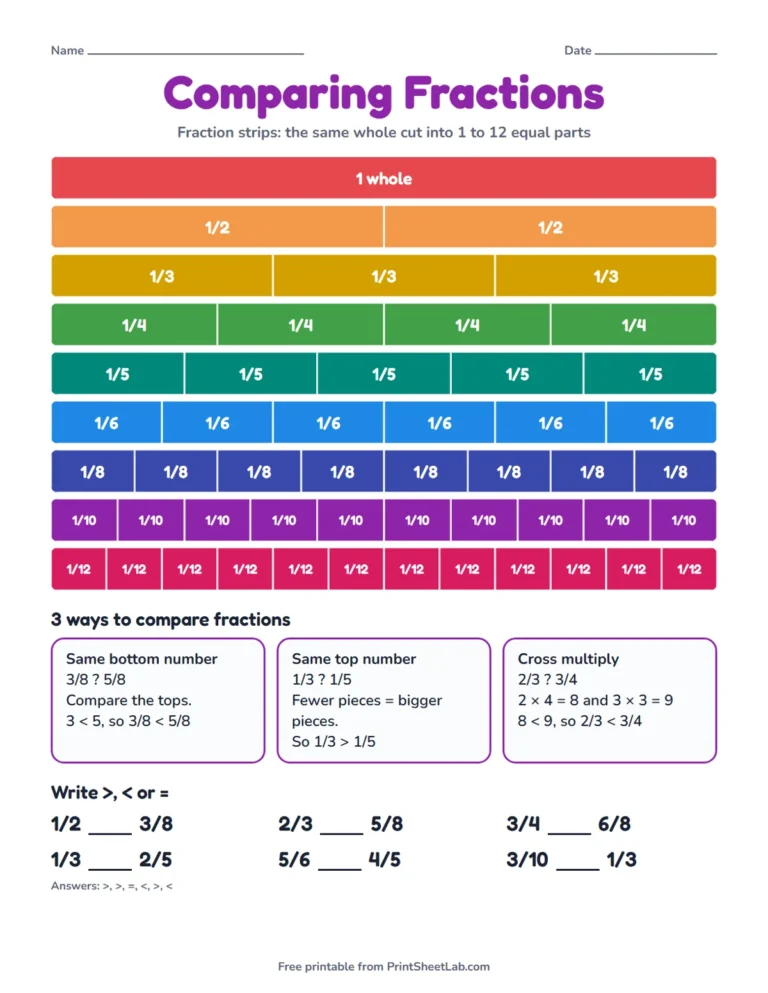
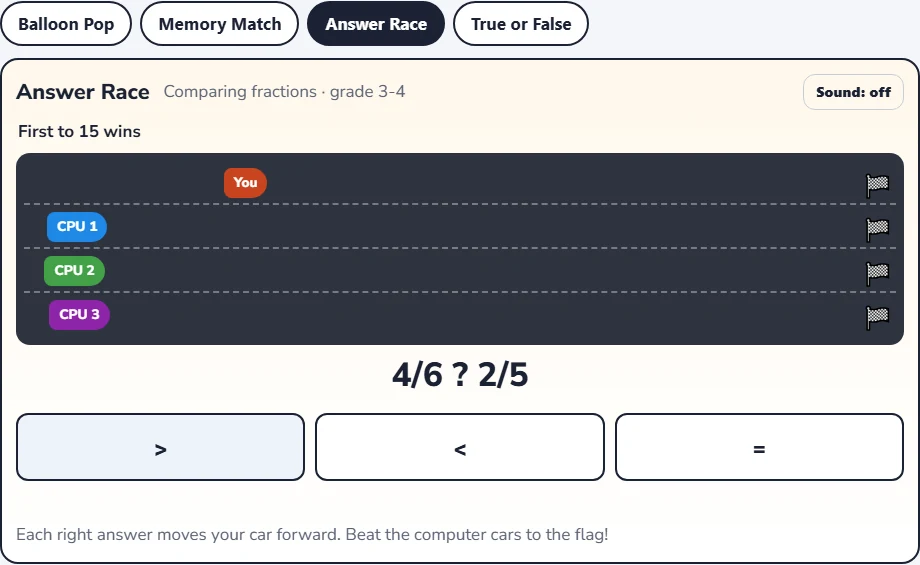
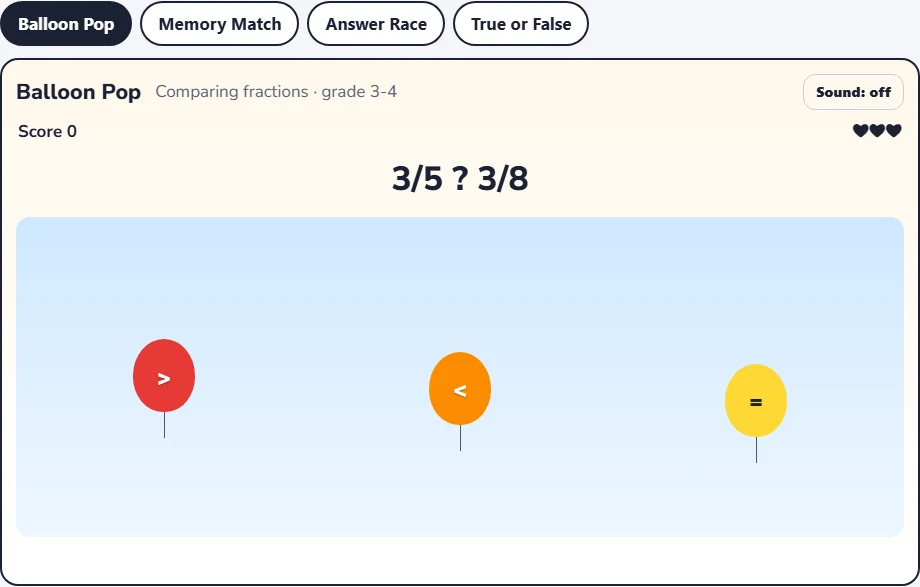
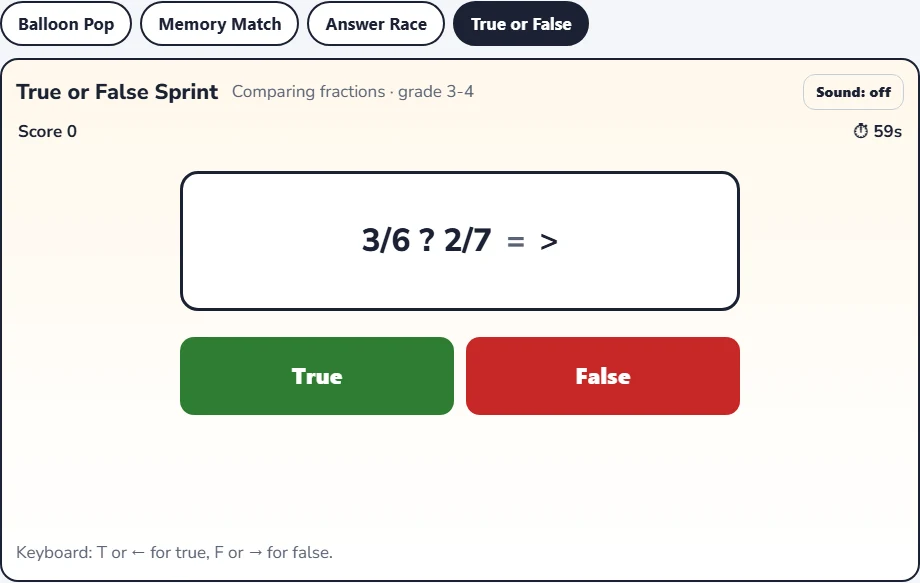
The game below has three modes, and each one asks only fractions questions. The printable chart shows the same whole cut into 1 to 12 equal parts, so children can see why one third is bigger than one fifth. The pictures show Answer Race, Balloon Pop and True or False on this page.
How the comparing fractions game works
- Answer Race: every right answer moves your car forward, and you race three computer cars to the finish flag. The first to 15 wins, and wrong taps cost time, not places.
- Balloon Pop: answers float up on balloons, and you pop the right one before it drifts off the top. There are three balloons, one for each sign, so the real work is deciding whether the first fraction is greater than, less than or equal to the second. The game speeds up as your score climbs, and three misses ends the round.
- True or False: sixty seconds on the clock. Decide whether each comparison, such as 3/6 ? 2/7 = >, is right or wrong. A streak of five or more scores double.
3 ways to compare fractions
- Same denominator: when the bottom numbers match, the pieces are the same size, so the bigger numerator is the bigger fraction. 5/8 is greater than 3/8 because 5 pieces beat 3 pieces.
- Same numerator: when the top numbers match, the fraction with the smaller denominator is bigger, because its pieces are bigger. 1/3 is greater than 1/5, since a whole cut into 3 parts has larger parts than a whole cut into 5.
- Cross multiply: for any two fractions a/b and c/d, compare a × d with c × b. The larger product belongs to the larger fraction. For 2/3 and 3/4, 2 × 4 = 8 and 3 × 3 = 9, so 2/3 is less than 3/4.
A fourth idea is to compare each fraction with one half. 3/8 is less than 1/2 because 4/8 is one half, and 5/8 is greater than 1/2. This benchmark trick is a fast way to settle many questions without any calculation.
Compare fractions greater than less than: worked examples
| Question | Cross multiplication | Result |
|---|---|---|
| 1/2 ? 3/8 | 1 × 8 = 8 and 3 × 2 = 6 | 1/2 > 3/8 |
| 2/3 ? 5/8 | 2 × 8 = 16 and 5 × 3 = 15 | 2/3 > 5/8 |
| 3/4 ? 6/8 | 3 × 8 = 24 and 6 × 4 = 24 | 3/4 = 6/8 |
| 1/3 ? 2/5 | 1 × 5 = 5 and 2 × 3 = 6 | 1/3 < 2/5 |
| 5/6 ? 4/5 | 5 × 5 = 25 and 4 × 6 = 24 | 5/6 > 4/5 |
| 3/10 ? 1/3 | 3 × 3 = 9 and 1 × 10 = 10 | 3/10 < 1/3 |
The sixth example, 3/10 and 1/3, is a good one to remember: 3 × 3 = 9 and 1 × 10 = 10, so 3/10 is just a little smaller than 1/3. Wikipedia’s fraction article explains the idea of a numerator and a denominator in more depth.
Equivalent fractions game: why 2/4 equals 1/2
Whenever the game shows the equal sign as the right answer, the two fractions are equivalent: they name the same amount in different pieces. 1/2, 2/4, 3/6 and 4/8 are all equal, and so are 1/3, 2/6 and 3/9. Fraction strips make this visible, because the 1/2 bar lines up exactly with two 1/4 pieces or three 1/6 pieces. Use the fraction strips maker to print strips for the whole class, and the equivalent fractions worksheets for follow-up practice.
Fractions game tips for parents and teachers
- Draw it: sketch two bars of the same length, split them, and shade each fraction. Seeing the shaded parts settles most doubts.
- Use food: cut a pizza or a sandwich into fractions and ask which piece is bigger.
- Say it in words: “three fifths is more than three eighths because fifths are bigger pieces” builds understanding, not just a rule.
- Start with the signs: make sure children know that the open side of the > sign faces the bigger number.
Where the comparing fractions game fits at school
| Level | What children are expected to do |
|---|---|
| Grade 3 (US) | Compare two fractions with the same numerator or the same denominator, and record the result with >, = or < (3.NF.A.3d) |
| Grade 4 (US) | Compare two fractions with different numerators and denominators by using common denominators or benchmark fractions such as 1/2 (4.NF.A.2) |
| Year 3 and 4 (England) | Compare and order unit fractions, and fractions with the same denominator |
The standards come from the Common Core grade 3 number and operations: fractions section. For paper practice, print the comparing fractions worksheets, and for a quick check use the fraction calculator.
Printable fraction strips chart and compare fractions game online
You can use this compare fractions game online on any device with a browser, with nothing to download. The printable fraction strips chart is the paper partner of the comparing fractions game: print it, cut the strips and slide them side by side to check an answer from the game. Seeing that the 1/2 strip lines up with the 2/4 and 3/6 strips makes the equal sign obvious.
Comparing fractions game: frequently asked questions
What age is the comparing fractions game for?
The comparing fractions game is aimed at grades 3 and 4, roughly ages 8 to 10, when children first compare fractions with different denominators.
How do you know which fraction is bigger?
Use the same denominator, the same numerator, a benchmark such as 1/2, or cross multiplication. All four methods give the same answer.
Which sign is which?
The sign > means greater than, < means less than, and = means equal to. The open side always faces the larger fraction.
Why are there only three answer choices?
Two fractions can only be in one of three relationships: the first is greater, the first is less, or they are equal. That is why the game gives three signs.
Is the comparing fractions game free, and do kids need an account?
Yes, it is free, and no account is needed. Best scores are saved only in the browser on this device.
Does the comparing fractions game work on phones and tablets?
Yes. Every game is built for touch first and also works with a mouse on a computer.