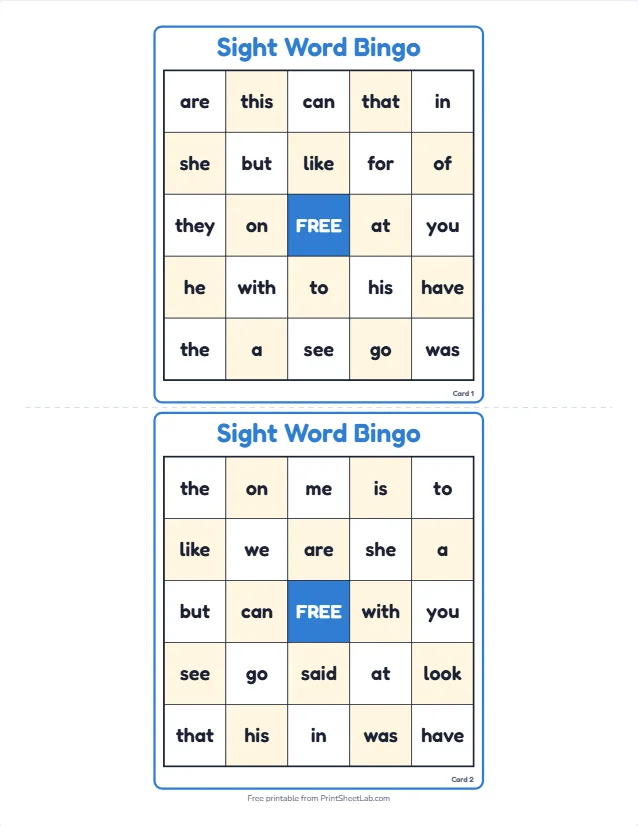
Sight words bingo turns the least exciting part of learning to read, repeating the same little words, into a game that children ask to play again. You call a word, every child scans a card looking for it, and the match between a sound they hear and a word they see happens dozens of times in ten minutes. This page gives you free sight word bingo cards with 32 words to start with, a way to swap in your own list, and real numbers on how long a round lasts.
In short: press Edit and print this card in the card maker above to open the full-screen editor with the 32 words already loaded. Change any word on the Items tab, choose 1 to 100 different cards, and download one PDF. It is free, needs no sign-up, and the words you type never leave your browser.
Why sight words bingo suits early readers
Beginning readers need to see the same high-frequency words again and again before they read them without effort. A worksheet repeats a word on paper; a game repeats it with a reason to look. In a round of sight words bingo the teacher says a word, and each child has to find it among 8, 16 or 24 printed words. That is recognition practice with a built-in answer check, because the child can see at once whether the word was on the card.
Sight word bingo has two other advantages for a busy classroom. Every card is a different arrangement of the list, so a child cannot copy a neighbor’s page, and a slower reader still has a fair chance of finishing a line. And the adult needs almost no preparation: one list, one print job, and a pile of chips. The Common Core kindergarten foundational standard (RF.K.3.c) asks children to read common high-frequency words by sight, and its examples include the, of, to, you, she, my, is and are, all of which are on our template.
Sight word bingo cards: what the template contains
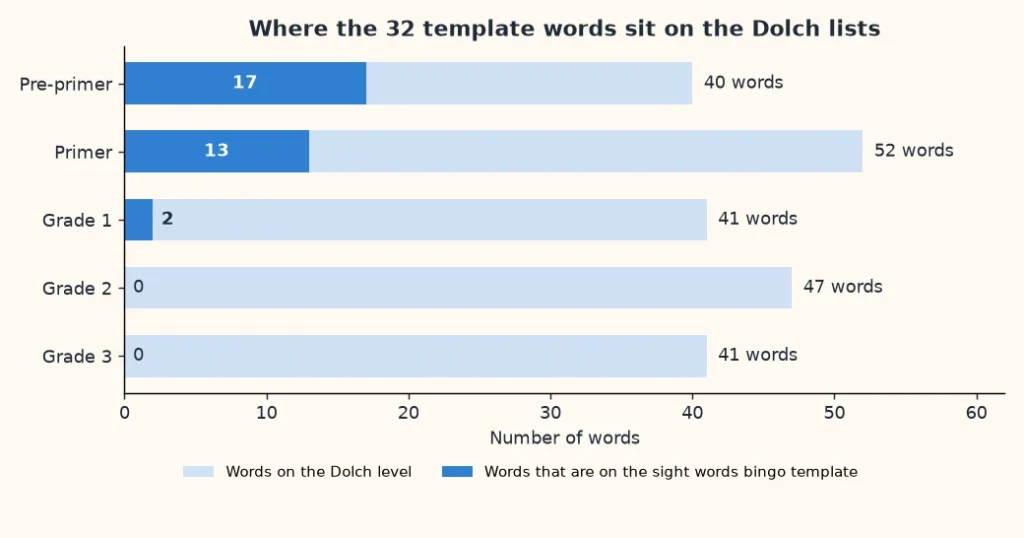
The template in the card maker holds exactly 32 words, chosen from the top of the Dolch list, the classic list of frequent English words. We checked every one against the Dolch non-noun lists, and all 32 are on them: 17 come from the pre-primer level, 13 from the primer level and 2 from first grade. None are nouns, which means a child cannot lean on a picture clue and has to read the word itself.
| Dolch level | Words on the template | How many |
|---|---|---|
| Pre-primer | the, and, a, to, said, you, it, in, for, we, go, look, see, can, my, me, is | 17 |
| Primer | he, was, on, they, are, she, with, at, but, that, this, have, like | 13 |
| First grade | his, of | 2 |
| Second and third grade | none on this template | 0 |
The mix leans on the words children meet first, which is why this sight words bingo set works for pre-K through grade 1 and for any older learner who is still shaky on the basics. Why 32 and not 24? A 5×5 card with a free center needs 24 words, and with 32 on the list, eight words are left out of any one card. Different sight word bingo cards therefore hold different words, and a child who looks at a neighbor’s page does not see the same squares.
Dolch sight words bingo: the five levels explained
If you want Dolch sight words bingo for a specific grade, it helps to know where the list comes from. Edward William Dolch published his basic sight vocabulary in 1936 and then printed it in his 1948 book Problems in Reading. According to the Wikipedia article on the Dolch word list, he built it from children’s books of his time and ended with 220 “service words” plus a separate list of about 95 nouns. The 220 are grouped by the stage at which a child was expected to learn them.
| Level | Words (in the copy we used) | Sample words | Card size that fits |
|---|---|---|---|
| Pre-primer | 40 | a, big, blue, go, help, jump, look, play, red, run | 3×3, then 4×4 |
| Primer | 52 | all, ate, black, did, eat, new, ride, soon, want, well | 4×4 or 5×5 |
| First grade | 41 | after, again, could, every, give, just, know, stop, think, walk | 5×5 |
| Second grade | 47 | always, because, been, buy, cold, fast, gave, green, sleep, wash | 5×5 |
| Third grade | 41 | about, better, carry, clean, draw, hurt, laugh, never, together, warm | 5×5 |
The counts above add up to 221 because published copies of the list differ by a word or two (the Wikipedia copy we used lists 47 second-grade words, other copies list 46). If your school uses a printed Dolch set, type that exact list into the Items tab and your sight words bingo cards will match your flash cards. The grade labels are Dolch’s own intended stages, not a promise about any particular child.
One honest caution: the same Wikipedia article records that some reading researchers argue children should learn these words through phonics instead of whole-word memorizing. Most of the Dolch words are regular enough to sound out, and a good sight words bingo routine does both: the child says the word, taps out the sounds, and then finds it on the card. Our guide to what sight words are explains the difference between sight words and decodable words in plain language.
Printable sight words bingo: set up your set in five steps
This printable sight words bingo is made in the card maker, so there is nothing to download and edit before you start. The same steps work for any other list of words, so a spelling list becomes a sight words bingo round too.
- Open the template. The card maker above has the sight words loaded. Press the button to open the full-screen editor with its tabs: Setup, Items, Design, Templates and Print.
- Pick a grid size on the Setup tab. For most beginners, 3×3 or 4×4 is plenty; 5×5 suits second graders and review games.
- Edit the words on the Items tab. Type your own list, paste one in, or delete the words you do not need. Keep the list at least as long as the number of squares on one card.
- Style it on the Design tab: color theme, font, text size, borders and a title such as “Week 4 Words”. Turn ALL CAPS off, because children will meet these words in lowercase in their books.
- Print: choose how many different cards you need (one per child, plus spares), 1, 2, 4 or 6 on a page, Letter or A4. Turn on calling cards if you want to draw words from a pile, then download the PDF or print directly.
The Items tab is where the page earns its keep. A printable sight words bingo set that cannot be changed goes stale in a week; here you replace three words every Monday and print a new set. If you plan to reuse the list, save the shareable link, which stores the words only, and open it again whenever you need new cards.
Sight words bingo for kindergarten: picking a card size
For sight words bingo for kindergarten the card should be as small as the child’s attention span. A 3×3 card has 9 squares, and with a free center it holds only 8 words, so a four-year-old can scan the whole card in a second. A 4×4 card needs 16 words and suits children who are already reading a few dozen words. The 5×5 card needs 24 words and works from first grade up.
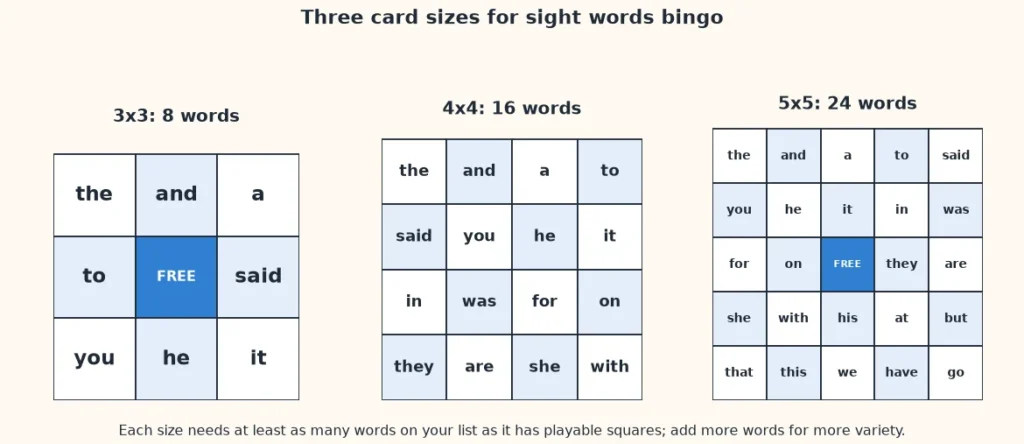
| Card size | Words needed | Possible lines | Typical use |
|---|---|---|---|
| 3×3 with free center | 8 | 8 (3 rows, 3 columns, 2 diagonals) | Pre-K and early kindergarten, small groups |
| 4×4, no free space | 16 | 10 (4 rows, 4 columns, 2 diagonals) | Kindergarten and first grade |
| 5×5 with free center | 24 | 12 (5 rows, 5 columns, 2 diagonals) | First and second grade, review days |
If you do not know where a group stands, start with a 3×3 card of eight words that every child can already read. The first round of sight words bingo should be a success, because that is what makes children want a second one. Then add words slowly, because sight words bingo works best when every child can win early. A simple six-week plan looks like this.
| Week | Card | Words on the list | What changes |
|---|---|---|---|
| 1 | 3×3 | 8 known words | Only the rules are new |
| 2 | 3×3 | 12 words (4 new) | Different cards start to hold different words |
| 3 | 4×4 | 16 words (8 known, 8 new) | Longer scan, bigger board |
| 4 | 4×4 | 20 words | Swap out the words everyone has mastered |
| 5 | 5×5 | 24 to 32 words | Full-size cards, longer games |
| 6 | 5×5 | Your own 40-word review list | Blackout round as a check |
This plan for sight words bingo is a suggestion, not a rule. The point is that the list grows by a few words at a time, and that you keep the words on the card slightly easier than the words in the day’s lesson, so children succeed at sight word bingo and the lesson words still get extra repeats.
How to call words in a sight word bingo game
Calling is where a sight word bingo game becomes teaching, and sight words bingo gives you plenty of ways to do it. The words are spoken by an adult or a child, not by a machine, so you can use the same sight words bingo cards in four or five different ways. In the Print tab you can switch on calling cards with the words from your list, shuffle them, draw one at a time, and set each called card aside, which gives you a pile that settles any argument.
| Calling style | What you do | What it practices |
|---|---|---|
| Say it | Read the word aloud once, clearly, and wait. | Matching a heard word to a printed word |
| Say it and spell it | Read the word, then spell it letter by letter. | Letter names and word shape |
| Use it in a sentence | “I can see the dog.” Children find can, see and the one at a time or all at once. | Words in context |
| Show it | Hold up the calling card so children read it themselves, no voice. | Pure reading, no listening help |
| Child caller | A child draws a card and reads it. The group checks. | Reading aloud, confidence |
| Clue only | “It rhymes with me and starts with a letter near the end of the alphabet.” | Rhyme and word families, for stronger readers |
A short routine keeps a round of sight words bingo tidy. Say the word, pause for three seconds while children scan, say it again, and then give a quick cue such as “check your whole card”. If the game uses a stack of calling cards, each called card goes face up on the table, and a child who shouts bingo reads the winning line out loud while you point to each called card. Reading the line out is a second round of practice for the whole class.
You do not need a caller tool for sight words bingo, because the words are spoken or shown, not drawn from a number board. If you also play number games with the same group, such as skip counting, the skip counting guide pairs well with the same cards-and-chips routine.
The sight word bingo game: how long does a round take?
Teachers always ask how long a round of sight words bingo lasts, so we simulated it. Each simulated game calls the 32 words in a random order, every player holds a random card with a free center on the odd sizes, and the first line is any row, column or diagonal. We ran 8,000 games for each row and report the median call at which the first player has a line, so half of the games end sooner and half later.
| Players | 3×3: first line | 4×4: first line | 5×5: first line |
|---|---|---|---|
| 1 | 12 (9 to 17) | 18 (15 to 21) | 18 (16 to 21) |
| 10 | 5 (4 to 7) | 11 (9 to 12) | 12 (10 to 14) |
| 20 | 4 (3 to 5) | 9 (8 to 11) | 11 (9 to 12) |
| 30 | 3 (3 to 4) | 9 (7 to 10) | 10 (8 to 11) |
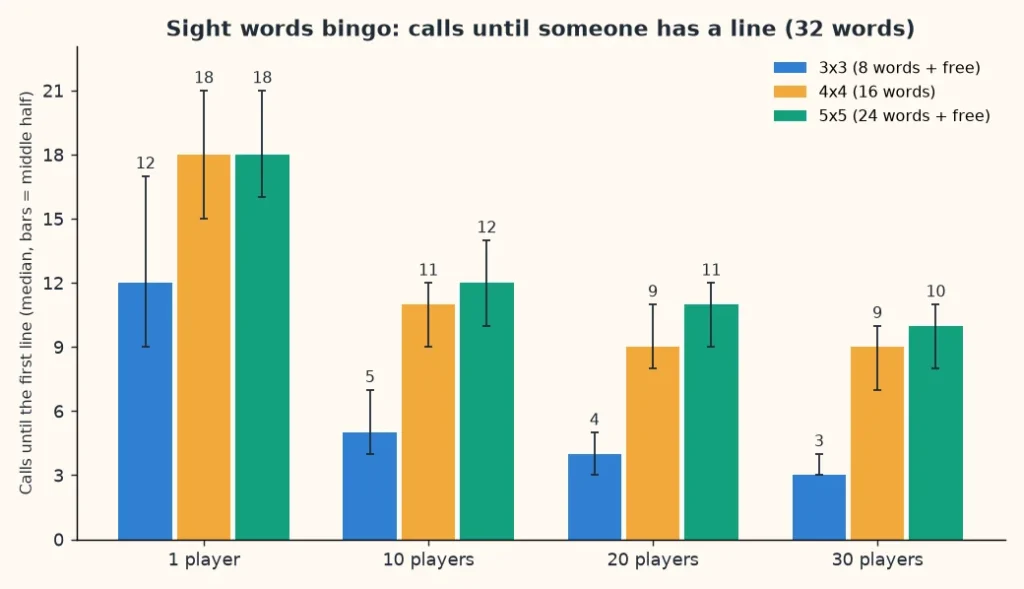
The first thing to see is how much smaller cards speed up the game. With 20 players, a 3×3 card gives a first line after 4 calls, a 4×4 after 9 and a 5×5 after 11. A 3×3 round of sight word bingo is therefore over in well under a minute at one word every five seconds, which is why you play several rounds in a row with young children and let the free center and the small grid give everyone a taste of winning.
The second thing is that adding players to a sight words bingo game has diminishing returns. On a 5×5 card, going from 1 player to 10 cuts the median from 18 calls to 12, but going from 20 to 30 players saves only about one call. For a group of 10 or more you can ignore class size when planning the length of a lesson. For a one-to-one game with a parent, expect around 18 calls before a line on a 4×4 card.
How many of the words does a child hear? In a game that stops at the first line, about 11 of the 32 words are called on 5×5 cards with 20 players, roughly a third of the list. If you play on to a full card, the median blackout comes after 30 calls, so almost every word is called. That gives sight word bingo a useful lever: stop at the first line for a quick warm-up, or play to blackout when the goal is to hear every word once.
The list length matters too. These are the medians for a group of 20 players on lists of different lengths.
| Words on the list | 3×3: line / blackout | 4×4: line / blackout | 5×5: line / blackout |
|---|---|---|---|
| 16 | 3 / 12 | 6 / 16 | needs 24+ words |
| 20 | 3 / 15 | 7 / 19 | needs 24+ words |
| 24 | 3 / 18 | 8 / 22 | 8 / 24 |
| 32 | 4 / 23 | 9 / 28 | 11 / 30 |
| 40 | 5 / 28 | 11 / 34 | 13 / 37 |
| 52 | 6 / 36 | 14 / 44 | 16 / 47 |
A 5×5 card needs 24 words, so a 16-word or 20-word list only supports the smaller sight words bingo grids. The simulation assumes everyone marks correctly and nobody misses a call. Real children mishear words and mark the wrong square, so allow a few extra calls, and treat the figures as a way to plan a lesson, not a stopwatch.
How many different sight word bingo cards can you make?
With 32 words, the number of different sets of words that can sit on one card is the number of ways to choose them, written C(32, k). Each set can also be arranged in many orders, which multiplies the totals enormously. The table shows only the number of word sets, so the real number of distinct sight word bingo cards is far higher.
| Words on the list | 3×3 with free center: C(N, 8) | 4×4: C(N, 16) | 5×5 with free center: C(N, 24) |
|---|---|---|---|
| 8 | 1 | – | – |
| 10 | 45 | – | – |
| 12 | 495 | – | – |
| 16 | 12,870 | 1 | – |
| 20 | 125,970 | 4,845 | – |
| 24 | 735,471 | 735,471 | 1 |
| 32 | 1.1 x 10⁷ | 6.0 x 10⁸ | 1.1 x 10⁷ |
| 40 | 7.7 x 10⁷ | 6.3 x 10¹⁰ | 6.3 x 10¹⁰ |
| 52 | 7.5 x 10⁸ | 1.0 x 10¹³ | 4.3 x 10¹⁴ |
Read the table like this. A list of exactly 8 words gives one set for a 3×3 card, so every card has the same eight words in a different arrangement. That is fine for a first game, and it also means a child cannot complete a line by luck of the draw.
At 12 words there are 495 sets. For a 5×5 card, a list of 24 gives one set, 32 words give 1.1 x 10⁷ sets, and 40 words give about 6.3 x 10¹⁰. For a class of 25, a 30-word list is the practical minimum for 5×5 cards with some variety.
Sight words bingo free printable: laminating, chips and printing tips
This sight words bingo free printable costs you only paper, but a few choices make a set of sight words bingo cards last a year or a month, depending on how you handle it.
- Size and spacing. Two cards per page give large squares, which is best for four-, five- and six-year-olds. Four cards per page makes a small, cheap card for chips. Six per page is for older readers or take-home sheets.
- Laminate or use sleeves. A laminating pouch or a clear page protector lets children use dry-erase markers or chips and wipe the card clean. A set of 6 to 10 laminated cards covers a small group for the whole year.
- Pick safe markers. Counters, plastic chips, torn paper and small erasers all work. Avoid anything small enough to swallow for children under three, and check food allergies before using cereal or candy.
- Write names on cards. The Design tab can print a name on each card, so a pile of laminated sight word bingo cards goes back to the right child, and you can see who still needs one.
- Use cut guides for calling cards. Turn on cut guides, print the calling cards on cardstock, and cut them once. A paper clip or a rubber band keeps them together.
- Print extra. Add two or three spare cards for late arrivals and for a game that goes to a second round, where you want to swap cards.
- Match the paper to the group. A different paper color per group makes it easy to see which stack belongs where when several classes share a copier.
When you save the PDF to your own computer, it is a file you can reprint whenever a card is lost. Nothing about our sight words bingo tool stores your words on our side, so the link you save is your own record of the list.
Customize your sight words bingo list in the card maker
The sight words bingo template is a starting point. The Design and Items tabs let you change how the page looks and what it says without any design skill.
- Words and pictures. Type a word, add an emoji beside it, or put your own image on a square. Pre-readers can match picture to word.
- Free space. On odd grids the center can say FREE or hold a word, an emoji or a picture. A favorite word of the day in the center is a simple way to review it.
- Look and feel. Choose color themes, fonts, text size, borders (solid, double, dashed or none), rounded corners, an alternating tint and a background pattern.
- Title and footer. Add a title as text or a picture, add a footer such as the teacher’s name, and print a name on every card.
- Lowercase by default. Because children read lowercase words in books, leave ALL CAPS off. Switch it on only for a lesson on capital letters.
- Shuffle and undo. Press Shuffle to re-deal the whole set; Undo takes you back a step if you change your mind.
If you want a card with a different list entirely, such as the first 24 words of the Fry list, or the spelling words from this week’s unit, open the bingo card generator and start from a blank grid, or use the blank bingo cards when students fill in their own words by hand.
Track progress while you play sight words bingo
Sight words bingo is also an assessment if you watch for the right things. You do not need a clipboard. A sticky note with the words that made children hesitate is usually enough, and that list becomes the next set of cards. The Wikipedia article on the Dolch list notes that a cited study found beginners needed about 35 repetitions to learn an irregular word as a sight word, so a few rounds of practice per week is normal progress, not a sign of a problem.
| What you see | What it means | What to do next |
|---|---|---|
| Finds the word instantly | The word is secure | Retire it from the next list, or keep it as a confidence square |
| Scans, then finds it | Getting there | Keep it on the list; call it twice in the round |
| Points to the wrong word | Confuses it with a look-alike, for example was and saw | Put both words on the same card and call them side by side |
| Does not look for the word | Not yet learned | Move it to a small-group list with picture or sentence support |
| Marks without listening | Copying neighbors or rushing | Use a smaller group, slower calls, and ask the child to read the square aloud |
A tracking sheet for sight words bingo can be a plain table: the list of words down one side and the dates across the top, with a check for each date a child found the word without help. After two or three weeks you can see which words need another round. Because you can reprint cards with new words in seconds, a word that is still hard comes back in the next set automatically.
Differentiate sight words bingo for every reader
| Child or group | Adjustment |
|---|---|
| Pre-K and early kindergarten | 3×3 card, large text, a picture beside each word, calls repeated twice |
| Kindergarten | 4×4 card, a mix of known and new words, play to the first line then play again |
| First grade | 5×5 card with 24 to 32 words, blackout round as a check, sentence calls |
| English learners | Say the word, show the calling card, and let children point before they mark |
| Children who need more time | Slow the pace, repeat each word, or let a partner share a card |
| Fast readers | Call a clue instead of the word, or ask for a sentence before a square is marked |
| Mixed groups | Print the same list on 3×3, 4×4 and 5×5 cards and let each child choose |
Pairs can also make their own sight words bingo sets. Give each pair a blank grid and a word list, let them write the words in any order, and trade with another pair. Writing the words is reading and spelling practice in itself, and the result is a card they care about.
More ways to play sight words bingo with the same words
Once a group knows basic sight words bingo, vary the win condition. Four corners and the letter X are good short games, and a blackout takes the whole card. Another idea is “read to claim”: a child marks a square only after reading the word aloud when you point.
A third is a team game, where two cards sit in the middle of a table and the table works together. Sight words bingo also works at home: a parent can print four cards for a family game night, and a grandparent can call the words over a video call.
For reading practice on paper, the sight word worksheets give writing and tracing for the same words, so the game and the sheet reinforce each other. For a group that cannot read yet, picture bingo for kids gives cards with images and no words at all. When you want to move from words to letters, our alphabet bingo page has a 26-letter card set, and classroom bingo covers vocabulary and math facts for older grades. The full set of themes lives on the printable bingo cards page.
If some of your learners are at home, the play custom bingo online page explains how to run a game with your own word list on screens. Classic bingo with numbers is a different game, but the same card maker handles it, and a sight words bingo card can also be shown on a projector.
Frequently asked questions
10 quick answers
What is sight words bingo?
Sight words bingo is a reading game in which the teacher calls a high-frequency word and each child looks for it on a card of printed words. A child who completes a line, usually any row, column or diagonal, calls bingo and reads the line out loud.
Are these sight word bingo cards really free?
Yes. You can create, edit, shuffle and print them without an account, and nothing you type is uploaded. You only need a printer or a way to save the PDF.
Which sight words are on the cards?
The sight words bingo template has 32 words from the Dolch lists: the, and, a, to, said, you, he, it, in, was, for, on, they, are, she, with, his, at, but, that, this, we, have, go, look, see, can, my, me, like, is and of. You can replace any of them.
How many words do I need for each card size?
A 3×3 card with a free center needs 8 words, a 4×4 card needs 16, and a 5×5 card with a free center needs 24. If your list has more words than squares, different cards get different words.
What card should I use for kindergarten?
Most kindergarten groups do best with 3×3 or 4×4 cards. Start with 8 words everyone can already read, then add a few new ones each week so the game stays winnable.
Can I use Fry words or my school’s list for sight words bingo instead of Dolch?
Yes. The Items tab accepts any words, so you can type or paste the Fry words, a phonics set, spelling words or a list of names, and print the cards in minutes.
How many sight word bingo cards can I print at once?
From 1 to 100 different cards in one PDF, with 1, 2, 4 or 6 cards per page, on Letter or A4 paper, in portrait or landscape.
How long does a sight words bingo game take?
In our simulation with 20 players, a first line comes after about 4 calls on a 3×3 card, 9 on a 4×4 card and 11 on a 5×5 card, so one round takes a minute or two.
Do I need to read the words aloud myself?
Yes, or let a child do it, because sight words bingo is a spoken game. The cards are made for a spoken game, and the calling cards in the Print tab give you a shuffled pile to draw from, so you never have to remember which words you have called.
Is sight words bingo only for young children?
No. It is also useful for English learners of any age and for older students with reading difficulties. Change the list and the card size, and the game stays dignified for every age.