A weighted grade calculator finds your course average when some assignments count more than others: weighted grade = Σ (score × weight) ÷ Σ weight. This free weighted grade calculator takes your categories, scores and grade weights, gives the weighted average with the working, and tells you the score you need on the rest of the work to hit a target.
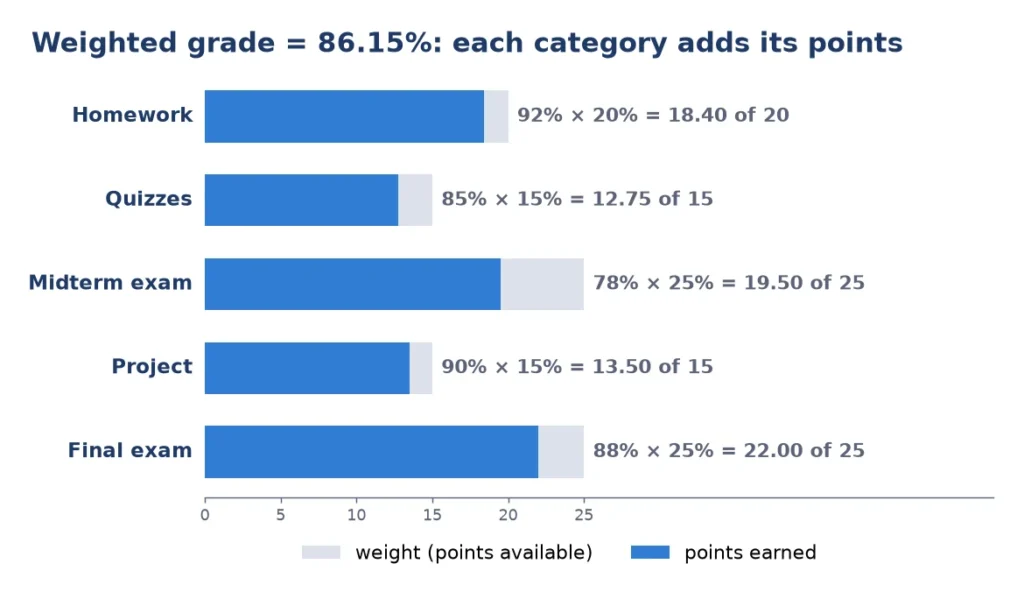
Quick answer: multiply each score by its weight, add the results, and divide by the total weight. Homework 92% (20%), quizzes 85% (15%), midterm 78% (25%), project 90% (15%) and final 88% (25%) give (1,840 + 1,275 + 1,950 + 1,350 + 2,200) ÷ 100 = 86.15%.
How to use this weighted grade calculator
Type one line for each category or assignment in the box, in the form name, score, weight. The weighted grade calculator updates as you type. A score can be a percent (88 or 88%) or points (44/50). The weight is the percent of the course grade, so 20 means 20%.
- My weighted grade (the default): list every graded category and read your current weighted average, your letter grade and a table of points earned.
- The score I need: write a question mark instead of the score for work you have not done, such as Final exam, ?, 25, then type the grade you want. The calculator tells you the average you need on the remaining work.
- Choose a grade scale at the bottom: United States, Canada, UK degree classes or Australia, so the result is shown in the right terms.
- Tap Copy result to paste the answer, or Copy link to share your setup.
| Part of the line | What to type | Example |
|---|---|---|
| Name | any label; commas are fine | Midterm exam |
| Score | percent, points out of a total, or ? if not graded | 78, 78% or 39/50 |
| Weight | the share of the final grade, as a percent | 25 |
Weighted grade formula
The weighted grade formula is a weighted average. Every score is multiplied by its weight, the products are added, and the total is divided by the sum of the weights:
weighted grade = (s₁w₁ + s₂w₂ + … + sₙwₙ) ÷ (w₁ + w₂ + … + wₙ)
Here s is a score and w is its weight. When the weights add up to 100, the division by 100 just moves the decimal point. The same formula works for any weights, so you can type 3 and 1 instead of 75 and 25 and get the same answer as long as the ratio is the same. A plain average is the special case where every weight is equal.
How to calculate a weighted grade: worked example
Here is the default example worked by hand. The weighted average calculator shows exactly these lines in its How it works panel.
| Category | Score | Weight | Score × weight | Points toward the grade |
|---|---|---|---|---|
| Homework | 92% | 20% | 92 × 20 = 1,840 | 18.4 |
| Quizzes | 85% | 15% | 85 × 15 = 1,275 | 12.75 |
| Midterm exam | 78% | 25% | 78 × 25 = 1,950 | 19.5 |
| Project | 90% | 15% | 90 × 15 = 1,350 | 13.5 |
| Final exam | 88% | 25% | 88 × 25 = 2,200 | 22 |
| Total | 100% | 8,615 | 86.15 |
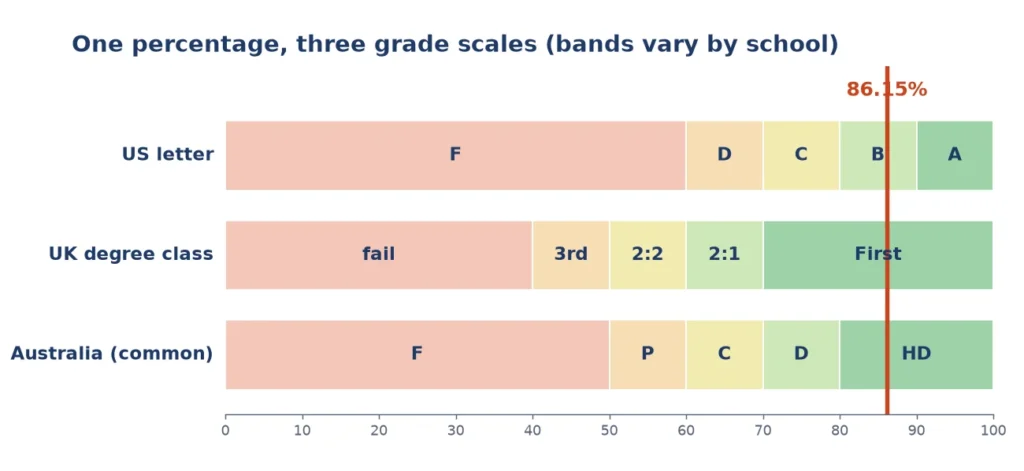
Add the products: 1,840 + 1,275 + 1,950 + 1,350 + 2,200 = 8,615. Divide by the total weight: 8,615 ÷ 100 = 86.15%. In a typical U.S. scale that is a B (3.0 on the 4.0 scale). In the UK degree system it would be a First, and in Australia a High Distinction, which shows why the scale matters as much as the number.
Example with points instead of percents
Scores out of different totals are converted to percents first. A quiz score of 8/10 is 80%, a homework score of 95/100 is 95%, and an essay score of 42/50 is 84%. Suppose quizzes are worth 10%, homework 20%, the essay 30% and the final exam 40%. With the final not yet taken, the completed work gives:
(80 × 10 + 95 × 20 + 84 × 30) ÷ 60 = 5,220 ÷ 60 = 87% on the 60% of the course graded so far. That is the grade so far; the final grade also depends on the 40% still to come.
What grade do I need on the final?
To find what grade you need on the final, rearrange the same formula. The score needed is (target × total weight − points earned so far) ÷ weight still to come. Use the “The score I need” tab and put a question mark where the final goes.
With the default categories but the final exam still ungraded, the points earned so far are 1,840 + 1,275 + 1,950 + 1,350 = 6,415, and the final is worth 25%. For a target of 80%, the score needed is (80 × 100 − 6,415) ÷ 25 = 1,585 ÷ 25 = 63.4%. For a target of 90%, it is (9,000 − 6,415) ÷ 25 = 103.4%, which is above 100, so that target needs extra credit or is out of reach.
| Target grade | Score needed on the 25% final | Reachable without extra credit? |
|---|---|---|
| 95% | 123.4% | No, above 100% |
| 90% | 103.4% | No, above 100% |
| 85% | 83.4% | Yes |
| 80% | 63.4% | Yes |
| 75% | 43.4% | Yes |
| 70% | 23.4% | Yes |
| 65% | 3.4% | Yes |
| 60% | 0%% (already secured) | Yes |
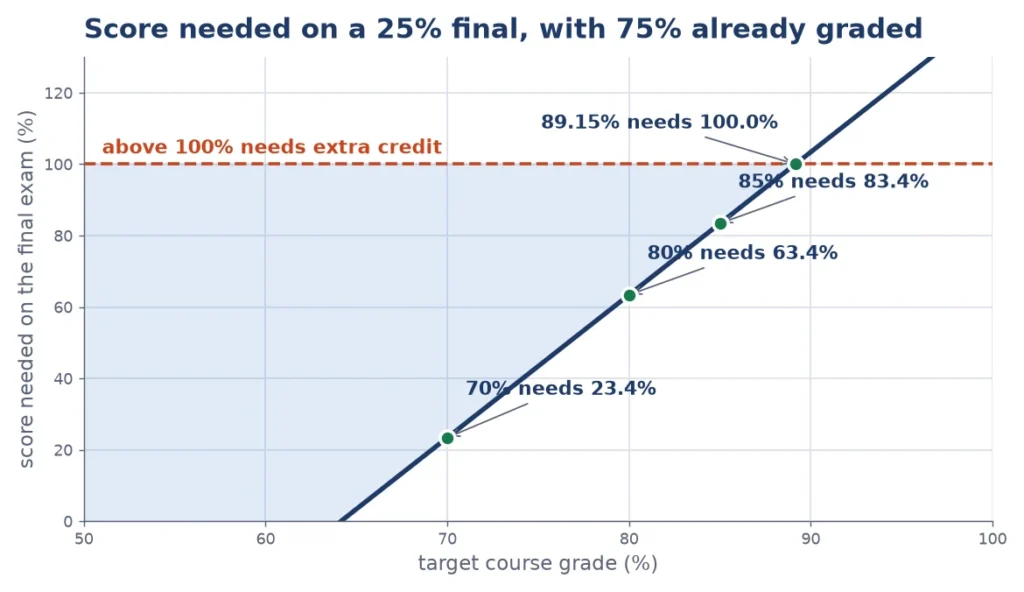
The best you can finish with is (6,415 + 100 × 25) ÷ 100 = 89.15%, and the lowest is 64.15% with a zero on the final. If the weights in your syllabus differ from the example, change the numbers and the table updates. The final grade calculator answers the same question with a single current grade and a single exam weight, while this page handles any number of categories.
Grade weights: what they look like in real courses
Grade weights tell you how much each part of a course counts, and they are usually printed in the syllabus. The splits below are illustrative only, to show the shape of typical schemes. Always use the numbers in your own course outline.
| Course type (illustrative) | Typical split | What to watch |
|---|---|---|
| High school class | homework 20%, quizzes 20%, tests 40%, final 20% | tests dominate, so one weak test costs more than late homework |
| College lecture course | midterm 30%, final 40%, assignments 30% | the final alone can move a grade by a full letter |
| Seminar or humanities | essays 60%, participation 20%, presentation 20% | participation counts even though it has no “score” until marked |
| Science lab course | labs 30%, exams 50%, lab report 20% | labs and reports can lift a low exam score |
If your weights do not total 100%, the weighted grade calculator still gives a correct average of the rows you typed and warns you about the total. That usually means a category is missing, so add it as a row with a question mark. If your teacher drops the lowest score in a category, average the remaining scores first, then enter that average once as the category score.
Weighted average calculator versus weighted GPA
This weighted average calculator works on one course. A weighted GPA is different: it adds bonus points to harder classes, such as an extra point for an honors or AP course, and then averages across courses. If you want a GPA across several classes, use the GPA calculator. For a simple average of equally weighted scores, use the mean, median and mode calculator.
Grade scale: United States, Canada, the UK and Australia
The weighted percent is the same everywhere; what changes is how a school labels it. Pick the grade scale that matches your school in the calculator, and remember that a single school can differ from the common pattern.
| Country | Common pattern | Notes |
|---|---|---|
| United States | A 90–100, B 80–89, C 70–79, D 60–69, F below 60; plus and minus grades and a 4.0 scale | many schools use plus and minus cut-offs such as A− at 90 and B+ at 87; check your syllabus |
| Canada | percent grades; letters vary by province and school | Alberta schools commonly list A+ at 90–100%, while British Columbia high schools use A for 86–100% and B for 73–85% |
| United Kingdom | degree classes: First 70% and above, 2:1 60–69%, 2:2 50–59%, Third 40–49% | conventional values; each university sets its own rules and often weights later years more |
| Australia | HD 80–100, D 70–79, C 60–69, P 50–59, fail below 50 | many universities use these bands but some set the High Distinction line at 85 or higher |
For UK schools, GCSE results use grades 9 to 1 rather than percentages, with grade 9 the highest, grade 4 a standard pass and grade 5 a strong pass. Exam boards set the boundaries each year, so a weighted percentage from coursework and exams is only an estimate of the final grade. This page is for planning, not an official result, so always confirm with your teacher or university.
Weighted grade calculator for credits and courses
The weighted grade calculator also works when the weights are credit hours instead of percents. A course worth 4 credits should count twice as much as a course worth 2. Suppose a student earns 88% in a 4-credit course, 92% in a 3-credit course, 79% in another 3-credit course and 95% in a 2-credit course. Type each course as a line with its credits as the weight.
The weighted average is (4 × 88 + 3 × 92 + 3 × 79 + 2 × 95) ÷ 12 = (352 + 276 + 237 + 190) ÷ 12 = 1,055 ÷ 12 = 87.92%. This is a percentage average across courses. A GPA works on grade points rather than percents, so use the GPA calculator for that.
Weighted grade calculator in Excel or Google Sheets
You can build the same calculation in a spreadsheet. Put the scores in column B and the weights in column C, then use =SUMPRODUCT(B2:B6, C2:C6) / SUM(C2:C6). SUMPRODUCT multiplies each score by its weight and adds the products, and SUM(C2:C6) is the total weight, which is exactly the weighted grade formula. For the default example this returns 86.15. The online weighted grade calculator saves the setup and shows the steps, which a spreadsheet does not.
How to raise a weighted grade
The weighted grade calculator makes it clear where your effort pays off. Raising a score by 5 points in a category lifts the course grade by 5 × weight ÷ 100 points. Using the default example:
| Category | Weight | Course grade gain from +5 points on that score |
|---|---|---|
| Homework | 20% | 1 points |
| Quizzes | 15% | 0.75 points |
| Midterm exam | 25% | 1.25 points |
| Project | 15% | 0.75 points |
| Final exam | 25% | 1.25 points |
The midterm and the final are worth the most per point, so a five-point improvement there is worth more than the same improvement on a quiz. If a category has several assignments, improving the lowest one often helps most, because it has the most room to rise. Plan with the grade weights from your syllabus, not with a guess.
Weighted grade calculator for teachers
Teachers can use the weighted grade calculator to test a grading plan before the term starts. Enter the categories you plan to use with typical scores, and check that the weights total 100. A good plan gives the most weight to work that shows what students can do, and keeps any single assignment from deciding the whole grade. Run a few cases: a student who gets 100% on everything, one who gets 60% on everything, and one who misses a single big exam. If the results look unfair, change the weights and try again.
How to calculate a weighted grade in your head
For quick estimates, round the weights to friendly numbers. If the final is worth 40% and the rest of the course averages 85, a score of 90 on the final gives about 0.6 × 85 + 0.4 × 90 = 51 + 36 = 87. Think of each weight as a share of one grade point of 100: the more it weighs, the harder it pulls the average towards that score. Then use the weighted grade calculator to confirm the exact number and see the working.
Common mistakes with weighted grades
- Typing 0.2 instead of 20. Weights are entered as percents here, so 20 means 20%.
- Using an unweighted average. Adding all scores and dividing by the count treats a quiz like a final exam.
- Forgetting categories. A weight total below 100% means part of the grade is missing from the calculation.
- Counting ungraded work as zero. Use a question mark in the “score I need” tab so the work is planned for, not punished.
- Rounding too early. Keep the decimals until the end; a 89.5% may round to 90% in some schools and not in others.
Frequently asked questions
10 quick answers
What is a weighted grade?
A weighted grade is an average in which each category counts in proportion to its weight. A final exam worth 40% moves the grade four times as much as a quiz worth 10%.
How do I calculate a weighted grade?
Multiply each score by its weight, add the products, and divide by the total weight. If the weights total 100, divide by 100.
How do I find what I need on the final to get an A?
Use (target × total weight − points earned) ÷ final weight. With 6,415 points earned and a 25% final, an 80% target needs 63.4%.
What if my weights do not add up to 100%?
The calculator divides by the weights you typed, so the average is still correct for those rows. A total below 100% usually means a category is missing.
Can a score be above 100%?
Yes. Extra credit can push a score above 100, and the calculator accepts it. It also tells you when a target needs more than 100% on the remaining work.
How do I enter points such as 45 out of 50?
Type 45/50 as the score. The calculator converts it to 90% before weighting it.
Is a weighted grade the same as a GPA?
No. A weighted grade is a percent for one course, while a GPA averages letter-grade points across courses and sometimes adds bonus points for honors classes.
How do I drop the lowest score?
Remove the lowest score, average the rest, and enter that average as the category score. The weight stays the same.
Does the calculator work for UK degrees and Australian marks?
Yes. Choose UK degree classes or Australia in the grade scale box to see First, 2:1, 2:2 or Third, or HD, D, C and P.
Is the result an official grade?
No. It is an estimate from the numbers you enter. Your teacher or university decides the official grade, including rounding and any dropped scores.
Related calculators and worksheets
- Grade calculator and final grade calculator for a single score and exam
- GPA calculator for a semester or cumulative GPA
- Percentage calculator and mean, median and mode calculator
- Z score calculator to see where a test score sits in a class
- Free printable worksheets and all calculators
Sources and further reading
- Weighted arithmetic mean (Wikipedia): the formula behind a weighted grade
- Academic grading in the United States (Wikipedia)
- Academic grading in Canada (Wikipedia): how letter conversions vary by province
- British undergraduate degree classification (Wikipedia)
- Academic grading in Australia (Wikipedia)
- GCSE (Wikipedia): the 9 to 1 grading scale
Last updated: October 2026.