A random number generator picks numbers between a lowest and a highest value so that every number has the same chance. This free random number generator works between any two numbers, such as 1-100 or 1 to 10, and can draw with no repeats, sort the list, add decimals or make lottery-style sets. It uses your browser’s cryptographic random source.
Quick answer: To get a random number between 1 and 100, type 1 in From and 100 in To, then press Generate. Each of the 100 numbers has a 1 in 100 chance (1%). The count of possible numbers is highest − lowest + 1. Tick No repeats to draw every number once.
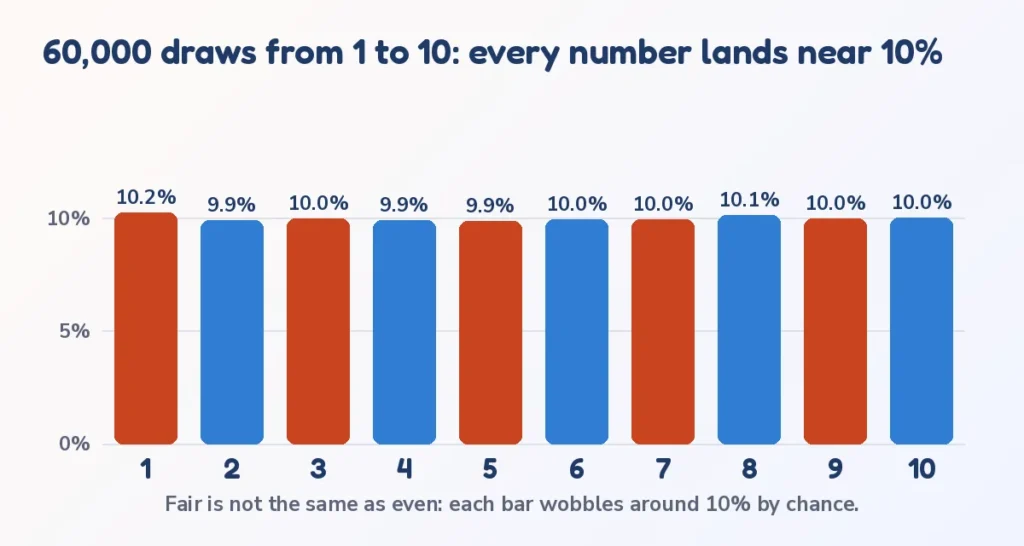
How to use the random number generator
Set the range, choose how many numbers you want and press Generate. Every press is a fresh draw that ignores the last one, and the working appears under the result.
- Type the lowest number in From and the highest in To. Both ends can come up.
- Type how many numbers you need, up to 500 at a time.
- Pick Whole numbers, Decimals or Lottery-style.
- Tick No repeats or Sort if you need them, and list any numbers to skip, such as 13.
- Press Generate, then Copy result or Copy link to share the exact setup.
| Setting | What it does | Example |
|---|---|---|
| From and To | sets the range, both ends included | 1 and 100 gives 100 numbers |
| How many | draws several numbers at once | 6 numbers |
| Decimals | picks values with 1 to 8 decimal places | 0 to 1 with 2 places: 0.37 |
| Lottery-style | no repeats, sorted, shows the odds of matching all | 6 from 1 to 49 |
| No repeats | a number can come up only once per draw | 10 different numbers |
| Skip these numbers | removes numbers before the draw | 13, 42 |
Examples and a printable probability sheet
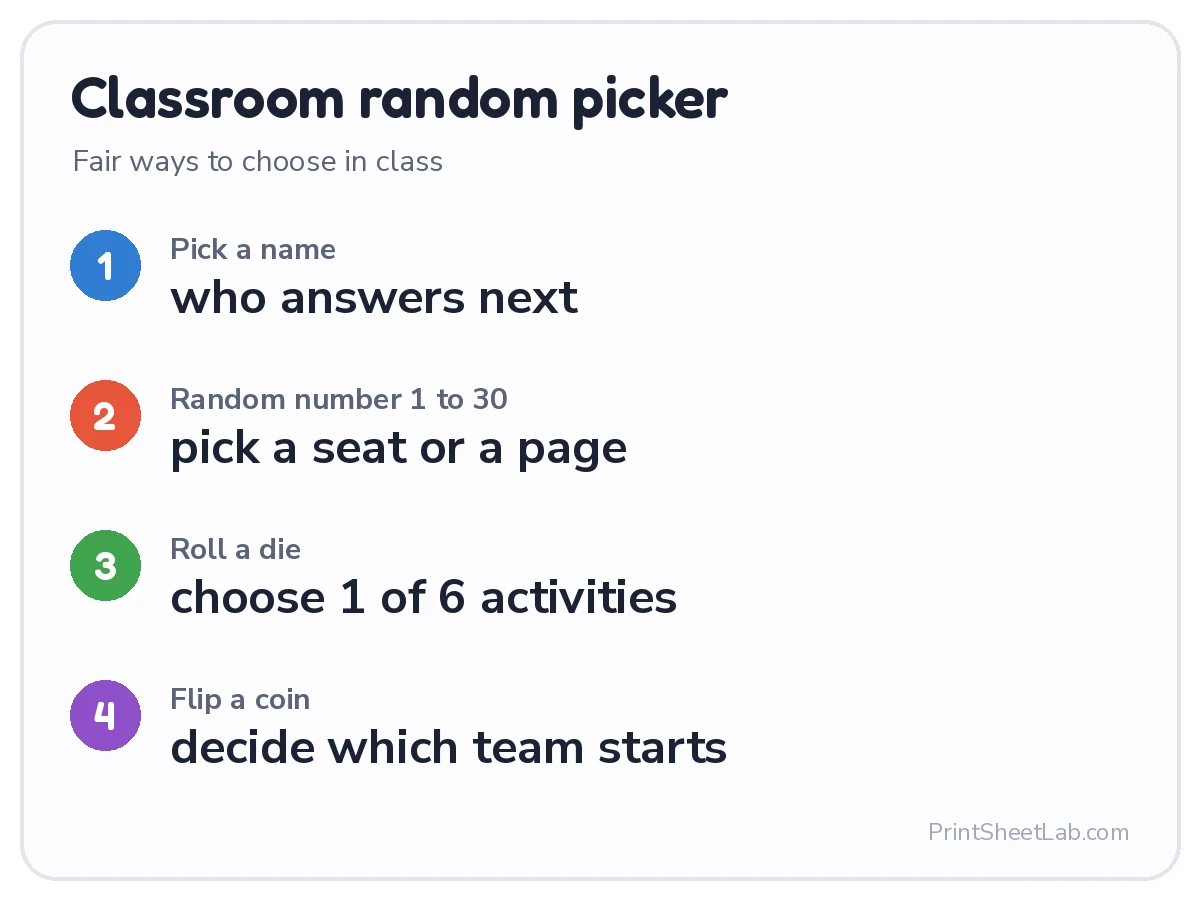
The cards show the odds behind two dice and coin flips and some fair ways to use a random picker in class. The printable tally sheet turns the generator into an experiment: draw 60 numbers from 1 to 6, tally them and compare the counts with the 10 you expect for each number.
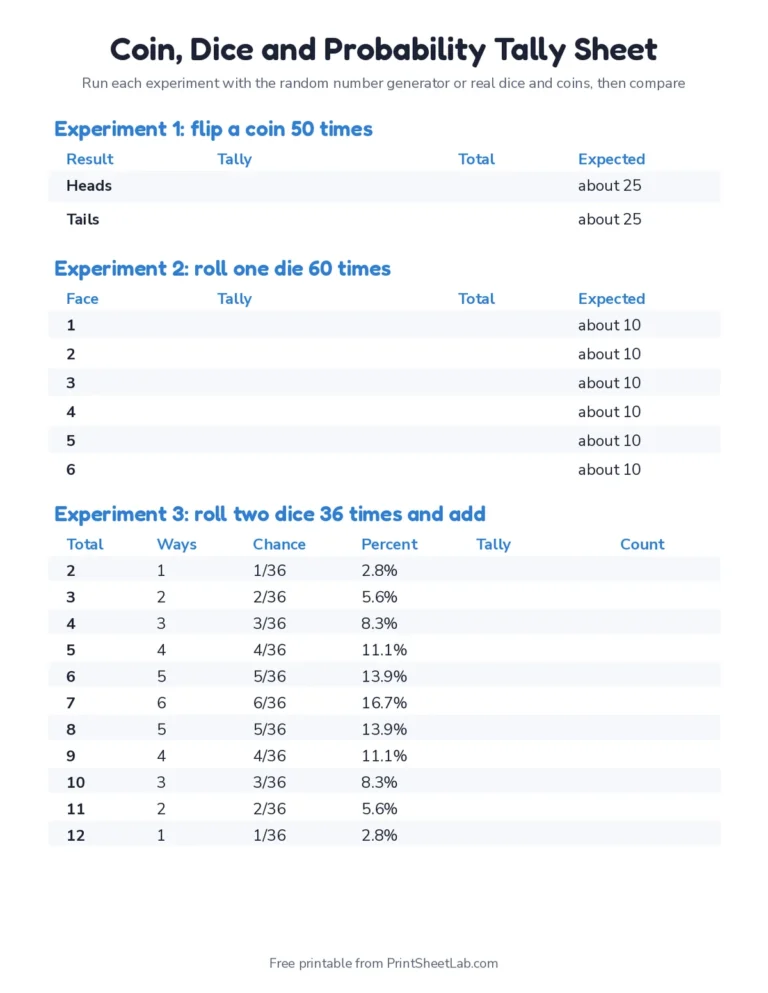
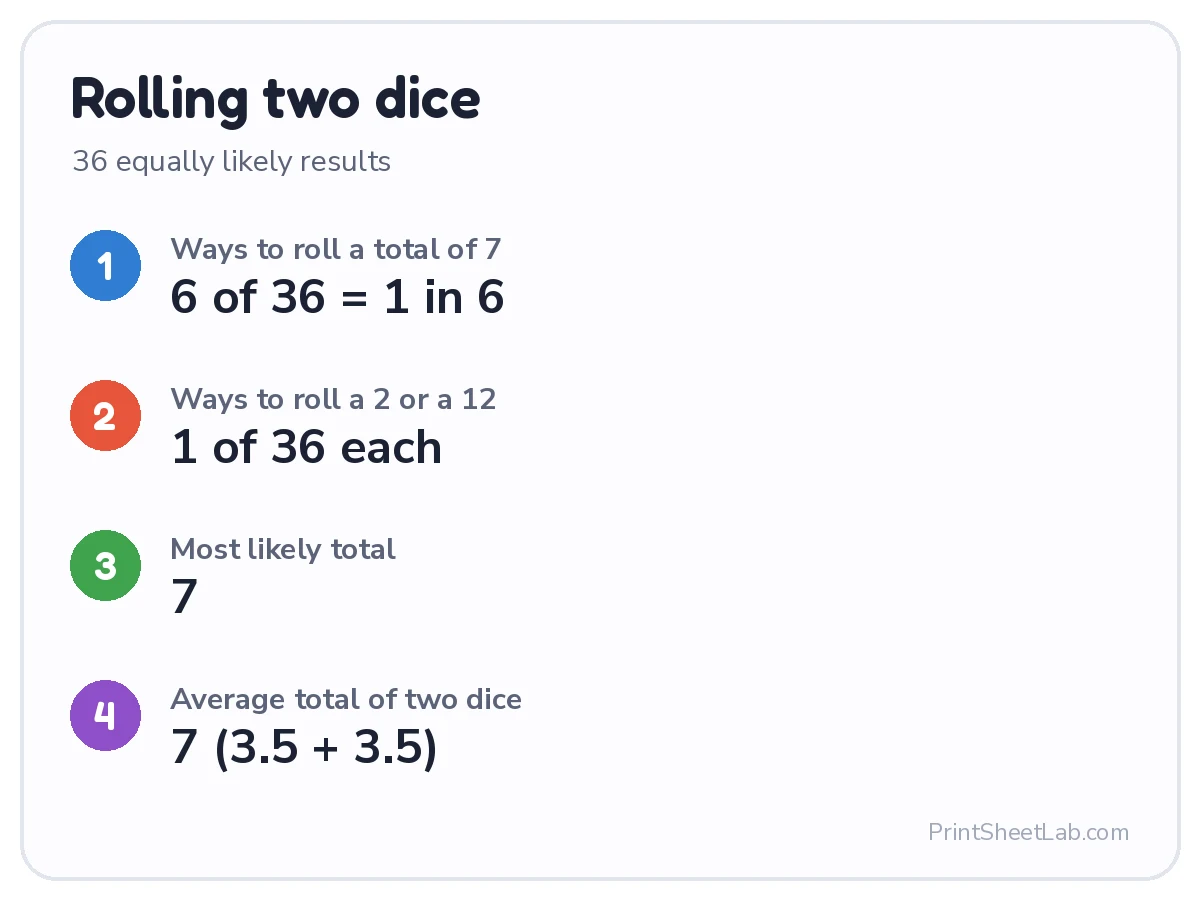
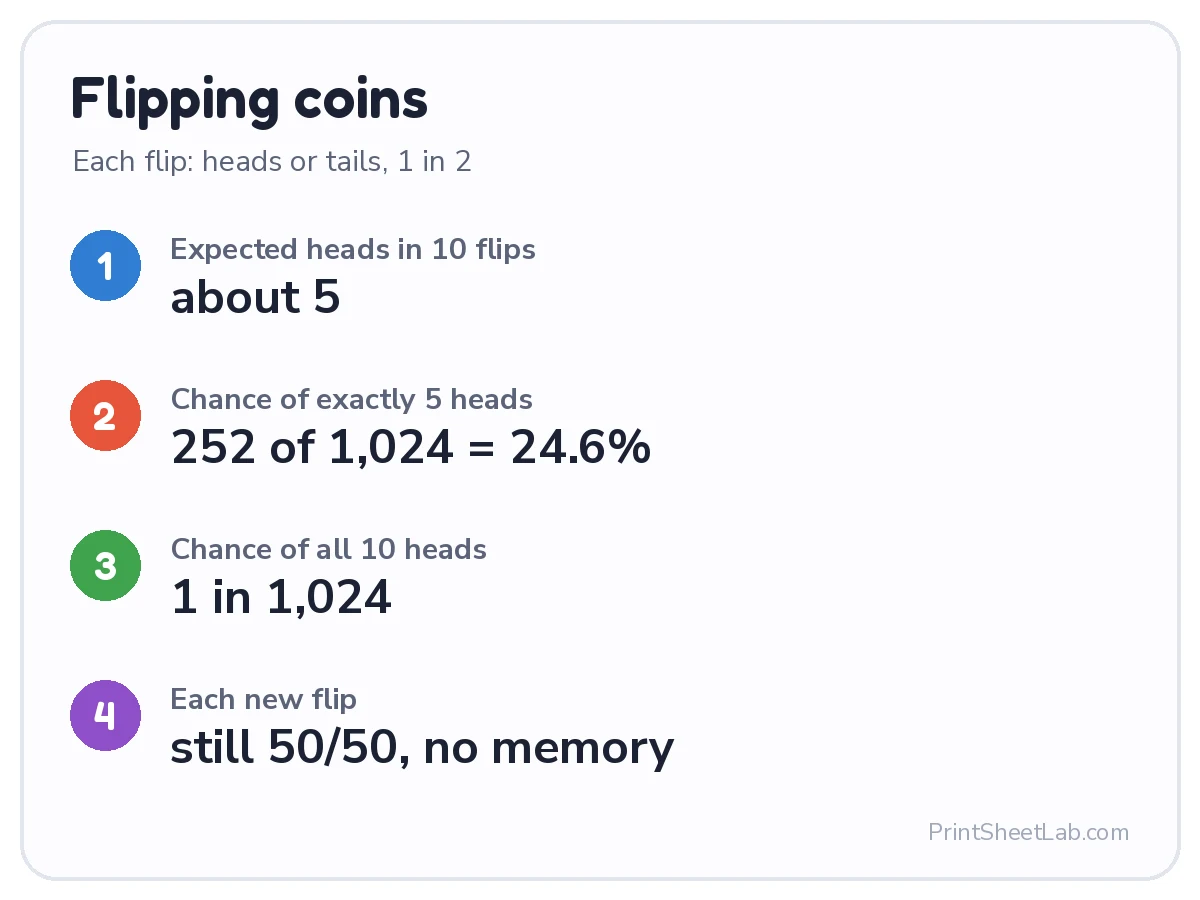
How the random number generator works
The tool counts the possible numbers, then asks your browser for random bits and turns them into a position in that list. The count is highest − lowest + 1, so 1 to 100 has 100 − 1 + 1 = 100 numbers and each has a 1 in 100 chance. When the random bits do not divide evenly into the count, the extra draws are thrown away and redone. This rejection step removes modulo bias, a quiet flaw that makes small numbers slightly likelier in careless code.
Worked example 1. Pick one number from 1 to 100. There are 100 numbers, so every number has a 1 in 100 chance, or 1%. Drawing 62 is no more or less likely than drawing 1.
Worked example 2. Draw 6 different numbers from 1 to 49, a common lottery-style format. The number of possible sets is C(49, 6) = 49! ÷ (6! × 43!) = 13,983,816, so the chance of matching all six is 1 in 13,983,816. Every set, even 1-2-3-4-5-6, is equally likely.
True random vs pseudo-random number generator
A pseudo-random number generator (PRNG) is a formula that turns a starting value, the seed, into a long stream of numbers that look random. A true random number generator measures something unpredictable in the physical world. RANDOM.ORG describes both approaches and uses atmospheric noise for its numbers. The NIST SP 800-90 series covers deterministic generators, entropy sources and how to combine them.
Your browser sits in the middle. MDN explains that crypto.getRandomValues() returns cryptographically strong values from a pseudo-random generator that is seeded with enough unpredictable data. That is the standard source for passwords and keys, and it is better than Math.random(), which MDN says should not be used for security. For a raffle or a number between 1 and 100, it is more than fair enough.
| Type | Source of randomness | Repeatable? | Good for |
|---|---|---|---|
| Simple PRNG (Math.random) | formula and a hidden seed | yes, if the internal state is known | games, shuffling, demos |
| Cryptographic PRNG (this tool) | formula seeded with device entropy | no, in practice | raffles, draws, classroom picks, keys |
| True random (hardware, noise) | physical process such as radio noise | no | research, high-stakes draws |
| Dice, coins, cards | physical shaking and tossing | no | board games, teaching probability |
Random number generator 1-100: chance of each number
Searches for a random number generator 1-100 are usually for a game, a classroom or a pick-a-number challenge. Each number from 1 to 100 has a 1% chance, and the pattern holds for any range: the chance of each number is 1 divided by the count of numbers. A longer list means a smaller chance for each one.
| Range | Numbers possible | Chance of each | As a percent |
|---|---|---|---|
| 1 to 2 | 2 | 1 in 2 | 50% |
| 1 to 3 | 3 | 1 in 3 | 33.3% |
| 1 to 4 | 4 | 1 in 4 | 25% |
| 1 to 5 | 5 | 1 in 5 | 20% |
| 1 to 6 | 6 | 1 in 6 | 16.7% |
| 1 to 10 | 10 | 1 in 10 | 10% |
| 1 to 12 | 12 | 1 in 12 | 8.33% |
| 1 to 20 | 20 | 1 in 20 | 5% |
| 1 to 50 | 50 | 1 in 50 | 2% |
| 1 to 100 | 100 | 1 in 100 | 1% |
| 1 to 1,000 | 1,000 | 1 in 1,000 | 0.1% |
Random number between 1 and 10 and other short ranges
To get a random number between 1 and 10, type 1 and 10 and press Generate. Each number has a 1 in 10 chance. Short ranges suit tie-breakers and party games: choose 1 to 2 for a yes or no, or 1 to 6 to replace a die. For the real thing, try the dice roller and the coin flip.
Short ranges repeat quickly. Drawing 5 numbers from 1 to 10 with repeats allowed gives a repeat 69.8% of the time, while drawing 3 numbers from 1 to 10 repeats 28.0% of the time. If you need different numbers, tick No repeats instead of redrawing by hand.
Random number generator between two numbers
The random number generator between two numbers works for any whole range, including negative numbers: type -10 and 10 to pick from the 21 whole numbers in between. If you want to build the same thing by hand, the formula is low + a random whole number from 0 to (high − low). For 7 to 12 that is 7 + a pick from 0 to 5, so the answer is 7, 8, 9, 10, 11 or 12 with a 1 in 6 chance each.
| Low | High | Numbers possible | Chance of each | A possible result |
|---|---|---|---|---|
| 1 | 100 | 100 | 1% | 62 |
| 7 | 12 | 6 | 16.67% | 10 |
| -10 | 10 | 21 | 4.76% | -3 |
| 0 | 999 | 1,000 | 0.1% | 417 |
| 1000 | 9999 | 9,000 | 0.011% | 5286 |
Random number generator no repeats: drawing without replacement
A random number generator with no repeats, also called a unique or non-repeating generator, takes numbers out of the pool as they are drawn. That makes it a fair way to set a speaking order or a draft order: 1 to 24 with 24 numbers shuffles a class. The tool uses a partial Fisher-Yates shuffle, so every order is equally likely.
Repeats are likelier than most people expect. Drawing with repeats allowed, a repeat shows up in a surprisingly large share of draws, as the table shows for the range 1 to 100. This is the same idea as the birthday problem.
| Numbers drawn from 1 to 100 | Chance of at least one repeat |
|---|---|
| 2 | 1% |
| 5 | 9.65% |
| 10 | 37.2% |
| 13 | 55.7% |
| 20 | 87.0% |
You cannot ask for more different numbers than the range holds, so 7 different numbers from 1 to 6 returns a plain message. Type unwanted numbers, such as 13, in Skip these numbers.
Random number generator with decimals
Choose Decimals and a number of places from 1 to 8 for a random number generator with decimals. With 2 places, the range 0 to 1 holds the 101 values 0.00, 0.01 and so on up to 1.00, and each has the same chance. The tool draws a whole number from that grid and divides it, so rounding never favors one value.
| Decimal places | Values from 0 to 1 | Chance of each | Example |
|---|---|---|---|
| 1 | 11 | 9.09% | 0.3 |
| 2 | 101 | 0.99% | 0.37 |
| 3 | 1,001 | 0.1% | 0.371 |
| 4 | 10,001 | 0.01% | 0.3715 |
A true continuous random number has endless digits, so any finite list is a grid. For simulations, 4 to 6 decimal places is usually plenty. Use the rounding calculator if you need to round a result afterward.
Lottery number generator: quick picks and honest odds
Choose Lottery-style, set From and To to the pool and How many to the count, and the lottery number generator returns a sorted set with no repeats, plus the odds of matching them all. Games differ by country and operator, so check the official rules for your game. Many draw about 5 to 7 numbers from a pool of roughly 40 to 70, and some add a separate extra number.
| Format (k numbers from n) | Possible sets | Chance of matching all |
|---|---|---|
| 5 from 40 | 658,008 | 1 in 658,008 |
| 5 from 50 | 2,118,760 | 1 in 2,118,760 |
| 6 from 45 | 8,145,060 | 1 in 8,145,060 |
| 6 from 49 | 13,983,816 | 1 in 13,983,816 |
| 6 from 59 | 45,057,474 | 1 in 45,057,474 |
No generator can improve those odds. Past results do not change the next draw, and a set such as 7-14-21-28-35-42 is exactly as likely as any other. A generator can only steer you away from popular picks such as birthdays, which lowers the chance of sharing a prize, not of winning. Treat tickets as entertainment and set a budget.
Random numbers for classrooms, raffles and games
Random numbers are everyday tools once you know the settings. Here are real setups with numbers.
- Raffle: tickets 1 to 250, draw 3 with No repeats for first, second and third prize.
- Seating chart: 1 to 28 with 28 numbers and No repeats gives a random order for 28 students.
- Sampling: choose 30 of 400 records by drawing 30 different numbers from 1 to 400, then sort them to read the file in order.
- Games: pick a random card, a level 1 to 12 or the number of squares to move.
- Choosing who goes first: 1 to 4 for four players, or use the random name picker to pick from names.
- Bingo-style calling: 1 to 75 with No repeats, or use the free bingo card generator with its own caller.
Random number generator in Excel and Google Sheets
Spreadsheet generators recalculate whenever the sheet changes, so paste as values to freeze a result.
| Goal | Formula | Notes |
|---|---|---|
| Whole number from 1 to 100 | =RANDBETWEEN(1,100) | Excel and Google Sheets |
| Decimal from 0 up to 1 | =RAND() | never exactly 1 |
| Decimal between a and b | =RAND()*(b-a)+a | round with ROUND(x,2) |
| 10 numbers in random order, no repeats | =SORTBY(SEQUENCE(10),RANDARRAY(10)) | Excel 2021 and 365 |
| 10 numbers in random order, no repeats | =SORT(SEQUENCE(10),RANDARRAY(10),TRUE) | Google Sheets |
In code, prefer a cryptographic source when fairness or secrecy matters: crypto.getRandomValues() in JavaScript, secrets.randbelow() in Python. Plain Math.random() and Python’s random are fine for games and simulations.
Random number generator myths and common mistakes
- “Random means evenly spread.” Real random draws cluster. The same number twice in a row, or three heads in a row, is normal.
- “It is due.” After 5 heads or a run of low numbers, the next draw has the same odds as before. This belief is the gambler’s fallacy.
- “Redraw until it looks random.” That changes the odds. Accept the first draw you set up fairly.
- “Modulo is fine.” Taking a big random value modulo 100 slightly favors some numbers unless the extra values are discarded, as this tool does.
Random number generator questions people ask
What is a random number generator?
A random number generator is a tool or algorithm that produces numbers with no predictable pattern, so each allowed number has the same chance.
How do I pick a random number between 1 and 10?
Type 1 in From and 10 in To, leave How many at 1 and press Generate. You get one whole number from 1 to 10, each with a 1 in 10 chance. Use the 10 quick-pick button to set the range in one tap.
How do I generate random numbers with no repeats?
Tick No repeats before you press Generate. Each number is removed from the pool once drawn, so you get different numbers. You can draw at most as many numbers as the range holds, so 10 different numbers need a range of at least 10.
Random number generator: frequently asked questions
Is this random number generator truly random?
It is cryptographically secure rather than physically random. It uses your browser’s Web Crypto generator, a pseudo-random source seeded with unpredictable device data. Results cannot be predicted from earlier draws.
Can the same number come up twice?
Yes, unless you tick No repeats. Each pick is independent, so repeats are normal. Drawing 5 numbers from 1 to 100 repeats about 9.65% of the time.
Are both ends of the range included?
Yes. From 1 to 100 includes 1 and 100, so there are 100 possible numbers. The count is highest minus lowest plus 1.
Can I use negative numbers or decimals?
Yes. Type -10 and 10 for whole numbers from -10 to 10, or choose Decimals and 1 to 8 places for values such as 0.37.
How many numbers can I generate at once?
Up to 500 in one draw. With No repeats, you can draw only as many as the range holds, after any numbers you skip.
Can I use it as a lottery number generator?
Yes. Choose Lottery-style to get sorted, non-repeating numbers and the odds of matching them all. It cannot improve your odds, because every set is equally likely.
Are my numbers saved or sent anywhere?
No. The draw runs in your browser, and nothing is stored or uploaded. Copy link only saves your settings, not a result.
Is it fair to use for a raffle or giveaway?
It is fair for informal draws such as a class raffle. For legal contests, follow the rules that apply to you, which may require an approved or audited method.
Why does a random list sometimes look streaky?
Randomness produces clusters. Runs and repeats appear in truly random data, and a list without them would be less random, not more.
Related calculators
- Dice roller
- Coin flip
- Random name picker
- Dice probability calculator
- Permutation and combination calculator
- Mean, median, mode and range calculator
- Free online games
- All calculators
Sources and further reading
- RANDOM.ORG: true random numbers vs pseudo-random numbers
- NIST: random bit generation (SP 800-90 series)
- MDN: Crypto.getRandomValues()
- Combination (Wikipedia)
Last updated: October 2026.