Haldi tambola is the easiest way to keep guests busy and laughing between the turmeric rituals. Print up to 600 unique haldi tambola tickets in golden yellow with a marigold on every one, then call the numbers and give prizes such as the Haldi Line, the Marigold Line and the Peeli Full House. The pack has a caller sheet, a prize list and a rules page, and you can also play haldi tambola live on phones.
Haldi tambola to print (PDF)
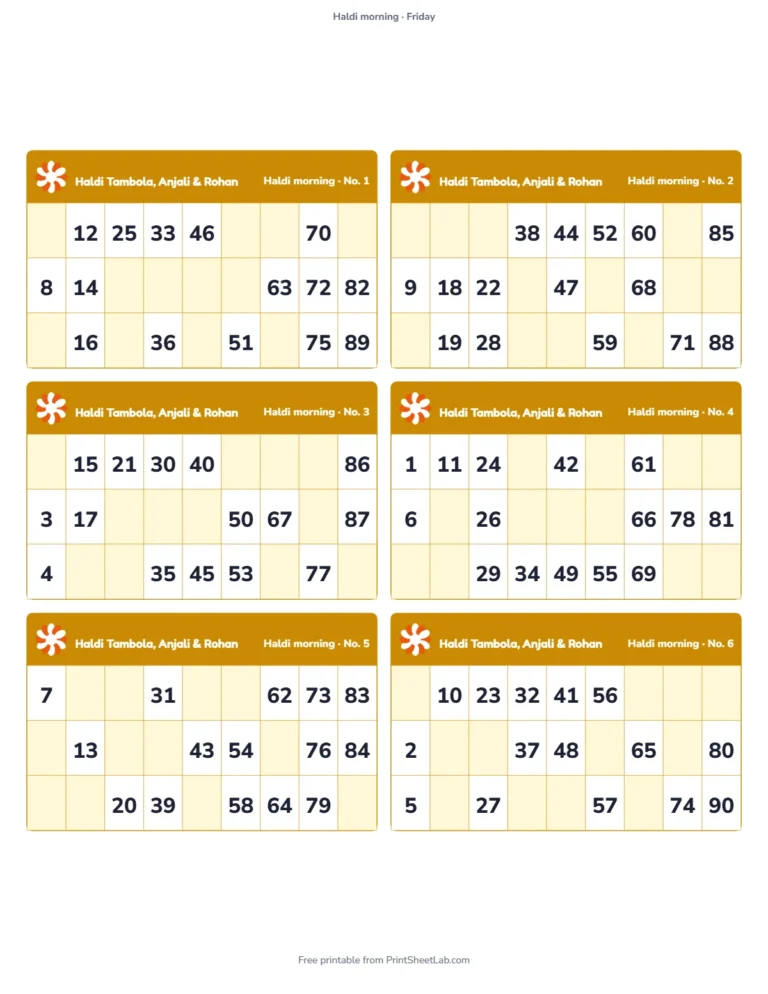
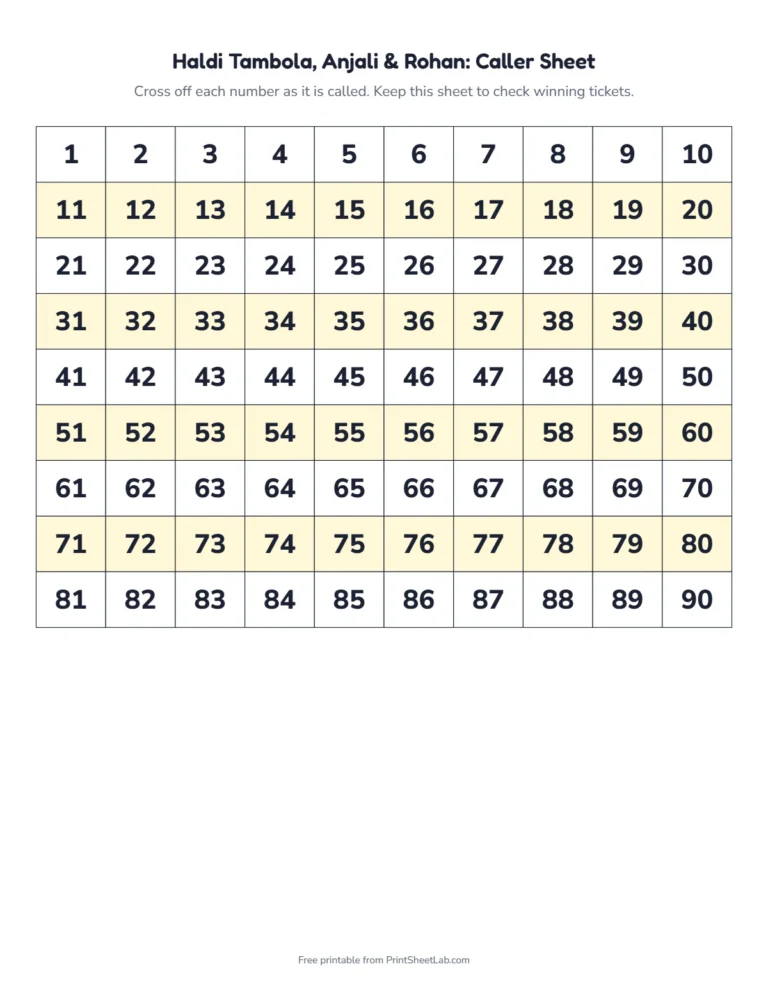
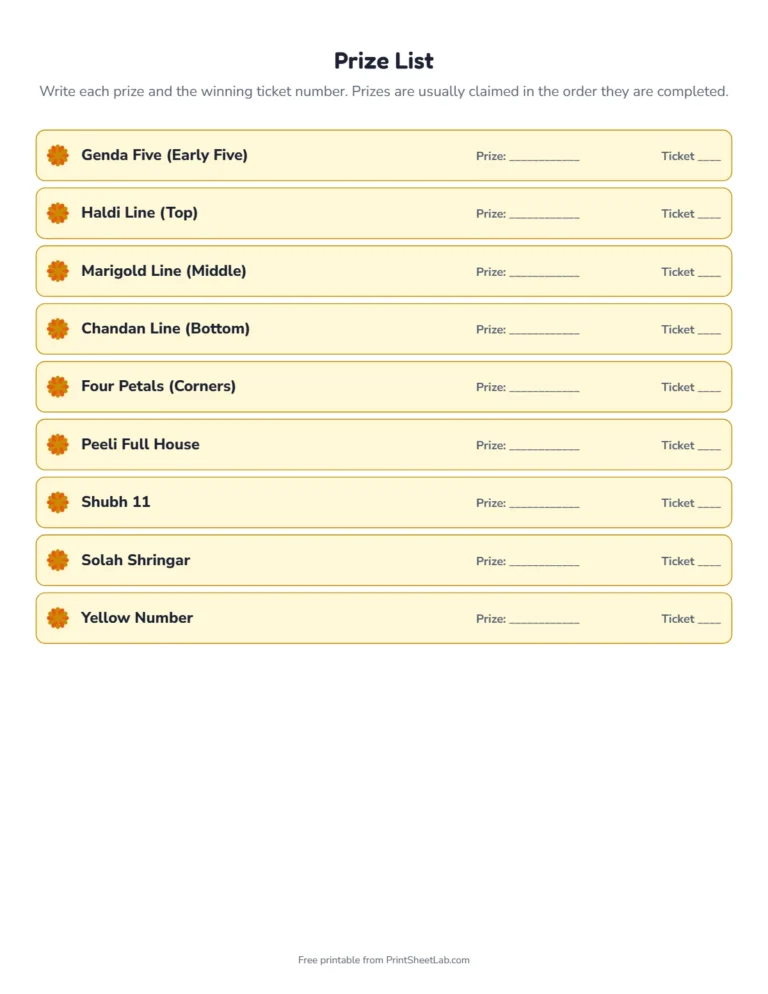
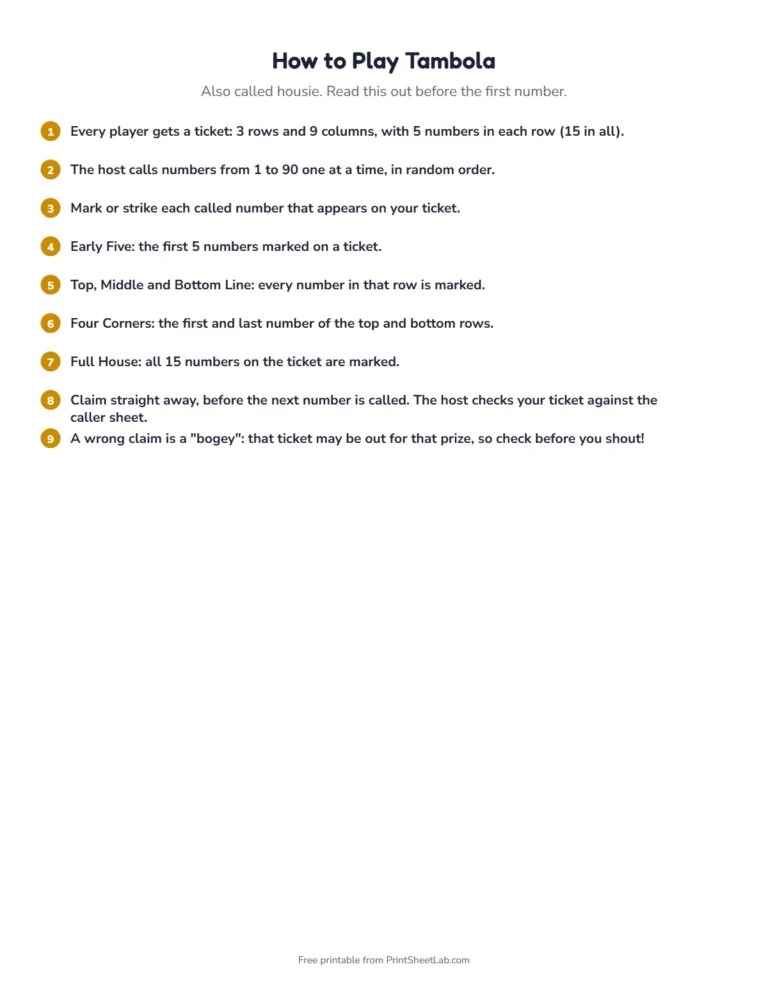
These four pages show a haldi tambola set for a pre-wedding morning: a page of yellow tickets titled “Haldi Tambola, Anjali & Rohan”, the 1 to 90 caller sheet, the prize list with the haldi prize names and the one-page rules. Click a picture for the PDF, or use the generator at the top of the page to change the title, the date, the paper size and the number of tickets.
What is in the haldi tambola pack
Everything below is made in your browser, and nothing you type is uploaded. Put the names of the couple, or the name of the family, in the title box, so the tickets match the invitation.
| Page | What you get | Details |
|---|---|---|
| Tickets | Real strips of six: each strip uses every number from 1 to 90 exactly once | Up to 600 tickets, golden yellow with a marigold motif and orange trim, with your title and the family name on every ticket |
| Caller sheet | A 1 to 90 grid to cross off as you call | Keep it to check every winning claim |
| Prize list | The six haldi prizes, from Genda Five to Peeli Full House | Space to write each prize and the winning ticket number |
| Rules page | A one-page script to read out before the first number | Covers claims and what happens after a wrong one |
Haldi tambola prizes and what they mean
The haldi theme names each prize after something you see at the ceremony, so reading the list out feels like a walk through the morning. Here is what each prize means and how to win it:
| Prize | How to win | Haldi link |
|---|---|---|
| Genda Five | Early Five: the first five numbers marked on a ticket | Genda is the Hindi word for marigold, the flower that decorates the stage |
| Haldi Line | Top Line: all five numbers on the top row | The turmeric paste itself, the heart of the ceremony |
| Marigold Line | Middle Line: all five numbers on the middle row | Garlands and petals in the middle of every haldi decoration |
| Chandan Line | Bottom Line: all five numbers on the bottom row | Chandan is sandalwood paste, often mixed into the haldi |
| Four Petals | Corners: the first and last number of the top and bottom rows | A petal in each corner of the ticket |
| Peeli Full House | Full House: all fifteen numbers marked | Peeli means yellow, so the big prize is the most yellow of all |
Number calls for your haldi tambola
A haldi tambola can borrow the numbers that are lucky or meaningful at an Indian wedding. Read the name first, then the number, and ask the guests who can tell you more about it:
| Number | Call it | Why |
|---|---|---|
| 1 | The first dab of haldi | By custom, an elder applies the first touch of paste |
| 2 | Two families | A wedding joins two families, and haldi is often held in both homes |
| 5 | Panch tatva | The five elements of nature in Indian tradition: earth, water, fire, air and space |
| 7 | Seven pheras | The seven rounds of the sacred fire that come after the haldi |
| 11 | Shubh gyarah | Amounts ending in 1, such as 11, 21 and 51, are thought lucky for gifts |
| 16 | Solah shringar | The sixteen adornments of a bride, from bindi to anklets |
| 21 | Shubh ikkis | Another lucky gift number in many families |
| 51 | Shubh ikyaavan | The lucky number often used for a blessing envelope |
How long does a haldi tambola game last?
A haldi tambola should fit while the turmeric is drying on the bride or groom, so it helps to know how long a game runs. The table shows when each prize is usually won and how many minutes the full game takes at the default speed of 10 seconds a call.
| Tickets | Typical crowd | Early Five | First full line | Full House | Time at 10 s a call |
|---|---|---|---|---|---|
| 12 tickets | a family haldi at home | call 14 (12 to 17) | call 43 (36 to 49) | call 76 (71 to 78) | 13 min |
| 30 tickets | a haldi with close friends and relatives | call 12 (10 to 14) | call 36 (31 to 41) | call 72 (69 to 75) | 12 min |
| 60 tickets | a haldi lunch in a hall | call 11 (9 to 12) | call 31 (26 to 36) | call 69 (66 to 72) | 12 min |
| 90 tickets | a big joint haldi and mehendi | call 10 (9 to 11) | call 29 (25 to 33) | call 68 (64 to 70) | 11 min |
The numbers come from real simulations of this generator: 300 games for each ticket count, with the typical call number and the middle half of results in brackets. More tickets mean the first prizes arrive sooner, but with 12 to 90 tickets the Full House still comes around call 68 to 76, because someone must complete all fifteen numbers. For a short ritual break, choose 6 seconds a call and stop after the Haldi Line and the Peeli Full House.
Haldi ceremony games: keep them playful and low-mess
Haldi ceremony games have to work for guests in yellow clothes who do not want to get dirty. Tambola is a sitting game with no props, so nobody touches a thing except a pen. It fills the waiting time while the turmeric paste sets, and it keeps the cousins busy while the elders do the rituals. Play it before the haldi to welcome guests or after the ritual to celebrate.
Haldi games and haldi function games for the whole family
Haldi games are not only for the young. A good haldi function games plan has three parts: a seated game such as tambola for everyone, an active game for the cousins, and a quiet moment for the ritual itself. Give each elder a ticket and let a child read the numbers: it ties the generations together, and the elders enjoy being included. Prizes can be small, practical and yellow.
Yellow theme party games and table styling
Yellow theme party games look best when the tickets match the room. Print the haldi tambola in color, use marigold petals or yellow candies as markers, and set the prizes in a basket of flowers. Turmeric itself has been used in South Asian cooking and ritual for thousands of years, so a small explanation of why the paste is applied makes a good intro for guests from other cultures. For general background, see the Wikipedia article on turmeric.
How to run a haldi tambola in six steps
- A week before: count the guests and decide the six prizes, one for each tambola prize.
- Print: type the couple’s names into the title box and print the yellow tickets, the caller sheet and the prize list.
- Set up: place a ticket, a pen and a small bowl of petals or sweets at each seat.
- Before the first number: read the prize list, and explain the haldi names to guests who are new to the ceremony.
- During the game: call a number every 10 seconds, with a pause for the ritual if the bride or groom is called away.
- After the game: check each win against the caller sheet, hand out the prizes and keep the tickets as a souvenir.
Prize ideas for a haldi tambola
- A small jar of sweets, such as besan ladoo, for the Genda Five
- A string of marigolds or a yellow dupatta for the Haldi Line and the Marigold Line
- A sandalwood soap or incense set for the Chandan Line
- A diya or a brass bowl for the Four Petals
- A bigger hamper, with a cushion cover or a mug, for the Peeli Full House
Type any of these into the “Extra fun prizes” box and they print on the prize list:
- Shubh 11: the first guest to mark the number 11
- Solah Shringar: the first to mark the number 16
- Yellow Number: the first to mark three numbers that end in 1
- Youngest Guest: a bonus prize for the youngest player who marks a number correctly
Host tips for a smooth game
- Choose washable markers, because turmeric is hard to remove from paper and clothes if it mixes with the pens.
- Keep a few extra tickets for relatives who arrive late or move between the ritual and the game.
- Ask a cousin to be the caller, and let the host of the haldi announce the prizes.
- Use petals or dried beans as markers instead of pens if the guests are in white or pastel clothes.
Wikipedia’s Hindu wedding article describes the rituals around a Hindu wedding, including the pre-wedding ceremonies.
Play haldi tambola live on phones
Press Create game in the live game below, share the link and every guest opens a different e-ticket on their phone. Numbers are called automatically at the speed you choose, read aloud in English or Hindi if you like, and you can check any winning claim by ticket number. No app and no sign-up. It works well if cousins in other cities want to join the haldi from home.
Haldi tambola: frequently asked questions
What are good haldi ceremony games?
Tambola is one of the easiest: it is a seated game, it needs no props and every guest has a ticket. Add a quiz about the couple or a round of antakshari for a longer morning.
Can we use haldi tambola for a mehendi or sangeet too?
Yes. The tickets are standard 90-number tambola tickets, and you can change the title and the prize names. For a mehendi night see Mehendi tambola, and for a sangeet see Wedding tambola.
How many haldi tambola tickets should I print?
One for every guest who wants to play, plus a few spares. A family haldi usually needs 12 to 30 tickets, and a hall event 60 or more.
How many tickets can I print?
From 1 to 600 in one go, with 3, 6, 8 or 12 tickets per page. Press New tickets for a completely different set, and choose Letter or A4 paper, in color or black and white.
Are the haldi tambola tickets free?
Yes. The tickets, caller sheet, prize list, rules page and live game are all free for home, club and classroom use, with no sign-up.