Thanksgiving bingo gives a crowded house something to do between the parade and the pie. The template on this page holds 29 squares that almost every American Thanksgiving produces sooner or later, from turkey and gravy to the football game, the dog waiting under the table and the nap on the couch. Pick a card size, press print, and every guest gets a different card to mark as the day unfolds.
In short: open the card maker above, press Edit and print this card, choose how many cards you need and download one PDF. It costs nothing, it needs no account, and nothing you type leaves your browser. Every square can be changed, so swap in your own family traditions.
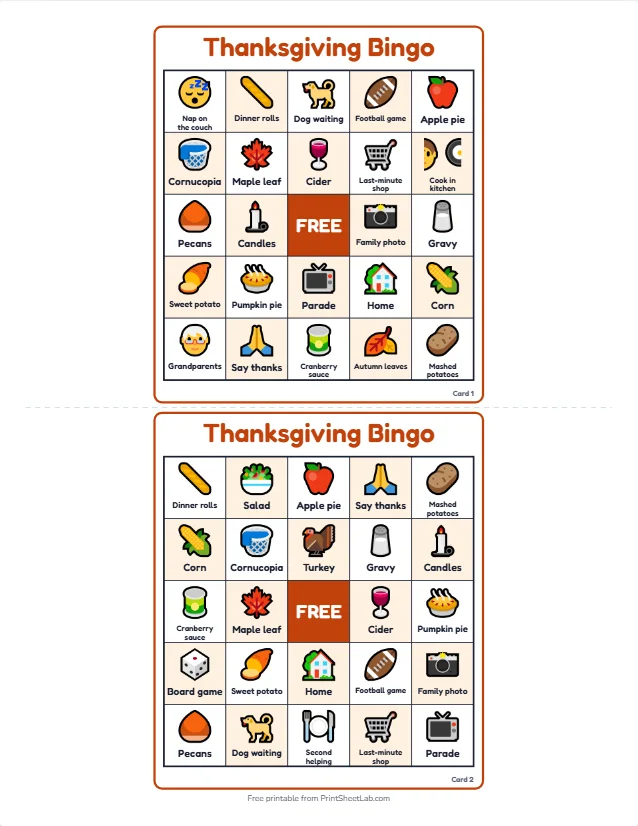
How to play Thanksgiving bingo
The rules of Thanksgiving bingo are the ones every bingo player already knows, with one change. Nobody calls numbers. The day itself is the caller. Each guest gets a card and a pen, and marks a square the moment that thing happens in front of them: the turkey arrives at the table, someone says grace, the dog starts begging. The first guest with five marked squares in a row, across, down or diagonal, announces it, and the table checks the squares.
- Hand out the cards at arrival. A card at the door gets guests talking right away, and the early squares (home, the cook in the kitchen, coffee) fill in before the main event.
- Agree on honesty rules. A square counts only if the person saw or heard it themselves, and it counts once. The host is the referee.
- Mark as you go. Pens, crayons, stickers or small candy corn pieces all work as markers. The free center square is already marked.
- Call it out. A winner reads the line aloud, and one other guest confirms each square. Prize time.
- Keep playing if you like. Go for four corners, an X, or a full card before dessert is served.
The reason Thanksgiving bingo works is that the holiday is predictable in the best way. Families disagree about politics and about whether stuffing belongs inside the bird, but nearly everyone agrees on what a Thanksgiving table looks like. That shared script is what you are marking on the card. If you want a gentler first round before the whole family arrives, try the dinner table version of Thanksgiving bingo further down this page.
Thanksgiving bingo cards: all 29 squares
These Thanksgiving bingo cards use 29 squares. A standard 5×5 card with a free center needs 24 of them, so each card leaves out five and the mix differs from one guest to the next. The table sorts the full list by the part of the day when each square tends to show up. The timing is a rule of thumb for a typical American family, and your own Thanksgiving bingo day may run on a different clock.
| Part of the day | Squares on the list | What to expect |
|---|---|---|
| Morning and kitchen | 🏡 Home, 🧑🍳 Cook in kitchen, ☕ Coffee, 🛒 Last-minute shop, 📺 Parade | The first marks. Coffee and the cook are nearly certain. The last-minute shop is a gamble. |
| Guests and decor | 🧓 Grandparents, 🕯️ Candles, 🧺 Cornucopia, 🍂 Autumn leaves, 🍁 Maple leaf, 🐕 Dog waiting, 📸 Family photo | Show up when people arrive and the table is set. Some depend on who comes. |
| The big meal | 🦃 Turkey, 🥔 Mashed potatoes, 🧂 Gravy, 🥖 Dinner rolls, 🌽 Corn, 🍠 Sweet potato, 🥫 Cranberry sauce, 🥗 Salad, 🌰 Pecans, 🙏 Say thanks, 🍽️ Second helping, 🍷 Cider | Cluster into about ninety minutes. This is where most lines are completed. |
| Afterward | 🥧 Pumpkin pie, 🍎 Apple pie, 🏈 Football game, 😴 Nap on the couch, 🎲 Board game | Dessert and the long evening. These squares rescue the card for the guests who are still short. |
The list is not an accident. Because the food squares all land within the same ninety minutes, a card made only of dishes would end in a rush at the table. Mixing in morning squares, guest squares and evening squares spreads the marking across the whole day, so people stay in the game from the first coffee to the last slice of pie. If your meal is a potluck, a Friendsgiving or a dinner abroad, edit your Thanksgiving bingo list to match; the section on the card maker below shows how.
How many different cards can you make?
With 29 squares and 24 places on a 5×5 card, the number of different sets of squares is 29 choose 24, which is 118,755. Each set can be arranged in many orders, so you will never run out of unique Thanksgiving bingo cards.
For a family gathering that matters less than the practical point: with only five squares left out, two guests may have nearly the same words, but their rows and columns will differ, so they rarely finish together. For a 4×4 card you need 16 squares, and for a 3×3 card with a free center you need 8.
| Card size | Squares used | Different sets from the 29 | Best for |
|---|---|---|---|
| 3×3 with free center | 8 | 4,292,145 | Toddlers and the kids table |
| 4×4 | 16 | 67,863,915 | A short game before dinner |
| 5×5 with free center | 24 | 118,755 | The classic all-day game |
A Thanksgiving Day timeline: when each square happens
To see how a day of Thanksgiving bingo really behaves, we turned each of the 29 squares into a window on the clock. The chart shows the window and the chance that the square happens at all. The numbers are our assumptions for a family that eats around 3 p.m. They are not survey results, and you should read them as a way of thinking rather than a measurement.
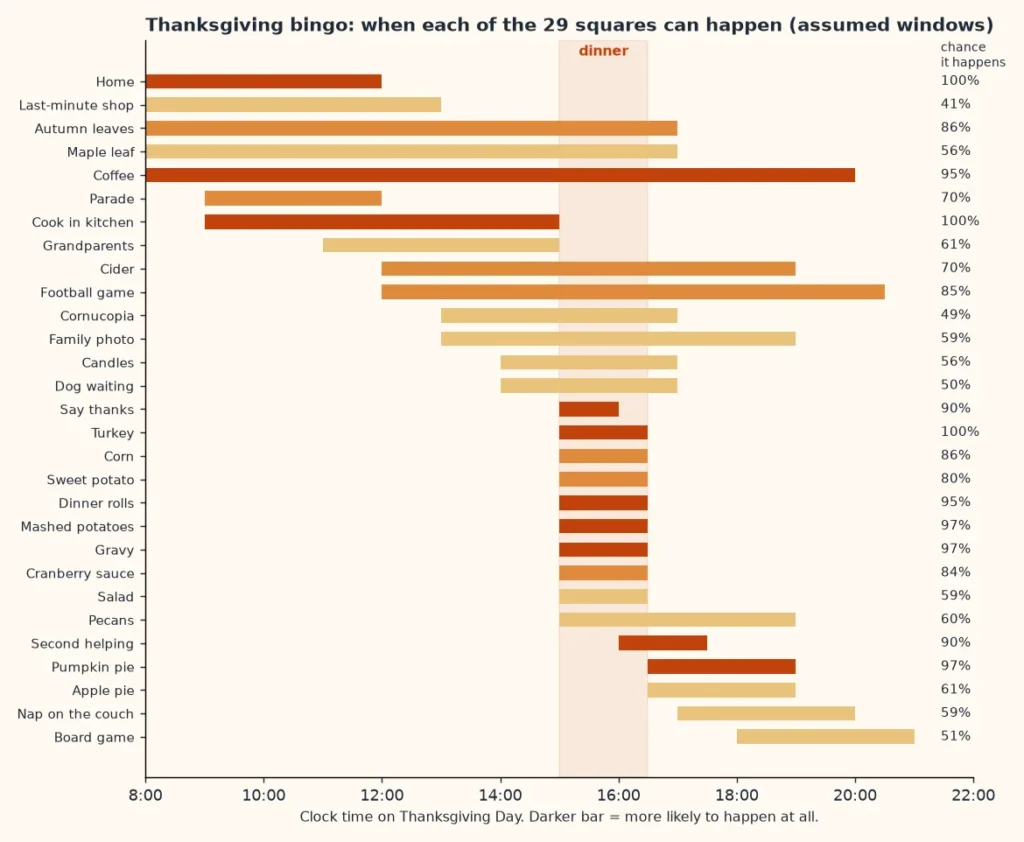
Three things jump out. About seven squares are 90 percent or more likely to happen around the meal, which is why dinner is the busiest bingo moment. Several others in the Thanksgiving bingo list, such as the cornucopia centerpiece, a board game and the dog hovering for scraps, depend on your household and are marked about half the time. And the early squares (home, the cook, coffee) are almost free, so no Thanksgiving bingo card starts completely empty.
Three ways to run a Thanksgiving bingo game
A Thanksgiving bingo game does not have to be one thing. The same printed cards support three quite different games, and many families play two of them in one day. The table compares them; the sections after it give the rules and prize ideas.
| Game | Who calls | Length | Best for |
|---|---|---|---|
| Day-long spotting game | Nobody. The day calls itself. | Morning to evening | Mixed ages with plenty of time between events |
| Thanksgiving dinner bingo | The table talks | One meal, about an hour | A full table where everyone is already sitting together |
| Drawn-card game | A caller draws cut-out cards | 10 to 20 minutes | Kids, a classroom party or an after-dinner game |
Game one: the day-long spotting game
Hand out Thanksgiving bingo cards as guests arrive. Play for a first line with a modest prize, then reset and play for four corners, then for a full card. Because the game is driven by real events, it runs on its own and the host can keep cooking. Prizes that fit the occasion are small: first pick of the pies, the good armchair for the football game, a pass on dish duty for the person who wins the line, and a jar of candy corn for the full card.
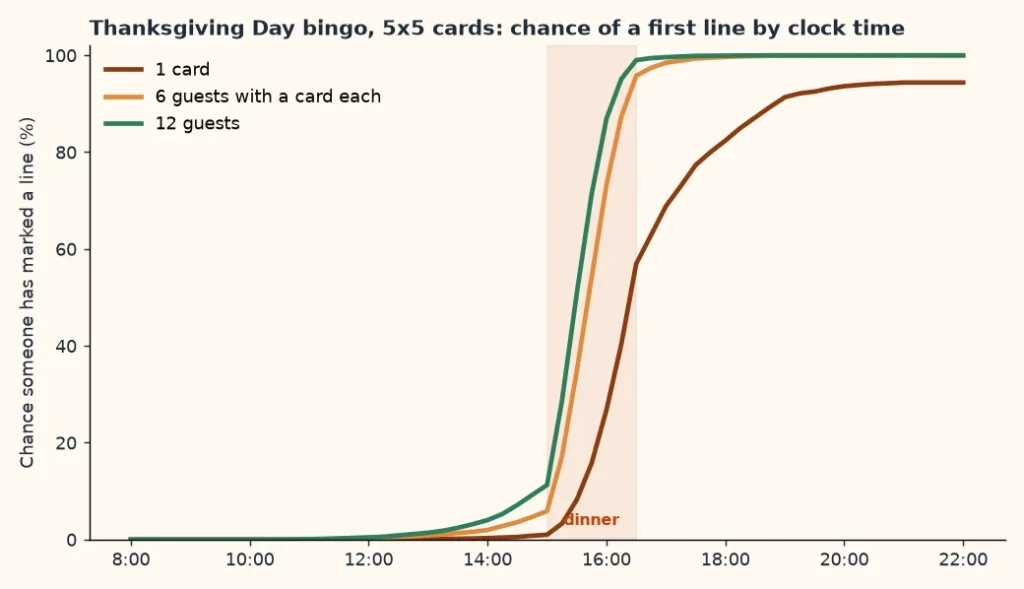
The simulation below shows when the first line in a Thanksgiving bingo game usually happens. In short, it is dinner. If you want a winner before the meal, print 3×3 cards, or add morning squares such as the parade and the last-minute shopping run.
Game two: calls from the drawn-card pile
This is the classic Thanksgiving bingo format. In the Print tab you can print calling cards to cut out, one per square. Shuffle them in a bowl, and a caller draws one at a time and reads it aloud. Everyone with that square on their card marks it.
Because the 29 squares come out of the bowl in a random order, the game is fair and predictable in length. The numbers are in the simulation section. For a play-along version on a screen, you can also host the game with the play bingo online page, where guests join by link and cards mark themselves.
Game three: after-dinner team round
When the plates are cleared, split the table into two teams and give each team one shared card. Teams take turns acting out or describing a square without saying the words: a nap on the couch, a football game, a cornucopia. The other team guesses, and the square is marked when it is guessed correctly. First team with a line wins. It works for adults who find a silent bingo card too quiet, and this Thanksgiving bingo round needs no extra supplies.
Thanksgiving dinner bingo: the table-talk round
Thanksgiving dinner bingo is a version built for the table itself. Everyone is seated, the food is out, and a square is marked when something on the list is on the table or is said out loud.
It is a good way to lead a family that is not used to talking to one another into easy conversation, because the game gives people a reason to start: “Who brought the cranberry sauce?” “Did anyone say thanks yet?” “That is my second helping.” The rules are nearly the same as in the day-long game, but time is short, so the winner is announced before the plates are empty.
- Use a 4×4 or 3×3 card. The meal is about an hour, and the food squares fill in fast. A smaller card keeps the Thanksgiving bingo contest tight.
- Say-it squares count by voice. “Say thanks” and “Second helping” are marked when anyone says them at the table, including the host.
- No phones. A pen and a card give the game its charm, and the card is a gentle reason to put the phone down.
- Prize for table talk. Give an extra mark to anyone who starts a story about a past Thanksgiving. It can turn a quiet table into a lively one.
If you want to add a conversation layer, put a few of the guest-mingling squares from getting to know you bingo on a separate card for a family that includes people who have not met. The two games combine well because Thanksgiving bingo is about things you see and the other is about people.
Printable Thanksgiving bingo: print, cut and pass around
Printable Thanksgiving bingo works best when the cards survive a messy table. A few small choices make a big difference. In the Print tab you pick how many different cards to print, from 1 to 100, how many per page (1, 2, 4 or 6), Letter or A4 paper, and portrait or landscape. For a family dinner of 12, two per page and six sheets of Thanksgiving bingo give each guest a card with room for a spare.
- Print on light cardstock if you can. A Thanksgiving bingo card that stands up to gravy is a card that will be played with all afternoon.
- Add names to the cards. The Design tab can print a name on each card, so no two guests mix them up.
- Keep a caller sheet. The Print tab can add a caller sheet and cut-out calling cards for the drawn-card game.
- Use sticker dots or dried beans. Wet pens bleed on thin paper, and little ones like to peel stickers.
- Print a spare set. Someone always spills cider on their card.
Hosts who travel can save the Thanksgiving bingo PDF to a phone or a USB stick and print at a relative’s house, since a printer is more likely to be there than at your hotel. The shareable link in the card maker keeps only the words of your list, not any personal details, so you can message it to the cousin who is handling the table and let her print her own set.
Thanksgiving bingo for kids
Thanksgiving bingo for kids is a ready-made answer to the question of how to keep the children busy between the parade and dinner. The pictures on each square help pre-readers, and Thanksgiving bingo gives the kids’ table a game of its own. How you set it up depends on the age of the child.
| Age | Card | How to play |
|---|---|---|
| 3 to 4 | 3×3, big pictures | A grown-up reads the square names. Sticker dots, no pens. Everyone wins a prize at the first line. |
| 5 to 7 | 3×3 or 4×4 | Words with emoji together. Kids spot things and shout. Play for a line, then for four corners. |
| 8 to 11 | 5×5 | Words only, plus two or three squares they write themselves. Add a rule that a square counts only if they can name who did it. |
| 12 and up | 5×5 or an after-dinner team round | Use the acting game and add a few jokes of their own to the list. |
A gratitude twist on Thanksgiving bingo suits younger kids well: when a square such as “Say thanks” is marked, the child who marked it says one thing they are thankful for. It takes five seconds and turns a game square into a small family moment. And if the kids’ table is already noisy, print 3×3 Thanksgiving bingo cards so a winner appears within the hour. For other party games to run next to the cards, the party games for kids guide has several that adapt to a holiday table.
Thanksgiving bingo free printable: what you get
Free and private
This Thanksgiving bingo free printable asks for nothing: no account, no email, no watermark. The editor runs in your browser, so the words you type for your Thanksgiving bingo never leave your device. When you close the tab, nothing is kept on our side. You need a printer or a PDF viewer, and that is all.
What you can change
The card maker has five tabs: Setup, Items, Design, Templates and Print. On the Items tab you edit every square, add emoji or your own pictures, and decide what goes in the free space. On the Design tab you pick a color theme, fonts, text size, borders, rounded corners and a card background, and you can add a title and a footer such as “Johnson family Thanksgiving 2026.” The Templates tab holds the other ready-made lists. The Print tab handles the number of cards, paper size, cut guides and the PDF.
You can leave the free space as it is or give it its own text: “Everyone is here” works well. Press Shuffle to rearrange the squares on every card, and Undo if you change your mind. The preview lets you zoom in before you download.
How long does a game last? A real simulation
Hosts of Thanksgiving bingo always ask when the first winner will appear. To answer that with numbers rather than a guess, we ran a simulation of 8,000 Thanksgiving Days. In each run, every square follows the window and the chance of happening shown in the timeline chart. Each guest has a card made of 24 randomly chosen squares from the list of 29 with the free center, and the first line is the earliest moment any guest completes a row, column or diagonal. Squares that did not happen that day stay unmarked.
The first line, by clock time
| 5×5 card | Median time of the first line | Line by 3 p.m. | Line by 4:30 p.m. | Line by the end of the day |
|---|---|---|---|---|
| 1 card (a solo player) | 4:24 p.m. | 1% | 57% | 94% |
| 6 guests, a card each | 3:42 p.m. | 6% | 96% | 100% |
| 12 guests, a card each | 3:29 p.m. | 11% | 99% | 100% |
With a 5×5 card, the first line arrives at dinner, almost without exception. A single player has a line about 57% of the time before 4:30 p.m., and a solo player misses a line altogether in about 6% of days, when too many squares simply do not occur. With six guests the line comes at about 3:42 p.m., and with twelve guests, 3:29 p.m.. More players do not change the shape, only the moment.
Smaller cards change the story
| Card (6 guests) | Median first line | Line by noon | Line by 3 p.m. | Full card done? |
|---|---|---|---|---|
| 3×3 with free center | 1:44 p.m. | 27% | 71% | about 40% of days by evening |
| 4×4 | 3:33 p.m. | 1% | 11% | about 4% of days |
| 5×5 with free center | 3:42 p.m. | 0% | 6% | almost never (0% of days) |
The 3×3 card is the only size that produces a winner before dinner. With six guests, the first 3×3 line comes around 1:44 p.m., and about 71% of days have a winner by 3 p.m. Full-card blackouts are rare on 5×5 cards because some squares never happen on a given day (a board game, a cornucopia, a last-minute shop). That is useful for a host: a full card is a long-shot prize, and a first line is the real contest.
The drawn-card game: how many calls?
The drawn-card Thanksgiving bingo game is much more predictable, because the 29 cards come out of the bowl in a random order and every square is called exactly once. Our simulation of 8,000 games gives the median number of calls to the first line on a 5×5 card:
| Cards in play | Calls to the first line (median) | Middle half of games | Calls to a full card |
|---|---|---|---|
| 1 card | 17 | 14 to 19 | 29 |
| 4 cards | 13 | 11 to 15 | 28 |
| 8 cards | 11 | 10 to 13 | 28 |
| 15 cards | 10 | 9 to 12 | 28 |
| 25 cards | 9 | 8 to 11 | 28 |
A Thanksgiving bingo game with eight 5×5 cards usually has a winner after about 11 calls, which is under two-thirds of the way through the list of 29. With a smaller 3×3 card and eight players, the median is just 5 calls. Use that when you have to finish before the pie cools. The assumptions behind all of these numbers are simple: every square on the list is equally likely to be called at any step, cards are random and independent, and all players play every call.
The first set of numbers, the whole-day game, depends on our assumed timetable. If your family eats at noon, shift the dinner window and the whole curve moves with it. We kept the model deliberately plain so that you can see how Thanksgiving bingo behaves, not to promise that your day will match.
Customize the cards in the card maker
The best Thanksgiving bingo cards are the ones that name your own family. The editor is built for that. Open the Items tab and every square becomes a text box. Type a new word, paste an emoji, or add a picture from your device. Here are a few swaps families make most often.
- Family in-jokes. “Uncle Ray falls asleep,” “Grandma critiques the gravy,” “Someone asks about plans for next year.”
- Regional dishes. Green bean casserole, tamales, collard greens, rice and gravy or a dish from your own culture belong on the card if they belong on the table.
- Friendsgiving squares. Potluck dish, a wine from a friend, a board game that gets everyone arguing.
- Travel version. Airport, rental car, a delayed flight, a hug at the door.
- Gratitude squares. “Thanks for the food,” “A kind word,” “Someone helped with dishes.”
With more than 24 squares on the list, the card maker gives each card a different subset, as described above. With exactly 24, every card has the same squares in a different order.
Because the free center square can have its own text, emoji or picture, you can use it for something personal: a family photo, the year, or “Together.” Then open the Design tab for a title on your Thanksgiving bingo card, such as the family name, and a footer such as the date. Use the Print tab to preview the cards before you download the PDF.
If you want a card with nothing printed in the squares, open the blank bingo cards page; and if you prefer to start from scratch with numbers or your own words, the bingo card generator offers every card type in one place.
Notes for hosts: allergies, dietary needs and a relaxed pace
A Thanksgiving bingo game that mentions pecans, dairy and wine needs a short sensitivity check. If a guest has a nut allergy, a square called “Pecans” is only a word on paper, but a bowl of nuts on the table is real.
Consider replacing the squares that point at specific foods when you know a guest cannot eat them, and keep Thanksgiving bingo about the things that happen rather than what everyone should eat. The same goes for the “Cider” square, which can mean sparkling apple cider for a guest who does not drink. You can swap any square for a neutral one in seconds.
The holiday itself is a good reason to keep the game light. Thanksgiving in the United States falls on the fourth Thursday of November, and the Wikipedia article on Thanksgiving in the United States describes how the day grew from harvest celebrations into a national holiday of food, football and family. Not every household shares that history or that menu, so treat the Thanksgiving bingo cards as a starting list and let each family put its own traditions in the squares.
A relaxed pace matters more than a perfect prize table. The most memorable Thanksgiving bingo games at a holiday table are the ones where the winner is a grandparent who has never played, or a six-year-old who spotted the dog first. Keep prizes small, let kids win the first round of Thanksgiving bingo, and put the pen down when the pie arrives.
More bingo cards for the holiday season
The card maker holds a whole set of occasion lists. When the turkey is a memory, the next one in the calendar is Christmas bingo, and the baby shower bingo list is handy if the family gathering includes a surprise. For a trip to the relatives’ house, the road trip bingo cards keep the back seat busy on the way. You can also browse every template on the printable bingo cards hub, or use a caller for number-based games on the bingo caller page.
When family is far away, hold Thanksgiving bingo over video: send the shared link, let everyone print or draw their own card, and mark squares as the day unfolds. The play custom bingo online page explains how to host a live round of Thanksgiving bingo with your own list.
Frequently asked questions
10 quick answers
What is Thanksgiving bingo?
Thanksgiving bingo is a bingo variation in which each square names something that happens or appears on Thanksgiving Day, such as turkey, gravy, football or a nap. Guests mark a square when they see it, and the first to complete a line calls bingo.
Are these Thanksgiving bingo cards really free?
Yes. You can make, edit and print the cards without an account or a payment, and nothing you type is uploaded. The editor runs in your browser.
How many squares does the template have?
It has 29 squares. A 5×5 card with a free center uses 24 of them, a 4×4 card uses 16 and a 3×3 card with a free center uses 8. Because the list has more words than squares, the cards differ from each other.
How many guests can play?
As many as you can print cards for. The Print tab makes 1 to 100 different cards in one PDF, so a family of eight or a school class of thirty both work.
Can I play Thanksgiving bingo without printing?
You can. Open the card on a tablet or phone and tap squares, or host a live game with a link on the play bingo online page, where cards mark themselves as items are called.
What prizes work for a Thanksgiving bingo game?
Small, funny prizes work best: first pick of the pies, a pass on the dishes, the best seat for the game, a jar of candy corn or a small bag of treats for the kids. Grown-ups tend to play harder for bragging rights than for treats.
When does the first winner usually appear?
In our simulation of a family that eats around 3 p.m., a 5×5 card with six guests has its first line at about 3:42 p.m.. Smaller cards finish earlier: a 3×3 card has a first line at about 1:44 p.m..
How is the drawn-card version different from the day-long game?
In the drawn-card version a caller draws cut-out cards from a bowl, so the order is random and the game takes about 11 calls for a table of eight on 5×5 cards. In the day-long version the day itself does the calling.
Can I change the squares to match my family?
Yes. On the Items tab every square can be edited, replaced with an emoji or given a picture. Add family names, regional dishes or inside jokes, and use the free space for something personal.
What size should I print for young children?
Print a 3×3 card with large pictures for children aged three to six. It has only eight squares plus a free center, so the first line arrives quickly and the child stays interested.