A BMI calculator works out body mass index, the number you get by dividing your weight in kilograms by your height in meters squared. This free BMI calculator works in feet and pounds or in centimeters and kilograms, then shows your WHO and CDC category, the healthy weight range for your height and your BMI Prime.
Every result comes with the working, so you can see exactly where the number comes from.
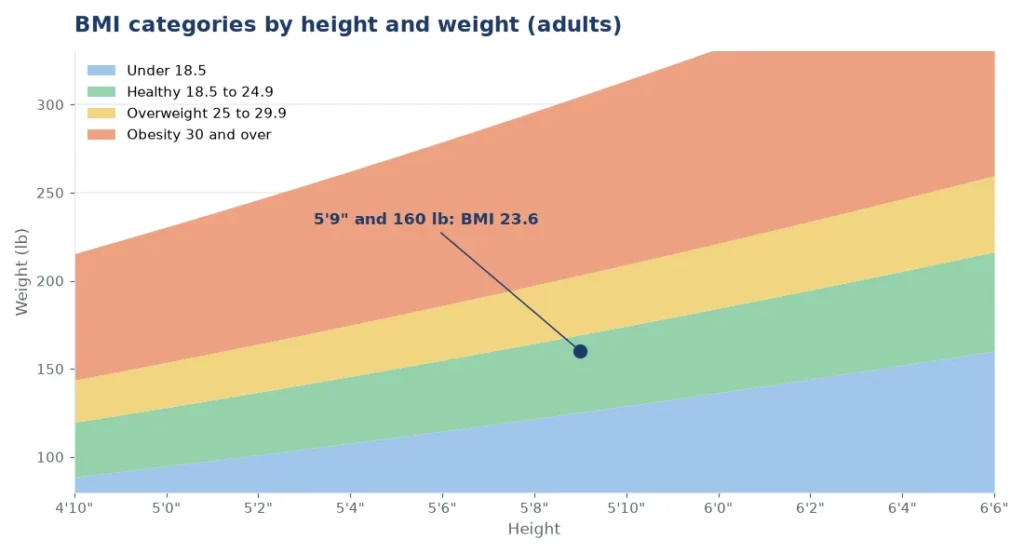
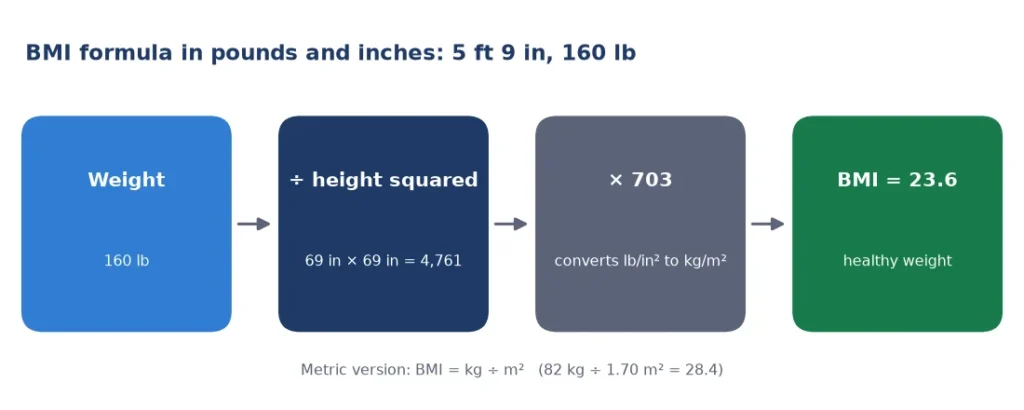
Quick answer: BMI = weight (kg) ÷ height (m)². In pounds and inches the BMI formula is weight (lb) ÷ height (in)² × 703. For example, 160 lb at 5 ft 9 in gives 160 ÷ 4,761 × 703 = 23.6, which is in the healthy weight category (18.5 to 24.9). For adults 20 and older the cut-offs are under 18.5, 18.5 to 24.9, 25 to 29.9 and 30 or more.
General information, not medical advice: The BMI calculator gives a screening number only. It cannot diagnose anything or replace a visit with a doctor, midwife, pharmacist or registered dietitian. If you are worried about your health, or have a medical condition, are pregnant or take medication, ask a health professional first.
How to use this BMI calculator
Choose your units, type your height and weight, and the BMI calculator updates as you type. There is no Calculate button. Tap Copy result to paste the numbers into a note, or Copy link to share the exact setup.
- Pick Feet, inches, pounds or Centimeters, kilograms.
- Type your height. In US units use two boxes: whole feet, then inches (for 5 ft 9 in type 5 and 9).
- Type your weight in pounds or kilograms.
- Type your age. From age 20 the adult categories apply; for ages 2 to 19 the tool shows the number and points you to the CDC percentile method.
- Leave the cut-offs on Standard (WHO, CDC), or switch to the NHS lower cut-offs if they apply to you.
| Input or output | What it means |
|---|---|
| Height and weight | The only two numbers the BMI formula uses. |
| BMI | Weight relative to height, in kg/m², shown to one decimal. |
| Category | Underweight, healthy weight, overweight or obesity, from the WHO and CDC adult cut-offs. |
| Healthy weight range | The weights at your height that give a BMI of 18.5 to 24.9. |
| BMI Prime | Your BMI divided by 25, the upper edge of the healthy range. |
BMI formula: how the BMI calculator works
The BMI formula is the same everywhere: BMI = weight (kg) ÷ height (m)². WHO and the CDC both define it this way. The number was devised in the 1830s by the Belgian mathematician Adolphe Quetelet, which is why it is also called the Quetelet index.
With pounds and inches, multiply by a conversion factor of 703 so the result stays in kg/m²: BMI = weight (lb) ÷ height (in)² × 703. The BMI calculator uses whichever one matches the units you pick.
Worked example 1: pounds and inches
A person is 5 ft 9 in tall and weighs 160 lb. Height in inches = 5 × 12 + 9 = 69. Height squared = 69 × 69 = 4,761. BMI = 160 ÷ 4,761 × 703 = 23.63, which rounds to 23.6 (healthy weight). The healthy weight range at 69 inches is 18.5 × 4,761 ÷ 703 = 125.3 lb up to 24.9 × 4,761 ÷ 703 = 168.6 lb, and BMI Prime is 23.63 ÷ 25 = 0.95.
Worked example 2: centimeters and kilograms
A person is 170 cm tall and weighs 82 kg. Height in meters = 1.70, squared = 2.89. BMI = 82 ÷ 2.89 = 28.37, which rounds to 28.4 (overweight). The healthy weight range is 18.5 × 2.89 = 53.5 kg up to 24.9 × 2.89 = 72.0 kg, so this person is 10.0 kg above the top of the range. Check both examples by typing them into the BMI calculator above.
BMI chart: categories for adults
This BMI chart lists the adult categories used by the CDC and the WHO. The CDC applies them to everyone aged 20 and older “regardless of age, sex, or race”, while the WHO defines overweight as a BMI of 25 or more and obesity as 30 or more.
| Category | BMI (kg/m²) | BMI Prime |
|---|---|---|
| Underweight | Under 18.5 | Under 0.74 |
| Healthy weight | 18.5 to 24.9 | 0.74 to 0.99 |
| Overweight | 25 to 29.9 | 1.00 to 1.19 |
| Obesity, class 1 | 30 to 34.9 | 1.20 to 1.39 |
| Obesity, class 2 | 35 to 39.9 | 1.40 to 1.59 |
| Obesity, class 3 (severe) | 40 or more | 1.60 or more |
The tool classifies the BMI after rounding it to one decimal, the same way the printed charts do. A BMI of 24.96 therefore shows as 25.0 and falls in the overweight row.
Healthy weight range for your height
The healthy weight range is the span of weights that give a BMI from 18.5 to 24.9 at your height. It is simply the BMI formula run backward: weight = BMI × height². The table gives the range for common heights, and the BMI calculator works it out for your exact height.
| Height | In cm | Healthy weight (lb) | Healthy weight (kg) |
|---|---|---|---|
| 5 ft 0 in | 152 cm | 95 to 128 lb | 43.0 to 57.8 kg |
| 5 ft 3 in | 160 cm | 104 to 141 lb | 47.4 to 63.8 kg |
| 5 ft 6 in | 168 cm | 115 to 154 lb | 52.0 to 70.0 kg |
| 5 ft 9 in | 175 cm | 125 to 169 lb | 56.8 to 76.5 kg |
| 6 ft 0 in | 183 cm | 136 to 184 lb | 61.9 to 83.3 kg |
| 6 ft 3 in | 190 cm | 148 to 199 lb | 67.1 to 90.4 kg |
BMI quick lookup: weight against height
Find your weight in the left column and read across to your height.
| Weight | 5 ft 0 in | 5 ft 4 in | 5 ft 8 in | 6 ft 0 in | 6 ft 4 in |
|---|---|---|---|---|---|
| 110 lb | 21.5 | 18.9 | 16.7 | 14.9 | 13.4 |
| 155 lb | 30.3 | 26.6 | 23.6 | 21.0 | 18.9 |
| 200 lb | 39.1 | 34.3 | 30.4 | 27.1 | 24.3 |
| 245 lb | 47.8 | 42.0 | 37.2 | 33.2 | 29.8 |
BMI calculator for women and for men
The BMI calculator uses one formula for everyone. The CDC adult categories apply to women and men alike from age 20, so a 5 ft 6 in woman and a 5 ft 6 in man with the same weight get the same BMI and the same category.
What differs between people is body composition, which BMI does not see. The CDC says BMI “does not distinguish between fat, muscle, and bone mass”, so use it as one input next to waist size, blood pressure, blood tests and a talk with your doctor.
BMI calculator for kids and teens (ages 2 to 19)
A BMI calculator for kids works differently from the adult one. For ages 2 to 19 the CDC does not use fixed cut-offs. It compares a child’s BMI with other children of the same age and sex and reports a percentile, because healthy BMI changes as children grow.
This tool still shows the BMI number for a child, but it does not guess a percentile, because that needs the CDC growth chart data for the exact age in months. Use the CDC’s own child and teen BMI calculator for the percentile, and ask a pediatrician to interpret it. The CDC cut-offs are:
| Weight status (ages 2 to 19) | BMI-for-age percentile |
|---|---|
| Underweight | Below the 5th percentile |
| Healthy weight | 5th to below the 85th percentile |
| Overweight | 85th to below the 95th percentile |
| Obesity | 95th percentile or higher |
| Severe obesity | 120% of the 95th percentile or more, or a BMI of 35 or more |
For babies under 2, doctors use WHO growth charts instead of BMI, so this tool does not give a result below age 2.
BMI calculator for Asian, Black and Middle Eastern adults
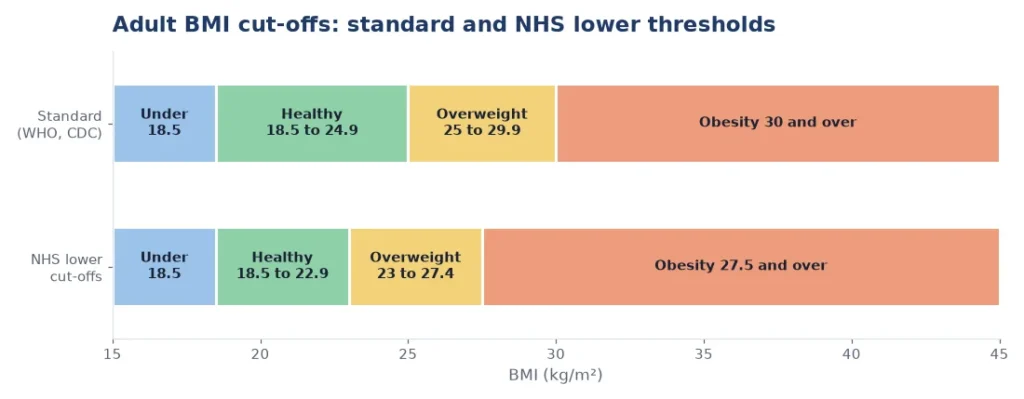
Health risks can start at a lower BMI in some groups. A 2004 WHO expert consultation published in The Lancet, “Appropriate body-mass index for Asian populations”, identified extra cut-off points at 23, 27.5, 32.5 and 37.5 for Asian populations.
The UK National Health Service applies lower thresholds to people of South Asian, Chinese, other Asian, Middle Eastern, Black African or African-Caribbean background: a BMI of 23 to 27.4 counts as overweight and 27.5 or more as obesity. Switch the tool to NHS lower cut-offs to see those, and your healthy weight range then tops out at a BMI of 22.9.
| Category | Standard (WHO, CDC) | NHS lower cut-offs |
|---|---|---|
| Underweight | Under 18.5 | Under 18.5 |
| Healthy weight | 18.5 to 24.9 | 18.5 to 22.9 |
| Overweight | 25 to 29.9 | 23 to 27.4 |
| Obesity | 30 or more | 27.5 or more |
BMI Prime: what it is and how to read it
BMI Prime is your BMI divided by 25, the top of the standard healthy range. It has no units. A value under 1.00 means your BMI is below the upper limit, and a value of 1.00 or more means your BMI is 25 or above.
The point of BMI Prime is easy comparison. A BMI Prime of 1.20 says you are 20% above the upper healthy limit, whatever units you used. For the 5 ft 9 in, 160 lb example the BMI Prime is 0.95, and for the 170 cm, 82 kg example it is 1.13.
Limits of a BMI calculator
BMI is a screening measure and is not intended to diagnose disease, in the CDC’s words. It has well-known blind spots:
- Muscle and bone. BMI cannot tell fat from muscle, so a muscular athlete can have a high BMI with little body fat.
- Where fat sits. BMI does not show whether fat is around the waist or elsewhere. WHO notes that waist circumference can also be used to identify overweight and obesity.
- Age. Older adults can lose height, which raises BMI without any weight gain, and children need percentiles.
- Ethnic background. Standard cut-offs can understate risk for some groups, as the NHS thresholds above show.
- Pregnancy. Pregnant women should not use a BMI calculator to judge their weight; a midwife or doctor tracks it.
Doctors weigh BMI together with medical history, blood pressure, blood sugar, cholesterol and lifestyle. Use the number to start a conversation with your doctor, not to label yourself.
BMI around the world: US, UK, Europe and beyond
United States. The CDC publishes the adult categories (under 18.5, 18.5 to 24.9, 25 to 29.9, 30 or more, with obesity classes 1, 2 and 3 at 30, 35 and 40) and a separate percentile method for ages 2 to 19. Heights are usually given in feet and inches and weights in pounds, which is why the tool defaults to US units.
United Kingdom. The NHS uses the same 18.5, 25 and 30 cut-offs and adds the lower 23 and 27.5 thresholds above. People in the UK often give weight in stones and pounds; one stone is 14 pounds, so 11 stone 4 pounds is 158 pounds.
Europe and the rest of the world. The WHO classification is the international reference, with overweight at 25 and obesity at 30 for adults. Follow your own health service for treatment decisions. These cut-offs were checked in October 2026.
Common mistakes with a BMI calculator
- Typing inches only. For 5 ft 9 in, type 5 and 9, not 59, and not 5.9 (which is 5 ft 10.8 in).
- Mixing units, such as pounds with centimeters. Choose one unit system for both boxes.
- Using the adult categories for a child or teen under 20.
- Treating one reading as a verdict. Weight shifts day to day, so weigh yourself in the same conditions each time.
Real-life uses for a BMI calculator
- Before a check-up. Bring your BMI to a doctor visit as a starting point for questions about waist size, blood pressure and activity.
- Math class. BMI is a tidy real-world formula for practicing squares, division and unit conversion. Try the decimals worksheets for rounding practice.
Questions people ask about the BMI calculator
What is a good BMI for my age?
For adults 20 and older the healthy range is 18.5 to 24.9 at any age, according to the CDC. The CDC applies the same adult categories regardless of age, while the NHS lowers the thresholds for some ethnic groups. For ages 2 to 19, use the percentile method instead.
Is a BMI calculator accurate?
The arithmetic is exact, but BMI itself is a rough screen. It correlates with body fat for groups of people, yet it can mislead for an individual because it ignores muscle, bone and fat distribution. Use it as a starting point.
How do I use a BMI calculator in kg and cm?
Pick Centimeters, kilograms, type your height in cm and your weight in kg. The BMI calculator divides the weight by the height in meters squared. For 170 cm and 82 kg that is 82 ÷ 1.70² = 28.4.
What is the BMI of 5 ft 6 in and 150 lb?
The BMI is 24.2. Height is 66 inches, so 150 ÷ 66² × 703 = 24.21, which is in the healthy weight category.
Frequently asked questions
7 quick answers
How do you calculate BMI?
Divide your weight in kilograms by your height in meters squared. With pounds and inches, divide weight in pounds by height in inches squared and multiply by 703. For 160 lb at 5 ft 9 in the BMI is 23.6.
What is a healthy BMI for adults?
A BMI from 18.5 to 24.9 is the healthy weight category used by the WHO and CDC for adults. Under 18.5 is underweight, 25 to 29.9 is overweight and 30 or more is obesity.
What is BMI Prime?
BMI Prime is your BMI divided by 25, the upper limit of the healthy range. Under 1.00 is at or below that limit, and 1.20 means 20% above it.
Are the BMI categories different for men and women?
No. The CDC uses the same adult cut-offs for women and men aged 20 and over. Body composition differs between people, which is why BMI is only a screening number.
What is the healthy weight range for 5 ft 9 in?
At 5 ft 9 in (69 inches) the healthy weight range is 125.3 to 168.6 pounds, which is a BMI of 18.5 to 24.9.
Does the BMI calculator store my data?
No. The calculation runs in your browser and nothing you type is sent anywhere. The Copy link button only puts your numbers in the web address.
Can a BMI calculator diagnose obesity or underweight?
No. BMI is a screening measure and does not diagnose disease. Only a health professional can assess your health using BMI together with other information.
Related calculators
- Calorie calculator: maintenance calories and goals from your height and weight
- Pace calculator: running pace, time and distance
- Due date calculator: pregnancy due date and weeks pregnant
- Unit converter: pounds, kilograms, feet and centimeters
- Percentage calculator and all calculators
- Decimals worksheets for practicing the rounding BMI needs
Sources and further reading
- Adult BMI categories (CDC)
- Child and teen BMI calculator (CDC)
- Obesity and BMI thresholds (NHS)
- Obesity and overweight fact sheet (WHO)
- Body mass index, formula and BMI Prime (Wikipedia)
Last updated: October 2026.